Inclusion/Exclusion

Inclusion/Exclusion

A justice and math weblog

  • Blog
  • About
  • Testimonios: Dr. Victor H. Moll

    Testimonios: Dr. Victor H. Moll
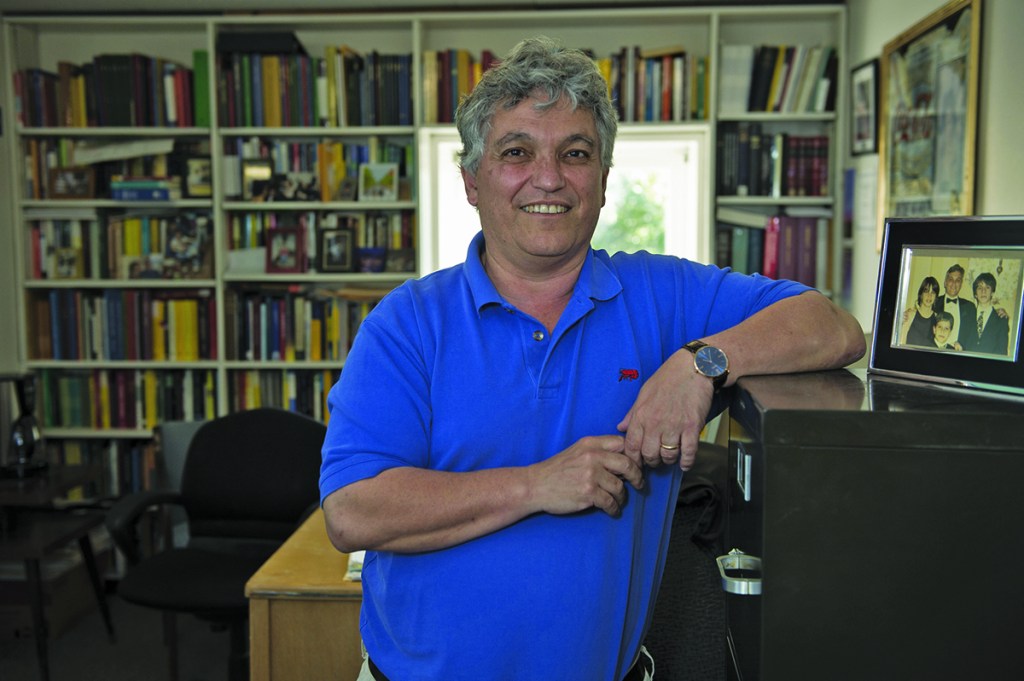
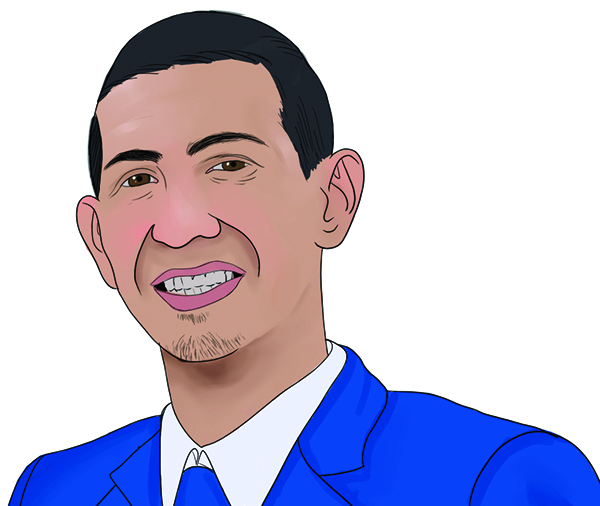
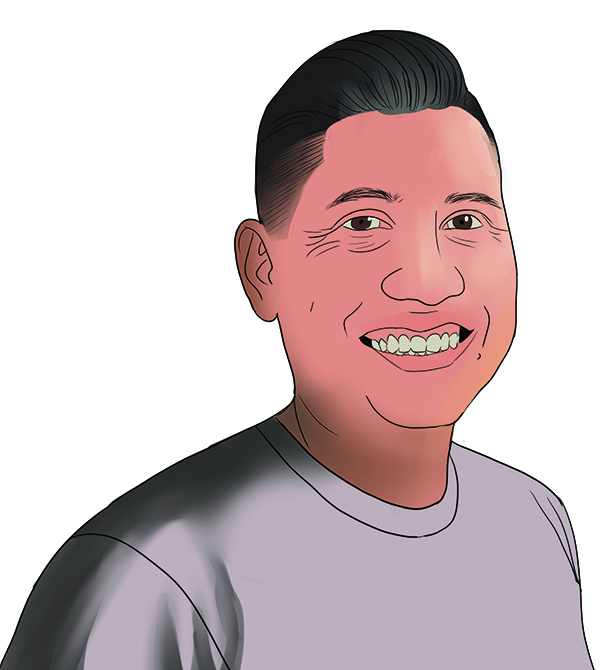
    Dr. Victor H. Moll; Illustration created by Ana Valle.

    The Early Years

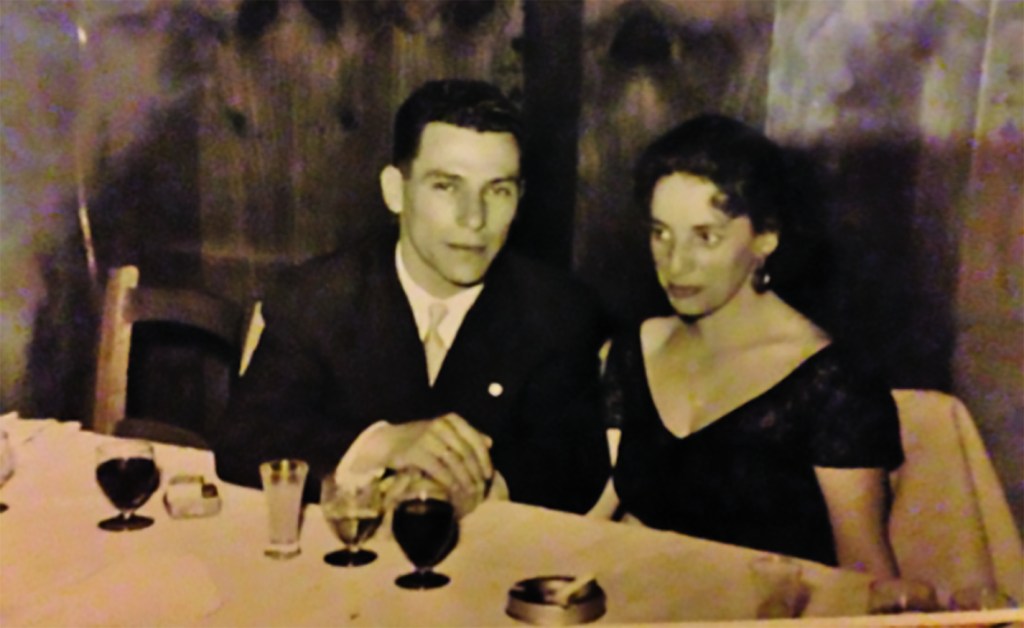
    I am not sure when, but part of my family came to the south of Chile from Germany as a nineteenth- century immigration policy by the Chilean government. [1] What I do know is that in the 1950s it was an established tradition in medical schools in Chile that upon graduation, doctors would serve in small towns before applying for jobs in Santiago and other large cities. My father, Victor Hugo Moll Strassburger, graduated in 1955, married Ema Lucy Becker Correa, his girlfriend since his first year of medical school, and took his first job in Cabildo, a small mining town north of the capital. In Chile you start medical school right after high school, so they dated for a long time. He was the only doctor serving several small villages.

    My parents, 1954.

    I am the oldest of three. My sister Ana Maria, my brother Ricardo Antonio and I were all born in Santiago, since the capital had hospitals with better facilities. My parents’ families all lived in Santiago, so we often visited them. The few memories I have from that time always involve relatives coming to spend time with us, with my grandmother Clara Moll Strassburger directing the group. Those visits by relatives always involved lots of cooking and among my favorite sweets were calzones rotos, [2] which is a deep fried cookie full of powdered sugar. After my father’s untimely death in 1963, my mother and the three of us stayed in Cabildo for one more year.

    My fourth-grade class, Cabildo 1964.

    So I spent my early years in Cabildo, starting my formal education in Escuela de Hombres, Número 5. This was a typical elementary school in a small town, probably with students of different ages in the same room. My teachers were Angelina Guzmán and Maria Eugenia Palacios. The photo above shows my fourth-grade class, I am the fifth from right to left in the middle row. Through social media, I have been able to reconnect with some of my classmates and with my teacher Ms. Palacios who sent the picture.

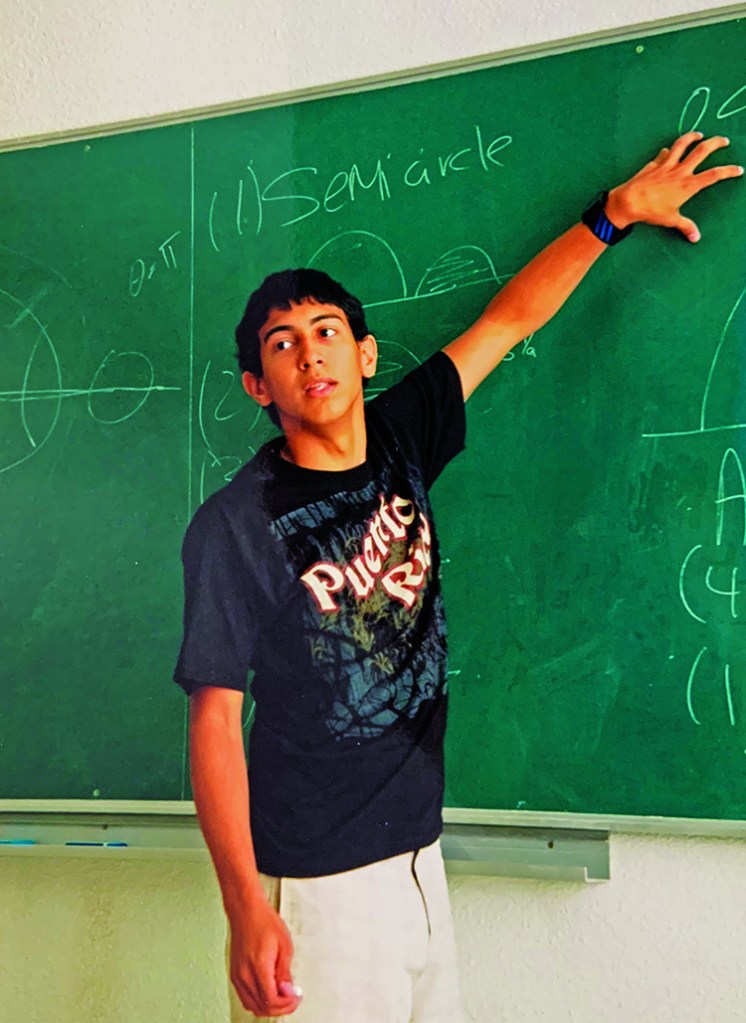
    After my father’s early passing, we moved to Quilpué, a town near Valparaiso. The privilege of being the family of the town doctor had ended. My mother, then 33 and a widow with three young kids (I was seven and the oldest), had to learn how to survive. She remarried Sergio Labarca very soon after that. She used to tell me, that without a doubt, this was one of the best decisions of her life. My siblings and I gained a new father, in the complete meaning of the word. It was his opinion that education was the most important gift parents can give to their children. He found one of the best schools in the region (and one of the most expensive ones). Most of the small income our family was receiving, with both parents working, went to pay for education. Therefore, I started fifth grade at The MacKay School. My sister and my brother went to similar types of schools. This was a British school founded in 1857 to serve the community of immigrants coming from England as part of the business activities around the port. Before the opening of the Panama Canal, Valparaiso was a major port for ships going from Europe to the West Coast of the United States. It was here that my teacher, Maria Eugenia Pardo, noticed that I had some talent for mathematics. I still remember that she was very happy when I was able to show that any angle inscribed in a semi-circle was a right angle. This was seventh grade, a period in which mathematical education in Chile was being guided by abstraction and axiomatic mathematics was taught even at this level. For me, there were some inherent life complications being from a working class family and being a student at a fancy private school. The economic standing, naturally associated from being the son of a doctor, had ended. Somehow mathematics became my refuge.

    I finished my secondary education at the public Liceo Coeducacional de Quilpué. It was a very stimulating time: the country was going through very interesting social changes in the early years of the 1970s and being in high school at that time offered many experiences that built character. Many of my classmates left the country after the coup d’état and are scattered all over the world. We still get together via electronic gatherings, which sometimes have to be early in the morning in order to accommodate those with very different time zones. Some years ago I had an interesting experience when I was invited to give a talk about my academic path by the office of the mayor of Quilpué. The chance to give a presentation to high school students about my academic life made me uncomfortable. The school had decreased in quality and was beginning a slow recovery period. For many years, the Chilean public had been convinced by authorities that private schools are always better than public ones. This had the consequence of depriving public schools of funds needed to function, leading to a deterioration of what was a very good school at the time that I attended. The beginning of recovery began when the mayor’s office decided to aim towards students interested in arts. During the time of my invited lecture, I met with many students, and tried to convince them that it is possible to be interested in science and not fit the stereotypes (they assume that if you liked mathematics, you had to be a nerd). I was lucky that two of my best high school friends, Kenna Meneses and Juan Francisco Carrasco, came to my presentation and vouched for my stories. At the end, they seemed to like what I was telling them. Although, I had returned to my high school with mixed feelings, having the opportunity to talk to the students made it all worth it in the end.

    Undergraduate Studies

    After graduation and with the knowledge that the best option for a high school student with interest in mathematics was to join an engineering school, I did so. In March of 1973, the beginning of the fall semester, I began my studies at Universidad Técnica Federico Santa Maria, one of the most prestigious engineering schools in Chile. The core part of the curriculum was common to every student, including three mathematics courses. It was there that I realized that my background was not optimal. Many other incoming first- year students had seen calculus in high school. This was all new to me. And then came the coup, September 11th, 1973. Learning integral calculus with a curfew was challenging. All of my undergraduate education was during the new regime.

    The geographical isolation of Chile, coupled with a nineteenth century immigration policy that allowed only Europeans mostly from England, Germany, and Yugoslavia to immigrate, created a more homogeneous society than some of our neighboring countries. I am not sure of all the details, but I believe that this is how my ancestors came to the south of Chile. This centralized immigration policy and the lack of travelers from other countries produced a relatively racially homogeneous population. I have no early memories of African, African-American, Asian, or other immigrants being part of our town. To me, the racial distinctions were weaker than the economic ones. More than that, the concept of class was very strong. There are even Chilean terms to describe the distinction between having class versus having money. Growing up, I never felt discriminated because of racial issues.

    Liceo Coeducacional de Quilpué in 1971.

    Although I took mathematics courses at Santa Maria, I began my career in college on a track to become an electronic engineer. In the university educational system in Chile, you choose a career at the moment you enter college. There is no concept of having a major. When I arrived, studying mathematics had been closed as an option to all incoming students, even though this had been an option in previous years. Fortunately, in my third semester as an undergraduate student at Santa Maria, I managed to transfer to become a mathematics student. There were only two other students in the mathematics program.

    Liceo Coeducacional de Quilpué in 2014.

    There are many differences between the Chilean and American university systems. From the point of view of this story, the most important one is the fact that in Chile students choose a career at the end of high school. If you want to be a lawyer, you go directly to law school. No time to warm up. If you do not like it or do not do well, you have to retake the entrance exams and apply again. If you are a student with some talent in mathematics, the most natural choice is to go to an engineering school. So I did. For some bureaucratic reason, at the end of my second year, I was allowed to transfer internally. This saved me from applying to university again—my parents would have been supportive, but not happy if I had to start again. The mathematics degree was a five-year program and during the last three years it had only three students. We had mostly mathematics courses, some courses in English (my father’s plan to put me in a British school paid off) and once in a while we registered in some physics courses. Classes were obviously small, sometimes in the instructor’s office. This is where I learned some analysis and to like espresso. There were lots of independent studies courses. Essentially, it meant that the instructor would choose a book and the students would lecture each other. During some semesters we would take classes at the nearby Universidad Católica. This gave us a chance to learn material not offered at Santa Maria.

    This was a period of transition in the life of the country. Among the instructors, there was a single PhD in mathematics, which was unique mostly because the university was not in Santiago: the center of everything. He was the renowned Roberto Frucht, an expert in graph theory. At a moment where I was thinking of abandoning mathematics and studying something else, a second PhD came to the department. Luis Salinas C. came back from Germany, rescued me back to the subject that I loved and became my advisor. Many times in my life I have been lucky and having him return to Chile then is among these lucky times. My last three semesters I took all of my courses with him. I owe him more than words can say.

    Things have changed in Chile since my days as an undergraduate. Many Chilean mathematicians came back to the country. They have created a wonderful educational structure and Chilean students travel to the best institutions in the world to study and many renowned mathematics departments have faculty from Chile.

    Graduate School

    Upon completion of my undergraduate studies I was hired as a faculty member of the Departamento de Matemáticas of Universidad Santa Maria. At that time (1978) it was not required to have a PhD to teach in a university. Yet my undergraduate thesis advisor, Prof. Luis Salinas C., was always talking to me about going abroad for a graduate degree. A real opportunity to go abroad developed with the visit to Universidad Santa Maria of Prof. Eugene (Gene) Trubowitz from the Courant Institute of New York University in July 1980. Since I spoke English (having been a student at The MacKay School) it became my role to be in charge of his visit. I still remember walking on the beach, with conversations that usually started as “Victor, suppose A is a normal matrix of size n.’’ To make a long story short, I joined the PhD program at NYU in September 1980 with financial support from my school. Since I was late in the application process and had not been aware of the required forms, I went to the American Embassy in Santiago with a telegram from Gene that essentially said “Come to New York, we will fix the paperwork here.’’ As you can imagine, the first time I showed up at the embassy carrying only this telegram I was denied a visa. The next time, it occurred to me that if I spoke English to the guard my chances might improve. They did. I got a tourist visa and left for New York. The paperwork was fixed after my arrival.

    It is hard to describe my early days in New York City. I came from a relatively small town without much foreign influence, where everybody looked like part of the same family. This was the time before the 1985 economic boom in Chile, when the country essentially became a 51st state. I made many mistakes in those early days. Perhaps the worse one dealt with housing. NYU owned a group of buildings nearby and studios were assigned to incoming graduate students. The first time I went to the housing office, they told me about this option and I realized that rent was about 40% of my total income. Immediately I refused the offer, much to the consternation of the person in charge. I did not understand why she kept explaining to me that these studios were my optimal choice. Needless to say, my off-campus living accommodations during the first year of graduate school ended up being inferior. Someone should have grabbed my hand and told me to sign the dotted line. It takes time to learn the American system.

    The schedule at Courant was such that classes would meet once a week for two hours. For me this meant that at the beginning of being in New York, before making friends, I had no human contact from Thursday night until Tuesday night. It came as a great surprise when one day after class, in the elevator going down, this person said to me, “We seem to be in two classes together, would you like to have a cup of coffee?’’ He was Fred Schiafando,
    who turned out to be a friend for life. Lectures at Courant moved fast, and soon a group of students decided to get together to study. Social life improved from that point on.

    Coming from an educational system with lots of classes I was surprised when at registration I noticed that taking four classes meant eight hours of contact. Naively I asked, “What I am supposed to do with the rest of my time?’’ The response was absolutely correct: “Try to catch up.’’ I was lucky to have Prof. Henry McKean as my instructor for complex analysis. His style of lectures and his point of view of mathematics as a whole made a profound impression on me. Being his PhD student has been one of the biggest honors of my academic life. At the beginning of my second year, I met a first-year graduate student: Lisa Fauci, who later became my wife. My life with her has been great since then.

    Professional Career

    After graduation, I took a postdoctoral position at Temple University in Philadelphia. Recently, cleaning my office, I found a copy of my job application: it was one-and-a-half pages long. It is remarkable how things have changed. During the next two years I spent a lot of time on the trains between Philadelphia and New York. I also attended a class on elliptic functions that Henry McKean gave at Courant. I worked out all the possible details and years later Henry and I coauthored a book. [3] In 1986, Lisa and I applied for jobs together and both took jobs at Tulane University in New Orleans, Louisiana. Our unspoken plan was to be in New Orleans for a short time and then move back to the Northeast. We never left.

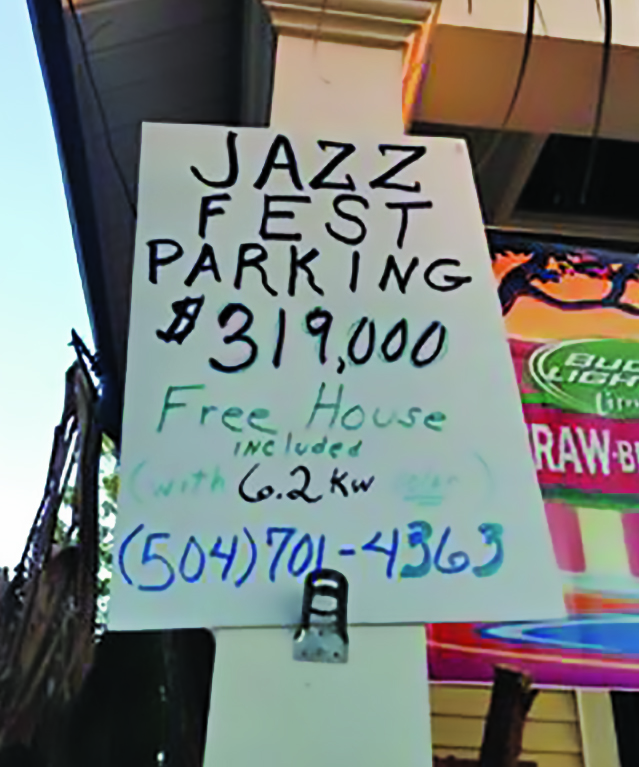
    New Orleans humor.

    First off, New Orleans is a great place to live in. New Orleans is not your typical American city. It is humid. Most of the time things do not work properly. Sometimes, the driver of the street car stops the ride so they can get themselves a cup of coffee and will turn around and will tell you to take your feet off the seats. Music is one of the city’s biggest priorities and soon became always present in our home. My kids, Alexander and Stefan, had a chance to become students at NOCCA (the New Orleans Center for Creative Arts) as jazz musicians. You should come visit, but come first when there are no big parties happening, which does not leave too many open days! One of my favorite events in the city is Jazz Fest, it takes place during two weekends in April-May. It was a fantastic feeling watching my son Stefan play piano on the Blues Stage. Such is life in New Orleans.

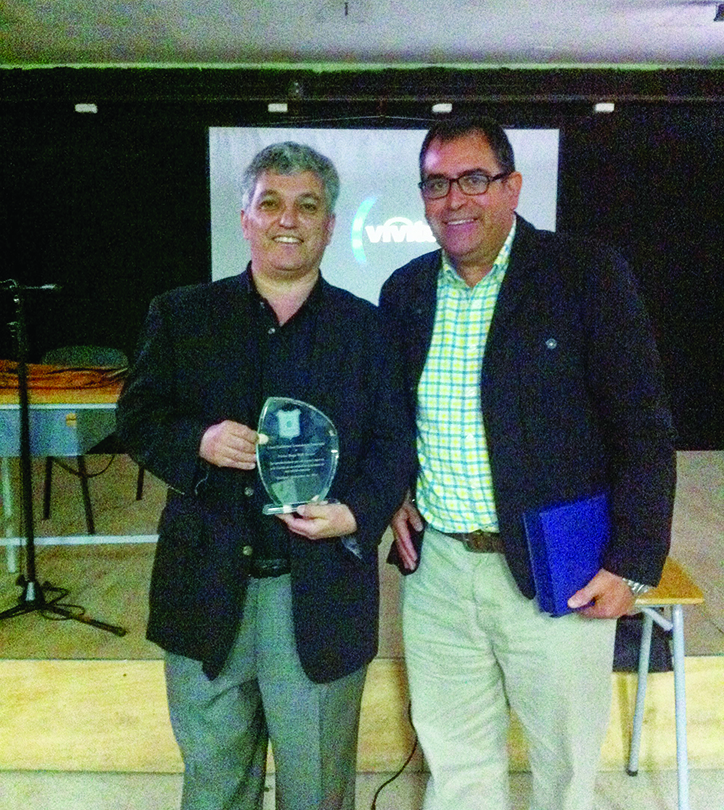
    Weiss award photo, New Orleans, 2011.

    It has been great to be at Tulane University. Among the many positive aspects of working at Tulane, I must say that the existence of a great child-care program, with a dedicated group of teachers that educated our kids while we worked in peace, is one of the best benefits that I have had. In addition, the undergraduate students that I have had a chance to work with have made my job a very enjoyable one. Among the many students, I would like to single out Roopa Nalam, who worked on a research project with me involving integrals of special functions, and Kirk Soodhalter, who wrote a thesis on some interesting aspects of modular forms. Roopa went on to complete an MD-PhD program and now is an Assistant Professor at the Baylor College of Medicine. Kirk completed his PhD in mathematics at Temple University (in numerical linear algebra) and is now an Assistant Professor at Trinity College in Dublin. I am very proud of the two of them. These two students are part of a large group of students who have enriched my academic life. Some years ago I was awarded the Weiss Presidential Award for Graduate Teaching. Since this award is chosen among faculty nominated by students, this had a special meaning to me.

    Research

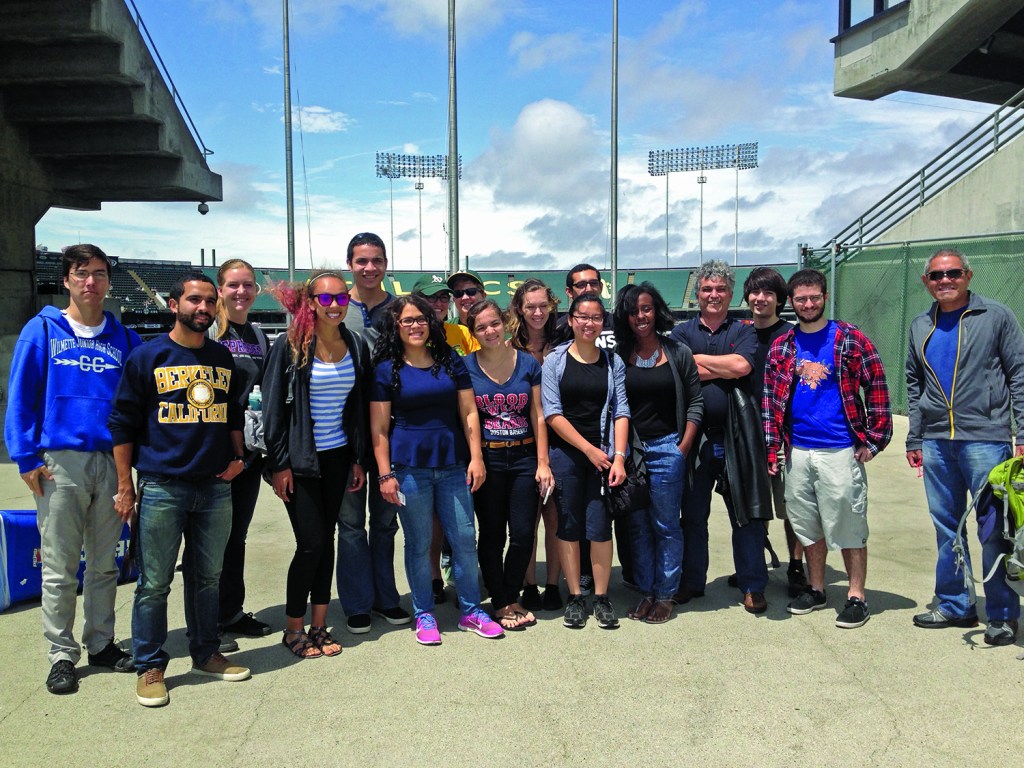
    MSRI-UP research group, Berkeley 2014.

    Working with students and young faculty. Over the years I have also had opportunities to work with undergraduates outside of Tulane. One day, I was asked by my friend and colleague Prof. Ricardo Cortez if I wanted to go to a conference of the Society for the Advancement of Chicanos/Hispanics and Native Americans in Science (SACNAS) in Portland, Oregon. I had to admit that I had never been aware of this organization. For me, one of the highlights of the conference was to meet Prof. Ivelisse Rubio and Prof. Herbert Medina. After I gave my talk, they told me about the Summer Institute in Mathematics for Undergraduates (SIMU), an undergraduate Research Experience for Undergraduates (REU) program at the University of Puerto Rico at Humacao, and asked me if I was interested in being the senior leader. This meant being in charge of 12 students doing research for about seven weeks. I still remember their voices telling me “This is a lot of work.’’ I accepted. My family and I spent a great time in Puerto Rico. They were at the beach and I was working. Even though the workload was enormous, I still believe that the SIMU model is one of the best for undergraduate programs. The students were exposed to research-level mathematics, which opened new avenues for them intellectually, but also were told how to approach the graduate school application process, how to present a paper at a conference, what is expected of them as members of the community, and many other aspects of being a mathematician. I loved it. Luis Medina, now professor at the University of Puerto Rico at Rio Piedras, was my student at SIMU. After that, I was lucky that he chose to come to Tulane University for graduate school. We still maintain a scientific collaboration. I am very proud of him. The SIMU model was later adapted by the Mathematical Sciences Research Institute (MSRI) at Berkeley, California in their Undergraduate Program (MSRI-UP). Participating there was a wonderful experience again, as I was surrounded by intelligent students and assisted by graduate students and postdocs. Many of the students participating in this program are now faculty members at a variety of schools.

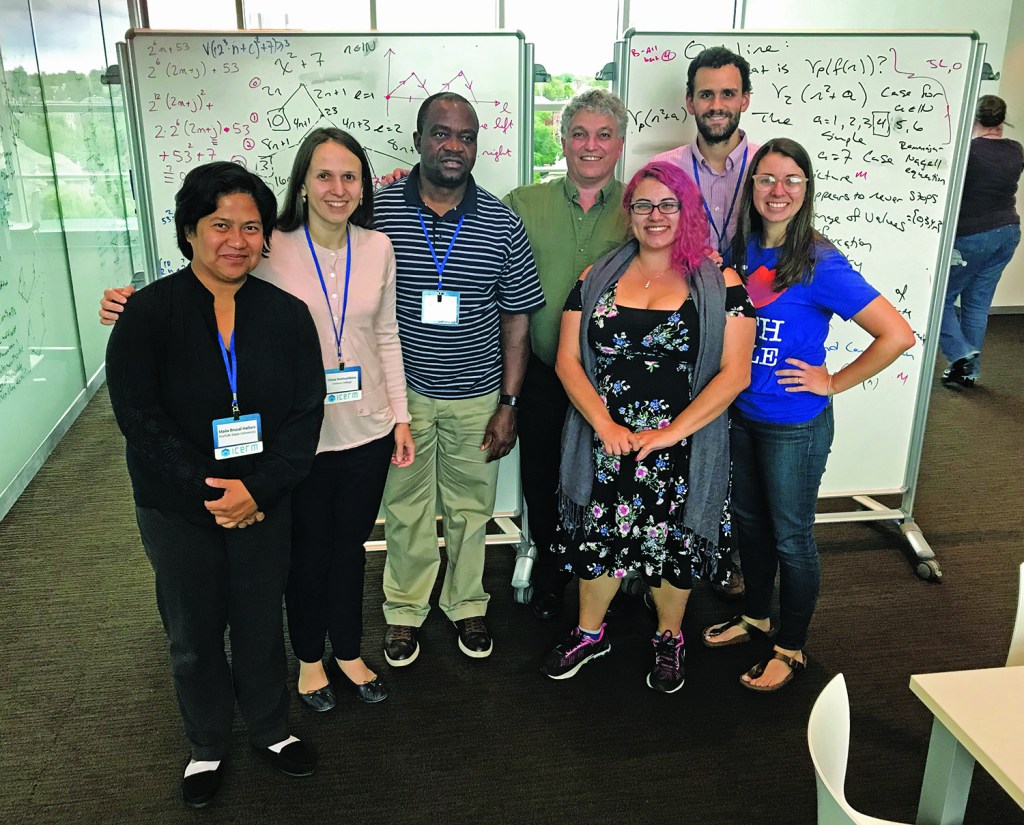
    In recent years, I have been involved in wonderful programs whose mission is to engage faculty—who work in schools with a high teaching load—in research. The programs that I have participated include PCMI (at Park City, Utah) as part of a special program in Random Matrices and the second one at ICERM as part of REUF (Research Experiences for Undergraduate Faculty). These are exceptional programs and I would like to encourage the mathematical community to participate in these programs. I am certainly planning to continue doing it.

    Math interests. My mathematical work these days started when a former graduate student, George Boros, told me that he could evaluate an integral. I have told this story in detail in “The evaluations of integrals: a personal story,” Notices AMS (2002) 311–317 and “Seized opportunities,” Notices AMS (2010) 476–484. George’s comment transformed my research. In fact, the evaluation of definite integrals will take you into many interesting areas of mathematics, and you should try it.

    Research Experience for Undergraduate Faculty (REUF) research group, Rhode Island 2018.

    The basic question is this: given a function f, defined on an interval [a,b] (with -∞ ≤ a < b ≤ +∞) one wants to evaluate ∫ab f(x)dx in terms of special values of a class of functions. This is familiar from elementary courses. On the other hand, students are often told that the function f(x) = e–x^2 does not have an elementary primitive, but there are methods to see that

    As a freshman, I was told that this exponential function does not have a primitive. I vividly remember my reaction: “Maybe you do not how to integrate it, but I will figure it out.” Needless to say all of my efforts went nowhere.

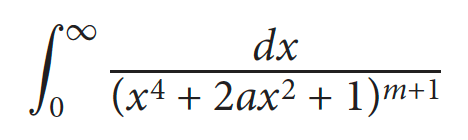
    In one of my luckiest academic moments, my former student George Boros told me that he could evaluate

    in terms of some elementary radical and a complicated polynomial Pm(a) in the variable a. He had a mechanism to evaluate the integral of a rational function by doubling the degree of the integrand and, by some symmetry reduction in certain special cases, he was able to cut the degree in half. That gave him a complicated expression for Pm(a).

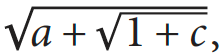
    At the beginning, not being particularly impressed with evaluating integrals (prejudice comes in many forms), the only part that I thought might be interesting was that his procedure vaguely reminded me of Landen transformations for elliptic integrals. I started trying to evaluate this example by other methods and failed. My not knowing about hypergeometric functions ended up being a good thing. One can prove George’s result in an elementary manner using these functions. The work on this integral took us through an almost magical trip visiting many parts of mathematics which appeared to be disconnected. Many roads of this mathematical trip are mysterious. For instance, the integrals above are the (Taylor) coefficients of

    expanded as a power series in c. Very strange. George’s proof uses a theorem of Ramanujan and to this day, I do not know how he thought of this. Since George passed away in 2008, the mystery will remain. For a long time I have looked for a different proof, using this double root. It should teach us something new about this problem. So far I have not had luck in this regard. It is needless to say that my original impression of George’s problems was wrong. I am glad that I did not dismiss him right away and decided to pay attention to his methods. My current students continue to surprise me like this. I do my best to listen to them. It is one of the privileges of the business we are in.


    [1] In the nineteenth and twentieth centuries, Chile established immigration policies that encouraged European immigration.
    [2] This literally translates to “ripped underwear.’’
    [3] Henry McKean and Victor Moll, Elliptic Curves: Function Theory, Geometry, Arithmetic, Cambridge University Press, 1999.


    Previous Testimonios:

    • Dr. James A. M. Álvarez
    • Dr. Federico Ardila Mantilla
    • Dr. Selenne Bañuelos
    • Dr. Erika Tatiana Camacho
    • Dr. Anastasia Chavez
    • Dr. Minerva Cordero
    • Dr. Ricardo Cortez
    • Dr. Jesús A. De Loera Herrera
    • Dr. Jessica M. Deshler
    • Dr. Carrie Diaz Eaton
    • Dr. Alexander Díaz-López
    • Dr. Stephan Ramon Garcia
    • Dr. Ralph R. Gomez

    Brian P Katz (BK)

    October 15, 2022
    Uncategorized
  • Testimonios: Dr. Ralph R. Gomez

    Testimonios: Dr. Ralph R. Gomez

    I would like to dedicate this article to the memory of my mother Sally Gomez, my father John Gomez, and my brother Johnny Gomez.

    Dr. Ralph R. Gomez; Illustration created by Ana Valle.

    Early Years

    Lemoore. About forty miles south of Fresno, California, in the Central Valley is a small town called Lemoore. This town is but one of many little towns that comprise the majestic farm-field tapestry of the valley. My grandparents, parents, aunts, and uncles all worked portions of these vast fields for many years as field workers picking plums, grapes, apricots, and peaches.

    I lived at the dead end of a street which spanned six blocks. My house was uniquely nestled between a corn field and the cheese manufacturing factory, Leprino Foods. Because of the house’s close proximity to the factory, the constant noise and agitation of diesel trucks shuffling about could be heard all hours of the day. Though my street was only six blocks long, it was regarded as one of the bad parts of Lemoore, primarily because of the gang activity in the area.

    In my family, I have two brothers, Johnny and Eric, and a sister Gloria (Johnny passed away in 2015). I am the youngest of the family. After being in the Navy for three years my father, John Gomez, worked in a mill called Continental Grain and kept that job for forty-two years until his retirement. My mother, Sally, stayed home and ran the entire household. When she was growing up, she had to drop out of high school to help take care of her younger brothers and sisters. Thus, she had a plethora of experience in helping others and maintaining a household.

    My oldest brother Johnny and I were seventeen years apart in age. By the time I was born, he had already moved out of the house, so I saw very little of him growing up. However, the times in which I did see him usually were not the best of circumstances.

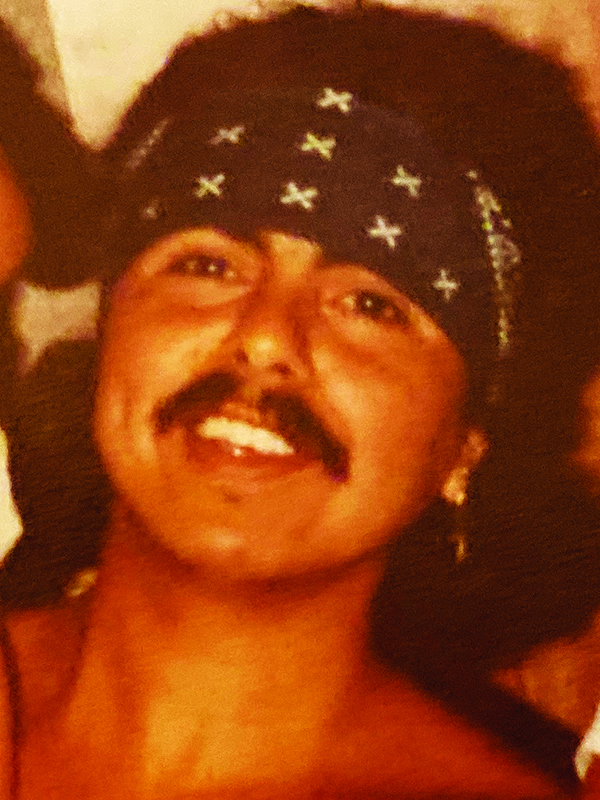
    My brother Johnny. Without a doubt, Johnny was one of the most influential forces that launched me on my trajectory to eventually become a mathematician. This attribution of influence is not because he was a pristine role model with infinite pearls of wisdom and prophetic advice. On the contrary, his life became a living example of the kind of life I did not want to lead. Exactly the opposite.

    Johnny Gomez, my oldest brother.

    Many of my early memories of Johnny revolve around going to the Kings County Jail with my mother and sister to visit him. He was in and out of jail for much of his life. I can vividly recall how one of my first visits to see him deeply and profoundly impacted me. When I was around eight or nine years old, my mom, sister and I went to visit Johnny in jail. As we entered the visitation room, we saw Johnny behind the glass partition, seated and waiting for us to take our seats. I remember looking at my mother’s face as she looked at Johnny. I could instantly read the complete heartbreak and the immense disappointment she had for him. It was during this time that I decided to follow a path which was in the exact opposite of my brother’s path if for no other reason than to spare my mother any more heartache and pain. Thus, I decided to embrace education and stay out of trouble.

    Skateboarding. Admittedly, it was sometimes challenging to remain on my self-selected path of embracing education and staying out of trouble. On my street was a gang called XIV (the fourteeners), which seemed to be based on one of the more notorious gangs in Los Angeles. Around my sophomore year of high school, I seriously considered joining this gang on my street. Some of my friends had joined, and I became attracted to the gang’s stature and cohesion. But fortunately for me there was a very welcomed diversion and that diversion was skateboarding. Though I had ridden a skateboard since the sixth grade, I began to take the sport very seriously in high school. During the school day, I concentrated hard on my academics. After school, I practiced skateboarding with equal intensity. Skateboarding became my primary outlet from academics, an avenue to forget all of the daily worries and focus on improving my skateboarding skills.

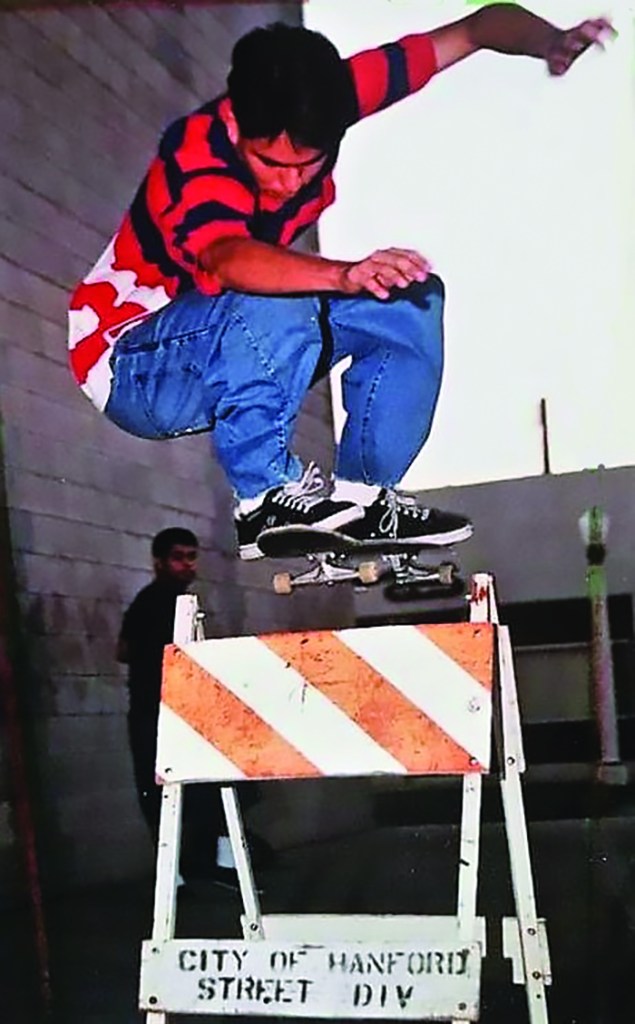
    An “ollie’’ is a skateboard move in which the skateboarder jumps in the air with the skateboard, unaided by the hands. Here I am doing an ollie over a traffic barricade in Hanford, California.

    From skateboarding, I sustained a myriad of collisions with the concrete; numerous sprained ankles, two broken bones, a sprained back, and many scrapes and head gashes. Hopefully I learned something from all of these injuries! Skateboarding gave me the necessary structure and the motivation to constantly improve at something. It allowed me to experience the triumph and satisfaction of learning a trick after countless failed attempts. It taught me to cultivate a deep sense of concentration and focus on something of interest—a quality that was crucial once I found my passion in mathematics.

    Higher Education

    Undergraduate experience. In my household, the idea of going to college was never discussed or mentioned. No one in my family attended college (although my brother Johnny was always fond of saying that he was a graduate of Penitentiary State!). College was an idea I only saw on the television. In high school, I took college preparatory classes, but there was never any intention of attending college. Taking such courses simply reinforced the idea that I was embracing education and attempting to extract the most I could from my small-town public high school. I took the usual advanced courses in English, biology, chemistry, and math. The highest math course I took in high school was precalculus. I had no idea what I was doing, nor did I have any interest in the subject.

    In my senior year of high school, I decided to enroll as a full-time student at the local community college, West Hills Community College, after graduation. I had no other plans and going to West Hills allowed me to stay close to my friends who were also enthusiastic about skateboarding. During the time I started college the campus was quite small, comprised of a main building and a few portable buildings. I actually preferred to attend College of Sequoias which was another community college further away from home. It had more course offerings, but was over thirty minutes away by car. My father said there was no way the family could afford all that gas as well as the prolonged use of the family car. Thus, I enrolled at West Hills Community College, which allowed me to walk to class and back home. These walks were actually quite useful because I used to lecture aloud to myself on scientific topics while walking home. I did a lot of homework at the community college library since it was difficult to concentrate at home.

    In my first year at West Hills Community College, the placement exams recommended I take trigonometry. My first math class at the college level was trigonometry! This was exactly the right starting course for me. It was during this time that I really started to take mathematics and science very seriously. I realized that doing a whole bunch of problems thoroughly and clearly greatly helped me solidify my understanding of topics. I also found that explaining the idea aloud to myself really helped me in absorbing ideas.

    My time at West Hills was an exceedingly pleasant one. I had a few inspiring professors at the college. For example, my chemistry professor, Dr. Robert Holmes, was one of the few instructors with a PhD at the college and was a very encouraging person to me. He was eloquent, highly scientific, and very serious. After earning top marks in his chemistry course he gifted me a chemistry book as a form of encouragement to continue. This inspired me to major in biochemistry once I transferred to a four-year university.

    I also took a history course that was highly influential in my future interests. For the final paper in the course, I had to write about an event that changed world history. I chose the topic of the development and use of the atomic bomb. During my research for the paper, I began learning about some of the scientists associated with the bomb. This in turn led me to read about some of the key contributions Albert Einstein made to physics. Soon after, I became extremely interested in the many wonderful ideas in physics. It was during this time that I began to realize the full power of mathematical thinking—its ability to describe nature. It motivated me to want to learn about general relativity and quantum mechanics. I was completely overcome by the magical beauty of how equations could so simply describe physical processes. I was particularly struck by just how geometric the universe actually is. But if I was going to delve deeper into the physics, I had to learn much more mathematics.

    After two years at West Hills Community College, I transferred to the University of California at Santa Cruz. Initially, I was a biochemistry major. The transition from community college to the university was incredibly difficult for me. In fact, after the first semester, I seriously considered dropping out of college. I could not keep up with the fast-paced environment and much higher demands of homework. Most of all, I grew very disheartened by laboratory sciences. I found the labs too tedious, and I had no intellectual investment or scientific curiosity for the laboratory exercises. I missed the purely theoretical aspects of mathematics.

    Realizing I would be much happier if I switched my major from biochemistry to mathematics, I changed my major. Finally, I could really spend time learning more advanced mathematics beyond calculus and try to learn some physics. I fondly remember leaving math classes with great excitement regarding all of the mathematical ideas I was learning. As a math major, it felt absolutely wonderful. I was able to think about mathematics all the time. Professor Arthur E. Fischer and Professor Anthony J. Tromba, both highly influential professors at UC Santa Cruz, completely convinced me of the incredible beauty and versatility of differential geometry. Their lectures were very enthusiastic, riveting, and inspiring.

    After graduating from UC Santa Cruz with a BA in mathematics, I stayed in Santa Cruz and worked for the UC Santa Cruz math department as a grader and a math tutor. In addition, I took a couple more math classes, and then I enrolled in the master’s program at UC Santa Cruz. After writing my thesis and taking the algebra qualifying exam, I obtained a master’s in applied mathematics. After completing my degree I took some time to consider the following question: Should I go further and get a PhD? During this time of contemplation, I returned to West Hills Community College because I accepted a position as an adjunct instructor there. It was also a great chance for me to thank the institution where I got my start. Had it not been for the existence of West Hills Community College, I would not be writing this article now.

    Am I Capable of Earning a PhD in Math?

    Earning a PhD. As part of my decision on whether or not to earn a PhD in mathematics, I felt that it was important to go to a different institution so I could see how other places did mathematics. I wanted to study Einstein geometry under Professor Charles P. Boyer. Charles Boyer was one of the leaders in that area, having discovered a new technique of constructing special types of Einstein geometries. Einstein geometry is a type of geometry that obeys an equation discovered by Albert Einstein in his modern theory of gravitation-general relativity.

    After numerous thorough discussions with friends, I decided to accept University of New Mexico’s offer to enroll in their PhD program. Part of the attraction in attending UNM involved a generous stipend sponsored by the New Mexico Alliance for Graduate Education and Professoriate (NMAGEP). This was a fantastic program that not only supported me with an additional stipend, but also provided numerous conferences and workshops for graduate students from underrepresented groups that focused on navigating the challenging road to becoming a professor. Looking back, this program was instrumental in helping me to think about what it meant to be a professor.

    After postponing my fall enrollment at UNM, I arrived there in January of 2003. It was refreshing to be studying mathematics once again, and I was growing increasingly optimistic about my future career trajectory. But this optimism was cast into the shadows. In the early fall of 2003, it was determined my father had stage four colon cancer. By the time the malignant mass was found, it was too late for any procedure or radiation to prolong his life. He passed away in September of 2003. Days before he died, quitting the PhD program was weighing heavily on my mind. If I withdrew from the program, I could return home and help out my mother. My sister planned on moving back to Lemoore from Palm Springs with her family. I felt like I was abandoning my family if I remained committed to the PhD program. The afternoon before my father passed away, I was sitting next to him, telling him my final goodbyes. By this time he was extremely frail and life seemed to be visibly evaporating from him. But somehow my father was able to conjure a sentence: “Don’t let this mess up your schooling.’’ In that single sentence, the decision for me to complete the PhD was solidified. I simply had to finish now.

    My mother and me after my PhD ceremony, 2008.

    PhD. With my father’s support and my sister’s willingness to uproot her life to take care of my mother, I stayed in UNM’s PhD program. Around this time, my advisor Professor Charles Boyer gave me a graduate fellowship from his research grant which allowed me not to teach and focus on courses and the beginnings of research. To have a professional and successful mathematician believe in me and encourage me the way he did, instilled a great wave of enthusiasm and excitement in me as I moved forward with my total immersion in mathematics. I earned my PhD in five-and-a-half years (with distinction) and a new life was ahead!

    My advisor Charles P. Boyer and me after he hooded me, 2008.

    The Professorial World

    After I earned my PhD, I accepted a two-year visiting position at Swarthmore College in 2008. This was an absolutely incredible position with a reduced teaching load, and I was thoroughly excited to be there. But gradually I had the uncomfortable feeling that I did not belong at such an illustrious institution. Not seeing much faculty diversity at the college, particularly in the Natural Sciences and Engineering division, made me feel more like an outsider. It became clear to me just how different my pathway was in becoming a mathematician and that perhaps I was ultimately doomed to failure since my pathway was not more traditional. Impostor syndrome took a strong hold of me. To further complicate matters, my brother Johnny was on his way back to prison yet again to serve a one-year sentence. What other faculty member in their first year in a visiting position had to worry about a sibling heading back to prison? To my mind, this was just one of many other examples of why I did not belong.

    Near the end of my two-year position, Swarthmore College was able to offer me an extension on my visiting position. This was very generous especially since this was around the time of the Great Recession. The college was actually pleased with my work and invited me to stay on for a few more years. This invitation was a clear signal that the college viewed me as thriving at Swarthmore. But there were three factors that led me to decline this offer at the end of my two-year visit. First, the desire to return to my family in California particularly because of growing worry about how my mother was handling my brother’s return to prison. Second, the personal belief that I was not Swarthmore material and thus did not belong. Finally, the need to secure a tenure-track job instead of staying in a visiting position. Not feeling like I belonged at Swarthmore was the main factor that ultimately convinced me I should move on. Thus, after my two-year visiting position I left Swarthmore college and took a tenure-track position in California. Before I left I met with Stephen B. Maurer (the chair of the mathematics and statistics department at Swarthmore at the time) to tell him the main reason why I was leaving. He sent me an email after our meeting which completely shifted my view about myself. With Stephen B. Maurer’s permission, here is the email he sent to me:

    I’d like to address the worry that you were brave enough to broach with me today: are you really good enough for Swarthmore? It’s really the same issue as when we admit students who have no history in their families of fancy colleges, or any colleges, or any history of expectations as demanding as ours or of positions of substantial responsibility in society. Swarthmore’s belief is: people with the right underlying talent don’t have to be brought up to the top gradually through several generations. They can leapfrog to comfort in an environment of high expectations in a few years. If we are right about this—and surely we are right in some cases—then Swarthmore, and not more laid back places, is really the place to make these people shine. This goes for the students from humble backgrounds that you inspire here, and it goes for you.

    I never responded to Maurer’s email because I did not know how to respond. It shook me to the core. I thought very hard about this email over the next several months as I adjusted to my new tenure-track position in southern California. I eventually came to the startling conclusion that Maurer was absolutely right! Moreover, I realized I was selling myself short. It is as if I finally let myself accept the idea that I did a successful job at Swarthmore. Within the first semester at my new position, I told Maurer that I was heading back on the job market. It turned out Swarthmore was able to offer me a chance to return but this time as a tenure-track assistant professor!

    In 2012, I returned to Swarthmore as a tenure-track assistant professor and achieved tenure in 2017. My mother passed away in 2018 and so I am very thankful she lived long enough to see me achieve tenure. She was always one to express how immensely proud she was of me. Returning to Swarthmore College is without a doubt one of the best decisions I have ever made in my entire life. With the help of an extremely supportive department and surrounded by inspiring students, I finally feel that I belong at Swarthmore.

    Advice

    Because my pathway to being a mathematician was not along a traditional path, I assumed that my role as a professor would therefore be less valuable and ineffective. This point of view was highly corrosive. It took a lot of conversations with colleagues, friends, and family to realize this view of myself was completely inaccurate. Something that I would like to impart upon the aspiring mathematician is this:

    There are countless paths to having a deep and meaningful relationship with mathematics.

    However, like any journey along an arduous path it is immensely helpful to have useful resources. I cannot stress this enough, dear reader. Build a network of people you can reach out to for help, advice, or direction. Seek out feedback, viewpoints, and opinions from others in your support system. You may be surprised how open people can be in giving you effective guidance. A favorite teacher, professor, friend, and family members are just a few examples of people you can add to your network of support. Even more support can be found for example through the Math Alliance (mathalliance.org), which has a vast database of professors who are ready and willing to mentor students interested in the mathematical and statistical sciences. With a solid support system at your disposal you will be able to be inspired and encouraged to carry on even in the darkest hour. And carry on you must for one day it may very well be you who takes up the role as a mentor!


    Previous Testimonios:

    • Dr. James A. M. Álvarez
    • Dr. Federico Ardila Mantilla
    • Dr. Selenne Bañuelos
    • Dr. Erika Tatiana Camacho
    • Dr. Anastasia Chavez
    • Dr. Minerva Cordero
    • Dr. Ricardo Cortez
    • Dr. Jesús A. De Loera Herrera
    • Dr. Jessica M. Deshler
    • Dr. Carrie Diaz Eaton
    • Dr. Alexander Díaz-López
    • Dr. Stephan Ramon Garcia

    Brian P Katz (BK)

    September 15, 2022
    Uncategorized
  • Testimonios: Dr. Stephan Ramon Garcia

    Testimonios: Dr. Stephan Ramon Garcia
    Dr. Stephan Ramon Garcia; Illustration created by Ana Valle.

    According to certain metrics, I am a highly successful mathematician. In 2019, I was elected a Fellow of the American Mathematical Society and was awarded the inaugural AMS Dolciani Prize for Excellence in Research (see the photo on page 125). I have been on the editorial boards of well-known journals and written over a hundred papers, along with several books with top publishers. I have an endowed professorship at a top-tier liberal arts college, and I have received multiple NSF grants and six teaching awards. So it would seem that I know what I’m doing. However, I was rather clueless for much of my journey and often muddled through without clear direction. Nothing about my career was inevitable: some favorable circumstances, fortuitous timing, coincidences, and good luck played important roles, along with lots of hard work.

    Early Life

    My father’s family fled to the United States from Cuba in 1960. They had to quickly adapt to life in Miami. My grandfather worked as a Spanish teacher and my grandmother as a hairdresser. My father studied at Miami-Dade Jr. College and earned an associate degree in electronics.
    My mother was born in Hiroshima during WWII and is an atomic bomb survivor. She attended some college in Japan but did not complete her English degree. In 1969, she was visiting her sister, who had married a U.S. marine, in New Jersey. My parents were set up on a blind date and the rest, as they say, is history.

    My paternal grandparents, and my father and aunt (Cuba, 1950s).

    I remember little about life in New Jersey, save that I would eagerly hop up on a wooden box to look out the window to see my father returning on a motorcycle from his job as a technical aide at Bell Labs. He went to night classes and got a bachelor of Science in electrical engineering from Newark College of Engineering. When I was a toddler, my father secured an engineering position in San Jose, California. The city was years away from its emergence as a globally-recognized center for technology. At the time, it was a sizable, but unremarkable, city in the shadow of nearby San Francisco.

    My maternal grandparents (Japan, 1946).

    Our new neighborhood was lower middle-class, with cars propped up on blocks in driveways and frequent petty crime. The nearby public schools were mediocre, which caused my parents to enroll me in a series of private schools. I was an only child and my parents were frugal, so this was just barely affordable. I recall little about my first few schools, save for a vague sense that I did not belong there.

    From third to fifth grades, I attended the local public elementary school. My third-grade teacher gave me more advanced math books, and I started learning algebra and geometry. I was placed in a special program for “gifted and talented’’ students and bussed once a week to another school for enrichment activities.

    We moved to a different neighborhood when I was in the middle of fifth grade. Although the public schools there were much more highly rated, it was at first a step back for me. Instead of being viewed as “gifted,’’ as I was in my old neighborhood, I was largely overlooked, even being placed in the lowest English class. Being one of the few Latinx students in the school, I stuck out and was frequently picked on. Fortunately, I moved to middle school after a few months, which was a welcome reset. There I was a good, but unexceptional student in everything but science (I was awarded the prize for best science student at my middle-school graduation).

    My high-school career was unremarkable. I was the only Latinx student in most of my classes. I did not know how to learn although I was adept at going through the motions. Although I received a 5 on the AP Calculus BC examination, [1] I did not truly understand calculus. I simply knew how to robotically perform computations.

    My parents were immigrants with little knowledge of higher education in the United States, and we did not know how to “play the game’’ of college admissions. It was natural for us to assume that good grades and test scores were the keys to success. Now that I work at an elite private college, it is clear to me that admissions committees look at much more than grades and test scores. Students are often so “well rounded’’ that they can appear nearly spherical and paradoxically featureless.

    I had no curiosity or desire to attend school outside of California, and I applied only to large universities in state. We knew nothing about small liberal arts colleges. [2] I did not get into Stanford, despite excellent grades and test scores. I was simply not “well rounded’’ in the way that admissions committees valued. I had no student-government experience or athletic achievements; I started no clubs, performed no volunteer work, starred in no plays, and gave no solo concerts.

    Fortunately, my grades and SAT scores were high enough for me to gain admission to UC Berkeley with a UC Regents Scholarship. Berkeley was only an hour from home, so I never considered any of the other schools to which I was admitted.

    Undergraduate Education

    I had no idea what to do at UC Berkeley. There was no internet to speak of: no course reviews or “frequently asked questions’’ pages were available. I simply signed up for classes that roughly mirrored my high-school schedule. It seemed natural for me to take English, history, math, and science. Nobody told me to do otherwise.

    The Garcia family in the 1970s. Seated are my paternal grandparents and I. My parents stand at the upper right. My aunt and her husband stand at left.

    Early on, I got the top score on an exam in a 500-student mathematics class. Although there was no sign that the professor paid any attention to me or my performance, this was my first genuinely positive mathematical experience since elementary school. Brimming with confidence, I received a middling score on the second exam, although I did get an A in the end.

    Overall my work ethic as an undergraduate was poor. I spent most of my time playing video games or Dungeons & Dragons, practicing guitar, or playing basketball. I did as little work as possible while still earning a decent grade. Instructors did not notice or care that I skipped class frequently. In a “small’’ 100-student class, who would notice my absence? Certainly nobody ever reached out to me about it.

    By my sophomore year, I was leaning toward being an English major. I did not realize this at the time, but it was my burgeoning competence in mathematics that made me effective in my English courses. Essays and proofs are not so different: in both cases one makes a logical argument, supported by facts (either quotations from the text or previous results), intended to convince the reader that the thesis is correct. However, I quickly grew disillusioned with the English major. The books that my instructors selected felt increasingly motivated by cutting-edge literary fashion (which I did not care for), and I felt that I was being rewarded for inventing interpretations of texts that, in my heart, I knew that the author did not intend. In the absence of advising, I continued my old “high-school schedule’’ although I dropped English courses in favor of history and music. All the while, I was taking physics and mathematics (I eventually realized that what I liked about physics was the mathematics). As I progressed through linear algebra and differential equations, I developed a genuine interest in mathematics. I started reading popular titles like Infinity and the Mind; Gödel, Escher, Bach; and The Man Who Knew Infinity.

    My initiation into proof-based, upper-level courses was a shock. I took abstract algebra and real analysis first because these courses were labelled the lowest of the upper-level courses: 104 and 113, respectively. My abstract algebra professor was an unenthusiastic postdoc who lectured out of the book; the 8 am time slot ensured that I did not attend often. On the other hand, my instructor for real analysis was spirited and engaging. I would lean toward analysis and away from algebra for several years because of these experiences. This experience highlights an important lesson for students: a good professor can make any topic interesting and a bad professor can make any topic uninteresting. Don’t judge a topic based upon one course!

    Mathematics, in which the grades depended entirely on homework sets and exams, proved to be a good match for my largely nocturnal existence. There were no labs or discussion sections, and professors did not seem to complain so long as my assignments were turned in and I showed up for examinations. In retrospect, perhaps I was turned off by the posturing and preening of some of the other students.

    I briefly attended the Putnam [3] seminar, but did not find the atmosphere inviting. The professor in charge had a gruff demeanor and talked mainly to a few international students, all of whom seemed to have had previous math-contest training. I decided that the Putnam was not for me (or perhaps it was decided for me).

    Being of mixed race ensured that finding community was difficult. It forced me to be independent in a sink-or-swim fashion. It never occurred to me to want role models who were like me. From what I could tell, there were no people like me. Fortunately, these feelings never hampered me academically. It just seemed natural, indeed obvious, that I would be different from other students and my instructors. This probably helped me navigate a large, impersonal place like UC Berkeley.

    Since I had spent so long settling on a major, I needed to double- or triple-up on mathematics courses in order to graduate (it took me five years). I did well in most classes, stood out in a few, and was mediocre in some others. In particular, I earned top marks in a graduate-level analysis class, which proved fortuitous since the professor later served on the graduate admissions committee when I applied.

    Soon my senior (technically fifth) year loomed on the horizon. I wanted to avoid the real world; getting up early in the morning and wearing a tie sounded dreadful. So I applied to graduate school. [4] I had no idea what being a professor was like, nor did I know anything about research in mathematics. I liked mathematics and was intrigued by it, but I hardly knew what being a mathematician meant.

    I recall one conversation with a professor. He told me not to apply to top-tier places on the East Coast. He explained that Princeton, Harvard, MIT, and the like were out of reach since I had only taken two graduate-level courses, and I was neither a Putnam Fellow nor an International Mathematical Olympiad medalist. So I applied only to a few schools in California. My performance on the GRE, overall good grades, and the Berkeley name, ensured that I made it to the next stage.

    Graduate Education

    I was accepted by every graduate program to which I applied, although that is hardly an accomplishment since I applied only to a handful of schools in California. I had some satisfaction in rejecting Stanford’s offer; they had rejected me as an undergraduate. In retrospect, I might have benefited from their smaller program. However, at the time the mathematics PhD program at Berkeley was tied for number one in the nation, so I did not seriously contemplate leaving for slightly lower-ranked Stanford. After all, Berkeley was familiar and Stanford seemed so distant.

    There were ten of us assigned to two adjoining offices in the windowless corridors of Evans Hall. Of these, I think only two or three of us completed the program; at least five quit or were kicked out. There were a few other Latinx graduate students in the department, but they all seemed to have been the top students in their countries and many had experience in the International Mathematical Olympiad.

    Because I already had a circle of friends in Bay Area, I did not hang out in the math department. Consequently, I did not learn useful tips from other graduate students or from postdocs and professors. Since I did not understand the titles or abstracts, I did not attend colloquia or seminars. I failed to integrate myself into the social side of mathematics. I simply had no idea how mathematicians socialized or learned. The department at Berkeley was large, and it was possible to disappear completely, which I did. Nobody told me what I needed to be doing, and I got lost.

    Because I had an NSF Fellowship, I did not need to teach. However, I asked if I could teach one course per semester. It seemed like a good idea to have teaching experience since, I imagined, teaching was an important part of being a professor. I went on to win several teaching awards at UC Berkeley, which opened a few doors.

    The transition from taking classes to doing research was left largely unexplained. Since I liked analysis and had just taken complex analysis with Donald Sarason, I asked him to be my advisor. He agreed without hesitation. Because of my lackluster performance in the program and my sparse attendance at department events, I suspect that many other potential advisors would have politely excused themselves.

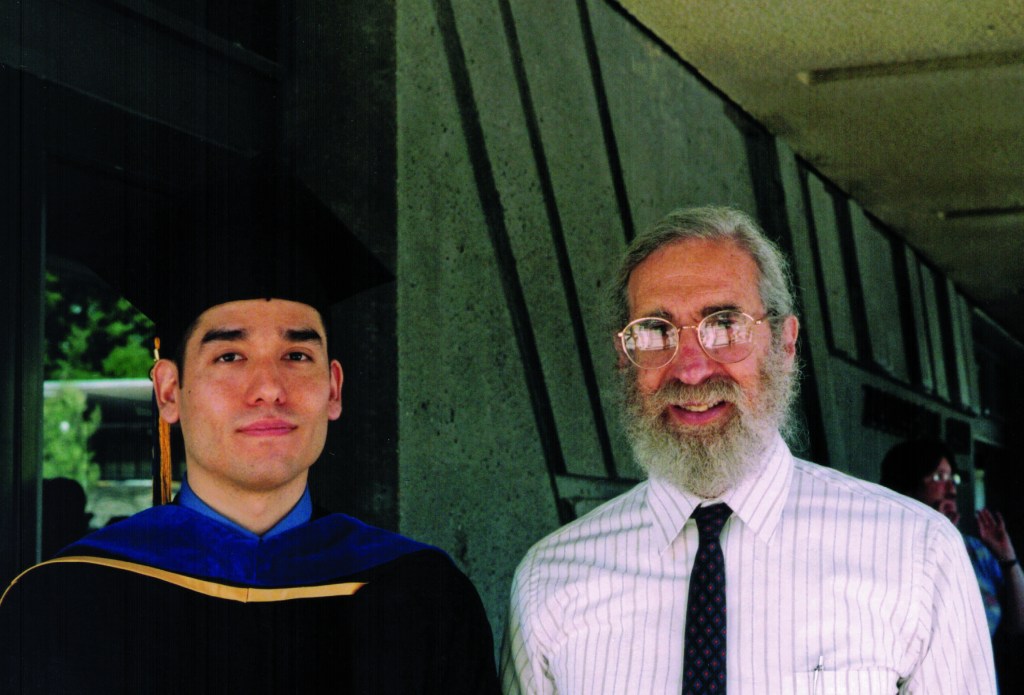
    With my thesis advisor, Donald Sarason, at my graduation from the PhD program (2003).

    Sarason, then nearing seventy years old, was kind and patient, but unusually quiet. His advisor, Paul Halmos, said “[he] is a quiet man; he never uses eight words when seven will do.’’ Perhaps a more astute career move would have been to attach myself to an up-and-coming star, swimming in grant money and fresh off an International Congress of Mathematicians (ICM) lecture or major prize. However, the preening roosters and showoffs were attracted to such advisors, and it is not clear that I could have flourished in such a competitive environment. Somehow things worked out for the best.

    My qualifying examination committee consisted of Sarason, Michael Christ, and Vera Serganova, along with an engineering professor who admitted sheepishly that he was just there as an outside observer. Although I answered the first few questions well enough, things turned for the worse. Christ is a tall, imposing man with a deep voice, and I felt somewhat intimidated when I fumbled one question. Serganova asked a few algebra questions in a kindly fashion, perhaps taking pity upon me, or possibly just throwing out softballs since algebra was the minor topic on my examination. After a long several minutes in the hallway, I was informed that I had passed, although I certainly felt that I hadn’t or shouldn’t.

    My fifth year of graduate school rolled around, and I had accomplished relatively little. Without formal coursework or well-defined goals, I had spent most of my time in graduate school on non-academic endeavors, although I had apparently done just enough to convince the department that I was worth keeping around. Probably I could have used a swift kick in the rear or stern words from some authority figure.

    I had no idea how to be a mathematician, no idea how to do research. I had never been to a conference, nor had I met key players in my field. By some stroke of luck or inspiration, I managed to put together a decent thesis. Although my dissertation solved a problem from an old Bulletin of the AMS article, it was written so abstrusely and tersely that it gained little traction. I briefly met one of the authors of the Bulletin article at my advisor’s seventieth-birthday conference. However, I could not succinctly express my ideas: I was a poor mathematical communicator. The professor appeared impatient with my rambling, and I received a cool and critical response. Clearly, I had no idea how to give an elevator pitch.

    Sheldon Axler probably saved my professional career. As a clueless graduate student just about to hit the academic job market, I needed letters of recommendation. But I didn’t know anyone! Sarason reached out to his former student, who was, fortunately, willing to meet with me. I traveled to San Francisco State University, where Axler had relocated as department chair after a distinguished career at Michigan State. Fortunately, he entertained my rambling and incoherent explanations long enough to see that there was something worthwhile behind the nonsense. He wrote a letter for me which, I can only assume, was a decent one.

    I had survived graduate school, if only barely. A last-minute thesis breakthrough and my advisor’s connections had saved the day. What next?

    After Graduate School

    I was fortunate enough to obtain a postdoctoral position at UC Santa Barbara. My girlfriend, Gizem Karaali, completed her PhD at UC Berkeley the following year and also secured a position at UCSB. We married soon after.

    My mentor at UCSB was Mihai Putinar. Although the graduate students dreaded him as the “demanding Eastern European analysis professor,’’ I found him to be a prolific mathematician with a broad perspective. He gave timely advice about mathematical politics, grant writing, and all aspects of the profession. We wrote several influential papers during those years and I really came into my own as a mathematician. I probably would not have succeeded without Mihai’s guidance.

    With my mother (left), paternal grandparents (middle), and Gizem (right) at my graduation from the PhD program (2003).

    Although I spent most of my time on research, I won another two teaching awards at UCSB. [5] Moreover, I turned my bad habits around and became a workaholic: it was the only way to survive the publish-or-perish academic job market. Now that I knew what I was doing, there was a lot of catching up to do! Moreover, I felt that I had to work twice as hard for half the recognition: I was not in a “hot area’’ at the cutting edge of fashion, and I had to struggle against the constant perception that I was not a “real’’ mathematician and just there for window dressing.

    Our daughter with her great grandparents in Miami (2010).

    The economy was still humming in 2005, with the Great Recession several years away. Gizem and I were fortunate that hundreds of tenure-track positions were advertised that year; we each applied to over one hundred. It strikes me even today how one’s career opportunities depend upon the vagaries of fate. We had several pairs of job offers, along with multiple single offers. We were in a strong position with plenty of bargaining power. Would we be mathematicians today if we had applied in 2008? Perhaps not.

    Looking Forward; Some Advice

    As a Cuban-Japanese person from New Jersey, my life story is hardly universal. Nevertheless, I think that we can still identify some counterproductive behaviors, unfortunate incidents, and repeated mistakes from which we can extrapolate some useful general recommendations.

    First of all, don’t let other people limit your options. Don’t let people tell you what you are capable of, set your limits, or deny you opportunities. You can be your own best advocate: if you don’t believe in yourself, others are unlikely to step up and go to bat for you.

    Second, get your head out of the sand. Meet people and socialize: mathematics is a social endeavor. Don’t be afraid to ask questions; if you don’t ask, you won’t find out the answer. Learn from other people and network, network, network! There are lots of things that “everyone knows,’’ but nobody tells you. If you isolate yourself, then you won’t learn the ropes and you’ll get left behind.

    Lastly, focus and work hard. The first stages of one’s mathematical career are difficult and stressful; for someone swimming upstream doubly so. Whatever you do, put in 111% (since you’ll have to outwork those 110% folks). Sometimes you will have to do more work for less recognition. You’ll eventually earn your place at the big table and then you can pay it forward and lift up the people behind you.

    Although I’ve done a bunch of things over the years, I believe that my biggest impact has been in the classroom. Students look to you as a role model and mentor, but more importantly they look to you as the one-stop shop for part-time jobs in the department, research opportunities, graduate school advice, letters of recommendation, and emotional support. You are the one who needs to tell them the things that “everyone knows.’’ You are the one who needs to ensure that they don’t make the same mistakes that you did. Once you figure something out about how the world works, make sure your students know!

    I mentioned times when teachers thought lower of me because of my background or when professors, perhaps inadvertently, dissuaded me from pursuing opportunities. I still occasionally find myself in settings that are uninviting, in which people view me as necessary decoration, a nod to diversity. You just have to prove people wrong. Once you get to the big table, don’t be afraid to stand up for yourself or voice your opinions. Most importantly, find like-minded individuals and mentors. Others have been there before you, so make sure to draw upon their collective wisdom!

    Receiving the inaugural AMS Dolciani Research Prize at the 2019 JMM.

    Although my “success’’ was not pre-ordained, I did have some lucky breaks. I was fortunate to have parents who valued education and a stable home environment. Both of my parents overcame poverty and suffering; I benefited from the opportunities they struggled to give me. The Berkeley stamps on my diplomas carried significant weight at crucial moments. My advisor’s connections gave me a last-minute reprieve when I needed another letter of reference. At UCSB, I found exactly the right mentor at the right time. Moreover, the global economy cooperated with our job searches.

    Even though I now have many of the trappings of “success,’’ my journey was neither inevitable nor without difficulty. There were moments of indecision, self-doubt, and discouragement. I hope that students reading this will realize that even those who seem to know what they are doing may have once been lost themselves.


    [1] From collegeboard.org: The AP Calculus BC Exam will test your understanding of the mathematical concepts covered in the course units, as well as your ability to determine the proper formulas and procedures to use to solve problems and communicate your work with the correct notations. According to the College Board a 3 is ‘qualified,’ a 4 ‘well qualified,’ and a 5 ‘extremely well qualified.’
    [2] Years later, when my parents moved out of my childhood home, I found recruitment letters from Pomona and Harvey Mudd. None of us knew at the time that I would end up in Claremont.
    [3] From the Mathematical Association of America website: The William Lowell Putnam Mathematical Competition is the preeminent mathematics competition for undergraduate college students around the world.
    [4] In hindsight, this was a good idea. I graduated in 1997, as the tech industry was booming. Many of my friends went into industry, only to be laid off or have the startups they worked for go belly up with the burst of the dot-com bubble in 2000. It took some time for them to find their feet again, only to get wiped out again by the 2008 crash.
    [5] Upon my arrival at UCSB, one of the senior faculty members advised me “don’t spend too much time on teaching. You are here to do research.’’ Because I had won two teaching awards at UC Berkeley, there was apparently some fear that I was not serious about research.


    Previous Testimonios:

    • Dr. James A. M. Álvarez
    • Dr. Federico Ardila Mantilla
    • Dr. Selenne Bañuelos
    • Dr. Erika Tatiana Camacho
    • Dr. Anastasia Chavez
    • Dr. Minerva Cordero
    • Dr. Ricardo Cortez
    • Dr. Jesús A. De Loera Herrera
    • Dr. Jessica M. Deshler
    • Dr. Carrie Diaz Eaton
    • Dr. Alexander Díaz-López

    Brian P Katz (BK)

    August 15, 2022
    Testimonios
  • Testimonios: Dr. Alexander Díaz-López

    Testimonios: Dr. Alexander Díaz-López

    When It All Started

    It’s Saturday evening and the sun is about to disappear from the horizon. I hear the sound of dominoes, clashing with each other. A table is set, my sister and cousins are shuffling the dominoes and we all get ready to play. Sometimes for hours. When (if!) we got tired, we would switch to Monopoly or card games. Regardless of the game, there was one constant: I always enjoyed counting the game points/“money’’ at the end. In a sense, this is where it all started for me. These are the earliest memories I have about numbers and mathematics.

    Dr. Alexander Díaz-López; Illustration created by Ana Valle.

    My parents, however, tell a different beginning. They share stories about how I could not speak until after I was two years old but then quickly learned how to speak, read, and count in a very short time; well before starting kindergarten. They tell stories about me extrapolating that if 1+1 is 2 then 10+10 is 20 and 100+100 is 200 at a very early age. Some years later, when I finished second grade, a teacher suggested I skip third grade and jump directly to fourth grade as I had the mathematical skills for it. My parents agreed and I skipped third grade. Unfortunately, I have no recollection of any of these events.

    The domino playing crew, some years before we actually started playing.

    School and Early College

    El Triángulo de las Matemáticas. Almost all of my childhood memories start in seventh grade. They are mostly about how I would spend my evenings playing outside with my friends and cousins as, at the time, my parents did not have the resources for me to attend after-school clubs or camps. The memories that do involve math have to do with when we played board games. As a matter of fact, throughout most of middle school and high school, I enjoyed mathematics but never really felt passionate about it. I had the same teacher from eighth to eleventh grade and while I was doing well, the math discussed in class was very mechanical and I never felt engaged or challenged in these classes.

    The Math Triangle logo in our club shirt, which I still keep.

    It all changed when I entered an after-school math club El Triángulo de las Matemáticas [1] during my late years in high school. It was led by Mr. Jorge Haddock, who was also my math teacher during my high school senior year. We met every week to work on cool math problems. The thrill I felt after struggling and then solving what at the time felt like very hard problems was an indication that I wanted to keep engaging with mathematics. I felt like I would enjoy doing what Mr. Haddock was doing (and I did not know any mathematicians other than my school teachers), so I decided to apply to college as a math major with the goal of becoming a high school teacher.

    Remembering mom and dad’s sacrifices. My transition to college, in 2007, required a big adjustment. I had just turned 17 when I moved out of my mom’s house to live in a tiny college apartment with my best friend in the western part of Puerto Rico. We were both attending the University of Puerto Rico at Mayagüez, a state university known for their engineering programs. As happens to many college freshmen, for the first time I had to take full care of myself (e.g., having to cook, clean, manage finances, set my own schedule, do my coursework, etc). It was then that I started to understand what a big sacrifice it must have been for my parents to take care of me and my sister and provide us with the best possible chance at a college education.

    For instance, in order to pay for our house, Dad entered the military and completed missions in several international destinations. He left home to stay in deserts, camps, and other non-desirable places. Mom held the fort down while Dad was away and then she went back to college in her thirties to complete her bachelor’s degree, while working full time and taking care of me and my sister. I realized that if my parents were so strong to go through really difficult times to chase their dreams, I should try my best to do the same.

    Summer research programs. It was Spring of 2009 and one day, out of the blue, my phone rang. I picked up and a strange but energetic voice said “Hello Alexander, how are you?… Can you read these papers?’’ Somewhat in shock, I said: “Yes.’’

    Some months before the call, a faculty member told me I should apply to summer Research Experiences for Undergraduates (REU). I applied to a dozen of them, despite the fact that I was underprepared for them. I had only taken an introduction to proofs class and while I worked really hard at the applications, I wrote what I can now confirm were very poor application essays. Not surprisingly, I didn’t get accepted to eleven of them. Yet, a twelfth, Dr. Frank Morgan’s SMALL REU group needed something special. They needed more than a mathematician. They needed a bilingual mathematician.

    In that same year, Frank Morgan had arranged to spend the summer at the University of Granada in Spain and bring his REU group with him. I have never asked him, but my guess is that the idea of having at least one bilingual student was too tempting for him to ignore. So, he looked at my application and called me to talk about the program. When he asked me if I could read some papers and tell him what I thought, I did what I needed to do. I spent hours reading the papers, although I could barely understand what was written in there. A week later we spoke and he officially accepted me into the program.

    June came, I packed my stuff and flew internationally for the first time in my life. Once we arrived in Granada, we settled at the Carmen de la Victoria university residence, overlooking the imposing Alhambra Castle. At the time, I found it all very impressive. Then, reality struck. During the first couple of research group meetings, the other three participants in the program (all coming from prestigious institutions) were talking about densities, manifolds, and isoperimetric curves. I could not understand much of it. By the third day, I felt hopeless, so I started packing and decided I was going to head back home.

    Before making it official, I spoke with Frank and told him I was lost. We sat down and discussed the background needed for me to work on a particular case of the research problem we were working on. More than anything, our conversation gave me hope that I could at least attempt to work on a problem. I spent the next four weeks working on it and the problem became part of my first math publication. From that point on, Frank became a big advocate for me and later recruited me to join the Notices of the AMS editorial board when he was Editor-in-Chief.

    Giving my first-ever research talk in Granada.

    The following summer, I applied and got accepted to the Mathematical Sciences Research Institute Undergraduate Program (MSRI-UP) in Berkeley, CA. This time I was better prepared to work on a research project and had a good experience throughout the program. It was uplifting to do research mathematics in such an amazing place and with an excellent group of peers. To top it off, my research advisor was Dr. Edray Goins, who became a mentor and role model for me.

    Graduate School: Learning from the Hard Times

    Finishing my undergraduate degree was my second biggest academic accomplishment at the time (getting the SMALL REU problem solved was the first). I feel blessed to have experienced many other positive moments in my life that fill me with joy every time I think and reflect back on them: getting married, getting my PhD, co-founding Lathisms, getting the job I had desired, among others. While these moments have carried and continue to carry me through life, they aren’t the moments that made me stronger. Difficult times are the ones that have taught me how to be resilient.

    I rarely talk about these difficult times, but was recently reminded of the power of sharing these moments, particularly, for a younger generation that might look at us and see “awesome mathematicians who rarely struggle.’’ So, here are some of my most difficult academic moments.

    First year of grad school was HARD. It was an early week in January and the beautiful Notre Dame campus was covered with snow. Temperatures had ranged from single digits to below zero for the past week and I was in my on-campus graduate apartment. I had been inside for about 300 straight hours. I was tired, without energy, and frankly a bit depressed. “How did we get here?’’ I thought.

    A year before that, after the two REU experiences, I was sure I wanted to become a math professor. After a long and stressful graduate school application period, I received a handful of offers and decided to enroll in the mathematics PhD program at the University of Notre Dame. “I am only one degree away from my goal of becoming a university professor,’’ I thought at the time.

    The first two weeks of the semester were a slap in my face in many ways. I had the privilege to be raised in a place where I was part of the majority; now, at Notre Dame, there were no Black, Latinx, or Native American faculty in the math department. Overall, there weren’t many people of color in the department and more generally, in the university. It felt isolating and it was a sudden introduction to the racial disparities and lack of a path for a graduate education that many people of color face in the United States.

    A second shocking issue was classwork. I was not sure what type of mathematics I wanted to study and was unsure about my background, so I thought it would be a good idea to take four courses in my first semester. I enrolled in Real Analysis, Complex Analysis, Algebra, and Topology. Very quickly the semester turned into a stress-inducing machine. Reading notes and books, doing weekly homework, studying for exams. I was spending a lot of time (and doing well) in Algebra and Complex Analysis, but was really struggling with Topology and Real Analysis. In an unhealthy pattern, I would spend most hours of every single day of the week doing course work. Despite this, I kept struggling with Real Analysis. The professor’s teaching style, which would have him talk for the whole hour while writing very few things on the board, was not working for me. I obtained less than 40% on both the midterm and the final exam. By being one of the three students who “stuck with it’’ for the semester (out of the initial 12 or so students), I obtained an A–. But my course average, just like my energy and desire to continue learning from the professor, was much lower than 40%.

    With all my family and friends back at home, I was alone, stressed, and tired. Qualifying exams were coming in January and temperatures were ranging in the single digits. I decided to quarantine myself in my apartment to study for the qualifying exams for twelve straight days. This is how I ended up inside for about three hundred straight hours, exhausted, and depressed. By the end of it, I took my qualifying exams and felt like I had not only dumped all the stuff I had just studied, but that I also left all my humanity there.

    As soon as I turned in the exam, I knew I was out of energy and motivation and needed help. After taking a week-long break, I reached out to my community; I talked to my girlfriend (who is now my wife), advisors, counselors, and colleagues. The consensus was that I needed to make changes; otherwise I would not survive graduate school. I started exercising and playing sports, stopped prioritizing coursework over my own physical and mental health, and reduced the coursework to a manageable load and in areas I was more interested in. Fortunately, I really enjoyed Katrina Barron’s Algebra class and so I started taking more courses in the area. Not surprisingly, I ended up getting my PhD in algebra (under the direction of Matthew Dyer).

    Withdrawing from differential geometry. The lessons I learned during my first-year graduate experience helped me get through the remaining years of my graduate career. For the most part, years two through four were fairly positive, in part, thanks to the advisor and area of research I chose. But there was one more experience worth pointing out. For the first time in my life, I had to acknowledge that I was going to fail a math course. I had a 3.90-ish GPA in high school and college and had never really failed a course. Even graduate Real Analysis, with the low scores I had, I was fairly sure I would pass as every other student was in the same boat. Then I met differential geometry. After the first two weeks of classes, it was clear to me that either I devote all my time and energy to that class (mostly to pick up all the needed background and then to catch up in the class) and relive what I lived through during my first year or I was going to fail the course. I had it clear at the time. There was no way I would go back to the unhealthy habits of year one. Hence, I accepted I was going to fail and decided to drop the class.

    Job search. Going into my fifth year, there had been one question I was dreading to ask my advisor. “When do you think I will finish the program?’’ After a year struggling to get myself to ask it (and afraid of the potential answer as I had guaranteed funding for exactly five years) I did ask him. Matthew, quickly asserted: “If it all continues well, you can finish this year.’’

    I felt so relieved. I could finally finish and fulfill my goal of getting a PhD and becoming a professor. Yet, one more difficult process lied ahead—the job search. Looking for jobs in academia is a nine-month process. First, drafting your documents (in August at the latest), then searching open positions, submitting applications (early winter), getting interviewed (January), doing on-campus interviews (February/March) and finally accepting a position. It’s a draining process, to say the least.

    I was inexperienced in the process and had no training about it. So, I asked my colleagues what they planned to do and many said they would apply to 100+ jobs. I then did the same. It wasn’t until a year later that I realized this was a terrible idea, at least for me. How can one really research 100 places, gather information about their positions, the type of department they are, what they are looking for and then tailor every single one of the applications? I don’t find it possible.

    Not surprisingly, I received 80+ rejections. Well technically less, as many of the places never actually contacted me with a formal rejection. Fortunately, I seemed to have been an exciting candidate to some liberal arts institutions, as I got visiting offers from Swarthmore College, Haverford College, and Williams College, and a tenure-track offer from Hobart and William Smith Colleges. After visiting these places, I decided to decline the tenure-track offer and join the Department of Mathematics and Statistics at Swarthmore College. It was a risky move, but it ended up being one of the best decisions I made. The year I spent at Swarthmore confirmed that being a professor is the perfect job for me and a year later I obtained a tenure-track position at Villanova University. The three years I have spent at Villanova have been professionally and personally fulfilling.

    Community Building

    As a Latino who grew up in Puerto Rico, I benefited from a culture in which building and fostering communities was always important. Yet, the somewhat individualized experience I had in graduate school and some solitary experiences at the Joint Math Meetings made me wonder if it would always be like that. Thankfully, it has not.

    Meeting Erik, Darleen, and Pam at USTARS. The Underrepresented Students in Topology and Algebra Research Symposium (USTARS) was the first conference I attended in which I felt I belonged. Instead of being the single or one of the few people of color in every single event of the conference, the whole conference was centered around us. More importantly, there was a concerted effort to create a supportive and welcoming atmosphere for the graduate students involved in the conference.

    USTARS participants and organizers in 2014. Photo provided by the USTARS 2014 organizing team.

    In that place, I started building a community. I attended a talk by Darleen Perez-Lavin, which led me to also meet Darleen’s collaborators Pamela E. Harris and Erik Insko and which later resulted in a research collaboration between all of us. Since then, Pam, Erik, and I have worked on numerous research projects. Through the connections I made there, I also met Mohamed Omar, Alicia Prieto-Langarica, Gabriel Sosa, and many other individuals who have been influential in my career.

    The biggest lesson I learned is that building community does not happen by chance. It requires planning, purpose, and commitment from the individuals involved. And once you build communities, they can be life-changing. Thus, I have decided to get involved in projects which, in one way or another, are centered in building community.

    Lathisms: Latinxs and Hispanics in the Mathematical Sciences. During a conference, Pamela E. Harris, Alicia Prieto-Langarica, Gabriel Sosa and I discussed the idea of showcasing the contributions of Hispanic and Latinx mathematicians during Hispanic Heritage Month (HHM) as a starting point for building a stronger and more connected Hispanic and Latinx community in mathematics.

    Lathisms poster produced by the American Mathematical Society.

    Shortly thereafter Lathisms (Latinxs and Hispanics in the Mathematical Sciences) was born. During the first year, we showcased one mathematician per day during HHM. They are featured in the poster to the right. Since then Lathisms has created a podcast, listserv, and continues to showcase Hispanic and Latinx mathematicians on its website. With support from the American Mathematical Society (AMS) and Mathematical Association of America (MAA), the project has reached thousands of schools and many universities.

    Villanova: DREAMS Program, Co-MaStER. One of the nicest things about Villanova is that the faculty in the department have a great rapport with each other. Yet, our connection to math majors is not as robust. To bridge the gap, I co-created two programs: DREAMS (Discovering Resources and Exploring Advanced Mathematics and Statistics) and Co-MaStER (Community of Mathematicians and Statisticians Exploring Research).
    DREAMS’ goal is to introduce students to intriguing problems in mathematics and statistics that could potentially lead to a research project and to provide graduate school information and advice, along with mathematics career perspectives that demonstrate the value of advanced studies in math. Co-MaStER is a research program where we gather research projects from different faculty in the department, send them to students, collect students’ applications and pair interested students with appropriate research projects. Each research group functions independently, but once a month everyone gets together for professional development and research sharing sessions. So far we have received overwhelming positive feedback about them.

    Math SWAGGER. In Summer 2020, I joined Pamela Harris, Vanessa Rivera Quiñones, Luis Sordo Vieira, Shelby Wilson, Aris Winger, and Michael Young in co-leading the Mathematics Summer Workshop for Achieving Greater Graduate Educational Readiness (Math SWAGGER), a five-week virtual summer program for underrepresented students enrolled in a mathematics/statistics graduate program. We engaged in conversations about topics that affect the life and academics of graduate students. In addition to the fact that we all learned from each other and from our stories, advice, sufferings, and successes, the early results so far point to the creation of a strong community of scholars ready to support each other through their own graduate paths.

    Conclusions and Advice

    Through all the programs I have been part of (both as participant and organizer), it has become clear to me that while no individual can single-handedly create a space where all members feel welcomed, heard, supported and given an opportunity to thrive, when we all come together as a community of engaged scholars with a common purpose we can create such events and spaces. When creating these spaces, it is imperative to think about who are the most vulnerable members of our communities and how can we make sure we provide the tools for such members to excel.

    A second and final concluding thought, which I shared in a 2020 interview for the Meet a Mathematician series, is about the idea of being successful. In the interview, I was asked to provide some words of wisdom to the mathematics community. My response: “Don’t let others define what success is for you.’’ Success can have many different forms in the mathematical community: being a professor at a research university, a liberal arts college, or a teaching college (see Lathisms.org for many examples), teaching at the elementary, middle, or high school level, becoming a journalist or freelance writer (e.g., Evelyn Lamb), leading community centers (e.g., Amanda Serenevy), running nonprofit organizations (e.g., Jeanette Shakalli), working in industry or government, and many others. Choose what is more appealing to you and define success for yourself.


    [1] The Math Triangle


    Previous Testimonios:

    • Dr. James A. M. Álvarez
    • Dr. Federico Ardila Mantilla
    • Dr. Selenne Bañuelos
    • Dr. Erika Tatiana Camacho
    • Dr. Anastasia Chavez
    • Dr. Minerva Cordero
    • Dr. Ricardo Cortez
    • Dr. Jesús A. De Loera Herrera
    • Dr. Jessica M. Deshler
    • Dr. Carrie Diaz Eaton

    Brian P Katz (BK)

    July 15, 2022
    Testimonios
  • Testimonios: Dr. Carrie Diaz Eaton

    Testimonios: Dr. Carrie Diaz Eaton

    Early Life

    I grew up straddling worlds. I was born and raised in Warwick, RI, a couple miles from Providence. My mom was also born in Warwick, RI, but my dad was born about 3700 miles away in Lima, Peru.

    Dr. Carrie Diaz Eaton; Illustration created by Ana Valle.

    My dad, Hugo Evaristo Díaz Mendizábal, was the second oldest of nine children. He would tell a story about one day when they had no money to buy food and his mom went to the butcher. She placed a stack of butcher paper on the scale and demanded that she was owed that much meat over the years of buying from the butcher’s store—and it worked. This story is indicative of the strong Mendizábal women, and also of the reasons that my father immigrated to the U.S. in 1960. As the second oldest, he and his older brother were the first two children to immigrate to the United States after his dad, a surveyor, immigrated and then promised them jobs with him. At fifteen years old, after completing his cartography certification at the Instituto Geográphica Nacional and speaking little English, he arrived in California—to a broken promise and no job.

    My mom came from a working-class, New England Protestant family. My grandfather worked his way up to a foreman in a machine shop, and my grandmother was a homemaker. They built the house they lived in—living in the basement until the first floor was complete and so forth. They both survived the Depression, which forever left an impression on their lives. My grandfather enrolled in the Civilian Conservation Corps, a federal work program initiated by Roosevelt. They had an urban homesteader garden before it was trendy and when it was necessary. My grandmother could make dinner out of any scraps and passed her knowledge of pie making and preserve making to me.

    My dad’s employment prospects brought him eventually to the east coast. It was in Rhode Island in 1966 when he met my mom, on an invitation from his Filipino coworker to dinner at his wife’s house. My mom, Becky Ober, was the wife’s younger sister. In 1967, my mom graduated high school, married my dad, and was pregnant with their first child.

    Becky Ober and Hugo Diaz dating.

    I think I was aware of how unlikely my parents’ (and my aunt’s) marriage was. I was raised in my mother’s church, but my dad went to a Spanish-speaking Catholic church in Providence. But naively, I never linked these to race or ethnicity. It wasn’t until years later, as I was watching Guess Who’s Coming to Dinner? with Sidney Poitier when I understood the world in 1967. It wasn’t until 1967 that the Supreme Court overturned the “miscegenation laws’’ prohibiting interracial marriage, as unconstitutional.

    My parents raised my older sister, Alisa, in Rhode Island for only a short time before moving to southern California, to where the rest of my father’s family had now immigrated. It was in California where my older brother, Devon, was born. My dad was able to find work during the day, live in UCLA family housing, and attend night school in the evening, working on his degree in computer science. By this time, he realized that maps were going digital or perhaps more broadly foresaw the future of computing—nearly all of his siblings pursued degrees in math and computer science after coming to the U.S.

    Living in Los Angeles in the late 1960s as a Latinx family was a very different experience than what I was raised with by the time my parents had me. When Alisa was enrolled in school, due to her dark complexion, she was automatically placed in a Spanish-speaking classroom. In this age of assimilation, she had been raised as English-speaking only, leaving her crying when she got home from her first day of school. My dad recalls that he would have to carry a copy of his class schedule in his pocket because on his way to night-class he would be routinely pulled over by cops who wouldn’t believe he was on his way to class. They lived in California only a few years before returning east.

    I was raised in a different America—one nearly 15 years later, on the other side of the United States from my Latinx familia. One where my dad finally finished his computer science degree after 18 years of night-school and transferring colleges. One where my mom also went back to college to transform from a 1980s secretary to a school-based speech-language pathologist. One where I was raised in an English-speaking home but took Spanish-classes to be more connected to my Latinx roots. One where I proudly brought my dad’s Peruvian trinkets to class for show and tell. One where this Latinx family had now achieved something akin to the American Dream (as long as you don’t count the years of school debt, the clash of family backgrounds, and the lack of wealth-building). One where many of my Peruvian aunts and uncles had been successfully educated and employed in the burgeoning computer science industry.

    Finding Mathematics

    In an article I co-authored with my mathematician cousin, Marizza Bailey, called “Revealing Luz’’, I wrote about my journey both towards and away from mathematics. [1] “Revealing Luz’’ was about my great aunt, Tía Luz, who my dad knew growing up in Peru. She was a math teacher and inspired many school children and family members. The greatest gift she gave me was that my dad grew up knowing that the women in his family had the potential to be incredible mathematicians and educators. As I balanced this line of being Latinx-identified, but separated from most of them on the opposite coast, most of my connection to my mathematical and computational successes as well as my Latinx heritage was through my dad. My dad often spent our time together working on math workbooks while my younger sister, Naomi, was in dance class. My older siblings would show me math flashcards as a baby, however, one could argue an even earlier influence—I am a part of mi tía and she is a part of me, and math is a part of both of us. This is a concept Rochelle Gutiérrez brings back to us from Mayan philosophy called In Lak’ech in which we see ourselves in others. [2] The version Dr. Gutiérrez introduces in “Living Mathematx” is more an acknowledgement of a broader community interconnectedness and perhaps less literal than what I mean. No matter the reason, my identity as a mathematician is thoroughly wrapped up in my identity as a Peruvian-American.

    My dad, ever the influence on my mathematical opportunities, chose a town to move to when he relocated to Boston that had an excellent math program. I captained a math team at a public school with a multi-year winning record in Massachusetts and New England. I was also part of the American Regions Mathematics League Massachusetts A team that won in 1998. I would guess others considered me very successful in mathematics, but I always thought of myself as a modest performer among the best. I clearly loved calculating, but had no interest in studying proof-based mathematics in college. All of my siblings solved this by pursuing degrees in civil engineering, but I wanted to go save the oceans and the rainforest. I did not understand what math could offer me other than a job teaching (which I have to say I loved doing, as by this point I had been tutoring math for years. But I did not love this as much as saving the planet!). My rebellious choice as a headstrong teenager was to reject math, and also reject the thought of applying to any college without a zoology program. My second rebellion was to reject the idea of an Ivy League education—in part because I was turned off by the pomp and circumstance, but also because I did not understand that the price tag was just a suggestion. I was worried about the cost and didn’t want my dad to spend the money. At that time, I didn’t realize places like MIT have substantial money for financial aid.

    I found my way back to math because I found my way into a community of mathematicians. In retrospect, I had always been looking for my community. Throughout all of my schooling, I felt I never quite fit in and had longed to be in college. When the University of Maine offered me a full scholarship, I found that community and underwent something akin to a metamorphosis. I became involved with various “diversity’’ groups and found the Latinx and Spanish clubs welcoming of my white face and school-learned Spanish. I credit UMaine, under Dr. Angel Laredo’s leadership as Dean of Students, with the intentional development and support of these communities—from its new inclusivity programming to its student leadership programs. I will always remember at our first Latinx festival and dance at UMaine, Dean Laredo gave an opening talk and said that it was las ganas (the desire), that drove us to be the best. I also found community in the mathematics department, in the math club, and in my small math classes—unlike my large biology lectures. Within these communities, I found my voice as a leader, and then I found my way back to mathematics. For many, finding math is the difficult part, but for me, it was finding my way back to math since it was a part of me from the beginning, or as we said in “Revealing Luz,” finding something that was “always-already-there.”

    Balancing Identities

    During the summers in college, I worked for a temp agency in Boston. I was placed at MIT in Cambridge and for two summers, worked in the basement of Building 11 as a copy assistant. I had wonderful and funny coworkers and enjoyed it immensely. We were responsible for all of the copying and computer rental time for the math department, and I found myself longingly flipping through past Putnam exams and math course textbooks. There is an odd sort of message looking back on this now—that the Latina in Building 11 was only good enough to make the photocopies. My dad, perhaps seeing this longing and realizing that I was leaning to switch to mathematics, called the MIT admissions office and made an interview appointment for transfer. What my dad did not see was the ragged students copying their thesis who hadn’t showered in many days, the campus reports of suicide, and the fact that I felt more at home among the copy staff than the faculty. I also felt more at home among my newly found University of Maine community and family, and I did not want to leave them. Ultimately worried about how I was going to afford tuition and in the midst of developing a community at UMaine, I declined MIT’s offer to transfer.

    At the beginning of my third year, a few changes began to solidify my new path. I was invited to join a research group and graduate topology course by a professor, Dr. Bob Franzosa. I started dating my best friend, Scott Eaton, and by my senior year, we married. The math department hired a mathematical biologist, Dr. Sharon Crook, who combined both my interests into a single discipline. Finally, the department introduced an interdisciplinary master’s in mathematics. Dr. Crook offered me the opportunity to stay as a graduate research assistant in computational neuroscience, which conveniently solved my new two-body problem. It also gave me the opportunity to move in with my grandparents to help as they aged, despite the long commute. Sadly, in the first semester of my master’s program, my grandfather passed away, but we were grateful to be there for my grandmother.

    While at UMaine, I continued to take biology courses and became particularly interested in a specific area of mathematical biology called evolutionary theory. At the time, my cousin Marizza was a PhD student in Galois theory. This gave me some confidence to pursue a PhD in order to stay in Maine as a full-time faculty member. This was a difficult leap because, in order to get a PhD in mathematics, I would have to leave Maine. Fortunately, my husband and I were accepted into all of our graduate programs, with generous assistantships and fellowships. We picked the University of Tennessee because it was relatively close, affordable, and offered the same level of interdisciplinarity I currently enjoyed while training in a rather unique area of study.

    Balancing family, identity, and a PhD in math was not an easy road. As I once described it, it continued to be like the TV show Ninja Warrior—trying to navigate both the planned obstacles while dodging all the surprise ones. I had no idea really about how I was supposed to study for my first prelim at the end of the summer. Even though I excelled in class, I felt like I barely passed the prelim. The final exam for my second prelim class was held on the “Day without Immigrants.” [3] I was distracted the whole time thinking about how I felt I could not boycott my exam that day in solidarity. What gave me joy in these hard times was my work mentoring graduate students. I had begun calling for a teaching assistant support program after completing my exams. My proposal to the department was approved, and the next fall I began co-directing the math department’s first TA teaching development and mentoring program.

    Two weeks before my orals to advance to candidacy and eight and a half months pregnant, my car was hit broadside by a tractor-trailer. I had to be induced and had my son, Gabriel, on July 25th. Then the childcare facility I had reserved space in closed without notice, and I could only find care two days a week. When my son was two and a half weeks old, I was back at the university teaching the TA development class. I called my parents to come help until daycare could start and a fellow graduate student, Erin Bodine, would watch Gabriel while I was in class. When he was not quite two months old, I passed my oral exams, wading through the fog of sleepless nights as a new mom. I was nursing him when I turned down the opportunity to attend an evening awards banquet—where, I later found out, I had been awarded the University’s Chancellor Award for graduate teaching.

    Diaz siblings with papá in the middle. L to: Devon, Naomi, Hugo, Alisa, and Carrie.

    Nearly five years into my PhD, my husband received a job offer for an instructor position back in Maine. By this time my parents had divorced, remarried, and retired to Maine, and my husband’s family also lived in Maine. Much to the surprise of my advisor, I decided to take a leave from my PhD ABD (all but dissertation) to be closer to family support. We moved back in with my grandmother, who by then was no longer grieving, but needed more assistance at home. I nearly quit my entire PhD as I realized I was pregnant with my daughter, Yudani. It had always been good enough to stay here with my family and teach at a local college. However, part of this dream scattered when I realized that the adjunct pay I was earning and my husband’s instructor position were not going to be enough to make ends meet. I also felt a sense of regret at the thought of never finishing the last chapter of my dissertation. So, with some babysitting provided by my retired parents, I finished as much as I could on my dissertation independently before my daughter was born, and went on the job market for a full-time position. As a math biologist in the 2000s, I was lucky to have many interviews in Maine, and I accepted an Assistant Professor position at a small environmental college, Unity College—teaching math to save the environment. It was that position, contingent on finishing my PhD before my first contract review—and the encouragement of my peers—that gave me the last push I needed to finish off the final chapter, which in retrospect was my most independent and intellectually creative work.

    Moving home meant my family had more support, and it turned out to be fortuitous timing. My dad was diagnosed with a muscle degeneration disease. My mom was in a severe motorcycle accident just a few weeks before my final dissertation defense and nearly died. She was air-lifted to the hospital I lived only a few miles from, and I was there to support her and her husband as the decision was made to amputate her leg. I went to a conference only a week later, having organized sessions. I have a vivid memory of my advisor asking me if I was ready for my defense, and trying to tell him about my mom while crying on the escalator. My house in those times was a host for all of my family who came to visit my mom in the hospital. In the end, I passed all those exams and all the trials and defenses. It would be years later that I would find out I was the first Latina to graduate with a mathematics PhD from the University of Tennessee. It was an accomplishment of both grit and luck, but not particularly graceful.

    Sometimes I feel conflict about the decisions I made on my path. I frequently rejected “superior’’ choices of institutional name to stay closer to my values in both family and mathematics. However, I do not think I sacrificed any education—maybe connections and access, now that I see the view from Bates, the elite small private college where I currently teach. Perhaps if I did not center family, I would not have faced the roadblocks of being a mother in academia or burdened a significant care-taking role for my parents and grandparents when they needed me. But I know also that if I had made different choices, I would not have been the same person, embraced by my communities, and given the opportunity to lead. I cannot imagine who I would have become had I not made my decisions based on the values that I held dear. I have found this true also for the students I have taught along the way, which have always held the same hidden potential, no matter where they have attended school. My advice for those on the path of self-discovery is to be true to yourself. My advice for everyone else is to look beyond the labels of worthiness that mathematicians use to judge others.

    Interdisciplinarity Means Working Together

    Although I describe my upbringing as fundamentally different than my siblings, I was also largely naive and shielded. I still had struggles navigating the differences between my mother’s and father’s side. We interacted a lot with the Latinx community through my father’s church, as my father would often help with translation needs. I have a vivid memory of having a newly arrived refugee come to the house with his daughter. I played with the daughter, while my dad helped the father. Later I asked him about the father because I had heard him crying with my dad. His wife had been shot at the border. Years later, in my suburban English class, I would write about this experience. My teacher scoffed that I most certainly had to be exaggerating. These many differences between worlds also played a huge role in my parents’ divorce. My dad could never shake the feeling that he was always trying to prove he was more than the Latino boy that got my teenage mother pregnant.

    Carrie, Scott, Yudani, and Gabriel in 2018.

    There were many worlds my family upbringing straddled—Catholic and Protestant, conservative and liberal, white and Brown, English and Spanish. I only added to these diverse experiences when I moved between mathematics and biology and became a northerner in Tennessee. In addition, I had to navigate these multiple worlds as a mother, as an underrepresented minority in STEM, as a woman, and as a queer individual. These many intersections, worlds, and bridges, created a confluence of experiences by which I became a leader as a boundary spanner. I was used to translating experiences between worlds. I understood the values and axioms that made these worlds operate, and I was consistently looking for common ground between frameworks and ways of seeing the worlds. I was used to thinking about language as reflecting culture and history. Other researchers in Chicana studies and education call this Nepantla—the space between these spaces which allows us to think differently and open new spaces of being. [4] Therefore, interdisciplinary research for me is an outlet by which I can use the sum of my knowledge and experience, but also I have found my type of boundary spanning is needed to move research and education forward.

    Now I am almost used to moving between disciplines and moving between or embracing multiple identities. This perspective has been particularly important as I have started to work in building an interdisciplinary and inclusive STEM education. How do we talk to biology students about mathematical concepts? What does math feel like to others when it is spoken without first understanding their own cultures and conceptualizations of mathematics? It turns out that biology students already know a lot about math and modeling, they just understand it differently—the engineering examples of calculus speak a different language than what biology students understand. Community co-evolution has also become an important and reoccurring theme. My research in evolutionary theory led me to study plant-pollinator networks—species that work together to build diverse and resilient communities. That final chapter of my dissertation that was almost never written because I left Tennessee ABD was about how mutualistic communities co-evolve together, the structure of those networks, and why they are both diverse and resilient. [5] I want the STEM disciplines to build a diverse, resilient community together.

    Networks for Change

    Re-conceptualizing my research strengths as synthesizing frameworks and as about cultivating diverse, resilient, co-evolving community networks has given a coherency to my research program that others’ used to label “too-broad’’ or “scattered.’’ In retrospect, I always naturally gravitated to forming community support networks in my early leadership days at UMaine and with the TA support program at UT even when that work seemed separate from my research.

    As soon as the ink was dry on my PhD, I wrote my first grant, to support a network called QUBES (Quantitative Undergraduate Biology Education and Synthesis). We had a dream that we would help others find high-quality curriculum materials in math and biology by collaborating broadly with professional societies across disciplinary boundaries and by providing a robust cyberinfrastructure. [6,7] Seven years and about $4 million later, we have moved far beyond our original dreams. I have also been involved in a number of other networks, all with the goal of bringing groups together to collaborate, and more recently with an emphasis on equity and social justice.

    I have also been avidly involved with institutional governance and professional societies, which I enjoy. I am not sure how I started, but I have always tried to be a reliable and hard worker and say no when I cannot deliver, and so my name seems to continue to be recommended. I have served as Chair of the Education Subgroup of the Society for Mathematical Biology. I also served on the Board of BioSIGMAA, the Special Interest Group of the Mathematical Association of America (MAA) devoted to undergraduate education in mathematical and computational biology. I am currently the Chair for the MAA’s Committee on Minority Participation in Mathematics. I have served on the Editorial Board of Letters in Mathematics and currently serve on the Editorial Boards of CourseSource and Problems, Resources, and Issues in Mathematics Undergraduate Studies. In 2020, I was awarded the Society for Mathematical Biology’s John Jungck Prize for Excellence in Education.

    Concluding Remarks

    In all of my experiences, my biggest joys have come from raising a wonderful family and from supporting others to be successful on their own terms. I remember being told as a new person in a new institution, that the ideas I had were not going to work. Even though I have seen many ideas rise and fail, I myself have seeded improbable ideas that radically succeeded. Instead of crushing potential, my goal is to always bring out the strengths of the people I work with. The next generation of mathematicians and biologists seems to be more insightful and creative than I have been, and I actively work against the institutionalized ideas that older means wiser, that collaboration means a lack of self-sufficiency, and that niceness fixes systemic inequality. There is still work to do, but I believe we can do it together.

    Advice

    I conclude with some advice that I have learned through experience in my life and career. I share it with the hope that it helps readers who are exploring mathematics as a career as well as those who have already found their way to mathematics and have embraced it.

    • I think math is a part of us and we are a part of math, but some of us find ourselves on a lifelong entangled path with it. Follow both your heart and your brain. My brain made me pick math over biology as a primary discipline, but my heart brought me to the work I do today.
    • Find your support system at school and outside of school, and use it. Figure out what keeps your brain and your heart motivated and use that to keep you going through challenges.
    • My advice for those on the path of self-discovery is to be true to yourself. My advice for everyone else is to look beyond the labels of worthiness that mathematicians use to judge others.
    • Actively work against the institutionalized ideas that older means wiser, that collaboration means a lack of self-sufficiency, and that niceness fixes systemic inequality. It is easy to be lulled into assimilation, so reflect often.
    • Working together, we can build diverse and resilient communities.

    [1] Revealing Luz: Illuminating Our Identities Through Duoethnography, Eaton, Carrie Diaz and Bailey, Luz Marizza, Journal of Humanistic Mathematics, 8, 2,(2018).
    [2] Living Mathematx: Towards a Vision for the Future, Gutiérrez, Rochelle, Philosophy of Mathematics Education Journal, 32 (2017).
    [3] On May 1st 2006 various protests and strikes occurred around the United States to demonstrate the importance of immigration to the United States.
    [4] Embracing Nepantla: Rethinking “knowledge’’ and its use in mathematics teaching, Gutiérrez, Rochelle, REDIMAT, 1, [1], (2012). and Making Faces, Making Soul/Haciendo Caras: Creative and Critical Perspectives by Feminists of Color, Aunt Lute Books, (1990).
    [5] Diaz Eaton, C. E. (2013). Modeling the Genetic Consequences of Mutualism on Communities (PhD dissertation).
    [6] Quantitative Undergraduate Biology Education and Synthesis (QUBES): The Power of Biology X Math X Community (qubeshub.org).
    [7] Donovan, Sam, et al. “QUBES: a community focused on supporting teaching and learning in quantitative biology.” Letters in Biomathematics 2.1 (2015): 46–55.


    Previous Testimonios:

    • Dr. James A. M. Álvarez
    • Dr. Federico Ardila Mantilla
    • Dr. Selenne Bañuelos
    • Dr. Erika Tatiana Camacho
    • Dr. Anastasia Chavez
    • Dr. Minerva Cordero
    • Dr. Ricardo Cortez
    • Dr. Jesús A. De Loera Herrera
    • Dr. Jessica M. Deshler

    Brian P Katz (BK)

    June 14, 2022
    Testimonios
←Previous Page
1 … 4 5 6 7 8
Next Page→
 

Loading Comments...
 

    • Subscribe Subscribed
      • Inclusion/Exclusion
      • Join 42 other subscribers
      • Already have a WordPress.com account? Log in now.
      • Inclusion/Exclusion
      • Subscribe Subscribed
      • Sign up
      • Log in
      • Report this content
      • View site in Reader
      • Manage subscriptions
      • Collapse this bar