Inclusion/Exclusion

Inclusion/Exclusion

A justice and math weblog

  • Blog
  • About
  • Testimonios: Dr. Hortensia Soto
    Testimonios: Dr. Hortensia Soto
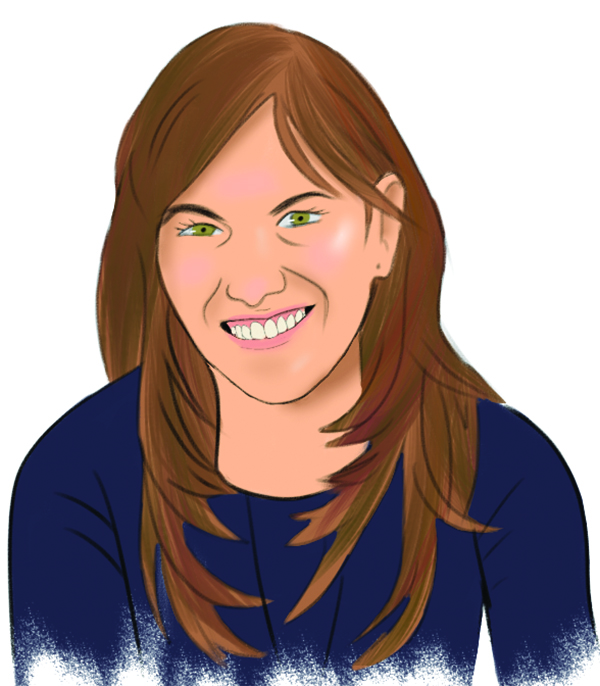
    Dr. Hortensia Soto; Illustration created by Ana Valle.

    In the Beginning

    I want to begin with the story of Agustin Soto and Sara Ramírez, my parents, because their journey, their struggles, their sacrifice, and their work ethic molded me into the person I am today. It’s important that I apologize to my parents because I am omitting their life experiences that occurred before they were married. They both came from well-to-do families; my mom was the tenth child of eleven children, and Daddy was the oldest of eight children. They each had their own adventures; my mom recalls climbing trees, going to serenatas, [1] while learning all the skills needed by Mexican women of that era, which included grinding corn for the masa, [2] cooking, sewing, raising children—all things to be a “good wife.” Daddy’s life consisted mostly of work; at age six he plowed with an ox, and at the age of eight he spent nights out in the fields, where the corn bundles scared him. He credited his Padrino [3] Jesús, who was very patient with him, for making the work bearable and fun.

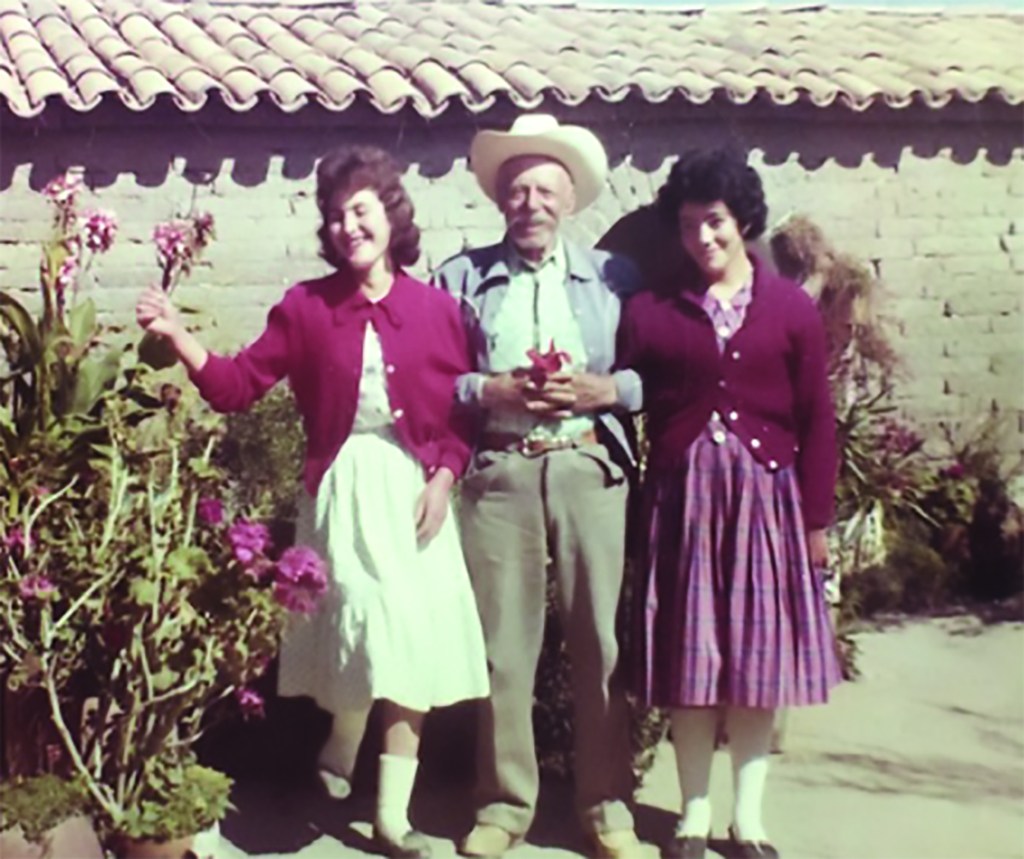
    Daddy, Tía Tila, Padrino Pablo.

    My daddy Agustin and mom Sara married on October 4, 1962, in Santa María del Valle, Jalisco. They lived next to my paternal grandparents where Daddy farmed and raised pigs with his dad. While they each had a wealth of life skills, they only had a third-grade education. Their marriage started off fairly normally until my paternal grandfather was shot and killed. After this tragedy, my paternal grandmother sold everything, including Daddy’s animals, and moved to Nochistlán, Zacatecas and left my parents with nothing. This dramatically changed the direction of my parents’ lives.

    Mother, my maternal great-grandfather Manuel, and Tía Eva.

    My parents then moved to Belén del Refujio, Jalisco where Daddy worked for a farmer. This is where my older sister, Eliasar, and I were born. Photos below show the two-room home where I was born; the piece on the end is the hogón, [4] where my mom cooked. In this adobe home, my mom saw snakes coming through the roof as my sister and I slept. My parents suffered much during this time. They struggled to feed us, and Daddy almost died because he became ill and didn’t have money for a doctor. He used to talk about his sandals that were held together with corn husks. Hunger led us to emigrate.

    The house where I was born—one door went into the bedroom and the second to the kitchen; I visited it for the first time when I was 15.
    I am on the far right, mom on far left, boy in blue is brother Mauro. Others are cousins and Tía Anjelina (Daddy’s sister).

    My maternal grandmother’s dying wish was for us to move to the United States, where my mom had a lot of family members. My mom’s brother, Tío Lupe, who lived in Nebraska, contracted the coyote [5] and we were set to cross the Rio Grande without either of my parents knowing how to swim. It was 1967, and I was a little over a year old and Eliasar was three years old. Daddy crossed first, with his total savings of $7.00. [6] My mom was supposed to be next, but fear set in and she refused to cross. This resulted in the three of us staying with the coyote’s grandmother for ten days at the border; there I learned to walk, while Daddy waited in Nebraska for the coyote to figure out how to get us to him without having to swim across a river. For $30.00, the coyote arranged for my mom to use a woman’s passport and for Eliasar and I to use passports from another couple’s daughters. Although there were passports for all three of us, crossing the border had to be done in shifts—first my mom and then me and my sister. The coyote took my mom across and left her at a theatre (this was her first time at a theatre!) and instructed her to stay there until someone came by to notify her that we would be arriving. With fear that she would never see us again, my mom waited about five hours. Finally, a young man arrived and escorted her to the back seat of a car, where my mom was uncertain of what would happen. Then in the rear-view mirror, she saw a car emerge, the coyote walked out, opened the door, and there were her girls. After driving straight through, only stopping once in Colorado for a meal, we reunited with Daddy. My mom and dad raised us to always give thanks to God for the people who have helped us; Tío Lupe and his family are on that list.

    Mother and Daddy after reuniting in U.S.
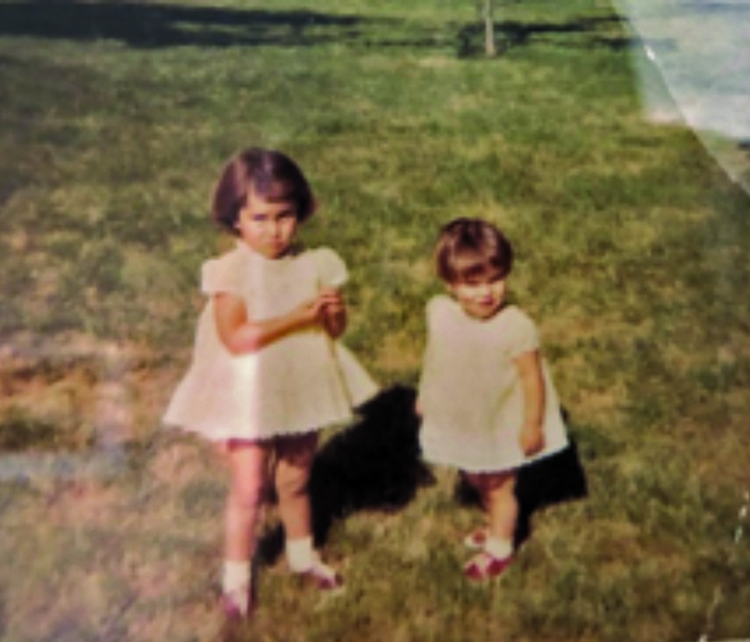
    Eliasar and me after arriving to U.S.
    Agustin Jr. on the way.

    We settled in Morrill, Nebraska, where the population numbers fewer than 1,000. Daddy had odd jobs and one of his first big jobs was helping to build the Morrill Golf Course. His bosses were impressed with his attention to detail, his ability to learn quickly, and his innovativeness so much so that they recommended him to a local farmer, Art Dienes, who was seeking a hired man. Art wasn’t keen about hiring Daddy because he didn’t speak English, but my Dad said he would work for free for two weeks, and then Art could decide whether or not to hire him. At the end of the first week, Art decided to hire him. This job allowed us to move from a house that shook when the trains went by to a house where Daddy made all of us sit in the car for fear that the house would explode when he lit the pilot to the heater. We later moved to another two-room house. I remember this house fondly because Eliasar and I played in a run-down school bus that sat behind the house. By this time, my brother Agustin Jr. was born, and we discovered that we had been reported to the immigration authorities. Art helped Daddy get a lawyer, who let us know that we couldn’t be deported because Agustin Jr. was a U.S. citizen.

    Me and my mom on my second birthday in the house that Daddy feared would explode.

    After a long wait and another addition to the family (my brother Ernie), we finally obtained our green cards and were allowed to live in the U.S. legally. By this time, I was in kindergarten. Also, when my mom was pregnant with Ernie, Art and his family moved to a smaller house so we could live in the main farm home. This was a house with indoor plumbing, a restroom, a phone, a front and back porch, an upstairs, a dining room, and a big yard. According to my five-year-old eyes, we lived in a mansion. We moved out of that house when I was 12, but to this day when I dream of home, it is that house. Art helped Daddy start farming on his own, shared his equipment with Daddy, and was instrumental in Daddy buying our farm (this is a magical story). Art became our grandfather we called him “el patrón”—not in reference to being the “boss,” but to the patron saint who saved us. He and his family are on the gratitude list.

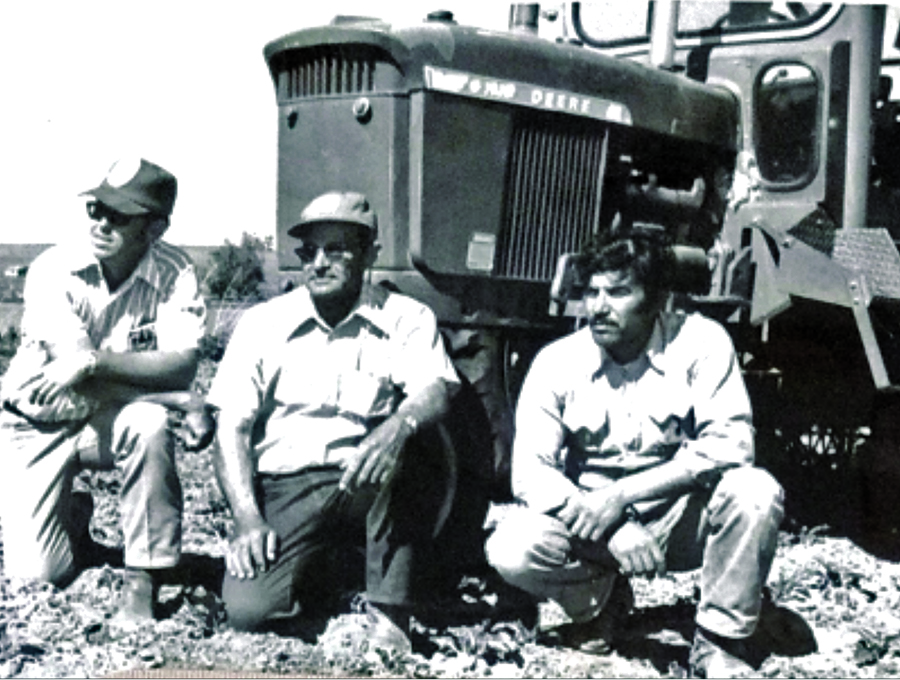
    Another farmer, Art, and Daddy.

    Hortensia’s Early Years

    I did not know English when I started kindergarten, but with the most compassionate memories. I clearly remember learning the word “scissors” when my kindergarten teacher taught me how to cut because I didn’t know how to hold scissors. My first-grade teacher left my name up on her door so I could go to it to see how to spell my name—it took me a while to learn this task. She didn’t make a big deal about it; she let me do what I needed in order to learn. That year, Daddy also discovered that I had memorized my reading books and didn’t actually know how to read. He quickly put a stop to that by randomly selecting words for me to pronounce, covering all the other words, and making me sound out words one at a time. During this time, he attended night school to learn English thus he was able to help.

    I have two very vivid and important memories from second grade, one in spelling class and one in math class. After spelling “lace” correctly out loud, my teacher asked me to use it in a sentence. Knowing that I was at a total loss, she added “it’s on your dress.” My mom made all my clothes and there were lots of things on this dress, such as buttons, polka-dots, and a zipper. None of these resulted in a positive response as I pointed to them, so my teacher hinted that it was at the bottom of my dress. I incorrectly translated bottom to mean under, so I slightly lifted my dress to show my slip, but with excitement my teacher commented: “you are touching it.” That day I learned the definition of lace and I also learned what patience looked like. The second memorable experience from second grade was the day we were exposed to exercises that looked like this:

    3 + 5 = ☐, 3 + ☐ = 8, ☐ + 5 = 8, 11 – 7 = ☐, 11 – ☐ = 4, ☐ – 7 = 4.

    I struggled with exercises of the last two types, but I found them intriguing. I wondered how one would get the answer without trial and error, which is what I did. Imagine my excitement when I learned algebra—memories of these exercises flooded my brain and I was in awe.

    Second grade might have been when my passion for mathematics began. Most people who know me know that my fifth-grade teacher transformed my life. The teacher kept me in during recess to catch me up so I could move to the “high group”—the group of students who were more successful academically. I was not excited about this because the “high group” did not have any Hispanics and according to me, since they could afford to be in band, they were also rich. I cried as my teacher walked me to the “high class,” the class for the high achieving academic students; she hugged me and said that I would be just fine. I was worried about feeling out of place, but my first class with the “high group” was mathematics and she was right, I did just fine. By seventh grade, I decided that I wanted to attend college. Knowing that this was only feasible if I got scholarships, I decided that I would work towards becoming valedictorian of my class.

    Even though they were different worlds, it is difficult to separate my educational experiences from my home experiences, so I will try to weave the two worlds. While most kids yelled with glee at the end of the school year, I cried because I hated summer. Yes, I hated summer! At the age of six, I started working in the fields, hoeing beets, weeding beans, and even weeding cornfields. I did this until I went away to college. My summers consisted of getting up at 4:30 am, packing a breakfast, getting the younger kids ready, helping my mom prepare lunch, and going to the fields. We generally arrived between 5:30 and 6:00 am and ate breakfast there; the kids who were less than six years old stayed by the car. My mom was creative and covered the windshield of the car with a blanket and left the doors ajar, so it would stay cool. We went home for lunch at noon, washed the dishes, and by 2:00 pm we were back in the fields till about 7:00 pm; sometimes we had to go irrigate the fields after this. It wasn’t unheard of for us to have dinner at 9 pm. This was our routine six days a week, starting mid-May until school started in August.

    In the fall, we had other harvest-related work; in the winter we mostly helped to separate calves from the cows or move cattle. I didn’t complain much about the work in the fall and winter, but of all of us nine kids, I complained the most about the summer work. It seemed that every farmer north of Morrill wanted us to work their fields, and I wondered why their kids didn’t do the work. My mom frequently reminded us (mostly me) to be grateful because these farmers were trying to help us; they knew that we needed work. My parents worked so hard, especially in the summer; I can only imagine what time they arose in the morning. The one benefit of working in fields was that it gave me time to daydream. I daydreamed of becoming valedictorian, going to college, becoming a lawyer, and helping Daddy pay off the farm. Unlike other kids, I didn’t learn to swim, play sports, go to the movies, go to birthday parties or have friends spend the night. I learned to work.

    Given that I didn’t have a social life, it was easy to bury myself in learning during high school, and my mathematics class quickly became my favorite class. Math was the last homework that I worked on—it was dessert. I had the same mathematics teacher all through high school, and his pedagogical knowledge was ahead of his time. He rarely lectured; instead, we worked in groups on scaffolded packets where we discovered the big ideas. Sometimes, we had oral exams where the teacher probed further into our understanding. I loved my “aha” moments, where I connected concepts and explained them to others. I got pretty good at explaining and if there was a need for a substitute teacher, I was asked to teach the mathematics classes for that day. This seemed crazy to me because it meant missing other classes, but I loved it. For me, mathematics was one big puzzle and each class offered more pieces to the puzzle. My teacher was very supportive and encouraged me to pursue mathematics as a career, but I wanted to be a lawyer and most importantly, I hadn’t yet convinced my mom that it was OK for a young woman to leave home to attend college. This was a huge obstacle!

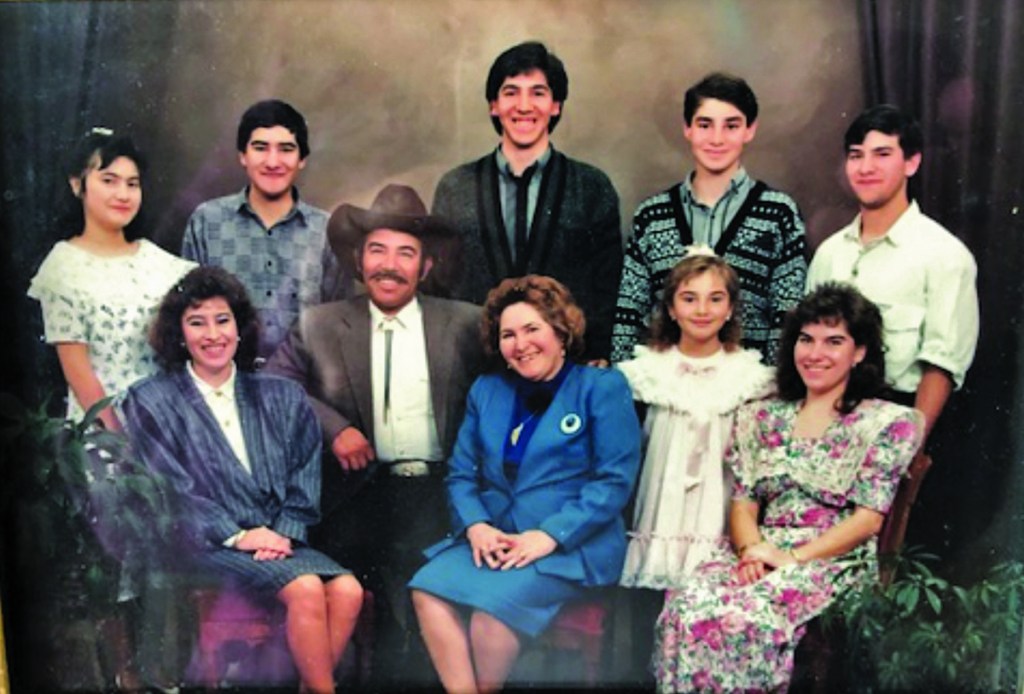
    Top L to R: Diana (deceased), Ernie, Agustin Jr., Bruno, Mauro. Bottom L to R: Eliasar, Daddy, Mother, Sarah, and me. I have another sister Norma who died when I was 12.

    My mom’s belief was that girls stayed home and learned how to become a wife, until they got married. As I got older, I understood this, but as an adolescent, I fought with her quite a bit about this issue. I was stubborn and determined to go away (far away) to college —I would not work in the fields for the rest of my life. Art had Daddy’s ear and shared the importance of a college education. In fact, Art and a woman whose house we cleaned set up a scholarship for Eliasar to attend one of the local community colleges (another magical story). This was my breakthrough; in my junior year, Daddy said that if I started off at a local community college and lived at home, then he would help pay so that I could finish my bachelor’s degree. I agreed but knew that this would be a financial burden because by this time there were nine kids in my family. Thus, I continued working on my valedictorian goal and decided that I would become a naturalized citizen when I turned 18 so that I could qualify for Pell Grants. [7]

    I graduated high school as prom queen, president of student council, and valedictorian, and that summer Eliasar and I became naturalized citizens. My first two years at Eastern Wyoming College (EWC) were completely paid for with scholarships. I was on my way to becoming a lawyer. As a side note, all my siblings have a college education. When my youngest sister, Sarah, graduated from college my mom looked at Daddy and said, “We did it; they all have an education.”

    Hortensia’s College Life

    At EWC, I started off as a political science major and was the only mathematics tutor. After completing first-semester calculus, I met with my advisor to discuss courses for the following semester where I planned to enroll in Calculus II and the following conversation occurred.

    Him: Calculus II isn’t a requirement for a political science major.
    Me: But we didn’t finish the book.
    Him: Don’t you think you should be a math major?
    Me: Yes, I do.

    After graduating from EWC, I moved away to start summer classes at Chadron State College (CSC), where I planned to become a high school mathematics teacher because I had no idea what else one did with a mathematics degree. With new scholarships that covered tuition at CSC, I just needed rent, food and book money, so within a week I was a Pizza Hut waitress. At CSC, I also graded for the most amazing and supportive advisor and teacher, James Kaus, who is on the gratitude list. In his classes, he challenged us, we struggled and worked together, he patiently asked questions, and we learned. One day, while working on a topology problem in his office, he remarked, “You should get a PhD” I asked, “What’s a PhD?” I don’t remember doing anything special—I was just working away on the problem that I asked him about. I valued and trusted Mr. Kaus—if he said to do something then I did it. I didn’t even know what a PhD was so I didn’t have any goals on getting one. I only wanted one when he suggested I get one, when I realized he believed in me.

    I student-taught, but I knew that wasn’t what I wanted to do. So during a job fair at CSC, I visited Mr. Kaus and told him about my uncertainty of teaching high school. He suggested that I apply to CSC’s master’s in mathematics education program, so I did. I received a position as a Teaching Assistant that included tuition and a $3,000.00 stipend a year. This wasn’t enough money to cover my living expenses, so I tutored on the side and I also worked at a local store on the weekends. Teaching collegiate-level mathematics immediately felt right—I found my passion. I loved my time at CSC, because I got to spread my wings. I am also very proud of my CSC education and that my parents didn’t have to pay for any of it. If I needed fun money, Eliasar was my bank. Eliasar was working at an insurance agency at the time. We were raised with the philosophy that the more you give the more you get. Eliasar claimed that every time she lent me money, she would get a raise or bonus. After earning a bachelor’s and master’s in mathematics education, I was in debt $400.00 to her … interest-free. She is on my gratitude list.

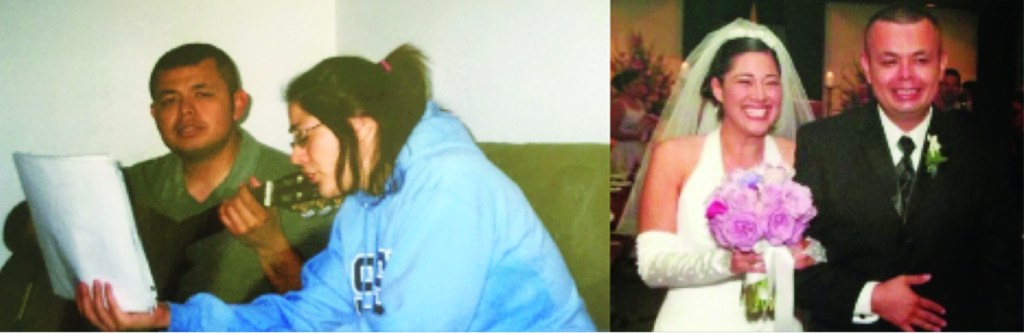
    Upon graduating from CSC, I applied for a job as the Director of the Mathematics Learning Center at the University of Southern Colorado (USC). One of the interview questions was about where I saw myself in five years. I replied, “working on my PhD.” I got the job, and this is where I met my future husband, who was a statistician in the department. Shortly after getting married, we moved so I could pursue my PhD in mathematics education at the University of Arizona (UA).

    Struggle. For some reason at UA, I immediately felt inferior. It seemed that all the other graduate students came from elite schools and that I was under-prepared for what lay ahead. Some of these students had already earned a PhD in another country. Every mathematical concept seemed so foreign to me. For the first time in my mathematical life, I was scared that I wasn’t smart enough, and I lost all my confidence in my ability to learn mathematics. The fact that by the third week some of the courses dwindled down in size, scared me even more—if the smart people dropped the course, what was I doing there? Although the graduate students supported one another, I felt no support from the faculty, and they didn’t seem eager to create a rapport with any of us. One time when I asked a question in analysis, the instructor replied, “All I can do is say it louder…” and then he said it louder. When I went to his office to ask about a homework problem that had been marked incorrectly, he said, “I don’t really think you know what you are doing so, I didn’t read it,” as he flung my homework back to me. After 18 years of having some of the most compassionate, patient, and encouraging teachers, I was at a place where teachers quickly dismissed my questions. I did not pass one of the analysis qualifying exams and, thus I had to leave the program. My advisor helped me to find a new program in mathematics education and it happened to be at the University of Northern Colorado (UNC). I left UA with a second master’s in mathematics, deflated, embarrassed, feeling less than human, and certain that I didn’t know any mathematics. It took me years to get over this.

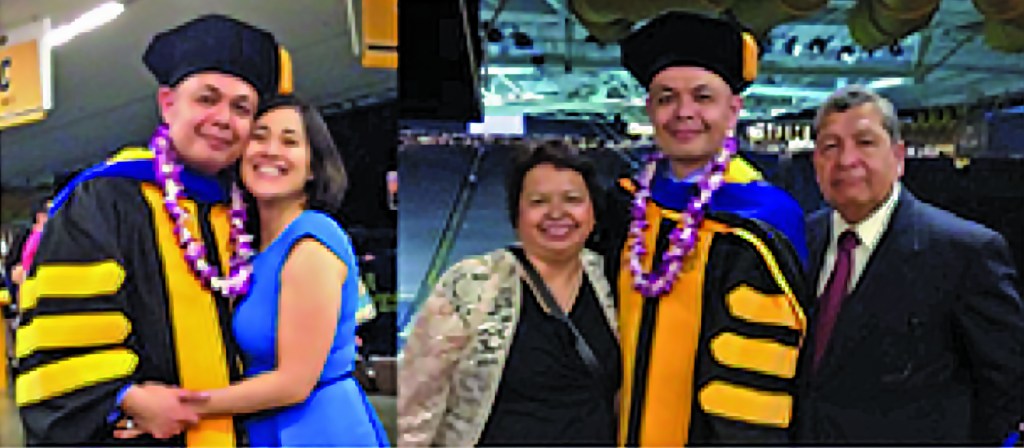
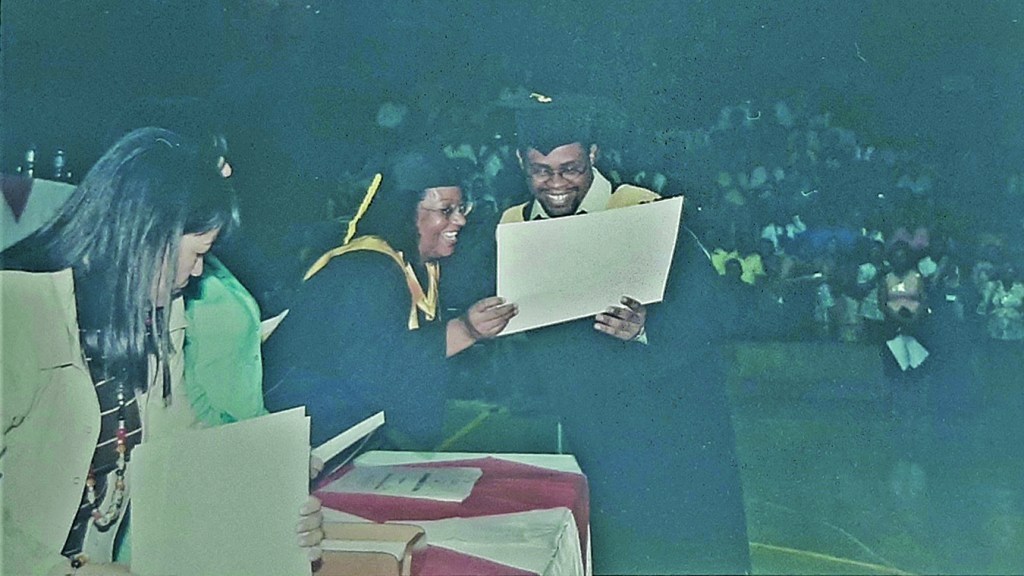
    Resurrection. The first faculty member that I met at UNC was the graduate advisor, Dr. Ricardo Diaz (also on the gratitude list). On our first meeting, we were scheduled to go over courses that I had completed, and I was unconfident and full of shame. His first words were, “you have a very strong math background.” These words brought a little glimmer of hope that maybe I could earn a PhD. I cruised through the program and surprised myself at what I knew. All of a sudden, I had ideas, answers, and creative proofs—my confidence came back. Yes, I struggled with some concepts, but I wasn’t afraid to tinker and my instructors were helpful, pushed me, and had faith that I could do it. In retrospect, I did learn a lot of good mathematics at UA and developed as a mathematician, though it wasn’t clear at the time. Most importantly, at UNC I learned how to conduct mathematics education research. I defended my dissertation shortly before my thirtieth birthday, received the Dean’s Citation for Excellence Award at graduation, and delivered the commencement address. I did it!

    Hortensia’s Professional Life

    My professional life has been full of wonderful surprises. After completing my PhD, I started as an assistant professor of mathematics at USC and was accepted as a Mathematical Association of America (MAA) Project NExT fellow. This is a two-year professional development program for collegiate faculty that offers suggestions on integrating student-centered teaching and learning, writing grant proposals, and maintaining a research program. As part of this program, the second-year cohort creates and offers sessions to the new cohort. At the end of my first year, one of the project directors, Chris Stevens, asked if I would organize the sessions for the new cohort. I was stunned and honored that of the 70+ fellows, she asked me and, of course I said yes—which is what Joe Gallian taught us as part of Project NExT. This is how I found my professional home. In 2002, I became the first Project NExT fellow to serve on the MAA Board of Governors. I can still remember seeing Martha Siegel (Secretary), Anne Watkins (President), and Tina Straley (Executive Director) on the stage running the show. It was the first time I saw women with such power and authority—I was in awe. Martha and Tina quickly took me under their wings and invited me to serve on committees, some of which I was not qualified for, but they believed in me. The MAA community seemed to see something in me that I didn’t know I had: leadership skills, which they nurtured and continue to nurture. I am beyond grateful for all the opportunities that the MAA has offered. It has been a pleasure to serve on the various committees, as the Governor for Minority Affairs, Associate Treasurer, and now as the Associate Secretary. In fact, I am the first female, first Hispanic, and first mathematics educator to serve in the role of Associate Secretary. I truly LOVE this community, which consists of so many friends.

    Teaching with an embodied activity.

    After spending nine years at USC, now known as Colorado State University—Pueblo, my then-husband and I decided to leave USC because I wanted an opportunity to conduct more research and I had a high teaching load there; thus, I began to apply for jobs. UNC was also hiring, but I did not apply because I was certain that they wouldn’t hire one of their graduates. Later they called me, asking me to apply, and I got the job. The downside was that I had to give up tenure and rank, but I did get three years of service towards promotion—this was very stressful. I spent the next two years working till 2 am and sacrificed family time. Teaching 18 credits a year, conducting my own research, and guiding dissertations took a toll on my marriage. I got divorced (so grateful that we remain friends), became a single mom, and delved into work. My research on the teaching and learning of complex analysis along with my work on embodied cognition began to thrive. My graduate students are publishing in top-tier journals—professional life is good.

    My work has been recognized by both UNC and the MAA. At UNC, I was the recipient of the College of Natural and Health Sciences’ Excellence in Faculty Research Mentor at the Graduate Level and the Excellence in Service Award. I am also the recipient of the Burton W. Jones Distinguished Teaching Award—MAA Rocky Mountain Section, and the MAA Meritorious Service Award. I am also the first Hispanic person to receive the MAA Deborah and Franklin Tepper Haimo Award for Distinguished College or University Teaching of Mathematics. In fall of 2020, I started as a tenured full professor at Colorado State University. My work has paid off—I am so grateful.

    Conclusion and Advice

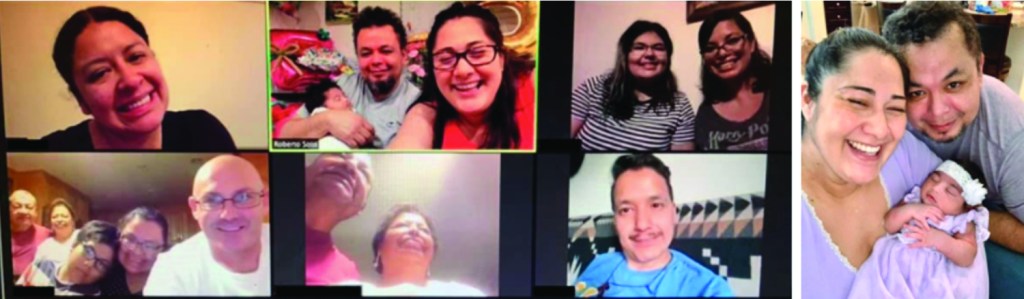
    Although I didn’t know it growing up, I am blessed to have a big family. My parents instilled in us a work ethic and a strong faith in God. From this story it is probably no surprise that I am a daddy’s girl—he passed away in 2017 and I miss him dearly. He was the first to hear of any of my successes. My son Miguel Agustin Johnson is my greatest gift. We are very close, and I treasure any time with him because he is pure love.

    Daddy and me on his 74th birthday.

    My advice to students is do not be afraid to have dreams that seem unreachable. The people who believe in you will emerge and push you to become more than you dreamed. My advice to mentors is that sometimes it is the little acts of kindness that make the biggest difference. Do not be afraid to be a human being and vulnerable with your students. Have high expectations while showing patience and compassion.

    Me and Miguel.

    [1] Serenatas are musical performance delivered in honor of someone or something.
    [2] Masa is Spanish for dough that is traditionally made of flour used to make tamales, tortillas, and many other Mexican foods.
    [3] Padrino is godfather in Spanish.
    [4] Hogón is the Spanish word for bonfire.
    [5] A coyote is a common term for a person who is hired to assist people to cross the U.S.-Mexico border.
    [6] For reference, we note that based on inflation rates in the United States, $1.00 in 1974 is approximately the equivalent of $5.56 in 2020.
    [7] Pell Grants are a subsidy the U.S. federal government which provides financial support for students who need it to pay for college.


    Previous Testimonios:

    • Dr. James A. M. Álvarez
    • Dr. Federico Ardila Mantilla
    • Dr. Selenne Bañuelos
    • Dr. Erika Tatiana Camacho
    • Dr. Anastasia Chavez
    • Dr. Minerva Cordero
    • Dr. Ricardo Cortez
    • Dr. Jesús A. De Loera Herrera
    • Dr. Jessica M. Deshler
    • Dr. Carrie Diaz Eaton
    • Dr. Alexander Díaz-López
    • Dr. Stephan Ramon Garcia
    • Dr. Ralph R. Gomez
    • Dr. Victor H. Moll
    • Dr. Ryan R. Mouruzzi, Jr.
    • Dr. Cynthia Oropesa Anhalt
    • Dr. Omayra Ortega
    • Dr. José A. Perea
    • Dr. Angel Ramón Pineda Fortín

    Brian P Katz (BK)

    April 15, 2023
    Testimonios
  • Show me the money (or at least where it came from)

    Show me the money (or at least where it came from)

    By Tarik Aougab and Marissa Loving

    Disclaimer: While we planned a Summer@ICERM program with other people, the opinions expressed in this blog post reflect only the views and experiences of the two authors. 

    We’re writing this post for two reasons: 

    1. We dedicated several weeks during one of the busiest times of the year (towards the beginning of the Fall 2022 semester) to crafting a carefully written proposal for an undergraduate summer research experience at the Institute for Computational and Experimental Research in Mathematics (ICERM). After initially accepting our proposal, ICERM rescinded their acceptance when we said that we were not comfortable with the program being partially funded by the National Security Agency (NSA). We don’t want others to waste the same valuable time and effort that we did and so we’re writing this as both a public service announcement and a warning.  
    2. We are incredibly frustrated. We feel like we were treated callously by a major mathematics institute that couldn’t care less about our time or the opportunities our program would have provided for historically excluded students and mathematicians. So, to be completely honest, we are writing this because ICERM acted like our concerns about accepting NSA funding (and how that decision would impact both our goals and our integrity) were meaningless and silly, and now we want to be heard. 

    After giving a very brief summary of the events as we experienced them, we thought the most effective way to share this story would be with receipts – quotes from the email back-and-forth we had with an ICERM representative. We have chosen not to reveal the identity of the person with whom we corresponded, as we are quite certain that these replies reflect the collective position of the ICERM board, as opposed to the ICERM representative’s personal opinions on the matter. We want to emphasize that the purpose of this blogpost is to highlight how normalized it is to accept funding within mathematics without being critical about where that funding is coming from or how it has been obtained. Thus, this recounting of events is not intended to target any one individual.

    We also want to acknowledge that because of how pervasive and unquestioned the use of national security, defense, and military funding in mathematics is, it makes sense that ICERM wasn’t prepared for us to say that we will not accept funding from an agency that proliferates violence, racism, and oppression on a global scale. However, what truly shocked us was how little ICERM was willing to engage with us on this incredibly important topic, or to relinquish any control or authority over the funding process.

    We’re led to believe that ICERM’s board was afraid to set a precedent in which organizers have any say whatsoever over major funding decisions, even when the source of the money impacts the capacity of the organizers to carry out the very programming they approved of in the first place. But we’ll let readers decide this for themselves.

    After submitting our proposal, we received the good news that ICERM chose it and was ready to move forward with us in planning the Summer’s programming:

    ICERM’s Educational Advisory Board (EAB) has recommended we move forward with your proposed Summer@ICERM program for 2024. Congratulations! We look forward to working with you…

    …We are considering applying to the NSA for supplemental funding for faculty and student stipends for Summer@ICERM. Would you allow us to share your Summer@ICERM proposal with them as part of a future (October 2023) grant application?

    We welcome your suggestions on how best to recruit a diverse cohort of undergraduates!

    Please let me know if there are any questions.

    We replied to this email and explained that we weren’t comfortable accepting NSA funding for this programming. Both of us have publicly pledged to avoid this sort of support with the Just Mathematics Collective’s campaign “Mathematics Beyond Secrecy and Surveillance”. We asked if there was any leeway when it came to this plan; in response, we were sent a breakdown of ICERM’s budgeting for the program, and the proposal that we (as organizers) could be paid using other moneys but that there was no way to avoid NSA funding for student stipends and other costs:

    [ICERM] could avoid paying organizers with NSA funds; what [we] can realistically get from NSA is less than what [we] pay for student stipends, room, and board.

    We were disappointed by this and felt that it represented a fundamental misunderstanding of our objection to accepting NSA funding. The point here is not to keep our individual hands clean, but to prevent the NSA from using us and our students to launder its reputation and ingratiate itself with the professional mathematics world (guaranteeing its continued unfettered access to new talent and brainpower). 

    Most importantly, the program that we proposed was designed explicitly for students from groups that have been historically excluded from academic mathematics. Our aim was to curate a healthy mathematical space for people who come from the very communities targeted most violently by the cops and the national security state. We would never have been able to facilitate conversations about the systemic barriers in our society (cisheteropatriarchy, white supremacy, xenophobia, etc) and the way they shape the mathematics community without dying inside at the thought of our students unknowingly playing the role of tokens for the NSA’s whitewashing goals. 

    So, we replied with some concrete suggestions and some commitments to help ICERM find alternative funding:

    Thanks for your prompt response!

    We have a few questions, roughly sorted into two categories.

    1. (Other funding sources) We were wondering if there are any other sources/agencies from which we can solicit funding. For example, could ICERM seek supplemental funding from the NSF via an REU grant? Or could ICERM submit an official inquiry with the Sloan foundation or Simons foundation? The Sloan foundation appears to be a particularly suitable funding source, as our central scientific mission for Summer@ICERM 2024 closely aligns with their stated commitment to equity, diversity, and inclusion. We are happy to put together funding proposals, if that would be helpful. 
    1. (Decreasing REU costs) In 2022, the Summer@ICERM program supported 6 TAs. We are confident that we can provide students with the same level of support with 3 TAs alongside the faculty in residence. Additionally, does the program length reduction from 8 weeks to 6 weeks help with the budget in any way? We expect that some costs will remain the same (flights and stipends, for example), but perhaps the shorter time frame reduces the cost of room and board for students, TAs, and faculty. 

    At the end of the day, we are not comfortable having our intellectual merit used in a proposal for NSA funding, or having our broader impacts tied to this agency. One of our goals for the program is to coauthor research publications with our REU students, and those papers would need to acknowledge the NSA if any of the authors accepted their support. Bolstering the profile and reputation of the NSA in this way is antithetical to our professional goals and the work we hope to accomplish that summer. 

    We appreciate your continued support and flexibility!  

    The response we got (a couple weeks later) was curt, frustrating, and did not engage with any of our suggestions:  

    [Our] understanding is that your organization of the 2024 Summer@ICERM program is contingent on ICERM pledging not to use funding from the National Security Agency to support any part of the program.  

    …[Our] responsibility is to secure funding that allows us to pursue our scientific and educational missions. [We] cannot restrict our funding sources to align with organizers’ convictions. Indeed, the pledges of the “Just Mathematics Collective” are incompatible with our legal responsibilities. The Solomon Amendment requires educational institutions receiving federal funds to permit campus military recruiting.

    [We] assume that you’d like to withdraw your Summer@ICERM proposal under these circumstances.

    Our next reply was…extensive. It was our final attempt to clearly outline to ICERM our reasons for declining NSA funding. It also reflects the enthusiasm and passion we felt about the program we proposed to run in Summer 2024:

    Thanks for the reply and for clarifying where the board stands on this issue. We are disappointed by this response; there appears to be a refusal to address any of the suggestions made in our previous email, including the offers to help ICERM seek funding elsewhere. 

    Additionally, we feel confused and blindsided by the shift in tone: in your first email, you communicated that the board approved our proposal and that ICERM was “considering applying” for NSA funding – that is, there was a request to use our proposal as part of an NSA grant. We don’t understand why we were asked at all if the only acceptable answer was yes. Additionally, if agreeing to NSA funding was, in fact, mandatory, perhaps this should have been part of the REU solicitation; we would have appreciated knowing this before taking the time and effort to apply. 

    We understand that ICERM has a responsibility to secure funding for programming, but surely there are many ways to go about achieving that goal. We still hope that we can find a way to work together to run an REU in Summer 2024 – however, even if that doesn’t happen, we hope ICERM conceives of its decision to pursue funding for our program from the NSA as a choice, and a choice it could decide not to make. This view of the situation is different from what we took away from your last email: that ICERM’s hands are tied, and that its responsibilities to the law and to its program participants logically and unambiguously force it to work with the NSA to fund our REU program. 

    We understand that ICERM is subject to many laws and regulations. Certainly, none of us know firsthand the complexities of running such a large institute. Having said that, we are not asking ICERM to bar all military recruitment on campus, and we suspect ICERM wouldn’t have the authority or the capacity to do this anyway. At least in our understanding, the Solomon Amendment does not force ICERM to seek out funding from military agencies in all of its programming, correct? Surely, there are many grants that ICERM chooses to apply for, and many grants it chooses not to apply for.

    Therefore, this response feels like ICERM is framing a choice as a requirement. After consulting with several mathematicians occupying high positions at institutes of a similar size and stature to ICERM, we believe that there are other options for securing the funding the NSA would provide. But if ICERM decides that it absolutely must secure NSA funding for its Summer@ICERM program, then you must rescind your approval of our proposal. We are not withdrawing. We chose to apply to Summer@ICERM because we know from experience that we can run a wonderful, fulfilling, and excellent program there. It is simply that our proposal – which aims to center the experiences of students and mathematicians from groups historically excluded from academic mathematics – would fail on its own terms if, while carrying it out, we were also inadvertently bolstering the reputation of an agency complicit in the criminalization of the communities of those very same students. Therefore, if ICERM chooses the NSA here, it must also choose to reject our proposal.

    We want to be 100% clear: we are not asking ICERM to align with or support the Just Mathematics Collective’s aims and ethical principles. We are also not asking ICERM to stop pursuing NSA funding for its other programming. We are merely arguing that if our program is partially funded by the NSA, it will be a weak and ineffectual program, as we would not be in a position to facilitate discussions exploring equity and justice in mathematics with our full hearts and minds. 

    Members of our organizing team hold identities that are marginalized within mathematics – our own lived experiences give us a deep understanding that in most academic spaces, many mathematicians have to sever ties between their personal and professional identities. A central piece of our program would be showing our students that, contrary to how they may feel in a conventional mathematics classroom, there exist spaces where they do not have to leave important parts of their identities, cultures, and histories at the door to do research-level mathematics. This includes the realities of criminalization and over-surveillance they and their families may experience at the hands of agencies like the NSA, and the beliefs, convictions, and commitments that come with such experiences. We hope to convey to our students that their mathematics can be truly grounded in their whole personhood. We cannot in good faith ask our students to embark on this journey with us while not practicing what we preach. So, once again, this is about how we can make our program as strong and impactful as possible. We do not need the politics of ICERM to perfectly align with ours. We have merely suggested several cost-saving ideas, ways to pare down the program if necessary, and possibilities for alternative sources of funding so that we can successfully organize the kind of program that you approved. 

    Again, it will be very disappointing if we cannot reach an agreement around this, as we know that our program has the potential to have an incredibly positive impact on us, our graduate student TAs, and our undergraduate participants. Moreover, we do sincerely appreciate the pressures that must come with heading up such a big enterprise, especially one with a reputation for such high quality programming. However, if ICERM is unwilling to seriously consider our other suggestions for cost-cutting or look into alternative funding sources, then ICERM should rescind its offer to us to run the 2024 Summer@ICERM program.  

    So, there you have it. The only replies we received after this matched the others in their  brevity and failure to engage with any of our concerns. We were told that ICERM reposted its solicitation, and that was the end of our correspondence. 

    We hope the email exchanges made clear that we appreciate the challenges that large math institutes face as they navigate a landscape in which funding is hard to come by. This is why we offered to work closely with ICERM to find a mutually agreeable resolution – even to the tune of doing the legwork to find alternative sources of funding, as well as taking on the lion’s share of labor to apply for other grants. We also pointed out extremely small and simple changes ICERM could make to the way it solicits these sorts of proposals which would help ensure it doesn’t find itself in a similar situation in the future. 

    We hope this post moves the needle, even a little bit, towards the direction of no longer treating ethical funding questions as irrelevant, outside the scope of our everyday mathematical lives, or answered before asked. The NSA, the Department of Defense, the Institute for Defense Analysis, and the rest of the military industrial complex have colluded with our political leaders to hold the mathematics community hostage. At the same time as legislatures slash public funding for higher education and basic research, military agencies offer what amounts to a minuscule fraction of their ever-increasing budgets to researchers desperate for support. We’re told by our leaders that the only way we can hope to support historically excluded students and their communities is to collaborate with the very institutions responsible for enforcing their oppression. We need to start demanding more from our community and from the people within it who we’ve chosen to represent our interests.

    Wong Tian An

    March 27, 2023
    Institutions, Just Mathematics Collective, NSA
  • Testimonios: Dr. Angel Ramón Pineda Fortín

    Testimonios: Dr. Angel Ramón Pineda Fortín
    Dr. Angel Pineda; Illustration created by Ana Valle.

    The Grandmothers (Abuelitas)

    My personal mathematical story begins with two women who changed our family history. They supported their children to be educated in ways that no one in their family had been before. My maternal grandmother (abuelita Amada) was a single mom who raised two daughters (my aunt Gloria and my mother, Guadalupe). Abuelita Amada studied to be a secretary, but chose to support my mother through medical school by having a small store out of her house (a pulperia) in Tegucigalpa, the capital city of Honduras. The entire store was just a small room of her house facing the street, but abuelita’s hard work in that store changed the direction for our family. When my parents were still in medical school, with two young children, we lived with abuelita Amada. Later, when my parents were established doctors and my two youngest sisters were born, abuelita Amada came to live with us. Abuelita Amada dedicated her life to her daughters and her grandchildren.

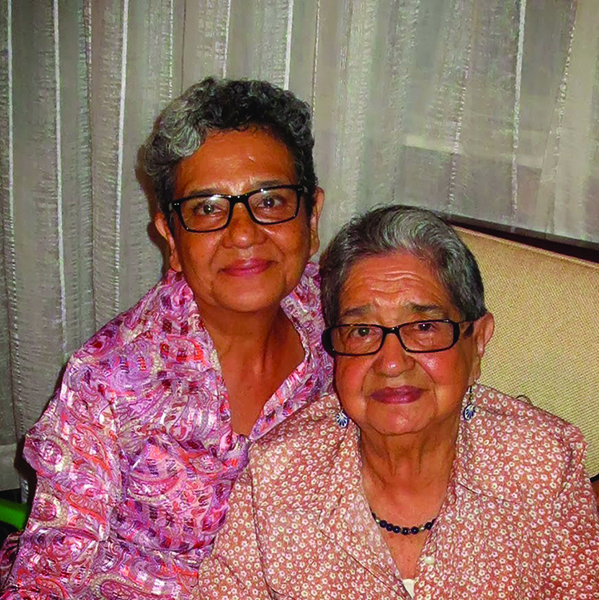
    Abuelita Amada and my mother Guadalupe.

    On my father’s side, abuelita Alejandrina (Nina) had eleven children and lived in San Nicolas, Santa Barbara, a small town in a coffee-growing region of Honduras. My father (Angel Sr.) was the seventh of those children and the first to wear shoes before he was school-aged. He only got to wear shoes that young because he was sickly and abuelita Nina was worried about his health. My paternal grandfather (abuelito Pancho) raised cattle and supported abuelita Nina, but the drive for education came from her. Abuelita Nina’s drive to have her children educated and the sense of family collaboration she instilled in her children created the opportunity for my father to go to medical school.

    Abuelita Nina with 10 of her children. My father, Angel Sr., is standing and the farthest to the right.

    The Parents: Guadalupe and Angel Sr.

    I greatly admire both of my parents. They were the first in their families to go to college, get a post-graduate degree, and study abroad. My mom became a doctor in Honduras and specialized in anesthesiology in Mexico. My dad also became a doctor and surgeon in Honduras and sub-specialized in hand surgery in Mexico. We are largely the product of our
    environment, and my love of learning came from a home where books were everywhere. My parents both encouraged my intellectual curiosity, but also balanced it with a love of sports and travel. At first, this story sounds idyllic, but it is amazing that it came to be.

    My parents (Guadalupe and Angel Sr.).

    My parents married during their second year of medical school and had me in their third. Because Honduras has an open admissions policy to medical school, the classes are very competitive and the completion rate is very low. It took a strong drive for them to both have graduated coming from modest means and while having children (my sister Marcela was born two years after me). By the time my dad went away to school, six of his siblings had already gone to school for trade schools or studied to be teachers. When the first siblings left San Nicolas to study, they left by mule because there was no other way. Even though they didn’t have much money, they rotated giving us a stipend each month. This family collaboration continued with my dad’s younger siblings who also went to college with the support of the older siblings. As a medical student, my dad worked providing healthcare to sex workers. My mom and dad would study with a child in one hand and a book in another. Both through hard work and family support, they were able to succeed. As I reflect on anybody’s success, my parent’s story highlights the importance of having a support structure along with hard work. As with everyone, my personal story began with the generations before me, who shaped me into who I am.

    Life Before Coming to the U.S.

    I was born in Tegucigalpa, Honduras in 1972. From a very young age, I loved school, and mathematics in particular. As a young boy, I would “work” at my grandmother’s pulperia at the register. Arithmetic was my first mathematical love.

    When my parents were medical students, they didn’t have much money, but they always prioritized school. We always went to the best school they could barely afford and sometimes we would be called to the principal’s office because we were late in the payments. My parents always put my sister Marcela and I in bilingual schools so we would learn English, even though they themselves didn’t speak the language.

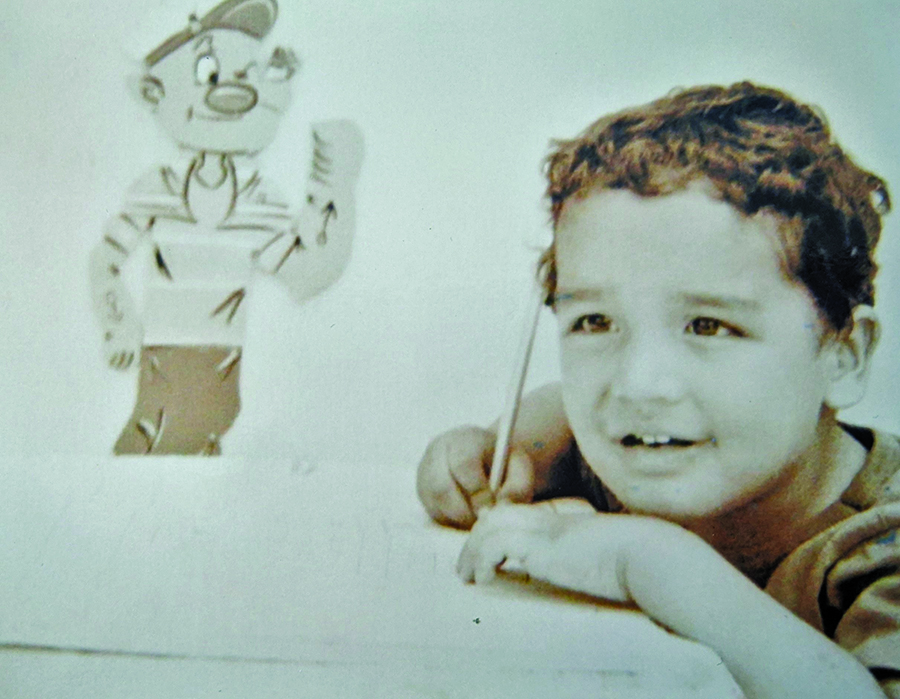
    Kindergarten photo.

    We moved a lot when we were young, settling in San Pedro Sula, Honduras, when they began their medical careers. My parents and my sister Marcela still live there.

    When the time came to apply for college, I didn’t know anybody who had gotten as much financial aid as I needed to attend college in the U.S. Because of that, I started college in Guatemala since that was the best school we could afford. As a long shot, I also applied to colleges in the U.S. that I found had financial aid for foreign students by reading a book at the local library. Lafayette College accepted me and gave me more financial aid than both my parents earned in a year. That library book on financial aid ended up changing the trajectory of my life.

    Life as a Student in the U.S.

    When I first came to the U.S., I had never been to Lafayette College. An uncle picked me up at JFK airport and put me on a bus to Easton, Pennsylvania. On that bus to Lafayette, I had a financial aid letter, but I wasn’t sure it was real. My high school grades were good, but my SAT scores were average for Lafayette. It was hard for me to believe I received that much financial aid.

    At Lafayette, I studied chemical engineering. Chemical engineering is interesting and useful, but I also chose it because if I went back to Honduras it would allow me to get a good job. My favorite college classes were in math. I loved the universality and structure of the ideas. Like so many immigrants, financial security played a big role in my decision of which major to choose.

    Rob Root (my undergraduate advisor and I at the 2010 Joint Math Meetings.

    My time at Lafayette was a time of professional and personal growth. From a professional side, I learned that in the U.S., I could make a good living as a mathematician. I also found that I wanted community service to be a core part of my life. Here is where one of my strongest mentors and advocates on both of those dimensions comes into my story. Rob Root was my undergraduate mathematics research advisor and has become a lifelong mentor and friend. At every stage of my career, Rob has been a voice of wisdom and support who has helped me get to where I am.
    I went on to the University of Arizona to get a PhD in applied mathematics. Arizona has an interdisciplinary program which was a good fit for a chemical engineering student who only had a math minor. Even then, I failed to pass my PhD qualifying exams the first time. If I didn’t pass it the second time, I could not continue in the program. This brings me to what I believe is one of the biggest factors in success: persistence. I worked even harder for the second test and passed the exam. Regardless of the outcome, I just wanted to know I had given it my all.

    After passing my qualifying exams, I was in a course in medical imaging where I saw the professor describe the human body as a mathematical function and imaging in terms of estimating that function from finite measurements. These thoughts combined my love of math with my desire to use mathematics in way that would help society like my parents did in their work in a public hospital in Honduras. That professor, Harry Barrett, eventually became my PhD advisor. I have heard it said that the most important decision you make in your life is choosing your life partner, but the second most important is choosing your PhD advisor. I agree and I feel fortunate to have picked Harry. Both as a mentor and a friend, he is an extraordinary person who shaped my approach to science through his combination of theory and practical application; combining the aesthetic and functional beauty of mathematics.

    Harry Barrett (my PhD advisor) and I in his house in Tucson in 1997.

    Like most people in a PhD program, I struggled at times, but a constant was Harry’s belief that all of his students, with enough time and support, could do great work. This belief in his students is something I internalized and try to impart to my own students today. I particularly have this view for students who underestimate themselves. Unfortunately, underrepresented students are often overrepresented in having this mindset.

    Professional Career

    After graduating with my PhD I went on to work as a postdoctoral fellow at the Radiology Department at Stanford University. It was a wonderful experience where I learned to apply the theory I knew from my PhD to clinical problems bringing me closer to patient care than I had ever been. In one of the projects, I was part of a team which included radiologists, physicists and engineers developing a method for separating water and fat in magnetic resonance imaging (MRI) in collaboration with GE Healthcare. This project resulted in four patents and is currently being used in MRI scanners. To me, it is amazing that a theoretical tool (Cramer-Rao Bound) could contribute to clinical care of patients. Being part of that effort was my biggest contribution to medical research to date.

    Even though I was coming from a postdoc at Stanford and had several publications, it was difficult for me to get a tenure-track position. The first year I applied to mostly research institutions and I didn’t receive a single interview. The second time, I applied to schools that had a balance of teaching and research that was closer to my own balance. That time I received three interviews and two offers, choosing to join California State University, Fullerton (CSUF). CSUF was a great fit for me. It is a Hispanic Serving Institution with many of the students being the first in their families to attend college. CSUF also has a master’s program in applied mathematics which emphasizes industrial applications. This student demographic and mathematical breadth made it a place were I could pursue both my interests in social justice and medical imaging research.

    Research students at California State University, Fullerton.

    At CSUF I mentored undergraduates in research, first through NIH funding and later through a grant from the Center for Undergraduate Research in Mathematics (CURM). That experience led me to become a member of the MAA subcommittee on research by undergraduates. I also became involved in mentoring underrepresented students through the Math Alliance. Continuing on the path of mentoring led me to be a joint principal investigator (PI) with Scott Annin of the NSF-funded Graduate Access to Research in Mathematics (GRAM) program which provided support for underrepresented students to attend graduate school. Like so many successes before it, it was not funded on the first attempt. Once again, persistence and collaboration were two major ingredients in making GRAM happen.

    At CSUF, I also developed my teaching philosophy. As a new assistant professor without much teaching experience, I sat in the classes of teachers who were known to be effective. I learned that one has to teach in one’s own voice. As a moderately introverted person, my voice was not as entertaining as some effective teachers. However, I found that I taught best in a quiet way, but using the curiosity about the material which also fuels my research.

    After getting tenured and promoted to associate professor, I fell in love with a long-time friend, Tanya, whom I first met when we were research students at Lafayette. I had been single for a long time. A friend once said I was looking for a unicorn as a partner, a person who didn’t exist, but I found her. Tanya lived in New Jersey and had two school-aged children who became my kids. Once again, I was looking for a job and this time on the other side of the country.

    During my job search, I was fortunate to receive an offer from Manhattan College, a small Lasallian college in the Bronx. Manhattan College serves a large number of low income students and was starting a master’s program in applied mathematics—data analytics. It was a great opportunity for combining social justice and applied mathematics. As the story repeated itself, the importance of fit in getting a job became clearer to me.

    Research students at Manhattan College.

    At Manhattan College, I keep working on teaching, research and service with the emphasis changing over the years. Currently, I am excited about the new NIH grant, of which I am the PI, to use neural networks to accelerate magnetic resonance imaging by assessing image quality by how well we can detect a signal. Once again I am able to combine mathematics, mentoring students, and improving medicine into one project. The hours are long, but the work feels like play. I am fortunate.

    Supporting Mathematics in Developing Countries

    I often think of the people in Honduras and other parts of the world who do not have the same access to education as we do in the U.S. Ideally we would all have the same opportunities regardless of where we are born.

    The first time I applied to the volunteer lecturer program (VLP) of the International Mathematical Union (IMU) I was not selected. Later, during a trip to Southeast Asia with friends, I visited a volunteer lecturer in Cambodia. The next year, I was selected to teach graduate numerical analysis at the Royal University of Phnom Penh (RUPP). As part of an international team, we were helping to rebuild the mathematical community that had been wiped out by the genocide brought about by the Khmer Rouge. That began a path of service associated with the IMU that so far has included co-authoring a report on the state of mathematics in Latin America, serving on the Commission for Developing Countries, and currently being the secretary for Graduate Research Assistantships in Developing Countries (GRAID), a program providing research assistantships to students in the poorest countries.

    Last day of classes after volunteer teaching in Cambodia.

    Being an Immigrant

    I have a perspective that is rooted in my upbringing growing up as a person in the racial majority in Honduras. About 90% of Hondurans are mestizos (a mix of Native American and European ancestry). Here in the U.S., when I fill out the census form, I check both the Native American and White boxes because mestizo is not one of the options. Having grown up as a majority shaped the way I look at the world in a way that is different from many of my Latinx students who grew up in the U.S. I have the mentality of the majority even though I am a minority.

    I am fortunate to have the language and culture that helps me connect with my Latinx students, but at the same time I realize that I have had many advantages they have not. When something bad happens to me, I rarely wonder if it is because I am brown even if that may be the reason. Growing up, my mother thought I could be president of Honduras, and I did too.

    Family

    With my three sisters (Marcela, Emma and Denise), abuelita and my parents.

    I love my job, but what I love the most is my family and friends. Aligning my time with my values is at the heart of my issues with work/life balance. I find that the best way to find balance is with those we love. My wife and I run marathons, and we say that life is a marathon, not a sprint. Even if you love your job, it is easy to burn out. It is important to find joy in all aspects of life and align your time with your priorities. This is a work in progress for me.

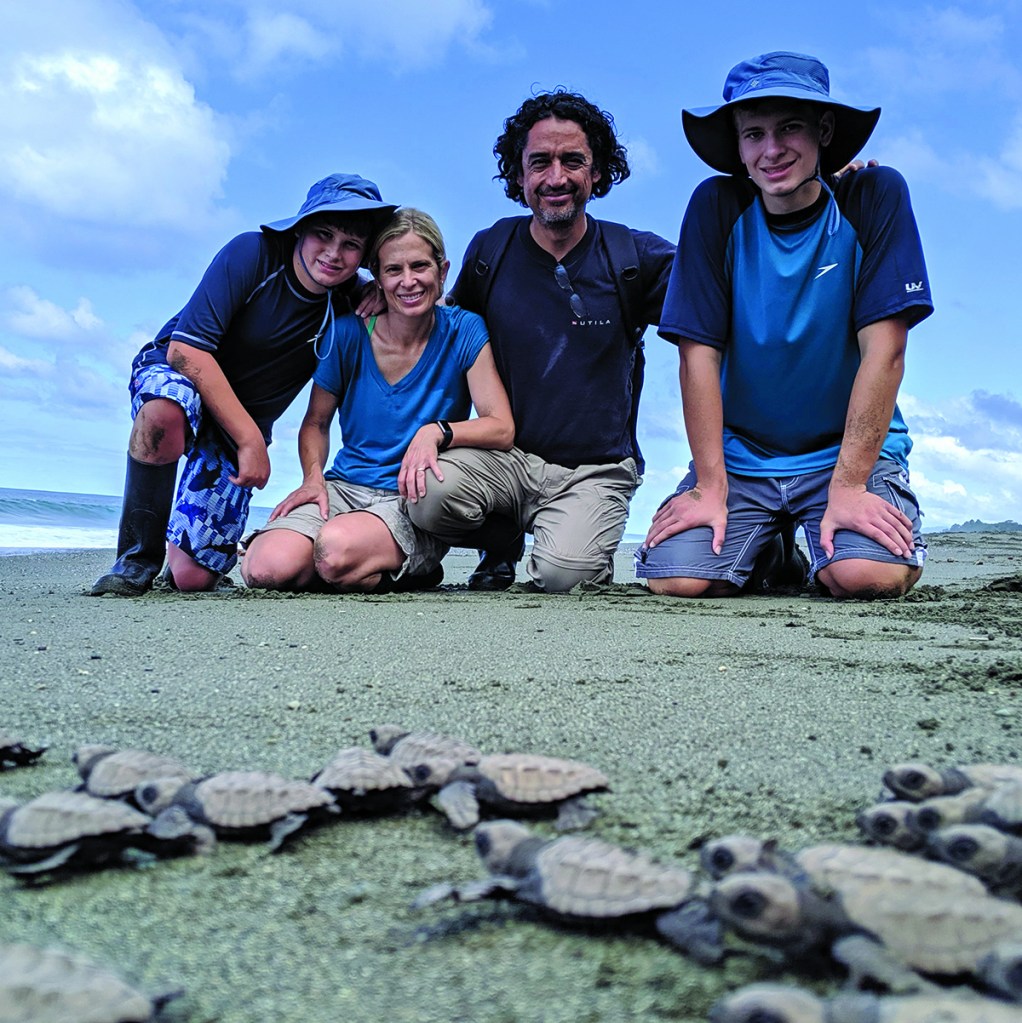
    With my wife (Tanya) and two kids (Max and Alex) at a sea turtle rescue in Costa Rica.

    Advice

    As I reflect on what I wish I had known earlier, I think of three things: we all need help, don’t give up, and align your time with your values. Throughout my life there have been people who have helped my family and me. An example that resonates is when my dad’s siblings helped support him in his education. When my younger sisters came to study to the U.S., I tried to do the same for them. If possible, it is important to surround yourself with a supportive community and to support others.

    I also think of how many times I failed before I succeeded. There are so many examples of that, but failing to pass my qualifier exam at the PhD level really stands out for me. I could have been happy in a different career path, but I really love what I do. Persisting, not giving up, made the difference. It is important to try to learn from failure and keep trying.

    Finally, I am currently working on being deliberate about aligning my life choices with my personal values. Within work, I value teaching, research, and service and try to align my time with how I value these aspects of my career. More broadly, on an almost daily basis, I try to create boundaries for my work so that I have a balance with my personal life. It is important to find a balance that feels right to you.

    Advice
    As I reflect on what I wish I had known earlier, I think of three things: we all need help, don’t give up, and align your time with your values. Throughout my life there have been people who have helped my family and me. An example that resonates is when my dad’s siblings helped support him in his education. When my younger sisters came to study to the U.S., I tried to do the same for them. If possible, it is important to surround yourself with a supportive community and to support others.
    I also think of how many times I failed before I succeeded. There are so many examples of that, but failing to pass my qualifier exam at the PhD level really stands out for me. I could have been happy in a different career path, but I really love what I do. Persisting, not giving up, made the difference. It is important to try to learn from failure and keep trying.
    Finally, I am currently working on being deliberate about aligning my life choices with my personal values. Within work, I value teaching, research, and service and try to align my time with how I value these aspects of my career. More broadly, on an almost daily basis, I try to create boundaries for my work so that I have a balance with my personal life. It is important to find a balance that feels right to you.

    Previous Testimonios:

    • Dr. James A. M. Álvarez
    • Dr. Federico Ardila Mantilla
    • Dr. Selenne Bañuelos
    • Dr. Erika Tatiana Camacho
    • Dr. Anastasia Chavez
    • Dr. Minerva Cordero
    • Dr. Ricardo Cortez
    • Dr. Jesús A. De Loera Herrera
    • Dr. Jessica M. Deshler
    • Dr. Carrie Diaz Eaton
    • Dr. Alexander Díaz-López
    • Dr. Stephan Ramon Garcia
    • Dr. Ralph R. Gomez
    • Dr. Victor H. Moll
    • Dr. Ryan R. Mouruzzi, Jr.
    • Dr. Cynthia Oropesa Anhalt
    • Dr. Omayra Ortega
    • Dr. José A. Perea

    Brian P Katz (BK)

    March 15, 2023
    Testimonios, Uncategorized
  • Testimonios: Dr. José A. Perea

    Testimonios: Dr. José A. Perea
    Dr. José A. Perea; Illustration created by Ana Valle.

    My Life through Mathematics

    The opportunity to write this chapter has been a breath of fresh air amid very tumultuous times. It is my sincere hope that when we look back to the year 2020, it will be as a watershed moment where a large majority agreed that racial injustice, xenophobic sentiments and less than competent leaders cannot be tolerated in society. Something that has come up again and again during this reflection is the idea that every perceived personal success has had many people behind it. Mentors who, with small acts of kindness, have a huge impact. I will try to describe a bit of my journey as a vehicle to articulate these thoughts.

    Early life. I was born in 1984 in Santiago de Cali, the third most populous city in Colombia, to Adiela Benítez and José Lúcio Perea. Geographically speaking, Cali is nestled between the central and western Andean mountain ranges; it has a beautiful year-round tropical climate, and it is a rich melting pot of indigenous and Afro-Latin cultures. People refer to it affectionately as La Sucursal del Cielo (Heaven’s branch office) or La Capital Mundial de la Salsa (The world’s salsa capital). The Afro part of Cali can be traced back to several migrations, particularly from the Colombian Pacific. This predominantly Black part of the country emerged from early slave settlements in territories like Chocó—a region historically plagued by poverty and government neglect. My dad and my maternal grandma, Rosa Lia Mosquera, were born in the neighboring river towns of Santa Rita and Santa Ana, Chocó. I don’t think they knew each other while living there (age difference), but they both emigrated to Cali in search of a better life. They came with nothing; not even a high school diploma, but they both built a life for themselves as immigrants. My grandma worked very hard to singlehandedly raise my mom, and my dad put himself through school—almost finishing a university degree in accounting—while building a small tailoring business to support my family.

    My family (February, 1999). L to R: My sister, my mom, my dad, my grandma, and me.

    I credit my dad with breaking a very resilient cycle of poverty in his side of the family. When I was around fifteen years old, he took me on a trip to his childhood home in Santa Rita. I remember the two of us traveling by bus from Cali to Chocó, and then helping paddle a small boat for the better part of a day—a four-person canoe—along the Iro river. We finally made it to Santa Rita, where I found a beautiful town filled with warm and welcoming people, though with few paved roads and even fewer homes with electricity or running water. My dad’s home was not one of those few. Going back to those memories always makes me think of the effect that initial conditions can have, the importance of pushing for equitable policies, and of our responsibility as mentors to not let said conditions get in the way of someone’s work ethic and talents.

    Growing up we were not middle class, but my parents always made sure we had everything we needed. My mom and my grandma would repeat mantras like “being poor is not an excuse for having dirty shoes or wrinkled shirts,” which were part of a bigger theme. For example, in middle school I had horrible handwriting; my mom would sit with me to go through my notebooks, she would take out all the messy jumbled pages and make me rewrite them neatly. Today I have better handwriting thanks to her, and an appreciation for the benefits of putting effort into getting the small things right. I believe these were, in their way, an attempt to lessen our chances of being subjected to discrimination later on. My grandma had a line that went something like this: you’ll be judged as a Black man first, and your actions will reflect on Black people in general; it will not be José did this or that. As unfair as it sounds, this was in all likelihood a result of her upbringing, interactions with other people, and personal journey. I’ve had similar feelings as an immigrant in the U.S.; that I would be judged as Colombian first (I’ve heard all the cocaine-related “jokes” and they are still annoying) and that my failures could reflect poorly on an entire country. While these feelings are legitimate and, I imagine, shared by others, it is crazy to think that minorities—in addition to everything else—have to deal with the constant pressure of being “the” representative. I hope we can dispel these notions through honest conversations with our students, while we help build more diverse environments where people don’t have to feel this way.

    High school years. My love for math came almost at the end of my high school years at Centro Educativo Industrial Luis Madina. I had always been a good student with top grades, and learning was something I enjoyed, but I wouldn’t say that math was something I was passionate about. Physics, on the other hand, blew my mind. When we learned Newtonian mechanics, it was incredible to me that one could understand and formalize the world with math. I was also very lucky to have an unconventional physics teacher, Prof. Jesús Rivera. Once he noticed I was doing well on the tests and reading ahead in the book, he told me to go to the school’s library instead of coming to class; that I should study the material at my own pace and periodically talk to him as I made progress. This freedom to learn was empowering, and I was convinced that physics would be my major in college.

    In Colombia, students declare their major when they apply to a university; they submit their materials to a specific program and are admitted according to a ranking of test results.

    The test in question is called the ICFES exam. [1] It is a standardized test like the SAT, administered nationally to all high school seniors, and used by Colombian universities to determine admission. Needless to say, it is a big deal. The large public universities in Colombia are quite good, though there are few of them, and the ICFES scores are essentially their only admission criterion. Thus, for students who cannot afford private education, it is a high-stakes exam. This was certainly my situation, and my mom embarked us on a mission to make sure I got into Universidad del Valle (Univalle)—the third-largest public university in the country, located in Cali, and ranked among the top five nationally. She signed me up for a pre-ICFES course that met every Saturday. I was of course very reluctant—I thought I could study on my own—but I was pleasantly surprised with the unforeseen benefits.

    The preparation course was structured to review all relevant material for the test by splitting the content into classes. Among them was obviously mathematics, but the course was entirely subverted by the teacher in charge. On the first day of classes, he said, It is very unlikely we’ll be able to cram in a few Saturdays what you haven’t learned in six years; let’s learn something interesting instead.” The teacher was an undergraduate student in mathematics at Univalle, and he proceeded to review several “math facts” from one viewpoint—Why is this true? We covered several topics in arithmetic, algebra, and geometry from a discovery/proof-based perspective, which was entirely alien to me. Until then, I had seen math as a formulaic and rote memorization exercise, which is unfortunately still very common. From then on, I was hooked.

    The course ended, and the test came and went. In the end, I got the top ICFES score in my school, and the question became whether I would go for physics or mathematics in my application to Univalle. I didn’t have a good framework to make this decision, so I went to Prof. Rivera for advice. He asked me, “What it is that you find interesting?” I responded, “Figuring out why things work, why they are true.” Without missing a beat he said that I’d probably be happy doing math, and several years later I can report that he was 100% correct.

    I went to Univalle for my bachelor’s in mathematics between 2001 and 2006. As I mentioned before, the Colombian higher education system is geared towards students focusing on their major almost exclusively from day one, though other complementary courses are also included. By design, I ended up taking a lot of math classes: from number theory and set theory to abstract algebra, real and complex analysis, measure theory, functional analysis, differential geometry, and point-set/algebraic topology. Everything seemed super interesting. Along the way, I met several professors who inspired me to pursue mathematics, and selflessly helped me succeed. Among them, I want to highlight Dr. Doris Hinestroza, Dr. Gonzalo García, and Dr. José Raul Quintero. They all graduated from Univalle and went on to earn PhDs in mathematics from universities in the U.S.: Doris from the University of Cincinnati, Gonzalo from Cornell University, and Raul from the University of Maryland. Doris passed away in February of 2019; she was kind, warm, generous, a force to be reckoned with, and genuinely excited about doing and teaching mathematics. She is sorely missed.

    During my third year in college, I took Real Analysis with Gonzalo. My friends and I used to study for tests by attempting to solve all problems in the book (in this case Rudin’s Principles of Mathematical Analysis) for the units covered in the exam. Of course, there were problems we couldn’t do, so we would go to office hours often, and talk to Gonzalo about everything math-related. At the end of the semester, I told him that I wanted to learn algebraic topology, and asked if he would be willing to advise me. He agreed and the very next semester we set up a reading course (Massey’s A Basic Course in Algebraic Topology) and with his guidance, I was able to complete a laureate thesis titled The Borsuk-Ulam theorem and its applications. I thank him not only for his guidance but for the many opportunities he facilitated so that I could be successful. One of the first things he told me when we started working together was that he thought I was capable of getting a PhD overseas, but for that to happen I needed to speak English. At the time I could read it, but I certainly couldn’t write/speak or understand it without subtitles. Gonzalo, through his contacts, found me a job as a substitute math teacher in a bilingual (English-Spanish) school, and with the salary, I was able to pay for a one-year intensive English course. When the time came for me to take the TOEFL, GRE and GRE-math exams, Gonzalo let me use his credit card (my family didn’t have one) to pay the online registration fees. Of course, I paid him back later, but these were all things he didn’t have to do, which were huge for me. I cannot thank him enough.

    Looking back, I now think of these logistical challenges as examples of structural roadblocks where the socioeconomic background can limit access: did you go to a school where learning to speak a second language was possible/encouraged? Did your parents have resources available for extra-curricular/academic activities? Did you have access to people who knew the system and could give you timely and accurate advice? I was lucky to have people in my corner who helped me circumvent these roadblocks. The goal should be for all our students to feel that luck is also on their side.

    College graduation (April 2006). Doris was the dean of Natural Sciences; I was super happy to get my diploma from her.

    I graduated from Univalle in April of 2006 (Valedictorian) and started my PhD in mathematics at Stanford University in September of the same year. The application process for grad school started two years earlier, from the time Gonzalo suggested I learned English, to one afternoon in Doris’ home with her, Raul and Gonzalo helping me prepare the application packages—at the time these documents (translated and notarized grades, recommendation letters, CV, essays, etc.) needed to be physically mailed. The three of them wrote recommendation letters on my behalf and helped make sure that the right documents were in the right envelopes for each university. Due to costs, I could only apply to five schools; all in the U.S. and across a wide range of academic rankings. I was denied admission in two, short-listed for one, and admitted into the other two.

    Stanford Years

    The time I spent in California as a graduate student was filled with good experiences, both academic and social. I made a lot of good friends and learned a lot of mathematics. And even though I worked very hard, I vividly remember feeling like an impostor, that the admissions office had surely made a mistake when they let me in. There is actually a name for that, the impostor syndrome, and it must have been widespread enough at Stanford because there were several institutional initiatives to help combat it. For instance, I attended a university-sponsored workshop for coping mechanisms, in a packed auditorium, and there was also this very cool series called The Resilience Project, with videos [2] from top faculty—heroes of many—telling their stories of academic and professional failure. I had my share of those in grad school. I failed my first midterm ever within two months of starting (measure theory) and also failed the algebra qualifying exam. As painful as they were, those failures were useful. All the algebra I learned during the summer of that year, while studying to retake (and pass!) the qualifying exam, has helped me in my research to this day.

    PhD graduation (June 2011) with my parents.

    Speaking of research, I started graduate school convinced that I wanted to focus on algebraic topology. This is the branch of mathematics concerned with spatial properties that are invariant under continuous deformations. For most of its history, algebraic topology has been regarded as a purely theoretical subject. Imagine then my surprise when, during one of my reading courses, I found out that topological ideas were actually being used to solve real problems in data analysis. Today, computational and applied topology, and in particular topological data analysis (TDA), are rapidly developing disciplines at the intersection of statistics, mathematics, and computation, with many students, vibrant conferences, and faculty in universities worldwide. In its inception, the main advances in TDA were spearheaded by Dr. John Harer and Dr. Herbert Edeslbrunner at Duke University, and by Dr. Gunnar Carlsson at Stanford.

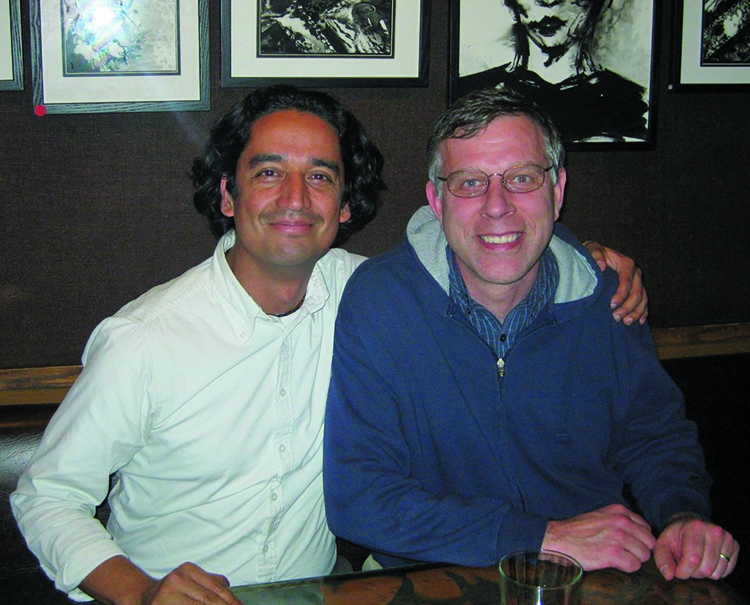
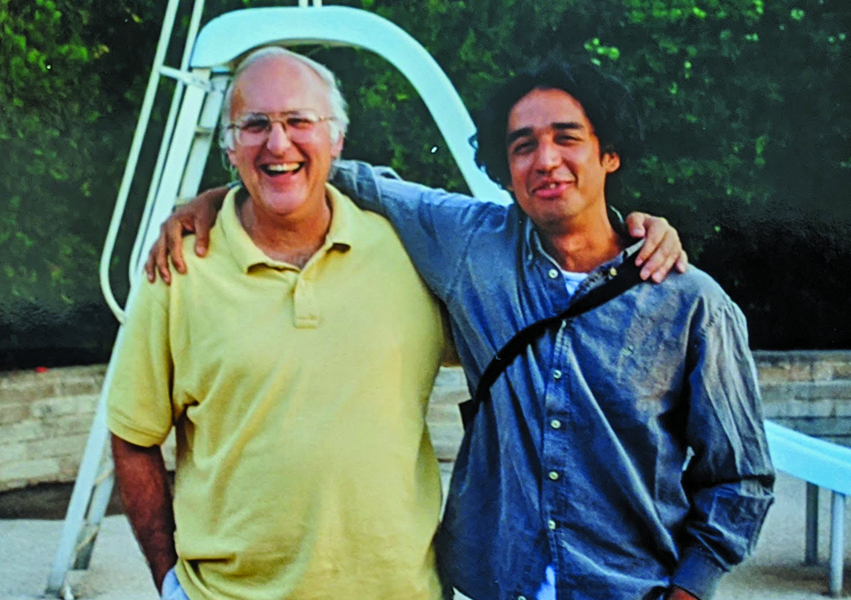
    I met Gunnar in a reading course I signed up for during my second year of grad school.These are directed studies where, typically, a faculty member guides a student through advanced/seminal research papers in their area. Gunnar is a widely respected mathematician with deep contributions in pure algebraic topology. During one of said meetings—we were reading Wall’s Finiteness Conditions for CW-Complexes—I asked Gunnar about what he was actually working on those days. He proceeded to tell me all about this new field, topological data analysis, showing that it was possible to leverage machinery developed by pure algebraic topologists, but now in algorithms to solve real problems in data science. It made total sense, and I was blown away. We stopped reading Wall’s paper, Gunnar became my thesis advisor, and from then on I’ve been working in TDA as my main research focus. [3]

    I graduated in 2011, and we were able to arrange for my parents to make the trip from Cali to California. I believe that was the first time they had flown on an airplane. We had to get passports and visas, I flew back to Colombia and then came back with them for the commencement; having them there was awesome. After the ceremony in the math department, where we actually got our diplomas, Gunnar came up to me with congratulations and said he wanted to meet my parents. I panicked for a second and said: Gunnar … they don’t … speak English—to which he responded: it’s ok, I just want to say hi. He goes up to my parents and tells them, slowly, in Spanish, José es un muy buen estudiante. [4] He then said bye and walked away. At the beginning of this chapter, I mentioned the idea of small acts of kindness from mentors, that can have a huge impact. The interaction I just described is a prime example of one.

    Post-Stanford Years—Making the World a Smaller Place

    After Stanford, I went to Duke University as a postdoc to work with John Harer. I was very excited to learn from and work with him—John has made pioneering contributions in algebraic topology, especially in the homology and cohomology of mapping class groups, and he has translated this expertise to establish foundational results in TDA. What gave me pause, however, was moving to North Carolina without any other context than the painful history of the overt racial violence that has plagued the South. As an outsider, the history books were my only reference. My experience there was positive, though. I always felt welcomed, and the four years I spent at Duke were fruitful both academically and personally. John was a great mentor to have; he helped me grow into the next stage of my professional career, and he and his family welcomed me into their home for every celebration.

    After four years at Duke, I moved to Michigan State University (MSU) as an Assistant Professor with joint appointments in the Department of Computational Mathematics, Science & Engineering (CMSE), and the Department of Mathematics (MTH). At MSU I’ve worked to build a vibrant research group with undergrads, grad students, postdocs, and the support of several sources (e.g., MSU, Defense Advanced Research Projects Agency (DARPA), National Science Foundation (NSF) and its CAREER program), advancing applied topology in ways that I personally find deeply fascinating. Over the last few years, I’ve been fortunate to also mentor students (e.g., by co-directing their thesis work) from Mexico, Colombia, and Brazil. One of them is now completing a dual PhD in CMSE and MTH at MSU. With other Latinx faculty at U.S. institutions, we have also run summer schools, workshops, and programs both in the U.S. and South America, which we hope to leverage in order to reach students that may not be aware of the many existing opportunities.

    The emergence of new areas in computational mathematics—like applied topology, applied algebraic geometry, computational harmonic analysis, etc.—provides a valuable opportunity to increase the representation of historically underserved communities in the mathematical sciences. Indeed, these areas blend mathematics with modern science in ways that students tend to find compelling, and with mostly democratized points of entry. Nowadays, academic software is open and widely available, online conferences and open courses can be followed anywhere in the world, and online social communities provide valuable information and mentoring that not too long ago were available to only a select few.5 If you know of someone that you think may benefit from any of these resources, please reach out to them; a seemingly small act of kindness can go a long way.

    Advice

    I would like to end with a few words of advice:

    (1) Advice to my younger self: Trust in your own ideas and pursue them with unrelenting passion; even if it doesn’t seem like it at times, things will work out in the end. Also, the tenure track is a gruelling process and busyness is a reality, but you must make time to take care of yourself both physically and mentally. Learning how to say “no” early on, and abandoning perfectionism, are good ways to create that space.

    (2) How to encourage and inspire younger people in math: At least when I was younger, there were two things that motivated me to do mathematics. One was the deep personal satisfaction I would get from solving a difficult problem, and the other was hearing the stories and learning about the human side of being a mathematician (Simon Singh’s Fermat’s Last Theorem, is one of those great stories). With this in mind, one of the best ways I have found to inspire students in mathematics is to facilitate their own discovery, with ample guidance, but avoiding easy/lazy answers that would deprive them of the satisfaction of figuring something out on their own. Something that I also think is valuable is connecting the act of doing mathematics to the social aspect of being a mathematician. By this, I mean the stories, the struggles, the joy of sharing with people at conferences and other social/cultural events. Also, math is just cool, with intrinsic beauty and many connections to science broadly; try (as tempting as it may be) not to make it uncool with unnecessary jargon and over-formalization.


    [1] The ICFES stands for Instituto Colombiano para la Evaluación de la Educación (ICFES).
    [2] The Resilience Project series is still available here: youtube.com/channel/UCWImwojhbas29JwQlslsLGg
    [3] Here is a recent talk (in Spanish) from the Cibercoloquio Latinoamericano de Matemáticas:
    youtube.com/watch?v=cBJOo0NX6So.
    [4] José is a very good student.
    [5] See, for instance, my lectures on TDA at youtube.com/watch?v=APgR3avai30 and the Network of Minorities in Mathematical Sciences group on Facebook.


    Previous Testimonios:

    • Dr. James A. M. Álvarez
    • Dr. Federico Ardila Mantilla
    • Dr. Selenne Bañuelos
    • Dr. Erika Tatiana Camacho
    • Dr. Anastasia Chavez
    • Dr. Minerva Cordero
    • Dr. Ricardo Cortez
    • Dr. Jesús A. De Loera Herrera
    • Dr. Jessica M. Deshler
    • Dr. Carrie Diaz Eaton
    • Dr. Alexander Díaz-López
    • Dr. Stephan Ramon Garcia
    • Dr. Ralph R. Gomez
    • Dr. Victor H. Moll
    • Dr. Ryan R. Mouruzzi, Jr.
    • Dr. Cynthia Oropesa Anhalt
    • Dr. Omayra Ortega

    Brian P Katz (BK)

    February 15, 2023
    Uncategorized
  • Testimonios: Dr. Omayra Ortega

    Testimonios: Dr. Omayra Ortega
    Dr. Omayra Ortega; Illustration created by Ana Valle.

    Why Math

    I have always been drawn to beauty and order, two concepts central to mathematics. I grew up in Far Rockaway, Queens, New York—a wonderful land on the south shore of Long Island (right near the beach). The ocean has always been a tranquil escape for me, and I’ve always felt a connection to my ancestry through the shared experience of the ocean. As a child in the early 1980s, I reluctantly spent many hours (on both weekends and weekdays) with my parents at church. Rather than engage with the spoken gospel, I would admire the interior of our church, St. Mary’s Star of the Sea, and take in the physical gospel that was presented before me. During these long masses, I would get lost in the lights and the architecture. I loved the symmetry and the grandeur of the altar and how that stately mirror-like design was continued throughout the entire building. I was especially hypnotized by the stained glass of the stations of the cross and the stylized geometry of the figures contained in each of the colorful panes of glass. Each image made more beautiful by the mid-morning sunlight. One of my earliest memories is waiting outside of the church after my brother’s youth bible study group, Las Jornadistas, got out. All of the young people were happily chatting and milling about before walking home. My brother and I got a rude surprise when we realized that his bicycle—our only mode of transportation at the time—had been stolen while we were in church. To this day we still marvel that someone would steal a bicycle with a baby seat attached from a church! It takes all kinds.

    My homeland, New York City, is a melting pot of people and cultures, and Rockaway, Queens had a similar mixture of cultures, but on a smaller scale. Rockaway Beach is a long peninsula on the south side of Long Island with a long swath of sandy coast facing the Atlantic Ocean. Rockaway Beach is defined by Breezy Point on the western border and Far Rockaway (where I was born) on the eastern border. All types of people are drawn to this area because of the beach and relative proximity to New York City, but the neighborhoods are somewhat segregated. Breezy Point tended to be more well-to-do and working class people of European descent. Many of my friends from this area were Irish Catholics. Breezy Point, Neponsit, Belle Harbor, Rockaway Park and Rockaway Beach are home to many of the firefighters of Irish descent who responded to and unfortunately perished in the 9-11 attacks on the Twin Towers (may they rest in peace). As you move further east on the Rockaway Peninsula into Arverne, Edgemere, Bayswater, and Far Rockaway, you would find the homes of the Black and Latinx Rockaway residents. The easternmost border of Far Rockaway was (and is) defined by a large orthodox Jewish community, beyond which lay the suburbs of Nassau County, what many people call the start of “Long Island” (though all of Brooklyn, Queens, Nassau and Suffolk define Long Island).

    My grandmother, in a pollera, with my mother and two uncles (everyone is wearing traditional Panamanian dress).

    My Familia

    If your family is anything like my family, every family function is the same. It didn’t matter if it was a baby shower, kid’s birthday party, quinceañera, wedding, graduation party, or a funeral:
    (1) There would be food.
    (2) There would be drinks.
    (3) There would be music.
    (4) There would be dancing.

    Omayra as a little girl.

    There would be your entire multi-generational overflowing family. The adults would dance and drink while the kids would go off with their snacks (popsicles, empanadas, and/or birthday cake) to play Hide-n-Seek, tag, or Nintendo (I am classically trained on the original NES, if you’re wondering). My family is almost exclusively Panamanian, it’s mainly my generation that has started “mixing” and marrying non-Panamanians (ay Dios mio!). Panama is a beautiful tropical isthmus with the Atlantic and Pacific Oceans on either side. We love our sancocho (soup), frituras, tamales, arroz con pollo, arroz con habichuelas, and most dear to our hearts, PLATANOS (plantains). Both of my parents emigrated from Panama when they were young—my mother when she was 14, and my dad when he was 18—both looking for a better life. They found each other after moving to New York City at—you guessed it—a Panamanian party. They married shortly after meeting, moved to Brooklyn, and started a family immediately. My two brothers Oscar and Omar were born within one year of each other, more than a decade before me.

    My father assures me that the family was not quite complete until I appeared, he says “siempre queria una hembra,” [1] and 12 years later, I made my appearance on this earthly plane. My mother assures me that all of her children were accidents, something I don’t doubt considering the lack of sex education in Panama City and New York in the 1950s. By the time I was born our family had moved into a house in Far Rockaway, Queens, New York, where we often held family gatherings in our basement, in our backyard, or at the beach.

    Omayra’s Grandmother.

    Everyone in our large extended family hosted family gatherings. My grandmother, Nana, was the matriarch of the family and frequently hosted us all in her home in Cambria Heights (Queens). My grandmother meant the world to me and I probably spent half of my childhood in her home.

    Early Education Years

    I remember after starting elementary school she asked me why I let my friends in school call me Oh-My-Rah, and I remember her face twisting up to say the letter ‘R’ in her most exaggerated American accent. I didn’t know how to ask people to say my name correctly. I didn’t know how to take up space yet, and I’m not sure that I’ve fully learned that skill even now, even though it means the world to me when people try to say my name properly. The very first time a teacher said my name correctly I was in college. I honestly almost cried when my ethnomusicology professor, Katherine Hagedorn, said my name correctly without any instructions from me. It has happened again, but it is still rare. It’s especially hurtful when people don’t even try to get my name right and insist on butchering it like it’s not my own name, and they somehow know how to pronounce it better than I do. FYI—single ‘R’s in Spanish sound just like a soft American ‘R,’ so you should not roll them (like a double ‘R’ in Spanish), and your American mouths should not have a difficult time executing them—it’s in your tongue’s lexicon! You can do it! (Si se puede!)

    Another important host for our family gatherings was my Tia Marta. This tia [2] made some of the most delicious food in our family. She was always ready with a FEAST. I should add that this tia was not a blood relative, but had been partially raised by my grandmother. I have a very large family, in part, because if a family friend spent enough time with us and had integrated themselves into several generations of our family, then they became family themselves. I think it is age that designates whether the person becomes an aunt/uncle or a cousin, but once they are part of the family, so are all of their descendants. Eventually they become blood. We also never differentiate between first cousins, second cousins… you’re just a cousin, and that is that. My tia had a daughter who was a constant in my early life. Our mothers were pregnant around the same time and my cousin was born 11 days ahead of me. We lived in the same town, and were the only girl-children in our generation, so we went to the same pre-school, we had frequent play dates, we would sit together at church, we even had a joint first communion celebration.

    Omayra and cousin at their first communion celebration.

    She was my very first friend and my BEST friend. When we started kindergarten at P.S. 183 in Rockaway Beach, Queens, I assumed that she would continue to be in my class since we’d been inseparable since day one (literally). I knew that I was going to be enrolled in the Astor Program for Gifted Children because of some tests I had taken, but my five-year old mind didn’t really understand the implications of this. I was heartbroken when we were separated and she wasn’t in my class.

    Dr. Ortega’s great-grandfather, Enrique Alonso Duesbury (right), and his brothers. McDonald Duesbury (great-grand uncle, middle) sponsored
    Dr. Ortega’s grandmother’s and children’s immigration to the U.S.

    At the time, the New York Public School System was tracked. Upon entering, students were sorted into one of three tracks: either the Astor gifted track, Regular Education, or Special Education. I felt honored to be in a class with other “gifted” children—I loved the new things that we were learning—but even then, it felt wrong to be separated from my cousin who, up until that point, I had spent my entire life with. I missed the comfort of her company and I didn’t know any of the other pupils in my class.

    There was one Astor class for each grade and the racial breakdown of the students between the three tracks was stark, even to a five-year old. Most of the students at P.S. 183 were Black or Latinx. These two subgroups defined almost 100% of the Special Education and Regular Education classes at that school. However, out of the 35 pupils in my kindergarten Astor class, only seven of us were Black or Latinx; the remainder were white. The contrast was so stark to my young eyes, and I still remember the full names of the other six. These numbers grew slightly each year, but never enough to tip the balance. The segregation that I observed on the Rockaway Peninsula seemed to have been maintained in my elementary school classrooms and would be a theme throughout my life.

    When I was around 12 years old I was nominated to apply to Prep for Prep 9 by my teachers at J.H.S. 180. Prep for Prep 9 was a program based in New York City that found talented youth from around the city and prepared them to attend prestigious boarding schools. This program changed the trajectory of my life. At a young age I decided to leave my parents’ home in Far Rockaway and move to a suburb of Boston for schooling. We all saw this as an opportunity that I could not pass up, and I was ready to leave my parents’ conservative home. While I loved spending time with my friends and family at church, the idea of “a woman’s place” was one that I could not fall in line with, so I was ready to start a new chapter in my life.

    Omayra at Milton Academy.

    Attending Milton Academy in the early 1990s was an academic blessing and a welcome escape from my conservative home in New York. I knew that this was a great opportunity for me, but it also took me away from my family and my culture. Prep for Prep 9 had prepared me for the academic rigors, but I was not ready for the extreme wealth of my classmates and the new social expectations. I thoroughly enjoyed my four years of high school—I made great friends, did well in my classes, and held several leadership roles—but issues of race and class were always in the back of mind.

    Undergraduate Education and Introduction to Mathematics

    I came to the field of mathematical epidemiology in a round-about way. When my dreams of becoming a medical doctor were dashed by my lack of success in my first-year general chemistry course, I focused my attention on my double major in mathematics and music. I loved my time at Pomona College. In retrospect, I can say that moving from the east coast to the west coast was one of the best decisions that I made in my young life. I can say this now because I still live in the beautiful state of California, but, during that first year, I wasn’t so sure. The social aspects of college life were most enticing to me, and, after my first semester, I was put on academic probation. Despite “trying to do better,” I was suspended for one year after my second semester at Pomona College and had to attend another school for one year and earn a B or better in all of my classes there. I wasn’t ready to go back to the east coast (read: go back to church), so I went to live with my Tia Nory and Tio Calin in Milpitas, San Jose, California and attended DeAnza Junior College in Cupertino. It was nice living with my maternal uncle’s family. I was able to live with two cousins close to my age and experience a portion of my “coming of age” years with my family. It was a challenging year where I worked full time and took more than a full load of classes at DeAnza, but this year gave me time to reflect on exactly what I wanted out of life and out of college. Gap years were not a thing when I went to school and certainly not a thing for people like me with working-class immigrant parents, but I understand how taking a gap year can give you extra time for reflection and for establishing life goals. While I enjoyed DeAnza to the fullest by joining every musical ensemble and taking most of the music courses offered on top of taking the required transfer courses for my majors at Pomona, I knew that I didn’t want to stay there any longer than I needed to. I knew that I wanted to return to Pomona College to complete my degree and I wanted to thrive there.

    College graduation.

    After that year, I was able to return to Pomona College and continue my degrees in pure mathematics and music performance. It wasn’t all roses, but I was successful and definitely improved over my performance during my first year. During my junior year I was encouraged to apply for a summer research experience (REU). These REUs were new at the time, but are pretty common now. I spent the summer between my junior year and my senior year attending the prestigious Mathematical and Theoretical Biology Institute (MTBI) which, at that time, was held at Cornell University. This program was formative for me in that I conducted research for the very first time, met many of the people who are my collaborators and colleagues, and chose my field of study: mathematical epidemiology. I also learned what it is to work, very hard, on a collaborative project. I was able to revive my deferred dream of working in a medical field. I learned that through mathematics, I could still be a healer by working in mathematical epidemiology and public health. In this program, I worked the hardest that I ever had. We packed SO MUCH into the short eight weeks that we had together. I acquired the basic skills in math modeling and differential equations that I continue to use to this day. Those sleepless nights also trained me for when deadlines approach faster than you expect.

    One of the most important memories I have from this program was when Dr. Colette Patt came and gave a presentation on the state of mathematics PhDs. I remember hearing that less than 2% of the PhDs awarded in mathematics in the previous year were awarded to people of color and less than 1% went to women of color. Those statistics made me very angry but also motivated me to pursue a PhD in applied mathematics. Those statistics haven’t changed much, so they continue to motivate the work that I do, to this day.

    The year before I started my PhD program, I participated in a summer program at Spelman College that set me up for success during my first year in grad school. I am very thankful to have participated in the Enriching Diversity in Graduate Education (EDGE) Program for Women. Through that program I got a more realistic perspective of the academic and social challenges that I would face during my first year, and EDGE gave me a network of supportive sisters and allies that would help me to succeed in the early years and throughout my career.

    Graduate School

    I didn’t get into grad school the first time I applied, but I did get in the second time (gracias a Dios). On the recommendation of my mentor, Carlos Castillo-Chavez, I went to the University of Iowa to study mathematical modeling of infectious diseases under Herbert Hethcote, one of the founders of the field. I had never been to the Midwest, so I experienced yet another period of culture shock and then acclimation. If you’ve never experienced a midwest winter, you are a blessed individual. The University of Iowa had recently been awarded a big Graduate Assistance in Areas of National Need (GAANN) grant from the National Science Foundation so I was very lucky to receive a fellowship to support my doctoral studies. This GAANN grant built off of the previous efforts of professors at Iowa to bring more students of color to the lush, verdant corn and soy fields of Iowa. Thanks to the efforts of professors like Gene Madison, Phil Kutzko, Yi Li, Juan Gatica, Richard Baker, and David Mandersheid, the University of Iowa Department of Mathematics won the Presidential Award for Excellence in Science, Mathematics and Engineering Mentoring in 2004. The math department at Iowa was a really warm and supportive community. Everyone helped each other if we were having trouble in classes, if we needed a ride to one of the (distant) airports, or if we needed help moving into a new apartment. I remember being so worried about my partial differential equation (PDE) comprehensive exam. I knew that I was doing fine in the class itself, but I wasn’t sure that I could complete those same types of problems in a classroom space not of my choosing and in a specified time frame. I normally worked on homework problems at all times in all spaces. I could be in my office on campus, working at a nearby coffee shop, or at home asleep, and the solution would come to me. The classroom really wasn’t where I did my best work. Several older graduate students made a point to share their study binders from previous PDE comprehensive exams and helped me to study. I am so thankful for their generosity because they helped me, not only to prepare for my exams, but allowed me to feel relaxed enough to perform at my best on the day of the exam (BTW—I passed with flying colors!).

    We were also there to celebrate each other if someone in the math department had a child, passed a comprehensive exam, or successfully defended their thesis. I remember coming together frequently at Phil Kutzko’s home, always over food and drinks. I loved the constant celebrations and get-togethers within the math department, as they reminded me of the way we would celebrate family at home in New York. Most of the math department were regulars at one bar and grill on Tuesday evenings where we took over many tables with our textbooks, pint glasses, and wing baskets on ‘Tuesday Wings Night,’ and we ended the week at another bar where we would lick our wounds and recap the week during ‘Friday After Class’. I really don’t think that I could have completed a PhD anywhere else. I have lots of colleagues in mathematics now, many who did not go to Iowa (no me digas?!) and, when I hear stories about their grad school experiences, I realize how lucky I was. Nowhere else would have supported me in the way that Iowa did. I felt nurtured both academically and socially inside the department, at the coffee shops, and even at the bars.

    Omayra and her mentor Dr. Carlos Castillo-Chavez.

    I spent the last two years of my PhD in an all-but-dissertation instructor position at Arizona State University. Those last two years teaching full time while trying to complete my PhD were arduous. I would not wish that experience on anyone, and I highly discourage anyone from attempting to start a new position before completing their PhD. Even though it started off rough, I am thankful to have had this opportunity because it led to a nine-year career at ASU. There were many moments when I thought I should just quit and be happy with a master’s degree in mathematics and another in public health, but I am glad that I persevered. My parents felt that I might as well finish since I had come so far, but they would support me if I decided to quit. Truthfully, they had no idea why I was still in college anyway, they hadn’t quite grasped the idea of graduate school (there’s more college after college?). I truly appreciated the professors from Iowa and Carlos Castillo-Chavez, who was at ASU at that time, who would occasionally check up on my progress at conferences, through email, and text messages. Without these ever constant, “How’s the thesis going?” questions, I might have given up. I felt the weight of what I owed to these mentors and the breadth of what they knew I could achieve. I am thankful that these mentors did not give up on me when it seemed like I was dragging my feet through the last phase of my thesis work.

    Because each successive step of my schooling moved me further and further away from my family, it took a lot of effort to maintain ties with my family and my culture. In some stages of my life, I was not successful or even motivated to maintain these ties. I am glad that I am able to reflect on this phenomenon now that I am an adult. In my day-to-day life, I find myself thinking more and more about how I can “decolonize my mind” for myself, for my students, and for my family. With each step in my education, I lost my connection to the Spanish language. We spoke Spanish in the household when I was little, but as soon as I started kindergarten, my parents only spoke to me in English. Even to this day, I have to work to get my parents to speak to me in Spanish. Even if I start the conversation in Spanish they naturally revert to English, to which I reply either “que?!” or “como?!” to get them to go back to their first language. Through my two brothers, I have four nieces and nephews and none of them even have a basic knowledge of Spanish. I see that part of our heritage getting watered down with each successive generation, and it makes me sad. Though I recognize both English and Spanish as “the colonizer’s language,” I’m trying very hard to keep my Spanish language proficiency up.

    Applied Mathematics and Public Health

    I grew up on Rockaway Beach and spent almost every summer day at the beach. I could play all day in the dancing ebb and flow of the waves. It’s one thing to see the dynamics of an ocean wave from the shore, but it can be a transcendent experience to be carried by describe the dynamics of the ocean’s waves. The poetry of mathematics is all around us, even when we are not aware. Though my love for differential equations stems from the modeling of infectious disease, I still marvel at how differential equations are applicable to so many different natural phenomena.

    Mathematical modeling allows me to describe the world with mathematics. I like to think that math is a universal language and, through modeling, we can share poetry about the world that we live in. The research that I’ve conducted in mathematical epidemiology first started that summer at MTBI. I worked with two other students modeling the evolution of drug-resistance in the yeast candida Albicans, using a coupled logistic equation model to describe competition between two strains of c. Albicans in a human host and the effect of using an antifungal agent to try to control their growth. From then I always focused my work on emerging infectious diseases, new vaccines, or tropical diseases.

    My research in mathematical epidemiology is grounded in the public health problems of today. Using mathematical modeling and the theoretical core of mathematics as tools, I am able to better understand and describe emergent health problems such as HIV, HPV, rotavirus, malaria, polio, and TB. My contributions to science and society improve the health community’s understanding of infectious diseases and inform policy makers on how these diseases can best be controlled at the population level. In order to be well prepared to contribute to this field of mathematical epidemiology, I simultaneously study applied mathematics, statistics, epidemiology, and public health.

    Currently, I work with a fantastic set of collaborators on mathematical models for coronavirus where we evaluate different isolation strategies and their cost-effectiveness. We also developed geo-spatial models for the spread of malaria which takes into account immigration, seasonal migration (i.e., seasonal workers), and tourism between Botswana and its neighboring countries. I first met these collaborators, who are a diverse group of women, at a workshop organized by the Association for Women in Mathematics at the Institute for Pure and Applied Mathematics, under the name, “Women in Math Biology” (WiMB). I am incredibly thankful that I could participate in this workshop because it helped restart my research program, which had been focused on undergraduate research only for about five years. I love developing research skills in undergraduates and I still maintain my Mathematical Epidemiology Research Group, comprised of all undergraduates; I also work with the Rocky Mountain Sustainability and Science Network every summer, but it is nice to focus on my own work and publications sometimes. I am also working on a project with colleagues from Sonoma State University (SSU) and other experts from other institutions trying to identify both institutional and implicit sources of bias in STEM, starting with the math department at SSU as the pilot study. This work lies at intersection of my service work and my research, so this is an exciting new venture for me—one, which I believe, could have only happened at my current institution. My experience at Sonoma State University, though still new, has been both refreshing and eye-opening after teaching at three other institutions of higher education.

    The Search for Balance and Advice

    It has been very nice to finally understand that I need a balance of teaching, research, and scholarship to be happy. If I focus on just one aspect alone, I feel that something is missing. Being at Sonoma State University has allowed me to continue my devotion to my students through teaching and research, to continue my scholarship and publications in the modeling of infectious disease, and to continue my service, not only within my own university and department, but also nationally through my service work with the National Association of Mathematicians, the Association for Women in Mathematics, the Society for the Advancement of Chicanos and Native Americans in Science, and the Mathematical Association of America. If there is one piece of advice that I can give to folks about to embark on a career in mathematics—one piece of advice I wish that someone had given me—is that you should thoughtfully choose the institutions where you will work, study, and devote large swaths of time, based on your interests and the type of life balance that you would like to have. Don’t be afraid of changing institutions if the institution that you start your career at is not a good fit for you. It’s better to have a delayed start than to finish at an institution that doesn’t work for you or, worse, not finish because you were at an institution that didn’t work for you. I didn’t always make the best choices initially, but that is really how life experience works. I am, and always have been, on the right path—my own path. Hold tight to your culture and your life goals. Use them as your North Star and Southern Cross to navigate the inevitable ebbs and floods that will cross your path.


    [1] Translating to “I always wanted a little girl.”
    [2] Aunt.


    Previous Testimonios:

    • Dr. James A. M. Álvarez
    • Dr. Federico Ardila Mantilla
    • Dr. Selenne Bañuelos
    • Dr. Erika Tatiana Camacho
    • Dr. Anastasia Chavez
    • Dr. Minerva Cordero
    • Dr. Ricardo Cortez
    • Dr. Jesús A. De Loera Herrera
    • Dr. Jessica M. Deshler
    • Dr. Carrie Diaz Eaton
    • Dr. Alexander Díaz-López
    • Dr. Stephan Ramon Garcia
    • Dr. Ralph R. Gomez
    • Dr. Victor H. Moll
    • Dr. Ryan R. Mouruzzi, Jr.
    • Dr. Cynthia Oropesa Anhalt

    Brian P Katz (BK)

    January 15, 2023
    Uncategorized
←Previous Page
1 2 3 4 5 6 … 8
Next Page→
 

Loading Comments...
 

    • Subscribe Subscribed
      • Inclusion/Exclusion
      • Join 42 other subscribers
      • Already have a WordPress.com account? Log in now.
      • Inclusion/Exclusion
      • Subscribe Subscribed
      • Sign up
      • Log in
      • Report this content
      • View site in Reader
      • Manage subscriptions
      • Collapse this bar