Inclusion/Exclusion

Inclusion/Exclusion

A justice and math weblog

  • Blog
  • About
  • Testimonios: Dr. Anthony Várilly-Alvarado

    Testimonios: Dr. Anthony Várilly-Alvarado
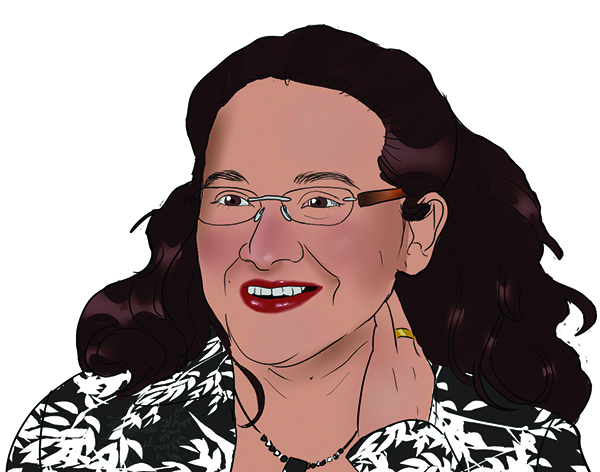
    Dr. Anthony Várilly-Alvarado; Illustration created by Ana Valle.

    Family History

    Brazil has a special place in my heart: I owe my existence to a chance encounter in 1976 between a Costa Rican woman in her late twenties pursuing a master’s degree in education, determined to make a better future for herself, and an Irish math PhD student who was following his advisor on their sabbatical at the Universidade Estadual de Campinas. After marrying in late 1978, my parents moved to Moravia, a suburb of San José, Costa Rica, where my mother had lived all her life until she went to study in Brazil. I grew up in a house built on the same modest plot of land owned by my great-grandfather; my father, Joseph, still lives there today. My mother lost a six-year battle with cancer in 2002.

    Her name was Jesusita, although most friends and family knew her as Susy. Jesusita de los Ángeles Alvarado Blanco, to be more precise. It is an unusual name, even by Latin American standards. My maternal grandmother, Julia Blanco Rojas, had been told she would have difficulty conceiving; she prayed and promised God that if she had a child she would name him Jesús. When my mother was born, Julia pivoted. My grandfather, Augusto Alvarado Montero, the oldest of five children, had many jobs in his life, including stints in his late teens picking bananas for the United Fruit Company on the Atlantic coast. He made good money doing this1 much of which he sent home to help pay for the education of his siblings. He never got to go to college.

    I didn’t meet either one of my maternal grandparents. Julia died of ovarian cancer in 1965, when my mom was 15; Augusto followed in 1973, from a stroke. Julia had a second child, my uncle Enrique, but he died young, and so by age 24 my mother’s immediate family was gone. [2] She had already completed a bachelor’s degree in science education at the Universidad de Costa Rica [3] and taught high-school chemistry at the Liceo Vicente Lachner in Cartago. A government scholarship allowed her to go to Brazil and get a master’s degree; she jumped at the opportunity, and began learning Portuguese in preparation for the trip.

    My maternal grandparents: Abuelita Julia.
    My maternal grandparents: Abuelito Augusto.

    Picking up Portuguese as a Spanish speaker is not too hard. My father Joseph, however, did not speak Spanish in 1976. But he is a quick study, and he loves to learn new languages. His path to Campinas was in some ways even more unlikely than my mother’s. He grew up in Dungloe, a small town in northwestern Ireland, the son of a policeman (and my namesake) and a homemaker, Nan Varilly (née Boyle). He is one of five siblings, all of whom worked hard to move up the socio-economic ladder from rather humble beginnings. By age 12, my father was out of the house, attending a boarding school in Letterkenny on a scholarship. Unable to attend Trinity College in Dublin [4] on account of being Catholic, [5] he studied mathematics at University College Dublin. There, he found a home and was well-supported by mentors like Seán Dineen. At age 21, he left his native Ireland for the United States, where he enrolled as a PhD student in mathematics at the University of Rochester. On Dineen’s advice, he began working with Leopoldo Nachbin, a Brazilian mathematician who had been in turn a student of Laurent Schwartz. When Nachbin asked him if he wanted to go to Brazil in 1976, my father gladly accepted the offer. [6]

    A picture of me as a baby being held by my mom, in 1981.

    Shortly after I was born, my parents decided to tear down the old house in Moravia where my mom had lived, and build a new house together. They timed their project just right: following some ill-advised monetary policy by then-president Rodrigo Carazo Odio, Costa Rica experienced a serious bout of inflation; the price of a sack of cement increased seven-fold during construction, forcing my parents to scale back their plans. By the end of the project, they were left with little disposable income. My mom often credited the guayaba and cas trees in the backyard for helping my parents get through the economic crisis, but I never understood exactly how. [7] I remember her being emotional when we had to cut down the cas tree in 1987; I was too young to understand the mixed feelings she felt towards it.

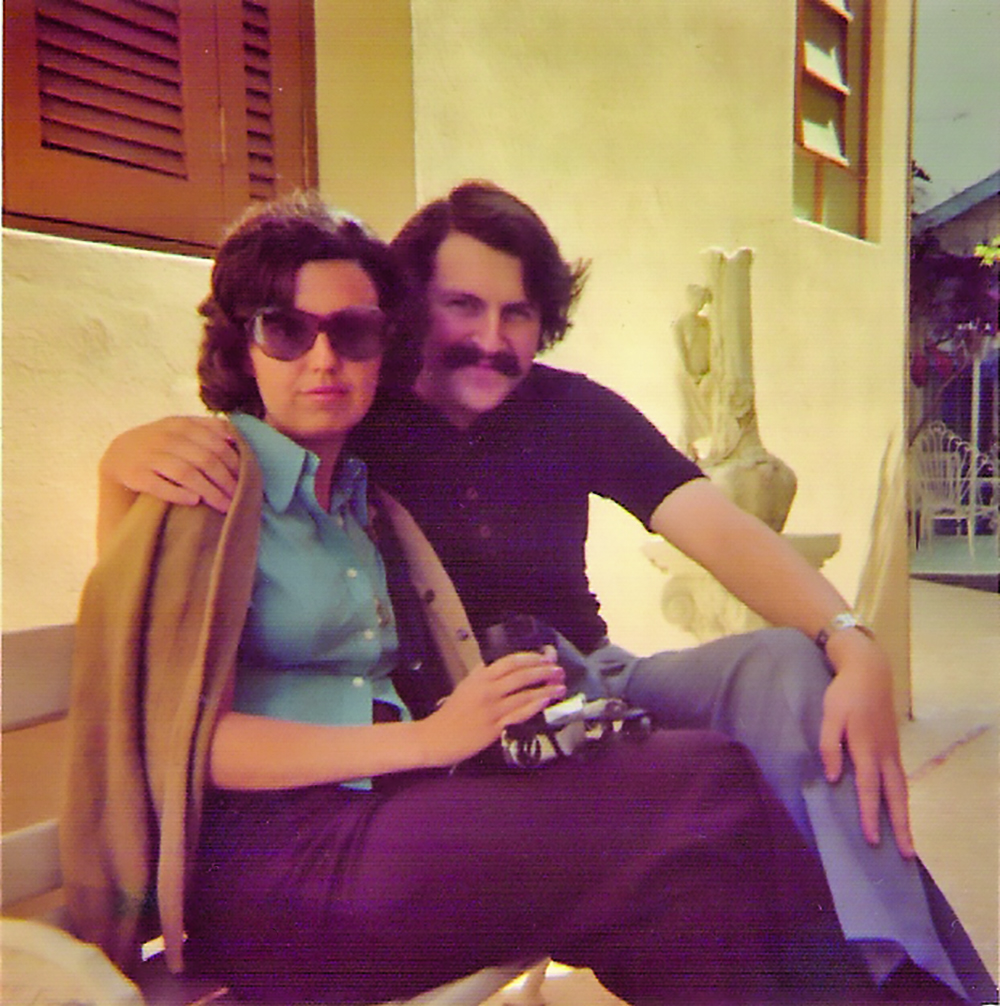
    My parents when they met.
    My father with my paternal grandparents in 1947.

    The struggles my parents experienced as they navigated the difficult economic turmoil of the 1980s were invisible to me. I was a happy kid; I loved to kick a ball around, though I was no good at it, and I collected Bazooka Bubble Gum tattoos. I entered kindergarten at the British School of Costa Rica in 1985, four years after the school began operating, and I graduated from it in 1998, having completed an International Baccalaureate (IB) Diploma. The British School is a small private school; my parents were determined to give my siblings and me the best education they could, and they wanted us to all grow up bilingual. Through most of my childhood and teenage years, my parents spent over half of their income on our education. It was a privilege and a sacrifice that we neither understood nor squandered. My mother had a few maxims she drilled into all of us. The most important one was perhaps Papito, lo que tenga que hacer en esta vida, hágalo bien, [8] but a close second was Papito, cuando yo me muera no hay herencia, sólo su educación. [9]

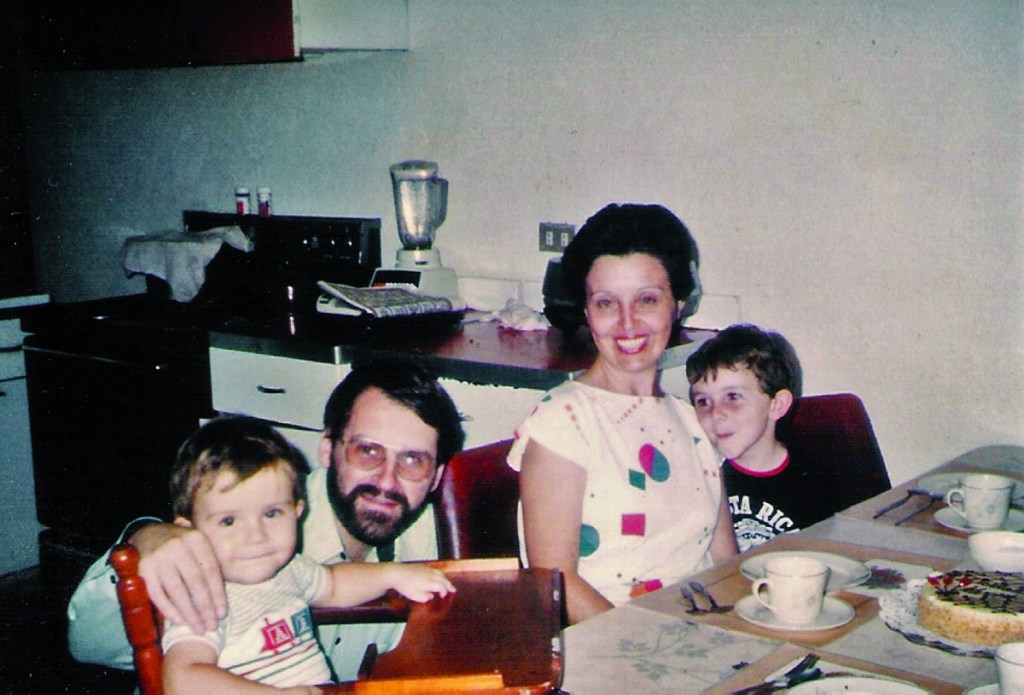
    A picture of most of the family in our kitchen. It was my mother’s birthday, circa 1986.

    Early Education

    When I was in ninth grade, on a totally ordinary morning at school, my math teacher, Paul Murray, changed my life. Right before the beginning of first period, he intercepted me on my way to class, catching his breath, and asked me to follow him. He explained that that day was the first round of the Costa Rican Math Olympiad and that the school wanted to send five students from tenth grade to it. But one of the designated team members had not shown up. “Wanna go?” Being a goodie-two-shoes, I explained to him that I did not have permission to skip class. He rolled his eyes, pointed to a bus, and said, “Just get on the bus with the rest of the team, will ya? I’ll take care of the rest.”

    I was good at math as a kid. Part of me felt like I had to be since my dad was a math professor at the University of Costa Rica. But I had never thought much of it. That morning, when I got to the first round of the Costa Rican Math Olympiad, something changed. I remember struggling for the first time. There were only 30 questions, for three hours, and they were multiple choice! But I had never seen problems like these. They required you to think in a way that school had never really challenged me. Some questions I could tell I simply didn’t have the background for, but other questions were within my reach if I only spent time toying and struggling with them. It was exhilarating.

    At eight years old.

    Throughout my childhood and adolescence, I was obsessed with astronomy. My contact with the subject came mostly from books at the University of Costa Rica’s library and the odd purchase of Astronomy magazine, of which only a few copies could be found throughout the country, at ridiculous prices; I never owned a telescope. There was no visible professional community around the subject in Costa Rica, and this reality slowly eroded my dream of becoming an astronomer. I began drifting towards subjects more grounded in reality, like civil engineering, even though my heart was not in them. Math Olympiads, together with a role model and coach in my dad, rekindled my love of abstract subjects, of the pursuit of knowledge as its own end. I have been lucky and privileged in this regard, having been raised by supportive parents who nurtured and respected my hopes for the future.

    International students in the United States often pay full tuition in college. Under ordinary circumstances, my parents did not make enough money to pay these kinds of sums, but by 1998, circumstances were not ordinary. My mother was being treated at M.D. Anderson Cancer Center, without U.S. health insurance. She would fly to Houston once a month for treatment. The hospital gave her many financial breaks, and the British School gave my brother and me a significant scholarship so we could keep attending school and finish out the IB program, but the financial strain on the family was immense. I had originally set my sights on studying abroad in England. But the fees for overseas students were simply out of my family’s means. So I started looking into American universities, armed with AltaVista, the leading search engine of the day. It soon became clear that some universities awarded need-based financial aid, even to international students. All of them, however, were very difficult to get into: Harvard, Princeton, Yale, MIT, etc.

    I’ll never know exactly what the admissions officers at Harvard saw in my application. I filled it out by hand, wrote my college essay in 45 minutes, and in the page dedicated to summer activities (usually packed by most students with summer camps, internships at companies and research labs, sports and musical pursuits), I wrote “Not Applicable” and left the rest of the page blank. To be sure, I was a good student, very academically inclined, but so are many other thousands of applicants. I had written a small paper on triangle geometry for the extended essay component of the International Baccalaureate, which I attached to my application. Perhaps it helped? I thought I bombed the in-person interview, though I later came to realize that my interviewer, Renata Villers, a Harvard alum, must have gone to bat for me in a serious way.

    Higher Education

    College years. I arrived in the United States on September 9, 1999, aged 19 and eager to study mathematics. My first semester at Harvard was rough. I felt like I was drinking out of a fire hydrant the whole time. I took Math 25: Honors Calculus and linear algebra, which wasn’t the hardest class offered to freshmen (that was Math 55), and for the first time in my life I really struggled with math, but not in the “fun struggle” kind of way. I began doubting if math was for me after all. The professor, Kalle Karu, was phenomenal, so I figured I was the problem. I confessed my anxiety to my parents, who encouraged me to keep at it, to give my dream of studying math a chance until the end of the year. At the beginning of my sophomore year, my doubts hadn’t gone away, so I began the year by taking some applied math courses, as well as physical chemistry. I loved those courses, but in the end, they made me realize how much I missed proof-based mathematics. By the fourth semester of college I was back as a math major, and I took abstract algebra from Barry Mazur and topology
    from Curt McMullen. Both were awe-inspiring instructors (and world-class mathematicians, though I didn’t fully grasp this at the time). They rekindled my love for the subject.

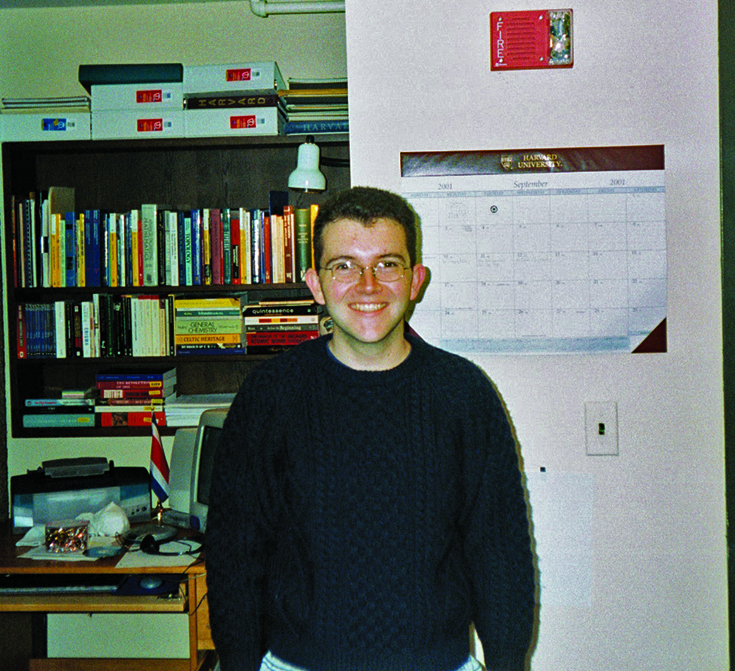
    Freshman year at Harvard.

    Looking back at freshman year, I think the problem was one of time. I worked in the dish room of Annenberg Hall, the freshman dining hall, doing shifts on Monday, Wednesdays, and Thursdays, from 4:30 pm to 8:30 pm. By the time I got home, I was physically exhausted and had a hard time focusing on homework. Like many other international students and students from underrepresented backgrounds, I took on the campus job that paid the highest hourly wage. More savvy students took on library desk jobs, where they essentially got paid to do homework. I changed course my sophomore year when I became eligible to be a course assistant in the math department, though I lamented leaving Annenberg Hall; the staff there worked fantastically hard though their efforts seemed barely noticed by the surrounding students. But if I wanted to be able to rise to the same mathematical level as my peers who didn’t have campus jobs, I realized I needed to take on a job that was more compatible with school work. I was fortunate to find such a job.

    Junior year at Harvard.

    Harvard taught me a lot of things; it was a humbling experience, to say the least. Its pressure-cooker environment is not for the faint of heart, but meeting people who are much smarter than you in what you consider your strongest suit is both disorienting and good for you. It made me realize that I liked to do mathematics because I loved the subject, not because I was decent at it. I learned that in the long run hard work will take you much further than innate talent. I also learned that meritocracy is a myth, having graduated in 2003 in the same class as Jared Kushner.

    My mother died on July 8, 2002, the summer between my junior and senior years of college. That fall, my brother Patrick started college at MIT. Through sheer determination and will power, my mother beat the life expectancy cancer sentenced her to by more time than any of us thought possible. At her funeral, several of her co-workers remarked to me that she had lived to see her dream of making sure her children went off to college.

    My family in Ireland, taken in 1994.

    If I could go back and have a do-over, I would approach college much differently. I was hard-headed, and I almost never went to office hours (this was a serious mistake). I loved working with other people, which was great, but when the time came to apply for graduate school, there were very few professors who knew me well enough to write a strong letter of recommendation. I’ve now chaired the PhD admissions committee in the Rice Math Department for six years; so I know that letters of recommendation are probably the most important part of an application. You need letters from professors who know you well, who can speak to your potential for completing a good PhD thesis. It all worked out in the end for me, but this is part of where a bit of luck and the privilege of coming from a top-ranked school with good grades have played an important role in my life.

    Graduate school. When I started graduate school at UC Berkeley in fall 2004, I had no idea what research was like in math. Research Experiences for Undergraduates (REUs) were not widespread in the early 2000s, and in any case international students were not eligible for National Science Foundation (NSF) stipends. Still, there were hurdles to be overcome before starting on research. For me, the hardest one was the advanced oral exam. I do well on written exams, but I freeze up on oral exams. To this day, when I am asked a question during a talk, I have to pause for a moment, breathe in and out a few times, and force myself to stop thinking that I am not thinking about an answer. My oral exam was rocky, to say the least. I passed it, though only because about an hour in I was certain I had failed, so I calmed down and was able to finally start thinking clearly.

    Towards the end of my second year in graduate school, I proved my first research-level result. It was a small proposition, something I needed for a project. I remember the moment distinctly: I proved something that people didn’t know already. It was a modest contribution to the sum total of human knowledge, but it was a contribution, and I was the author! That was the moment I finally believed I can do this! From there on out, I worked really hard on my thesis and a couple of side projects. Not everything panned out, and there were moments of intense frustration, anxiety, and anger at myself. I was extremely fortunate to have a strong group of friends in graduate school, including Dan Erman, Bianca Viray, and David Zureick-Brown; we supported each other through thick and thin. I also met some wonderful people who were a little older than me, at the postdoc stage, mostly at conferences, like Damiano Testa, Ronald van Luijk, and Mauricio Velasco. I learned a lot from them, and we collaborated in projects. There is no need to go at it alone. I learned this lesson serendipitously.

    We do not choose our families. But we do have a lot of say on who we let mentor us. Mentors really matter. You need many of them: no one person has all the answers and all the advice that is appropriate at all stages of your life and career. I have had many people I gladly count as mentors. Among them, my thesis advisor, Bjorn Poonen, and my postdoctoral advisor, Brendan Hassett, really stand out. I knew I wanted to work with Bjorn ten minutes after I, as a prospective student, met him. I asked him about his research, and in order to answer me, he asked three questions back, to calibrate the state of my mathematical knowledge, without judgement. Once he knew what level to pitch his answer, I was blown away by what he told me. At the time, I didn’t understand that I was drawn to Bjorn because he is a fantastic communicator. I love the area I work in, but I could have been happy doing many other things. Your relationship with an advisor is lifelong and is particularly intense during graduate school. Making sure the match between people is right is much more important than pursuing some specific subject. When picking a mentor, you should pick the person, not the subject.

    One thing that helped keep me sane through graduate school was a stable personal life. Throughout graduate school, I lived with my girlfriend, Sarah, a wonderful, caring, ambitious and supportive human being, who helped me navigate the ups and downs of graduate school. There was a semester early on where we had to live off of my $1,200 month stipend in the Bay Area (rent was $950/month), while Sarah looked for a job. Although at our poorest, I remember those months as some of the happiest of our relationship. We got married in 2010, though as sometimes happens, we grew apart and divorced a few years later. This of course was a difficult time, but I was already a tenured professor, and my work could absorb the personal shock to the system.

    Postdoctoral years. When I finished graduate school, I had some good offers for postdocs. One of them was at University of Georgia (UGA), another was at Rice. I happened to be visiting Atlanta while deciding where to go; a conversation with Danny Krashen helped me sort things out. Danny was trying to convince me to come to UGA. All I remember is that at one point he said, “OK, the truth is that there is no better mentor for you than Brendan Hassett [at Rice], but […]” I honestly don’t remember the end of the sentence. That moment crystallized things for me. I knew in my heart of hearts that Danny was right and that Brendan would be a great, if demanding, mentor. I took the job at Rice the next morning, on my way back to California. Years later I told Danny this story, and he gave out a big laugh. He told me something similar had happened to him earlier in life, and he was happy to have (inadvertently) paid it forward.

    Some of Brendan’s best advice came early on: “don’t stall, keep moving,” meaning prove the best results you can, but don’t hold off until things are optimal before releasing them to the world, at least not when you are a postdoc. Also, be proactive in your search for new research problems to work on. The other piece of advice was “don’t move away abruptly from what you know, work by analytic continuation,” meaning take advantage of what you know already, and move towards where you want to be slowly, writing papers along the way. I can very easily trace a path between a paper I wrote on Zariski density of rational points on del Pezzo surfaces over number fields and a paper constructing pluri-canonical forms on moduli spaces of special cubic fourfolds (there are four papers in between). It’d be hard to find a conference with talks in these two topics. Related to this, don’t spend six months learning an entire subject from the ground up because you might need it for a paper. Chances are you’ll eventually realize the idea won’t work, you’ll have six fewer months to write papers before you apply for tenure-track jobs, and no new paper to show for your six months of work.

    Brendan also taught me a lot about being a professional mathematician, about having long-term goals in mind, and problems of various sizes around those goals. I also learned a lot about taste from him (although this word was never used in our conversations). I learned that just because you have a hammer, and you see some nails in the distance, it may not be worth your time to go hammer those nails unless you have a good reason to do so. Our time is finite, and everyone succumbs to finitude. As you get older, you get more picky about the problems you work on, not because other problems are not interesting, but because each choice of a project closes doors on other choices. I cannot improve on David Foster Wallace on this point, so I will simply quote him wholesale:

    Day to day I have to make all sorts of choices about what is good and important and fun, and then I have to live with the forfeiture of all the other options those choices foreclose. And I’m starting to see how as time gains momentum my choices will narrow and their foreclosures multiply exponentially until I arrive at some point on some branch of life’s sumptuous branching complexity at which I am finally locked in and stuck on one path and time speeds me through stages of stasis and atrophy and decay until I go down for the third time, […] it seems unavoidable—if I want to be any kind of grownup, I have to make choices and regret foreclosures and try to live with them. [10]

    My own outlook on life is nowhere near as gloomy as DFW’s. I feel only gratitude for the privilege that I do something that I truly love that I get to share with students and colleagues. I have forfeited many other careers, some much more lucrative than my own. But I have no regrets about my choices. I once asked Ryan Hynd what he would do today if it were his last day on Earth. Without missing a heartbeat, he said, “same thing I had planned on doing this morning. And if that’s not your answer, then what the hell are you doing with your life?”

    Tenure-Track and Beyond

    In late 2011, I applied for tenure track jobs. There was a job opening at Rice, and even though it was a dream to stay there on a more permanent basis, it is highly unusual in mathematics for an institution to hire one of its postdocs into a tenure-track position. On a late Friday afternoon in mid-November, David Damanik, then the head of the appointments committee, knocked on my door and asked me if I was interested in interviewing for a tenure-track position at Rice. I’m not sure I kept my cool, but I immediately told him I’d love to.

    “Good. How about Monday?”
    This was a bit shocking and caught me unprepared. I mumbled something about teaching two classes on Monday.
    “OK. Tuesday then?”

    Realizing I could not delay the future much longer, I took the date. The interview went as well as it could have, though I didn’t hear back about an offer until February. I was not the top choice for the job, and that’s OK. I’ve never felt like I have a chip on my shoulder for that. Every year, hundreds of people apply for each available tenure-track position at a research-intensive university. I was under no illusions that I was somehow the department’s top choice for a position, though I did feel like I could rise to the challenge of the job. The top choice candidate could only take one job; thankfully, they didn’t want the job I dreamed of taking.

    I earned tenure in 2016, and in 2019, ten years after setting foot at Rice as a newly minted PhD to take on a G. C. Evans instructorship, I was promoted from Associate Professor to Full Professor. Never in my wildest dreams did I imagine that that’s what the future held in store for me when I first arrived in Houston. [11] Although I have worked tirelessly to get to where I am today, I recognize the luck and the privilege that have smoothed out my journey, and the sacrifices my forebearers made so that I could have opportunities to thrive. With a seat at the table, I now have the chance to help others thrive. I do not intend to waste the chance.

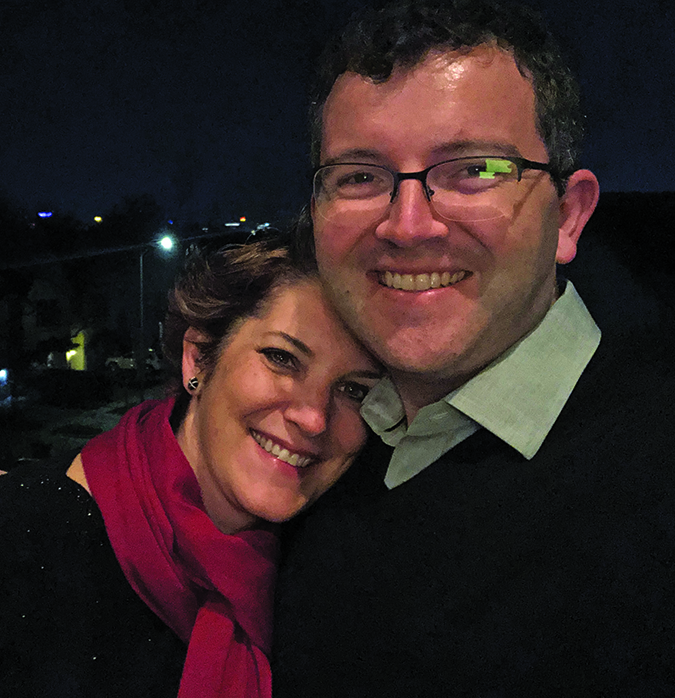
    With my partner, Carey.

    Today I live in Houston with my partner Carey, a smart, thoughtful, kind, and independent person I am happy to share my life with. We have both suffered loss in our previous marriages, and this perspective, afforded by failure, pushes us to make sure we don’t fall into the same traps of the past, or revisit mistakes. Before the COVID-19 pandemic we used to enjoy the arts and music scene in Houston, and we traveled together extensively. The pandemic brought a lot of our activities to a screeching halt, but we have found new hobbies together.

    Research

    Most of my work to date is in an area called arithmetic geometry. I study Diophantine equations through a geometric lens. Perhaps the most famous Diophantine problem is Fermat’s Last Theorem, which states that the only solutions to

    xn + yn = zn; n ≥ 3

    are those for which xyz = 0 (i.e., at least one of x, y, or z must be zero). A decade before Wiles gave his spectacular proof of this result, arithmetic geometers already had good reasons to believe that Fermat’s Last Theorem is true: for each n, the Fermat equation defines an algebraic curve on the projective plane, and the general theory of curves already showed that, for each n ≥ 4, there could be at most finitely many solutions to Fermat’s equation. For a detailed explanation of how this is the case, I invite you to watch my talk at the 2020 Joint Mathematics Meeting titled The Geometric Disposition of Diophantine Equations. [12]

    Chalkboard with a glimpse of my research.

    I’ve spent the better part of the last ten years studying equations that give rise to geometric objects called K3 surfaces. One of the most incredible surprises of my life has been a collaboration with people coming from electrical engineering, government security, and coding theory, to develop a geometric framework behind efficient systems for cloud storage, using K3 surfaces! I never expected that my knowledge reservoir on algebraic surfaces would be helpful in applications. Most projects I’ve worked on had applications internal only to mathematics when I began them, but now I’ve found that people from many kinds of applied fields can use these tools. I am currently working with earth scientists, using algebraic geometry to understand micro-layers of the earth’s mantle from earthquake data! Theoretical mathematics has a lot to contribute to the world, but you have to understand it at a deep level in order to make the connections to the world around us.

    I have the rare privilege of having a father who is also a mathematician. He works on non-commutative differential geometry. Our work within mathematics is quite distant, but we share a common basic language that allows us to explain to each other our recent papers. In 2017, we finally converged in a conference, the Mathematical Congress of the Americas, in Montreal. And in 2020 he came to Denver to watch the lecture linked to above, which was an invited address of the American Mathematical Society at the Joint Math Meetings. I feel incredibly lucky to be able to share this connection with him.

    Conclusion and Advice

    Some advice is peppered throughout the narrative above. Rather than rehash it all, I’ll offer some further pointers for different stages of an academic career.

    With my Dad.

    Undergraduate years. Less is more: fewer math classes, done excellently. This is a marathon, not a sprint. Early on, take proof-based linear algebra, abstract algebra, real analysis, and if possible a course in point-set topology (not all at the same time, of course!). Go to office hours. Connect meaningfully with your professors. Always ask why. To quote Ravi Vakil: “What is a group?” is not a great question. A better question is “Why is a group?” Whenever you meet a new definition, play with it through examples and ask yourself: why would anyone think it’d be a good idea to formally codify this concept?

    Graduate school. The first year will be brutal. Hang in there. When you get over the hurdles of written and oral qualifying exams, your world will be turned inside out: up to this point, the pressure to get things done has been external, framed by structured coursework, homework, exams, etc. Now it’s up to you to generate some internal fire to work on a research project. Think of it like a full-time job. Make sure you put in 40 hours of work per week. Above all, don’t go through it alone: find a group of friends who can act as a support network. Read and criticize each others’ work. When you look for an advisor, choose the person, not the subject.

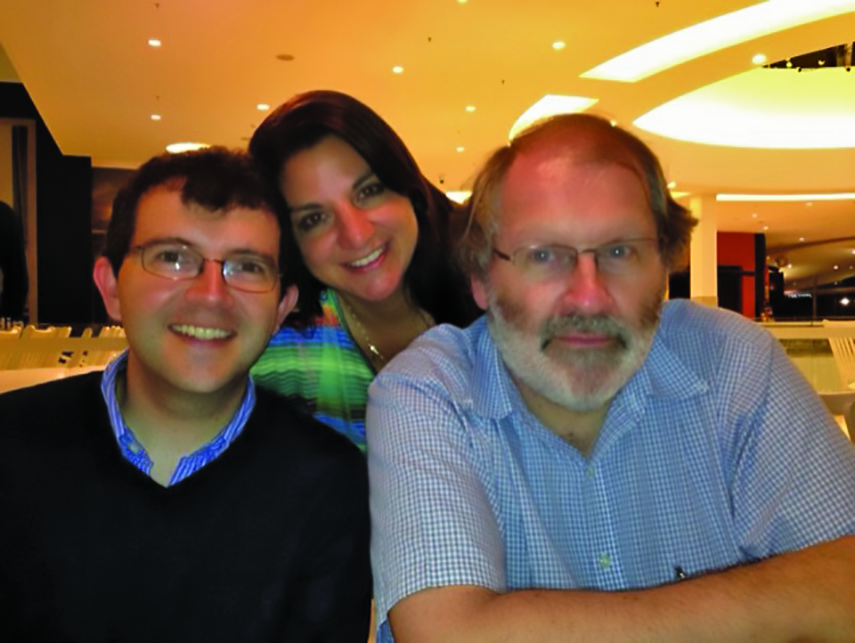
    With my sister, Paola, and my dad.

    Postdoctoral years. This is a hard, lonely time, with new mountains of responsibility. A good match with a postdoctoral mentor is key, but keep in mind that they are not your thesis advisor. Work hard, but take personal days regularly. Write all the papers you can, at the sweet spot intersection of interesting, feasible and within (or just beyond) your reach. Lean on your mentor to help choose projects.

    Tenure-track years. Keep your eye on the ball. Minimize committee work. Keep writing papers. Enjoy the flow. Otherwise, why are you doing this?

    Tenure. Keep moving. Time to give back. You will be busier than ever before, but in a good way. Mathematics requires community. You are now in a position to effect changes in that community, and by doing so, improve it. Do so.

    Related to this last bit of advice, and perhaps most counterintuitively: be a bit selfish during your development as a mathematician. We Latinx people have strong family cultures, and often seek out opportunities to give back to a community that has given us so much. You will do so, in due course. First, get a seat at the table. From there you will be able to help more people than you ever dreamed of.


    [1] This is not to say that the working conditions were good; see the chapter A la sombra del banano in Carlos Luis Fallas’s novel Mamita Yunai, originally published in 1940. (Yunai is a transliteration of Uni(-ted), the way in which most Costa Ricans referred to the United Fruit Company.)
    [2] My mother had a stepsister, my aunt Nelly, who was 15 years older. For reasons that were never clear to me, they were not close in the 1970s. Whatever the rift was, time helped heal the wound, so I grew up with an aunt and older cousins whom I’ve always been fond of.
    [3] My mom was never one to complain much, but I do recall a certain amount of bitterness when she talked about her college years: textbooks were both difficult to find, and often unaffordable, so she had to work off of her lecture notes as the sole course materials. The situation today has partially improved—textbooks are not as hard to find.
    [4] Trinity College alumni include George Berkeley, Edmund Burke, Samuel Beckett, William Hamilton, Erwin Schrödinger, Jonathan Swift, Oscar Wilde, and many others.
    [5] The restriction was counterintuitive: only after 1970 did the Catholic Church stop forbidding believers from attending Trinity College without special dispensation.
    [6] Keen readers will note that the Mathematical Genealogy Project lists Gérard Emch as my father’s PhD advisor. This is correct; things didn’t work out in the end with Nachbin, and my father switched advisors halfway through graduate school.
    [7] After showing my father a first draft of this testimonio, he explained: each night for some time, he and my mother would collect the windfall cases and guayabas and sell them to the local grocer. This would pay for the next day’s bus fares to their workplaces.
    [8] “Whatever you have to do in this life, do it well.” My father would usually abbreviate it this to “whatever you do, do it well,” although his favorite version, following Robert Heinlein, is “anything worth doing is worth overdoing.”
    [9] “When I die, there is no inheritance, only your education.”
    [10] This little reflection is embedded in A supposedly fun thing I will never do again.
    [11] As it happens, Houston already had a special place in my heart, even though I had never been to it: attentive readers will recall that my mother was treated at M.D. Anderson Cancer Center (without U.S. health insurance!) for the last few years of her life.
    [12] A link to the talk is provided here: youtube.com/watch?v=GnE2lFJ1x-Y.


    Previous Testimonios:

    • Dr. James A. M. Álvarez
    • Dr. Federico Ardila Mantilla
    • Dr. Selenne Bañuelos
    • Dr. Erika Tatiana Camacho
    • Dr. Anastasia Chavez
    • Dr. Minerva Cordero
    • Dr. Ricardo Cortez
    • Dr. Jesús A. De Loera Herrera
    • Dr. Jessica M. Deshler
    • Dr. Carrie Diaz Eaton
    • Dr. Alexander Díaz-López
    • Dr. Stephan Ramon Garcia
    • Dr. Ralph R. Gomez
    • Dr. Victor H. Moll
    • Dr. Ryan R. Mouruzzi, Jr.
    • Dr. Cynthia Oropesa Anhalt
    • Dr. Omayra Ortega
    • Dr. José A. Perea
    • Dr. Angel Ramón Pineda Fortín
    • Dr. Hortensia Soto
    • Dr. Roberto Soto
    • Dr. Richard A. Tapia
    • Dr. Tatiana Toro

    Brian P Katz (BK)

    August 15, 2023
    Uncategorized
  • Testimonios: Dr. Tatiana Toro

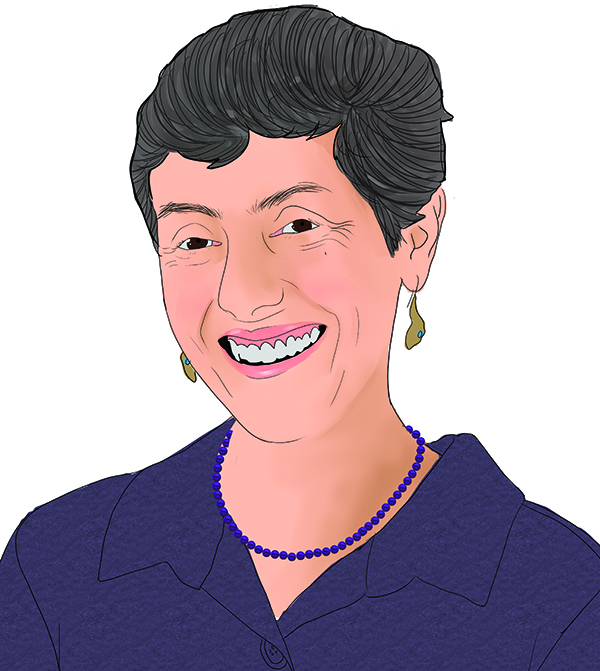
    Dr. Tatiana Toro; Illustration created by Ana Valle.

    Early Life

    The family. My father’s family is from Antioquia, a department in northwest Colombia, lying mostly within the Andes mountains and extending toward the Caribbean Sea. The paisas [1] in my family are mestizos [2] mostly of Spaniard descent. My father, Gabriel Toro, is one of ten siblings. He grew up on a farm, where from the age of six he had to work alongside his brothers and his father as jornaleros [3] tending to the sugar cane crop. His mother and sisters cooked for the day laborers. My father attended school at most six months of the year when sugar cane was not in season. The first time he wore shoes was the day of his first communion; it was the same pair of shoes his brothers before him had worn for their first communion. He got his own first pair of shoes at the age of 17, when he left the farm and moved to Bogotá to start medical school at the Universidad Nacional de Colombia. Despite his struggles with food and housing insecurities, my father graduated from medical school at the top of his class. He obtained a fellowship to study neuropathology at Charles University in Prague. He crossed the Atlantic by sea during the summer of 1959. He returned in 1962 after obtaining a PhD and turning down a job offer in Prague and one in Havana, Cuba.

    My mother’s family is from Huila, a department in southern Colombia, spanned by the Andes mountains. The opitas [4] in my family are mestizos mostly of indigenous descent from the Yalcón pueblo. My mother, Gladys Calderón, is one of four siblings. She grew up mostly in Zipaquirá, a small town near Bogotá where her father was a school teacher. My grandfather Carlos Julio Calderón was the eldest of fourteen children. When his father died of “sadness” during the great depression, he buried his wishes of becoming a physician and went to work to support his mother and his siblings. Gabriel García Marquéz, the winner of the Nobel Prize in Literature in 1982 was my grandfather’s student in Zipaquirá. Gabo’s dedication to my grandfather in his first novella La Hojarasca read: A mi profesor Carlos Julio Calderón Hermida, a quien se le metió en la cabeza esa vaina de que yo escribiera. [5]

    My grandmother Carmen de Calderón was a school teacher who believed in education as a means to achieve success and who fought for the rights of her daughters to attend college. My parents, both first generation to attend college, met in medical school. They got together when my mother was beginning her residency in pathology and my father had just returned from Prague. I was born two years later under difficult circumstances. Because my father had been labeled a communist and despite being the only neuropathologist in the country, he was unable to find a job; he had been banned from most hospitals. My mother was very ill toward the end of the pregnancy and had a long road to recovery after my birth. My first few years of life were financially challenging for the family. By the time my brother was born, when I was almost four, the situation was a bit more stable.

    Grade school. At age four, I started school in the Lycée Français Louis Pasteur in Bogotá. I was very lucky to have been accepted to the only private co-educational, non-religious school my parents could afford. The French government subsidizes these schools in developing countries to ensure that their citizens abroad have access to an education that is comparable to the one they would get in France. Having the opportunity to attend this school opened many doors and played a fundamental role in my deciding to study abroad.

    When I think back to my grade school years I think of my best friend who I met in kindergarten 50 years ago. Our friendship started from the shame we experienced to have to wear suspenders. The school uniform required grey wool skirts. These were expensive so to ensure that they lasted a while our mothers had bought a bigger size and put suspenders to hold them in place. This brings me to the second thing I remember about the school—a deep sense of not belonging. The majority of the kids at school were from a very different socioeconomic class, the children and grandchildren of several Colombian presidents attended the school while I was a student there. The third thing that comes to mind are the math classes.

    In first grade we learned set theory. We drew Venn diagrams on the playground and used the teacher’s giant blocks (a huge magnification of our own set) to study unions and intersections. We were given a lot of freedom and I could not imagine a better math class. That year we also learned how to count in different bases. With a partner, we used wood structures that resembled buildings, small plastic boxes and beans to count in different bases and to translate between two different bases. It was wonderful.

    We learned algebra in sixth grade from a beautiful book that I still remember fondly. At that time the French school system tracked students after ninth grade. I chose the math track. We learned calculus, linear algebra and some basic analysis in tenth, eleventh and twelfth (seconde, première, and terminale).

    In 1981, the United States hosted the International Math Olympiad (IMO) for the first time. The U.S. decided to open the competition and invited several countries that had never attended before. Colombia was allowed to bring an eight-person team. The Colombian organizing committee invited a large number of schools in Bogotá to send up to four representatives to participate in the process put in place to form the team. By chance, I ran into the four boys (all in twelfth grade) that had been chosen to represent my school, as they were leaving to go to the first meeting. I asked the school if I could go with them. They told me they were only invited to send four kids, since I was in eleventh grade they did not include me. They told me that I could try to go as an individual, but that the school would not sponsor me. I went to the first session, explained my situation and was allowed to stay, participate in the training and in the qualifying examinations. I made the team. At that stage the school decided to sponsor me!

    Although I did terrible in the competition which took place in Washington D.C., participating in the 22nd IMO in 1981 changed my life. I met a number of students who planned to study mathematics after high school; I did not know that was a life option. The French and the French-Canadian kids explained the path they were planning to follow, they were going to go to les écoles preparatoires aux grandes écoles (the preparatory schools for schools like Polytechnique, École Normale Supérieure, etc.) for two years, then take the exams for these schools and go study more mathematics. During those ten days I gathered as much information as possible: what the best preparatory schools were, what the application process looked like, what grades were needed on the baccalauréat, where people lived, etc.

    Going to one of those preparatory schools became my main goal. For a Colombian girl in 1981 this was a science fiction scenario, not even a dream. I worked very hard to get the grades I needed in the baccalauréat, filled out the application and found out from the start that these programs heavily favored boys. For example, the schools provided boys with housing in the dormitories and forced girls to find housing elsewhere. Initially, I did not even pay attention to this detail, I was determined to make this work. I was accepted to a couple of places and decided to attend Lycée Louis Le Grand in Paris. Interestingly, the main roadblock I encountered was societal: in Colombia in 1981, young women were supposed to live at home until they got married. It was unheard of for a teenager to move to Paris on her own. My father’s colleagues and siblings told him that no respectable father would ever allow such a thing to happen; it was considered the road to perdition.

    Higher Education

    France. I turned 18 in the summer of 1982, so as an adult I did not need my father’s official permission to leave the country. With my mother’s support and against my father’s wishes, I left for Paris. I was very naive, in my great scheme I had not considered the difficulties of living in a foreign country without any support system, especially coming out of a tight-knit family. Being able to only talk to my parents and my brother for a maximum of ten minutes twice a week was heartbreaking, first the anticipation and then the disappointment that the communication was bad and the time was too short. International communications were inefficient and extremely expensive, twenty minutes a week was all we could afford. My year in France was extremely difficult; I was very home sick. To my surprise, the school environment was dominated by deeply rooted male chauvinism. My thought was that after seeing the machismo [6] in Colombian society I had seen it all. I was wrong. In September, my class had 53 students, eight of whom were women. By the end of the academic year, only five women were left.

    Some of the things I recall from the classroom conditions were that tests were returned in descending order of performance and the grades were read out loud. Students were regularly called to the board, loud disparaging comments were common as was the impassive attitude from the math teacher. I recall confronting him, in front of all the class for allowing this abusive environment. The physics teacher was a woman and I recall thinking at the time that it must have been very difficult for her to get where she was. My academic performance, which was deeply correlated to my emotional state, oscillated between very good and terrible. My support system included my aunt who lived in Sicily and who I was able to visit twice, and a dear friend, who I met at the dorm, and her family who basically adopted me. Thanks to their incredible support I managed to finish the academic year. I went back to Colombia for the summer wondering whether I would be able to come back for a second year. The experience had been grueling, my parents financial situation was dire and given my performance during the first year, the school placed me on the track to enter an engineering school. I was not interested in becoming an engineer.

    Colombia. I returned to Colombia, took the entrance exam for medicine to the Universidad Nacional de Colombia in Bogotá and passed. As I was supposed to register to enter medical school I realized this was a mistake. It was not possible to transfer to the mathematics program that semester, but physics was an option. So I started my first semester as a physics student in the fall of 1983. This was very fortunate as I was able to immediately enroll in the physics lab that was required for math students in later semesters. In Spring 1984, I transferred to the mathematics program. On May 16, 1984, the Universidad Nacional de Colombia witnessed the bloodiest day in its history. After the kidnapping, torture and murder of a student from the campus in Cali, student assemblies and a demonstration were programmed for that day. Very soon the demonstration turned violent and the army was authorized on campus. As a result, students died and went missing, soldiers and policemen were injured, and the university was taken over by the military, surrounded by barbed wire and closed for over a year.

    Those were dark times, I had a sense of having wasted a golden opportunity in France. I was unable to attend college as the National University (a public institution) was closed and we could not afford a private school. During that period I learned how to knit as a way to cope with stress, and I also started to learn English. My mother thought it might come in handy. I did not agree with her. Given the role the U.S. had played in Latin America through the years, I could not imagine why anybody would want to live in the U.S. I only agreed to start because my mother was making such an effort to keep me engaged and preventing me from sinking further into depression. I also decided to learn math on my own.
    In the fall of 1984, faculty were allowed back into their offices. I wrote a petition asking that I be allowed to take exams for the courses in the major. I proposed to study on my own (if possible consulting with a faculty member from time to time) and then, when ready, take an exam on the subject. A passing grade in the exam will amount to passing the course. My initial petition was denied, but with time they accepted. The only prerequisite to be able to do this was to have taken the physics lab course I had completed during my first semester. It was a lucky coincidence.

    This is how I did most of my undergraduate studies. By the time the university reopened in 1985, I had passed a large number of the required courses to graduate with a degree in mathematics. I took math courses in person for a total of three semesters: one as a physics student, half before the closing and one and a half after the reopening. I had exhausted the offerings by then. A graduation requirement was to have been registered for four semesters. Fortunately, I was missing a history course, which was the only class I took my last semester. I received a BS in math from the Universidad Nacional de Colombia in December 1986.

    Three of my professors encouraged me to pursue a PhD in the U.S. I knew I wanted to learn more math, although I had no idea what one did with a PhD in math. I also knew I did not quite fit in Colombia, and that I might do better somewhere else. The English lessons came in handy after all. Furthermore, it was more the hardships and the challenges that I had faced than the mathematics I had learned that prepared me to succeed in graduate school.

    Becoming an Immigrant

    Stanford. I started graduate school at Stanford University in Fall 1987. I had assumed that there would be very few women in the program. Nevertheless, I recall being surprised during the welcoming event for the graduate students: there were 17 new graduate students and only one woman. Although less than 10% of the graduate students were women, the environment was healthier and more respectful than it had been in France. The graduate students were a very cohesive and supportive group. During the first quarter, in the complex analysis course, I met my future advisor, Leon Simon and my future husband, Dan Pollack. Leon was teaching the course, Dan was the TA. My English level required that I take a course to improve my spoken fluency. Dan used to joke that the homework for the English course was to find a gringo [7] boyfriend. I used to watch the news everyday as a way to improve my English. The first few months were exhausting.

    My advisor was demanding, firm, and straightforward. He deeply valued hard work. These were all characteristics that suited my learning style and spoke to my work ethic. We all have moments of doubt along the way. In the summer of my third year in graduate school, things were not going well. I was unable to focus on research and therefore was getting nowhere with work. In the back of my mind was a nagging question: What was somebody like me doing in a PhD program? My country was falling apart and I was doing nothing to contribute to the community I came from. My life at Stanford felt artificial and meaningless.

    One day, toward the end of that summer, Leon asked me to go for a walk. He wanted to understand what was going on. He listened as I explained what I was thinking. He told me that from what he heard about the situation, he could infer that in Colombia I would be an easy target and that he doubted I would be listened to or given a chance to develop any of the ideas I had in mind. Then he told me that if I really wanted to help my country and my community I should become the best mathematician I could be, that that would give me the platform I needed. I am immensely thankful to him for that walk, for what he said and for how he said it. I have wondered many times what would have happened if we had not gone for that walk. Maybe this is a good place to mention that walking plays a huge role in my life. I walk an average of five miles a day. Some of the most important decisions in my life have been made while walking and some of the most important conversations I have ever had have occurred during long walks. I have walked sixty miles in three days for a good cause.

    I obtained my PhD in 1992, after the fall of the Berlin wall in November of 1991 and the Tiananmen square protests in June 1989. These two events changed the world and the landscape of the job market for mathematicians in the U.S. I was fortunate to secure jobs that allowed me to continue through the academic path. Many of my classmates were not so lucky.

    Through my experiences in Palo Alto and Menlo Park (two very affluent communities neighboring Stanford), as well as through interactions with some of the undergraduate students I taught, I learned that the color of my skin and the way I looked were considered appropriate topics of conversation, as well as reasons to assume I was uneducated and could be taken advantage of. This was a revelation, and something I have reflected upon through the years. I was 23 the first time somebody made it clear that I did not belong in her neighborhood and mocked me under the assumption I did not speak English. I have spent time trying to understand what happens to a person when this abuse starts as a child. I acknowledge that the reality of a Latinx individual born or raised in the U.S. can be very different from mine.

    Professional career. After Stanford, I spent a year at the Institute for Advanced Study in Princeton, a year at UC Berkeley and two years at the University of Chicago. I met Carlos Kenig in Chicago. He has been a friend, a mentor and a wonderful collaborator through the years. In 1996 we moved to Seattle. I am half of a two-body problem [8] and the University of Washington (UW) offered us two tenure-track positions in a beautiful place, at a time when positions were very scarce. It was an offer we could not refuse. I went through the ranks at UW. I was promoted to Associate Professor in 1998 and to Full Professor in 2002. Initially my professional focus was in research. I followed Leon’s advice to become the best mathematician I could be.

    Over the past twenty-five years my research has developed in several distinct, but interconnected directions of analysis: partial differential equations (PDEs), harmonic analysis and geometric measure theory. The most representative theme of my research in PDEs corresponds to the theory that weak notions of regularity are well adapted to the study of boundary behavior of solutions to elliptic PDEs and to free boundary regularity problems. The success of this program, initiated in Chicago with Carlos Kenig, has significantly expanded our knowledge in this field. It has solidified the theory that weak notions of regularity are suitable to study this type of problems, which thus far had only been considered in terms of classical notions of regularity. These ideas have opened a new area in analysis. They were a central theme of the harmonic analysis program at Mathematical Sciences Research Institute (MSRI) in the spring of 2017 and of the research term at Instituto de Ciencias Matemáticas in Spain in the spring of 2018.

    I have been recognized with a number of prestigious invitations; I have been a speaker in the analysis session at the International Congress of Mathematicians (ICM 2010) in Hyderabad, India and in the 23rd Nevanlinna Colloquium, ETH, Zurich in 2017. I have given a number of named lectures, among others the NAM Clayton-Woodard Lecture at the Joint Mathematics Meeting in 2016 and the inaugural AMS Mirzakhani lecture at the Joint Mathematics Meeting in 2020. I am a Member of the American Academy of Arts and Sciences (2020), a Miembro Correspondiente de la Academia Colombiana de Ciencias Exactas, Físicas y Naturales (2017) and a Fellow of the AMS (2016). I have been awarded the Blackwell-Tapia Prize (2020) and the Landolt Distinguished Graduate Mentor Award from the University of Washington (2019). Furthermore my research has been continuously supported by the National Science Foundation since 1994.

    I have had the good fortune to work with wonderful groups of junior mathematicians: graduate students, postdoctoral fellows and beginning assistant professors. I have made an effort to create vertically integrated groups where team members are both mentors and mentees. Seeing young people grow mathematically and flourish professionally has been very rewarding. They have brought me lots of joy.

    Some of my mentees, who refer to themselves as “Toro-ites.’’

    I serve the mathematical community in different roles: as co-chair of the Scientific Advisory Committee at Mathematical Sciences Research Institute, as a member of the Board of Trustees of the Institute for Pure and Applied Mathematics (IPAM) at UCLA, as a member of the Board of Directors of the Banff International Research Station in Banff, and was a member of the Board of Directors of the Pacific Institute for the Mathematical Sciences (PIMS) at the University of British Columbia, Vancouver, Canada until early 2020. Currently I am a member of the U.S. National Committees for the International Mathematical Union. I was an elected member of American Mathematical Society (AMS) Editorial Boards Committee (2016–2019) and I currently serve as an elected member of the AMS Nominating Committee.

    In winter of 2012, there were several CAMP students in the calculus class I taught. The College Assistant Migrant Program (CAMP) at the University of Washington is federally funded through the U.S. Department of Education’s Office of Migrant Education. It is designed to reach out to and support students from migrant and seasonal farm-worker families during their first year in college. CAMP students are asked to get progress reports from the faculty after each test. The students started coming to my office because they were required to and then kept on coming. One of them talked to me after the final exam about how much it had meant to them to have me, somebody who looked like them, in a room with over 230 students with whom they did not identify. That same student told me that although she was not quite sure what a mentor was or did, she wanted to ask me to be her mentor. I am very happy to share that she is now a third-year medical student at UW, fulfilling her life’s dream.

    In 2013, in recognition of the small number of Latinxs in the mathematical sciences and motivated by my experiences with the CAMP students, I brought the idea of a conference for Latinxs in the mathematical sciences to Russ Caflisch, at the time the director of IPAM and to Alejandro Adem, at the time the director of PIMS. Their support and the hard work of my co-organizers brought my idea to fruition in 2015. The first Latinxs in the Mathematical Sciences Conference (LATMATH) was held in April 2015. Over 150 people participated, including undergraduate students, graduate students, postdoctoral scholars and faculty, and researchers in industry and government. Additionally, a group of high school students participated in a math circle and attended a panel featuring UW’s President Ana Mari Cauce, among others. The CAMP student who inspired me to organize the event was also there. The participants expressed enthusiasm for another LATMATH Conference. The second edition took place at IPAM in March 2018 with over 250 participants. Sponsors included National Science Foundation, National Security Agency, Elsevier, the Mathematical Sciences Institutes through the Diversity Initiative, UCLA, Facebook and UW. I am extremely pleased that this conference is now one of the programs in the Diversity Initiative of the Mathematical Sciences Institutes. Latinxs are significantly underrepresented in math and science. There are many problems that contribute to this deficit, and the solution must be multifaceted. This conference is one step in the right direction. The third edition of the conference is scheduled to take place at IPAM in March 2022.

    Issues of equity and underrepresentation are at the forefront of my professional interests. I believe that a solid scientific platform allows me to address these issues in settings where they are seldom discussed. To be successful we need to be represented all the way from the bottom to the top of the professional and academic ladders.

    Family. This testimonio [9] starts with the family and ends with the family. As a Latina there is nothing more important than my family. I am very thankful to my grandparents, my parents, my aunts, my husband Dan and my children Samuel and Sara for their love and support. Dan, Samuel and Sara have kept me honest, have inspired and challenged me. They have always believed in me. They have made my life richer and have given me the strength to always go forward.


    [1] A paisa is someone from a region in the northwest of Colombia, including the part of the Andes in Colombia.
    [2] A mestizo is a person of mixed ancestry.
    [3] Jornaleros are the equivalent of day laborers.
    [4] An opita is someone from the Huila region of Colombia.
    [5] The quote translates as “To my professor Carlos Julio Calderón Hermida, who had in his head the idea that I ought to write.’’
    [6] A strong or aggressive masculine pride.
    [7] In Spanish-speaking countries and contexts, the word gringo is used to describe a person, especially an American, who is not Hispanic or Latino.
    [8] The two-body problem in academia describes the difficulties an academic
    [9] testimony


    Previous Testimonios:

    • Dr. James A. M. Álvarez
    • Dr. Federico Ardila Mantilla
    • Dr. Selenne Bañuelos
    • Dr. Erika Tatiana Camacho
    • Dr. Anastasia Chavez
    • Dr. Minerva Cordero
    • Dr. Ricardo Cortez
    • Dr. Jesús A. De Loera Herrera
    • Dr. Jessica M. Deshler
    • Dr. Carrie Diaz Eaton
    • Dr. Alexander Díaz-López
    • Dr. Stephan Ramon Garcia
    • Dr. Ralph R. Gomez
    • Dr. Victor H. Moll
    • Dr. Ryan R. Mouruzzi, Jr.
    • Dr. Cynthia Oropesa Anhalt
    • Dr. Omayra Ortega
    • Dr. José A. Perea
    • Dr. Angel Ramón Pineda Fortín
    • Dr. Hortensia Soto
    • Dr. Roberto Soto
    • Dr. Richard A. Tapia

    Brian P Katz (BK)

    July 15, 2023
    Testimonios
  • An open letter to the MAA

    A billboard by the Human Rights Campaign that reads, "Gov. Ron Desantis welcomes you to Florida: The Sunshine State", but with a red sticker over Sunshine which reads "Don't say Gay or Trans"
    The MAA should take some notes from the Human Rights Campaign and have more honest advertising for MathFEST 2023.

    MathFest is the the Mathematical Association of America’s flagship annual conference, which draws in mathematics researchers, educators, students, and enthusiasts from across the US to a different US city each year. In addition to the talks, poster sessions, mini courses, town halls, and opportunities for networking that bring people to the conference, Project NExT – MAA’s professional development program for recent PhD’s focusing heavily (but not exclusively) on teaching – holds large parts of its programming in the days leading up to and during MathFest.  Despite significant community outcry, the MAA has forged ahead with their decision to hold MathFest 2023 in Florida. Moreover, the MAA has failed to provide any significant measures to mitigate risk or allow for participants who are unable to attend in-person to participate in the conference virtually.

    In this post we are sharing a letter we sent to the MAA MathFest 2023 organizers as a group of mathematicians who are opposed to the MAA’s decision to hold MathFest in Tampa. In particular, we are concerned about the safety of many participants in the wake of Florida’s recent wave of harmful legislation targeting trans people, reproductive health care, immigrant rights, and scholarly work related to African American history and gender studies. We discuss our concerns and what we feel are the bare minimum steps that MAA needs to take to mitigate the risks of harm for MathFest’s attendees in more detail in the letter below.

    Regardless of any in-person safeguards that MAA may put in place, this year’s MathFest will not be a safe event for trans people, for undocumented immigrants, or for many other members of our community, including disabled people.

    -an excerpt from our open letter

    This letter was sent on June 15th (via email) to the MathFest organizers, including MAA’s president, executive director, and both the current and incoming Project NEXT directors. At the time of this posting, we have received responses from both the current Project NEXT director, Dave Kung, and MAA’s president, Hortensia Soto. However, neither of their replies substantively addressed our outlined asks (and, frustratingly, most of our asks were not even acknowledged).

    We encourage the broader math community to join us in these demands by sending this letter (or using it as a resource/template) to the MAA MathFest organizers in solidarity with the mathematicians most affected by MAA’s decisions on this matter. A list of the emails we sent it to is included at the end of the letter. We also recommend sharing this blog post in your social circles including your departments and social media.


    Dear MAA MathFest organizers,

    We are reaching out because we feel alarmed and angered by the insistence that Tampa is a wonderful place to do math for all in the recent promotional materials arriving in our inboxes. The state of Florida is currently at the vanguard of a reactionary charge against immigrant rights, women’s rights and LGTBQIA+ rights with a particular focus against trans rights. Moreover, scholarly work is directly under attack as the teaching and learning of African American studies and Women and Gender studies is being banned from schools and libraries across the state. A few instances of these attacks include the nationally covered prohibition of books regarding fundamental parts of American History such as the enslavement of Black Americans, the banning of trans people from using the bathroom of their gender in government buildings (including convention centers), the legalization of discrimination in healthcare on the basis of gender identity and sexuality, among other attacks on LGTBQIA+ rights and the persecution of undocumented immigrants.

    These policies make Tampa and the state of Florida a particularly hostile place to have a math festival that strives to include and support the participation of a racially and gender diverse group of people. We believe that the statement on the MathFest website falls short in acknowledging that while in theory these bills may not explicitly bar attendance of certain groups from MathFest, each additional hurdle will certainly prevent many people from attending in practice. Keri Ann Sather-Wagstaff’s and Spencer Bagley’s MAA Focus article contributions included many arguments for why holding MathFest in Florida would be dangerous. However, since the MAA has continued to forge ahead with their decision to hold MathFest in Florida, extra steps must be taken to mitigate these risks. Moreover, although MAA may wish for a safe and welcoming environment for all, the optimism expressed in the conference’s promotional materials is intentionally misleading and exclusionary.

    Regardless of any in-person safeguards that MAA may put in place, this year’s MathFest will not be a safe event for trans people, for undocumented immigrants, or for many other members of our community, including disabled people. Therefore, our most urgent request is that you provide an online participation option. As mentioned on the MathFest website, expanding reactionary legislation may pose an insurmountable barrier to people traveling to attend, so hosting an inclusive conference requires finding ways for the participation of those who will be unable to attend in person. We understand that providing a quality online experience can be expensive and difficult, but after the last few years, we collectively have a wealth of experience in enabling remote participation, and this would be an expenditure of money that is aligned with MAA’s stated organizational values.

    We also ask that you include a thorough travel advisory on your website with explicit mention of Florida’s harmful and hateful legislation targeting trans folks, undocumented immigrants, and Black and Gender studies scholars. The MAA’s recent statement on “What MAA is doing to keep you safe and welcome” falls short on this ask in several ways. It did not:

    1. Explicitly name the groups primarily affected by these policies. In particular, it did not once mention trans people.
    2. Address concerns regarding the policing of attendees’ gender expression in gendered restrooms. This should be explicitly discussed in the conference code of conduct.
    3. Offer any legal protections to undocumented individuals at the venue.
    4. Provide any detailed and concrete safety plans to address scenarios such as the police being called on somebody using the restroom or a conference attendee requiring immediate medical care that has been criminalized in Florida. Such plans would include immediate support during the emergency and continued legal support afterwards.
    5. Add anything to the programmed material beyond what was initially planned on how individuals and the MAA as an organization will respond and organize against these dangerous and reactionary policies.

    The NAACP, the Florida Immigrant coalition, the League of United Latin American Citizens, Equality Florida, Spectra, Particles for Justice, and a collection of concerned mathematicians have all released statements that contain resources addressing different aspects of these attacks and could be useful when crafting a travel advisory for the MAA MathFest. The MAA’s travel advisory also needs to acknowledge that while these policies may attempt to mitigate the risks, they do not entirely eliminate them. Claims that MathFest will “pass this test with grace and dignity” are premature at best. Even if the MAA could ensure the conference venue was safe, Tampa being broadly more accepting does not make off-site, state-sanctioned discrimination impossible. For example, family restrooms at the airport do not replace trans people being allowed to use what restroom they choose, and everyone using a gendered restroom is at risk of having someone decide that they do not belong there.​​​​​​​

    Finally, we ask that all of your promotional materials going forward include a prominent link to the travel advisory and an announcement that there will be an online option for participation. Statements about how “Tampa loves math” along with depictions of the conference location as a perfect vacation destination are incongruent with the reality that many people will be put in immediate physical and psychological danger if they attend. 

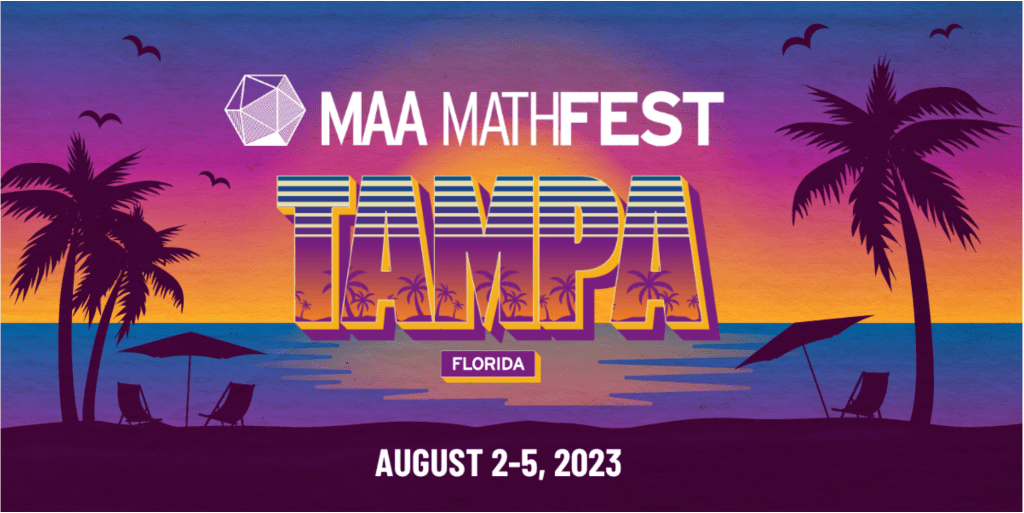
    The MAA graphics for the 2023 MathFEST, which read "MAA MathFEST Tampa, Florida, August 2-5, 2023" over a sunset beach illustration.
    The MAA advertising Tampa as an unproblematic, carefree vacation destination in the year of our Lord 2023 is…. quite the choice.

    By taking these measures, MAA would be setting a strong example for other many professional organizations, both in and out of mathematics, going forward. We hope this would also have a significant impact on how the MAA plans its own future conferences. Being proactive is especially important for large conferences such as MathFest since planning starts early and decisions are costly to change. The MathFest website mentions that in 2021 MAA leadership had looked into moving MathFest 2023 but was unable to move it without incurring a significant financial risk due a contract signed in 2018 that did not include clauses for cancelation due to changes in legislation. An example of specific and actionable language such a contract could use can be found in this blog post about the 2012 APSA annual conference being scheduled in New Orleans. The MAA’s future planning will need to be more nuanced than simply classifying states as either safe for conferences or not; in a country built on genocide and enslavement, no state is safe for all marginalized communities. All locations have risks. However, the risk profiles of different locations are neither identical nor static, and every stage in planning a conference needs to address the risks associated with the conference’s location and how those risks are evolving.

    Best regards,

    Spencer Bagley, Westminster University

    Matthew Durham, University of California Riverside

    Padi Fuster, University of Colorado Boulder

    Piper Harris, University of Toronto

    Max Lahn, University of Michigan

    Marissa Loving, University of Wisconsin-Madison, MAA AWM Section Lecturer

    Seppo Niemi-Colvin, Indiana University

    Florencia Orosz Hunziker, University of Denver

    Ben Stucky, Beloit College


    We sent this letter to the following people:

    MAA Meetings & Events: meetings@maa.org

    Hortensia Soto (MAA President):  hortensia.soto@colostate.edu

    Michael Pearson (MAA Executive Director):  mpearson@maa.org

    Matthew DeLong (MAA Chair of Meetings Committees):  mdelong@marian.edu

    Dave Kung (current Director of Project NeXT):  david.kung@austin.utexas.edu 

    Christine Kelley (incoming Director of Project NeXT):  ckelley2@unl.edu

    Marissa Loving

    July 13, 2023
    Institutions, Mathematical Association of America
  • Testimonios: Dr. Richard A. Tapia

    Testimonios: Dr. Richard A. Tapia
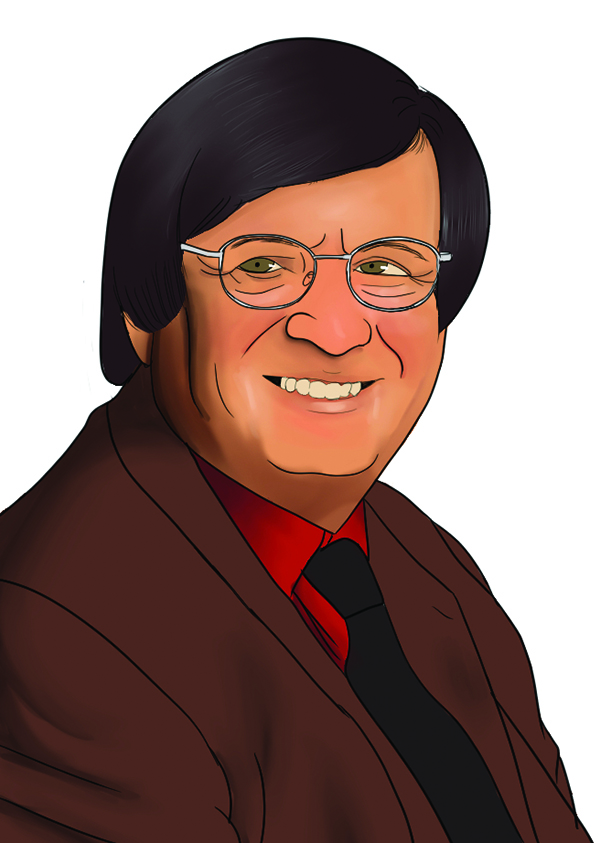
    Dr. Richard A. Tapia; Illustration created by Ana Valle.

    My Story—Made in America [1]

    Frankly, if you don’t know me, you may be wondering why you should care about my life or my work. In a nutshell, I have succeeded—against all odds—well beyond what anyone, including me, but excluding my wife and mother, ever would have dreamed. In 2017, the Houston Chronicle featured what they called the 36 most fascinating individuals in Houston. There I was, proudly next to Simone Biles [2] and her four Olympic gold medals. I hold the highest academic position at Rice University—University Professor—only the sixth person to hold this position in the 100-year history of the university and of course, the first Hispanic. The Blackwell-Tapia Mathematics Conference and the Tapia Celebration of Diversity in Computing Conference are named in my honor. I have received eight honorary doctorates from prestigious universities and given eight commencement addresses.

    I was elected to the National Academy of Engineering. President Clinton presented me with the inaugural Presidential Award for Mentoring in 1996, and in 2011, President Obama honored me with the National Medal of Science, the highest award given by the U.S. government to an American scientist or engineer; in 2014, I won the prestigious Vannevar Bush Award from the National Science Board; in February of 2017, the American Association for the Advancement of Science (AAAS) awarded me the Public Engagement in Science Award.

    Receiving the National Medal of Science from the 44th American President Barack Obama (2011).

    For all of these awards, I was the first U.S.-born Hispanic recipient. I say all this not to brag, but to convince you of my credibility. I marvel at what an individual can do in America. Yes, I have lived the American Dream, but it was without the apple pie. I call my life story “Made in America” because even though I have a Mexican heritage, I was molded in America and feel American.

    I embrace the word Tejano, popularized by the late Selena, [3] and closely identify with the Tejanos. After all, I have lived in Texas for half a century; however, I was born and raised in California, so I can never be accepted as a true Tejano. Hence, I am both an honorary Mexican and an honorary Tejano. I am proud to say that here I am in my early 80s and I consider the four papers that I have recently written in my late 70s the best papers of my entire career. That is the way we minorities are. We often start late (I got my PhD at age 30) and get better with age. I have always loved mathematics, and in return mathematics has been very good to me. It has given me wonderful opportunities and much satisfaction.

    My Family

    My parents Maria Magdalena Angulo (Magda) and Amado Bernal Tapia came as impoverished children from Mexico to Los Angeles seeking an education. Times were hard, as they had to support themselves and were not able to obtain the education that they sought. My mother came to Los Angeles alone, and lived with and was influenced by a Jewish family from the age of 12 to the age of 19, when she married. A similar story applies to my father, but in his case the family was Japanese. My mother went no further than middle school, my father finished high school. However, my parents’ educational dreams were fulfilled through their children. I have a twin brother, Bobby; a sister four years younger, Ana; a sister, Rebecca (Becky), who is seven years younger; and a brother, Steve, who is seventeen years younger. [4] Out of five children, four of us have undergraduate degrees and three of us have graduate degrees. I am a product of these Mexican parents, the city of Los Angeles, and the time period of the 1960s. My father worked extremely long hours—often leaving the house for work before we got up and returning after we had gone to bed. They were hard working, good people who came here for better lives and they found them. They certainly gave as much to this country as they received from it.

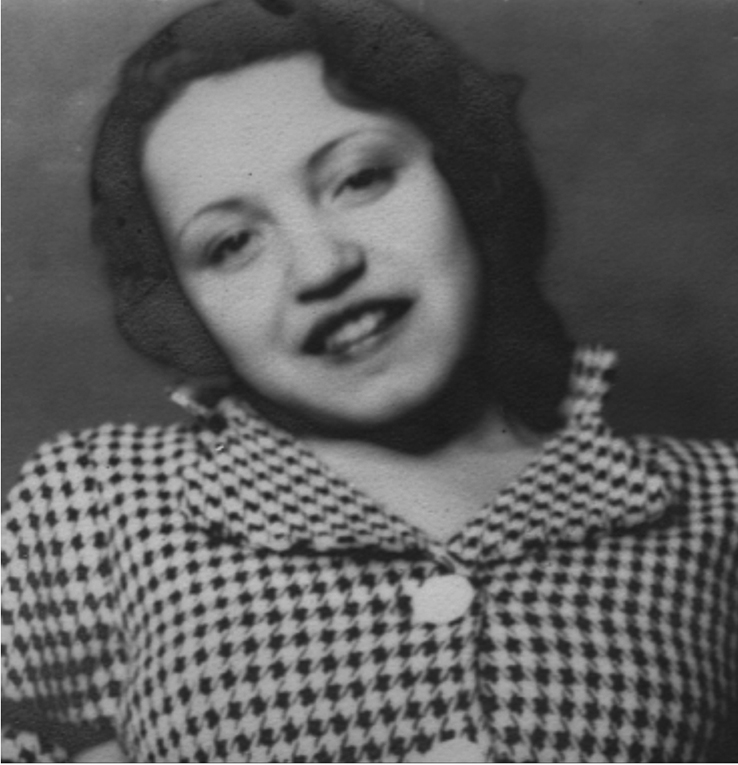
    My mother Magda.

    Although my parents were so very proud of being Mexican—while their hearts probably remained in Mexico—they adapted well to the new world and definitely made it work for their children. My father was inclusive, and everyone loved him. To this day my wife Jean claims that he is one of the people she loved most. While not everyone loved my mother as much as they loved my father, everyone respected her. She was well focused and strongly directed. As I reflect on my mother’s teachings, I summarize them as: 1) Be proud; 2) Believe that you can (sí se puede); 3) Demonstrate good work habits; 4) Strive for global excellence.

    My father Amado.

    School Days

    In the winter of 1943, Bobby and I started kindergarten at Dayton Heights Elementary in the Los Angeles Unified School District (LAUSD) and not far from our house in central Los Angeles. We were well groomed, but our dress style was outdated and we looked different from our male classmates. Our teacher Marjorie seemed to be quite fond of Bobby and me, and we felt it. The experience was a pleasant one, as we mostly listened to stories and played games with the other kids. On the other hand, Mrs. Anson’s first-grade class was a different story. Bobby and I would not join in group singing or participate in any oral activities. We were extremely shy and much more comfortable speaking Spanish than speaking English, but the language of the class was 100% English. Mrs. Anson called our mother to ask if Bobby, the quieter of the two of us, had any speech problems. Of course, she said no and decided that we would start speaking English at home.

    We moved to Torrance from central Los Angeles in the summer of 1946. While our house had a mailing address of Torrance, California, it was technically in the Los Angeles Strip, a narrow region that runs from Los Angeles to San Pedro. At the time, the Strip was not well developed and was heavily populated with so-called “Okies.” [5] We started school in Torrance (actually in Carson) in September of 1946 at Carson Street Elementary. The next year we were zoned to Halldale Avenue Elementary School in Torrance. As I reflect, I remember good things about Halldale. Our fourth-grade teacher was Mrs. Bentwood. She was the best teacher in the world. Realizing that Bobby and I were shy, she tried hard to bring us out. We were the only Mexican-Americans in the class (school). Whenever in reading or social studies we would encounter a Spanish word, she would ask either me or Bobby to pronounce it correctly in front of the class. When we would do math, she would excuse me from the new material saying that I already knew it and she would have me tutor the students who were behind. She made us feel good about who we were, perhaps for the first time in school.

    Bobby and I later went to Narbonne High School in Lomita, California for both middle school and high school. Due to crowded conditions, the middle school went in the afternoon and the high school in the morning. So, Bobby and I were free in the afternoons during our high school days. We spent all our afternoons and evenings working on cars, reading hot rod magazines, and listening to early 1950s music. Our passion was cars and drag racing. Bobby became a world-class driver and was elected to the National Hot Rod Association (NHRA) driver Hall of Fame.

    Narbonne was an extremely low-performing school, arguably the lowest in the district. In spite of my low-performing school, I did well academically, especially in mathematics, and was considered a star. Yet no one—no teacher, nor any counselor—ever suggested that I could or should attend college. Few students from Narbonne went to college. Low expectations have hurt so many potentially excellent minority students.

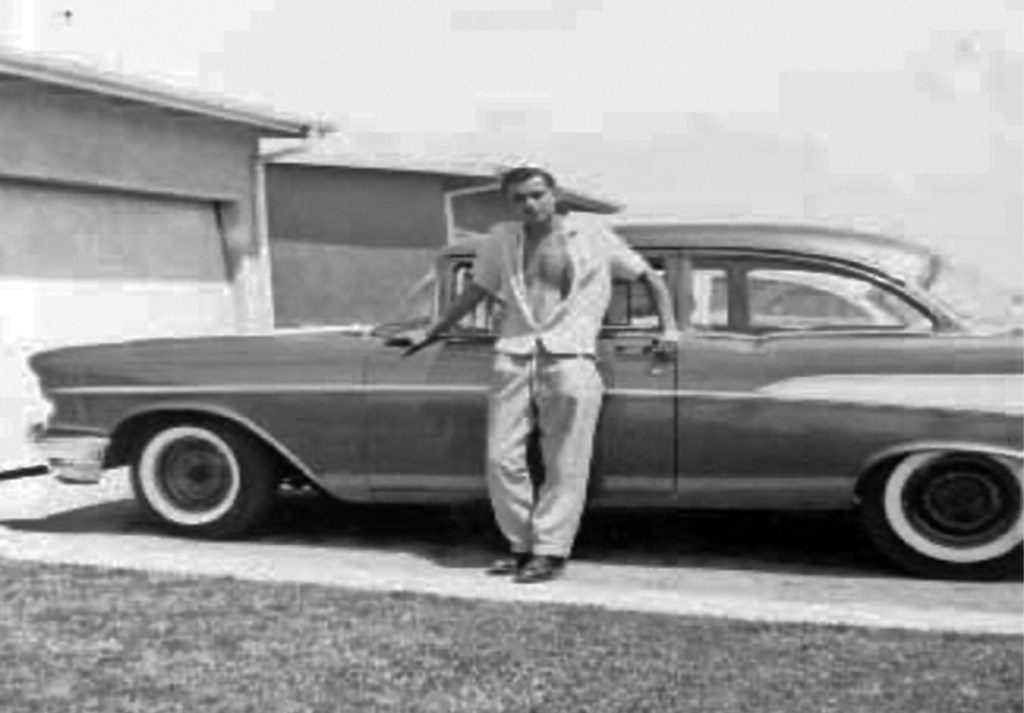
    Me and my ‘57 Chevy.

    In eleventh grade, the American Mathematical Society promoted mathematics appreciation among local Los Angeles high schools by administering a mathematics test to each school. The schools with high participation rates would be acknowledged. During an assembly, Principal Barnett encouraged participation by saying that the individual with the best score at Narbonne High School would be acknowledged and given an award in an assembly in front of the entire school. This was exciting. I took first place. Mr. Barnett called me to his office and said, “Congratulations, here is your pin.” I immediately asked, “But what about the assembly?” He replied, “There will be no assembly.” This deeply hurt me. I was so much looking forward to shining in front of the entire school. To this day, I am confused as to why there was no assembly. I even entertained the ridiculous thought that it was because I was a rare Mexican-American in an “Okie” school.

    Pursuing Higher Education

    Since no one encouraged me to pursue higher education, after graduating from Narbonne in January of 1956 I went to work in a muffler factory. I was happy working in the hot sun next to an individual from Mississippi who told me “Richard, do not make my mistake. You are smart, go to college.” By the end of summer I could take no more and ran off to Harbor Junior College (HJC) in Wilmington, California in September of 1956.

    I have fond memories of Professor Friedman’s calculus class at HJC. Several of my friends and I would sit in the last row. Every Friday we had a 20-point quiz. I would get 20 points, my neighbor would get 19 points, and the next neighbor would get 18 points, on down the line. Friedman explained the difference in scores by saying that the person that originated the answer got the most points, then the person who got it next would get second highest, et cetera.

    During my time in junior college I met Jean, my future wife, on April 21, Easter Sunday, of 1957. She was 15, about to turn 16, and I had just turned 19. We dated extensively through the summer of ‘57 and in September, her mother sent her to New York to continue her ballet studies at New York City Ballet. In Christmas of 1957, a friend of mine and I, at the spur of the moment, decided to drive to New York to visit Jean. I got back late and missed an exam in Professor Friedman’s calculus class. Since I had never received a B in a math class, he said that he would give me an A in the course if I scored 100% on his final. There were five questions, I easily did four. But I did not know how to do the fifth. So, I thought and thought and finally came up with an approach. Friedman was not confident that the approach was correct and gave me no credit for that problem. I asked him to tell me what was wrong with my approach. After a day or two, he gave me full credit saying I had rediscovered an old theorem that was not well known.

    Professor Friedman was perhaps the best math professor I have ever had; he told me to not go to a state school, but go to UCLA after junior college; so I did, in the Fall of 1958. At UCLA they told me that I could have been accepted with scholarship help if I had applied out of high school. No one ever told me that or even hinted at that. But there I was at UCLA, what a wonderful occurrence. I was a math star in high school and in junior college, but not at UCLA. I was just good enough. I survived by working hard for the first time in my life.

    My path to graduate school was not certain or smooth. As an undergraduate math student at UCLA, I was an A-B student, but mostly B’s. I had no illusions of going to graduate school on the strength of this record. In my senior year, two of my classmates told me that they were applying to the UCLA Mathematics Department for graduate school. I knew that I had done better and had more mathematical talent than both of them, so I applied and was accepted.

    But there was a problem. I had married as a sophomore and had a daughter as a junior, and Jean and I supported ourselves by working part-time. We were really broke. Moreover, I had taken out several student loans for my undergraduate education, forcing me to delay my acceptance and work for a year and a half. In that time, I worked for Todd Shipyards in San Pedro, California, on a grant from the United States Navy’s Bureau of Ships. The project consisted in using mathematics to define the surface of a ship. When the project finished in 1963, I returned to UCLA for graduate school. The Todd Shipyard experience reinforced my view that I needed a PhD in order to take a leading role in interesting projects. The time I was in graduate school at UCLA, from 1963 to 1968, was an exciting period in U.S. history, especially in California. The 1960s was my favorite decade and it was as wild and exciting as people say it was. Until this time, I knew that I was Mexican-American, but at UCLA in graduate school, I became Chicano.

    Of the nearly 300 graduate students in the UCLA Mathematics Department, I was the only domestic Latino. That did not really bother me because few Latinos attended my high school. When I started graduate school, there was one Black student. Naturally, we became friends, but he was a victim of the qualifying exams and had to leave UCLA. Classwork seemed fairly routine. I was not a star in class, but I was good enough.

    For two years of graduate school, I had no financial support from the department, so Jean and I worked part-time, staggering our hours so one of us was always with our young daughter, Circee. I worked part-time as a supplemental (student) employee for IBM in Westwood Village near UCLA. And on weekends, I worked for my father at La Fleur nursery in South Gate, California as a salesperson. Jean worked as a PBX operator at Saint John’s hospital in Santa Monica and taught social dancing at Arthur Murray Dance Studios. In spite of all this work, we had a great social life and attended parties weekly. Often, we would stay up all night partying and then go directly to work the next morning after going to a coffee shop for breakfast. I would take naps on the fertilizer stacks at La Fleur nursery.

    My twin brother Bobby joined me at IBM. Our boss at IBM was a very charismatic and smooth senior executive named Joe Mount. Joe had a PhD in math from UCLA. Putting great importance on the choice of advisor—and rightly so—he directed me towards choosing his former advisor, Professor C.B. Tompkins, as my advisor. Tompkins had been an excellent mathematician in his day; however, he gave me no guidance on choosing, researching, or writing a thesis. I was left alone to choose a problem, do all the research, and write the thesis. Tompkins did not even know what my problem was about. However, Dave Sánchez, a member of my doctoral committee, entered into the later stages of the process and guided me in rewriting my thesis, “A Generalization of Newton’s Method with an Application to the Euler-Lagrange Equation.” At one point, I told Professor Tompkins that I was making little research progress on my thesis because I was working too many hours outside of the university. So, he went to Professor Magnus Hestenes, the director of the Office of Naval Research-sponsored UCLA Institute for Numerical Analysis and was able to obtain a research assistantship for me. I then quickly finished my thesis, a respectable contribution to the math literature.

    Struggles with Identity

    As I grew up, I was often told by ignorant people “Mexican, go back to where you came from.” When I visited Mexico at the age of 13, I was told “Gringo, go home.” So my confusion led me to ask where do I belong, what is my identity? I am not a white American and I am not Mexican. At UCLA, in the mid 1960s, I would discover that my proper identity was being Chicano. That has served me well for my entire life. Soy Chicano! So the roles that I identify with and make me happy are: Chicano, Tejano, mathematician, and car enthusiast.

    Put those four identities into one and you get something that looks like this image taken from the cover of SACNAS News.

    Cover of SACNAS News.
    Photo courtesy of SACNAS (Society for Advancement of Chicanos/Native Americans in Science) sacnas.org.

    When I was at UCLA there were foreign Latino graduate students and faculty, but we did not really understand each other. They did not understand me as a Chicano growing up in the United States and the resultant extra baggage. Until I met Professor David Sánchez, a 1960’s Chicano, I believed that to be a successful math graduate student or math faculty member you had to be from another country. Sánchez was an appropriate and excellent role model for me. He knew well the path that I had traveled. We quickly bonded, and he served as the mentor and role model that I needed, but did not know that I needed. Foreign Latino faculty could not serve that function for me.

    The Spanish language, which plays the dominant role in defining us Latinos, can also play a role in dividing us. When I first meet a foreign Latino, they invariably speak to me in Spanish. I can see that this clearly strengthens our newly formed relationship. However, my experience has been that this bond will sooner or later be challenged by my lack of proficiency with the Spanish language. Yes, I have been intimidated by native Spanish speakers all my life; hence, how can they serve as role models for me? I say this, not to air personal grievances, but to explain the complicated Latino identity issues that may impact mentoring among Latinos. As Latinos, we are not all the same and here is why it matters: If you hire a foreign Latino as faculty and think that he or she will be able a priori to mentor well your domestic Latino, that may not be the case at all.

    Recently, one of our Chicano graduate students, who was born and raised in Los Angeles, decided to attend a meeting for Latin American graduate students at Rice. He is not fluent in Spanish, but at the meeting they all spoke Spanish and made fun of him, calling him a “fake Mexican.” He said he made a big mistake and will never attend those meetings again. I completely understood him and shared his discomfort. To be an active member of the Chicano movement in the late 1960s you did not need to speak perfect Spanish. Maybe I take pride that my identity is formed, in part, by my deficiency in Spanish. Being Chicano asserts my identity. Being Latino does not carry the same impact because it is far too broad and weak a distinction. I have been scarred over this issue of fluency in Spanish. This makes me react in a defensive manner as if I have a chip on my shoulder, which I probably do.

    Now, it is perhaps interesting to compare this impact that the Spanish language has on me with the impact that the language of mathematics has on me. If I walk into a room full of world-class mathematicians, I do not experience that same feeling of deficiency even though many of them will be far more proficient in the language of mathematics. But here I can stay quiet until we reach my area of expertise, where I can run with the world’s best and may even lead the race.

    Minority students are more likely to be inspired by those with whom they identify. Some believe that I am unnecessarily picky, but can’t they see the importance of this? The experiences of URM [6] students place them in contact with non-URMs all the time. Although it would be unrealistic to assert that only URM faculty can be of value as mentors and guides for URM students, it is important to cultivate the mentorship pool to include mentors made from the same fabric as the URM students.

    The Professoriate and More

    David Sánchez was the only domestic Latino mathematics faculty member at UCLA when I was a graduate student and he was on my doctoral committee. Upon graduation, he asked me what I was going to do. I replied that I did not know and would probably take an industrial job. He said that I should try academia. I had never thought of that, but told him that it sounded exciting, so I would consider it. Sánchez and Lowell J. Paige, the chairman of the UCLA Mathematics Department, called Barkley Rosser, the Director of the Army Mathematics Research Center at the University of Wisconsin Madison and convinced him to offer me a postdoctoral position. When I received the offer, I told Jean, by now my wife of nine years, to pack up our belongings and our two children because we were going to Wisconsin.

    Spending the next two years at The Mathematics Research Center (MRC) was the best decision I have ever made in terms of my professional career. I was no longer a student and had an opportunity to run with the big dogs: world-class mathematicians like Barkley Rosser, I.J. Schoenberg, and Michael Golomb. They treated me like a colleague; I was no longer a student and running with the best in the world. When I went on the job market after being at the MRC for two years, I had multiple excellent offers from Tier 1 Research Universities. Jean and I accepted a position at Rice University in Houston, Texas. I have to wonder how many of us URM mathematicians would rise to the top of our fields if we are given opportunities like I was given at the MRC.

    I started at Rice in 1970 as an assistant professor. At Rice I just wanted to be a good professor in terms of research, teaching, and service to the department and the university. However, I soon saw that as an URM who had traveled that challenging road, I could be very effective in mentoring and working with both undergraduate and graduate URM Science, Technology, Engineering, and Math (STEM) students. Moreover, there was a great need and there was no one who could step up to the plate. I immediately faced a critical decision that would challenge and plague me throughout my entire career. This is the delicate balance between professional activities, mainly research, that would be rewarded and outreach activity that would not be rewarded, but was so much needed. We young URM faculty had heard many alarming stories about minorities not being promoted for various reasons.

    It became clear to me that I should get tenure before I start doing significant outreach, so I did. Nothing tests an individual’s survival skills better than figuring out the path to promotion with tenure and then following it. Too often, young faculty do not seem to possess or exercise the needed skills. I was really quite good at university survival. I received a promotion to associate professor with tenure in 1972, essentially in record time.

    I always understood that you had to write many papers to secure tenure (they need not be great, but must be good enough to be published in good journals). You can write books and conduct high-risk, challenging, and truly important research after you gain tenure. As I reflect back, I probably advanced too early, but I made it, and it moved me even further towards the front of the bus. At times, I felt that I was driving the bus. Our chair suggested that I had such good visibility in the Rice community because I was an URM, and I had such good teaching evaluations because I had long hair. He may be right on the former point, but not on the latter point. I was now in a secure position to embrace giving back in terms of addressing underrepresentation. I can help because I have been there and I understand, and now I have tenure. The first thing that I did in terms of outreach was found the group Rice Association of Mexican-American Students (RAMAS) in 1972. In the photo below, you see our original group. We did have one woman in RAMAS, but she was absent for the picture. That was the gender balance in those days.

    Molding of Leadership—Rice Days

    Rice Mexican-American Student Group.

    The maids, the janitors, and the groundskeepers were almost exclusively Mexican at Rice. They were so proud to see one of their own at the faculty level and they showed it in their respect for me, the first Mexican-American faculty member. They could not speak English, so they were overjoyed that there was a faculty member with whom they could identify with, and that they could talk to in Spanish. In contrast to the foreign Latinos that I described earlier, my bond with these women was outstanding; they were my people. One day several maids came to my office saying that there was something important that they wanted to tell me—their boss, the director of buildings and grounds who was well-connected, was stealing from Rice. I asked these maids if they could have their immediate supervisor come and talk to me about this accusation. Mr. Cruz came and repeated the identical story. While I was trying to figure out what to do next, I was told by the maids that Mr. Cruz had been fired by the director of buildings and grounds. It seemed that he learned that Cruz had talked to me. At this time colleagues had shared with me that the German Department was trying to get rid of an excellent non-tenured young woman faculty member so that they could retain a not-so-excellent non-tenured male faculty member.

    It was clear now that I must go to then Rice President Norman Hackerman with my two concerns. Hackerman was forceful, direct, and talking to him seemed like standing in front of an approaching Mack truck. Yet, he was a brilliant and well-recognized chemist and at the time he was the chair of the National Science Board. I decided to visit President Hackerman and relate my two concerns. My stories did not fall well with President Hackerman. He sternly told me that my stories could not be true and that I was an enemy of the university. I so clearly remember those words. I now realize this was a bold move, since I did not have tenure at the time, and furthermore, a few months before, I had a verbal confrontation with then Rice Provost Frank Vandiver at a general faculty meeting over some comments that he made in reference to minorities as faculty. About a week later, I was called back to the president’s office. He told me that the German Department issue had been taken care of, that Cruz would be reinstated with back pay, that the top boss had been fired, and that he was going to nominate me to the National Science Board. He did nominate me, but I was not elected because I was junior faculty, and members of the National Science Board are distinguished scientists and administrators. However, I was elected some 25 years later. I realized that this was Hackerman’s way of saying he respected my bold style.

    Throughout my career I have been an active and visible leader at Rice. I was an active member of the undergraduate admission committee for six years. I was the chair of the Mathematical Sciences Department for five years, and I founded the President’s Lecture Series of Diverse Scholars. I directed the National Science Foundation sponsored Alliance for Graduate Education and the Professorate for more than ten years. I founded the Tapia Center for Excellence and Equity in Education. In addition, I was a good citizen, good teacher, and good researcher. I gave Rice excellent national visibility in many components.

    Molding of Leadership—Beyond Rice

    In 1968, the Chicano movement in Los Angeles and at UCLA was alive and strong. It was then and there that I found my identity. In 1972, New Mexico Medical School Professor Alonzo Atencio, with funding from the National Institutes of Health, called together a group of 17 young fresh science professionals to discuss the formation of an organization that eventually would be called Society for the Advancement of Chicanos and Native Americans in Science (SACNAS). We were brown with some shades of red, all male because that was the way that science representation was at that time. We desperately needed the support of each other, for only we, certainly not our university colleagues, growing up in this country, faced in our professional life. Chicano gave me an identity, and SACNAS gave me a family that supported that identity. Our first meeting, in 1973, consisted of 50 young professionals getting together in Atlantic City, New Jersey. Over the years our membership grew and at the 2019 SACNAS annual meeting more than 4,000, mostly brown undergraduate students, attended. The early SACNAS members became more than my professional family—they became my family.

    As an applied mathematics professional, I also became actively involved early in my career in the applied mathematics organization Society for Industrial and Applied Mathematics (SIAM). I attended its annual meetings, joined committees, gave talks, and served as conference organizer for several highly visible SIAM annual conferences and special conferences. My SACNAS and SIAM activities brought me nominations to prestigious committees, including the National Science Board, a Clinton presidential appointment. This visibility coupled with my research activity and well-recognized mentoring and direction of women and underrepresented minority students in turn led to prestigious awards, including selection to the National Academy of Engineering (first Latino ever) in 1992 and the National Medal of Science (only Latino ever) awarded by President Obama in 2011. This followed the creation of the David Blackwell–Richard Tapia Mathematics Conference in 2000 and the Richard Tapia Celebration of Diversity in Computing Conference in 2002. By now I had become a well-recognized national STEM leader with far more than my share of prestigious awards.

    Advice to Students and Mentors

    It is said that what does not break you strengthens you. I surmise that I am not completely broken, but the personal tragedies of my dancer wife Jean battling multiple sclerosis for more than forty years, our daughter Circee’s accidental death, and our son Richard’s bouts with personal issues have caused me to live increasingly close to this boundary of being broken. I would trade my numerous awards and honors, and my wife Jean would suffer through multiple sclerosis again, to avoid the tragedy of losing our daughter Circee to an automobile accident. But we do not have that choice. Our only choice is to give up or play the hand that we were dealt. The choice is easy. Life has its strange twists.

    When you encounter obstacles and adversity, learn to look both ways. Your challenge is to handle adversity. Prosperity is quite easy to handle. Realize that tragedy and failure are as much a part of life as are triumph and success. Failure is a part of every successful person’s life. You must learn to grow from your failures and to develop compassion and sensitivity from your tragedies. At each stage of your life and career, continue to dream and work to make your dreams come true. However, learn to cope and still enjoy life if they do not all come true. [7]


    [1] Much of the material in this chapter had its origins in Dr. Tapia’s forthcoming book Losing the Precious Few: How America Fails to Educate Minorities in Science and Engineering, Arte Publico Press University of Houston.
    [2] Simone Biles is an American artistic gymnast and is the most decorated American gymnast.
    [3] Selena Quintanilla, regarded as the Queen of Tejano music, was a Mexican-American singer and songwriter.
    [4] Bobby passed away in April 2020. Ana passed away in 2009.
    [5] Okies refers to farm families displaced from Oklahoma and nearby states to California in the 1930s by the Great Depression and the Dust Bowl.
    [6] Acronym for “underrepresented minority.”
    [7] Part of this section is adapted from Dr. Tapia’s commencement address at Harvey Mudd College in May of 2017.


    Previous Testimonios:

    • Dr. James A. M. Álvarez
    • Dr. Federico Ardila Mantilla
    • Dr. Selenne Bañuelos
    • Dr. Erika Tatiana Camacho
    • Dr. Anastasia Chavez
    • Dr. Minerva Cordero
    • Dr. Ricardo Cortez
    • Dr. Jesús A. De Loera Herrera
    • Dr. Jessica M. Deshler
    • Dr. Carrie Diaz Eaton
    • Dr. Alexander Díaz-López
    • Dr. Stephan Ramon Garcia
    • Dr. Ralph R. Gomez
    • Dr. Victor H. Moll
    • Dr. Ryan R. Mouruzzi, Jr.
    • Dr. Cynthia Oropesa Anhalt
    • Dr. Omayra Ortega
    • Dr. José A. Perea
    • Dr. Angel Ramón Pineda Fortín
    • Dr. Hortensia Soto
    • Dr. Roberto Soto

    Brian P Katz (BK)

    June 16, 2023
    Uncategorized
  • Testimonios: Dr. Roberto Soto

    Testimonios: Dr. Roberto Soto
    Dr. Roberto Soto; Illustration created by Ana Valle.

    My Parents

    The story always begins with my parents, Carlos y Maricruz. They immigrated from Guatemala in the 1970s and were looking for opportunity, both for themselves and for the children they hoped to have one day. And indeed, by 1990 they had five children, two boys and three girls, of whom I am the oldest. My parents placed a high value on education because they themselves desired it, but were limited by their circumstances. My dad is the eldest of ten siblings and had many responsibilities as a young man and only studied up to the eighth grade. My mom on the other hand worked since she was five years old and had to stop her education at the sixth grade.

    At eight years old, my dad helped my grandfather by planting and harvesting beans and corn in the family plot. The harvest was meant to supplement the family’s main source of income—my grandfather’s tailor shop. My dad also started helping out in the shop at age twelve, was sent to the city to apprentice at thirteen, and by fourteen years old he was serving customers by himself. At nineteen years of age, my dad opened up his own shop and was trying to complete his education at the same time. Yet it was difficult to do so, thus two years later, in early 1973, my dad made the journey to the U.S. to set the foundation for our family’s future, even though he was not yet married to my mom.

    (L) A picture of my parents and me in 1976. (R) A picture of my family in 1998, our parents Carlos y Maricruz, and my siblings, Leslie, Angel, Angelica, and Rosa, from left to right.

    My mom, on the other hand, is one of seven and only two of her siblings had the opportunity to study beyond the sixth grade. Unfortunately, my mom was not one of them despite being good with numbers at a young age. By the age of seven, my mom would take a ten-mile bus ride to buy cheese at a cheese factory and then take another thirty-mile trip to the city to sell the cheese at the market. She also needed to make it back home by noon to eat lunch and attend school from 1–6 pm. Thus, at the age of seven, my mom knew how to mentally calculate change, manage credit, and navigate a complex system of transportation! By fourteen, my mom was working full-time at a textile shop in downtown Guatemala City, where she eventually met my dad. By 1974, my mom was ready to pursue bigger opportunities to continue helping her parents while joining my dad to get married and start a family of her own. To this day it is difficult for me to fathom that she traveled through two countries by herself at seventeen! My mom is tenacious and a main reason for our success.

    My parents ended up living near downtown Los Angeles. Fortunately, my dad’s skills as a tailor and my mom’s experience at the textile shop allowed them to quickly find full-time jobs in the textile industry of L.A. As they navigated the culture of Los Angeles, they also spent a lot of time worrying about la migra [1] and had a few anxious moments. But by 1975, my parents were able to become permanent residents because they had a child born in the U.S.—me. In turn, my parents became the gateway for the rest of their family to also enjoy the freedoms and opportunities that the U.S. offered. There are now many college graduates and business owners among my cousins and their children because of the risks my parents took to gain a better life for the entire family.

    Compared to my parents, my siblings and I have lived a life of privilege. Not only did we have the basics in life, but we were able to pursue extracurricular interests and not worry about having to support our family as our parents supported theirs. Yet it was not easy for us to navigate our journey in the U.S. We still had the challenge of pursuing an education in a school system that underserved and continues to underserve our communities.

    Early Life

    Although I remember that I liked going to school, I also remember that my parents couldn’t always help me with my homework. This probably came from my earliest memory of struggle—I didn’t understand what a certain first-grade assignment was asking me to do and my parents didn’t know enough English at this point to help me. I remember feeling devastated that my parents couldn’t help me and that I was not going to be able to complete my homework. I must also admit that the only parts of math that excited me in school were the timed exams on basic computational skills. This probably came from the fact that my parents enjoyed playing number games with us and encouraged us to be quick with mental math. In fact, the only two school math-related memories that I have are the following: On the first day of school, my fifth-grade teacher, Ms. Tanner, told us that she loved math and my sixth-grade teacher told us that if we divide by zero, the answer is zero. My sixth-grade teacher’s mistake was caused by a question of mine. I remember that she took out a calculator, punched a few numbers, and told us the answer was zero. As you can imagine, this affected me greatly when I took calculus in high school and I didn’t figure out what she did until I played with the district’s basic calculators as a teacher fifteen years later. When you try to divide by zero, the calculator screen does show a zero, but it also shows a capital E in small print next to the zero to indicate that it is an error.

    At home, mathematics was more exciting and deeper than what I learned at school. For example, as soon as I learned how to count, before I turned five, I started counting every car I saw on the freeway when we visited Tijuana, Mexico. When my mom asked me why I was counting the cars, I told her it was because I wanted to get to the last number in the universe. This pursuit of finding the “last number” continued once I was in elementary school. About the time I was in fourth grade, our parents bought us a book that contained math puzzles and stories. One particular story intrigued me. It was about a girl who was hired to rake her neighbor’s leaves, and the neighbor offered to pay her in one of two ways. She could either receive $100 a day every day for a month or she could start with a penny today, two pennies tomorrow, four pennies the next day, and so forth doubling every single day for a month. The book then asked the reader to determine the best choice for the girl. I remember not looking at the answer because I wanted to explore this problem myself and I was surprised to discover that getting paid a penny on the first day and then doubling every day would be the best option. This “doubling” story also reminded me of the problem that I really wanted to solve which was to discover the “last number” of the universe. I decided on a new “strategy”—I would start at 1 and double each number until I found the “last number” I kept filling out paper after paper with numbers and my mom just let me compute because it was keeping me out of trouble. Finally, she asked what I was doing, and I told her that I wanted to get to the last number of the universe and that I had “discovered” a new technique that would allow me to get there faster. My mom looked at me quizzically and left me alone again as I filled out more sheets of paper with ever increasing numbers. Finally, she felt bad for me because she told me that there was no such number. I was shocked and I remember doubting her quite emphatically. She then challenged me to think of the largest number that I could and I said a googol times itself a googol times—I had recently learned from this book that a googol was a one with 100 zeros behind it, 10100. She told me that she could think of a number bigger than mine and I was dumbfounded! How could this be? She replied by stating that she could add one to the number I gave her, and my mind was blown! In fact, she insisted, she could always add one to any number I could think of and so this meant that there could be no “largest number.” I fell in love with my mom’s argument—my first proof by contradiction—and I should have known then that I was going to pursue math as a field of study.

    Nonetheless, my family was not aware that we could pursue math as a field of study, and they did not possess the means or knowledge to encourage or provide me with the opportunities that could have helped deepen my passion for mathematics. Even a few more math books could have made a difference, but my parents trusted that school would provide for all of my educational needs, including the mentorship that I needed. Unfortunately, there was nothing at school that intrigued me as much as this book or my mom’s knowledge of mathematics, and this was part of the reason that later in life I wanted to teach in my community. I wanted our students to have their curiosity encouraged the way my mom encouraged mine.

    Regardless, by sixth grade, I motivated myself by trying to show the world that Latinos could perform as well as anyone at school. It was going to be a proof by existence, not knowing that mathematicians like Bill Velez and Rodrigo Bañuelos were already opening doors for me. My dad kept encouraging me to show the world that Latinos were more than how they were portrayed in the media. Thus, my mission became to excel at everything, from math to English to baseball. I was going to outwork everyone and earn the best grades, even though there was nothing in my previous academic record to suggest that I could. But by the end of sixth grade, I had earned straight As, except for handwriting. I was so upset that I focused on handwriting all summer long so that I could earn straight As in seventh grade, not knowing that handwriting wasn’t graded in junior high. But it didn’t matter—in fact, it strengthened my resolve to be the best.

    Math kept capturing my attention. For example, in eighth grade, I remember walking home one day with my friends, not listening to their conversation because I was so intrigued with the idea of the commutative property of multiplication and how it was so succinctly encapsulated in the symbols ab=ba. I remember mentally multiplying different numbers to confirm this statement and how awed I was by the power of symbols. I also loved to prove theorems in geometry—they felt like puzzles, and it reminded me of my book. However, what I needed most and wasn’t receiving was guidance in developing my curiosity in mathematics.

    But not all was lost—I was lucky to have two adults at Sierra Vista High School (SVHS) who really cared for my well-being and who provided the mentorship I needed to fulfill my dream of obtaining a higher education. One was my English teacher, Ms. Kelly, who intimidated us, but who really wanted the best for us. The other person at SVHS who took care of me was our career counselor, Ms. Dunn. Both Ms. Kelly and Ms. Dunn believed in me more than I believed in myself. In fact, Ms. Kelly and Ms. Dunn would team up on me so that I would fill out scholarship applications. In one particular instance, Ms. Dunn took me out of Ms. Kelly’s class because I had not turned in a scholarship application that required letters of recommendation from community leaders. I disqualified myself because I personally didn’t know any community leaders. Ms. Dunn was exasperated with me and called my mom to ask her if she could secure the letters I needed. Ms. Dunn then sat me down so I could finish the application. By 3 pm mom had secured the necessary letters and was at school to pick me up. Ms. Dunn ensured I finished my application and sent us on our way to the post office to turn in the application by the deadline, 5 pm. It turns out that because of my involvement in our choir at Saint John the Baptist Catholic Church and my parents’ involvement in a family ministry, my mom was able to secure a letter from our pastor and from a city councilman. Thanks to Ms. Kelly, Ms. Dunn, and my mom this scholarship and many others guaranteed that I had less than $10,000 in debt after I graduated from UCLA.

    Looking back, I wish I would have had this type of mentorship in math and science. Although I took all of the advanced science and mathematics courses that our school offered, no one really tried to encourage me to pursue either as a career. I wonder if we, sons and daughters of immigrants, weren’t expected to pursue these types of careers. We were definitely not exposed to anyone who “looked like us” who pursued mathematics in college. Thus, even though I never owned a computer and did not know what computer science meant, I still chose computer science as my major when I applied to universities. In 1993, there was no way that I was seriously contemplating a math major.

    The College Years

    As a computer science major at UCLA I had the opportunity to participate in a program for historically underrepresented groups—the Minority Engineering Program (MEP). If I were to credit an entity for my success in completing my bachelor’s degree, it was definitely MEP.

    One of the features of the program was our problem-solving sessions led by a graduate student in STEM. The graduate student provided us with problems that were more challenging than our homework, and we were encouraged to work in groups to solve these problems. We always performed well on exams, and, to this day, I try to incorporate elements of these problem-solving sessions in my classrooms. MEP also helped us secure summer internships as freshmen, and I received an opportunity to work at IBM in northern California. That summer was important for two reasons. I was finally able to experience life in the U.S. outside of the L.A. metropolitan area. Unfortunately, the experience also reinforced the way my computer science classes made me feel—very inadequate. Many of my classmates owned computers and had been programming for years while I couldn’t afford a computer. It was discouraging to see my classmates finish projects ten times faster than me. I tried to continue as a computer science major, but I was enjoying my math classes more than my computer science classes. Instead of seeking out the mentorship I needed, I decided to switch from computer science to math.

    I definitely do not recommend that anyone do this.

    My first quarter as a math major started off on the wrong foot. I was taking linear algebra, and I did not form a study group nor did I seek help from my teaching assistant (TA) or professor—I decided that I could handle this class by myself. But, when my TA returned my first homework assignment, I was really contemplating switching to history. My TA wrote something akin to, “we do not write two-column proofs in upper division mathematics.” I received a zero for that assignment, and I remember being upset when I received a 61/100 on my first exam. The curve meant that my D would count as a B, but I was still wondering if I had made the right choice.

    In any case, at this point in my career, I obtained a job at the Academic Advancement Program (AAP) as a tutor for an Introduction to Linear Algebra course. AAP focused on providing support for underrepresented students in the College of Letters and Science, and the culture of AAP provided the support and community I needed to succeed. In particular, tutoring the Intro to Linear Algebra class forced me to learn how to read a math book. Not only did this help me become a better tutor, but I also learned how to prepare for my math classes. I applied this technique to my own linear algebra class and I was astounded to find out that I didn’t need to take as many notes in class because I already understood about 50–70% of the material. The lecture answered all of my questions, and I ended up earning an A. In fact, I earned an A in every math class except Probability and Statistics, and at this point even though the evidence suggested that I could pursue an advanced degree in math, I was still unsure.

    Career Path 1

    I enjoyed tutoring—it felt good to help someone with mathematics. Since I wasn’t aware of my career options, I decided to give teaching a shot. Our math department had an arrangement with the College of Education where you could start their credential and master’s program as a senior and have your credential and master’s one year after graduation. I asked my math advisor for her opinion and confirmed that it was a good plan. She also mentioned that my GPA would ensure that I would be accepted. I sometimes wish that she had said that my GPA also made me a good candidate for a PhD in mathematics.

    So I set out to ask for a letter of recommendation from my differential equations professor, and I was stunned by her response. She said that it would be a “waste” if I became a high school teacher. I was upset because she was reinforcing my parents’ feeling: they also thought that I would be wasting my talent as a high school teacher. But I truly felt that I could be an agent for change if I became a high school teacher in Baldwin Park to change lives by empowering students with mathematics. It took me a while to understand what my professor and parents meant, but I’m glad they shared their thoughts with me.

    I have never forgotten what my differential equations professor said because deep down I knew that she wanted the best for me. In any case, one benefit of having earned a master’s in education was the fact that my eyes were finally open to the injustices so many of my brothers and sisters faced around America and in my hometown of Baldwin Park. Those two years spent learning about education in America helped me understand that I was “lucky” to have gotten this far. I also learned that I could do more than just teach mathematics—I could use mathematics as a driver for social justice. Mathematics could open doors that would allow my brothers and sisters to fully participate in our society.

    Teaching is a Noble Profession

    I loved teaching high school—I taught for a total of eight years—and I especially enjoyed the six years that I taught at my alma mater. I have enjoyed watching my students grow and become successful adults. They inspired me to be the best that I could be for them every single day so that they could pursue their dreams. They also challenged me to keep growing by asking me, “what comes after calculus” and what it meant to pursue a graduate degree in math. I didn’t know how to answer, but I was fortunate to meet someone who was going to drastically change my life because she believed in me more than I did—Melissa, my wife of almost 14 years.

    (L) Melissa and me singing a church song in 2001. (R) Getting married in 2006.

    Melissa and I met in 2000, and she was so excited about math that she gave me a hug when she found out I was a math teacher. She also helped me reflect—I spent a lot of time helping students fulfill their potential, yet I had not done so. Moreover, she noted that I truly had a passion for math, was pretty good at it, and owed it to others to fulfill this potential. If I truly wanted my students to have access to the opportunities that were denied to our community, then I needed to explore how to gain such access myself and share my knowledge. It took me a while to gather the courage, but at thirty, I enrolled in a master’s of arts in math program at California State University, San Bernardino (CSUSB). A year later Melissa and I were married and I finished my degree in 2008. I took a small detour to earn a little extra money for our families in 2008, but by 2010, we were in Iowa where I was set to start the PhD program in mathematics.

    People always ask me how someone from Baldwin Park ends up in Iowa City. Frankly, I finally found the mentorship that I needed. Melissa introduced me to her advisor and LSAMP director at CSUSB, Dr. Belisario Ventura. I was searching for a PhD program that supported their students the way that MEP had supported me at UCLA. The first school he mentioned was the University of Iowa. Melissa and I arranged a road trip and in 2009 visited the University of Iowa where we met Dr. Phil Kutzko. Phil invited us to return to the Field of Dreams conference a week later and sure enough Iowa students were able to confirm Dr. Ventura’s recommendation.

    At 35, I enrolled at Iowa and started fulfilling a dream that I could never imagine. Having life experience made it easier to navigate the difficulties of a PhD, but the community at Iowa was also instrumental. Melissa and I met many friends who became part of my support network as we completed the journey together. Many professors at Iowa cared about our well-being, and I was blessed that my first algebra professor at Iowa was Dr. Frauke Bleher. Frauke’s class confirmed that my favorite topic in math was abstract algebra, and I could not have asked for a better research advisor. Frauke helped me grow as a mathematician, a writer, a presenter and was instrumental in making sure I conducted research on specific finite-dimensional k-algebras.

    (L) Melissa and me at my graduation from the University of Iowa in 2015. (R) With my parents on graduation day.

    Dr. Kutzko also helped me navigate the guilt I felt for pursuing pure mathematics as opposed to applied mathematics. My parents had instilled in us a desire to serve our community, which was easy to do as a high school teacher. As a pure mathematician, I felt that the math I was producing was not truly helping my community. But he reminded me that first of all, the act of obtaining a PhD in pure mathematics meant that I was helping to hold the door open for other minorities to walk through. Moreover, we never question the contribution that art and music have on society, and, likewise, pure mathematics has something to offer humanity. But finally, becoming a professor of mathematics would also enable me to return to my community and share what I had learned on my journey.

    Career Path 2: CSUF and Beyond

    I am now an assistant professor of mathematics and math education at a place that is a great fit for me—California State University, Fullerton. Most of our students are first-generation. We are both a Hispanic- and minority-serving institution. I meet many students who, like me, are navigating a university system that can sometimes feel daunting. Many of my students also love math, but are not sure what to do with their degree. They like the idea of graduate school, but are not sure how they’re going to finance it, not knowing that tuition is covered, and you also receive a stipend to earn a PhD. My current research also focuses on helping faculty develop their pedagogical skills to create classroom environments that are rigorous, inclusive, diverse, and equitable. And, although I have published a few papers in mathematics, I see that my time as a mathematician is now better spent in helping young mathematicians find their path.

    In the last five years, I have advised nine undergraduate research projects with nineteen students. My students and I have also collaborated in establishing a community of minority scholars that is focused on helping everyone rise. My students make me proud every day—for starting an inclusive research club called PRIME (Pursuing Research in Mathematical Endeavors) that focuses on opening doors for others, for overcoming many obstacles in their pursuit of excellence, and for teaching me that our feelings about math are as important as what we know in mathematics.

    (L) Our family reunion through Zoom during COVID-19 in 2020. (R) Melissa, Analissa, and me in 2020.

    Our family is now growing—my wife and I just had a daughter—and I want her experience to be even more privileged than the one I had. But I also want her and her cousins to live in a world that values their lives, and the culture that they bring to the table. And I also want my daughter to learn not just from my experiences, but from those that my parents have shared with us. Our success has only been possible because of them and their bravery, tenacity, and work ethic.

    Advice

    As I reflect upon my journey, if I could give my younger self advice, I would say “do not be afraid to ask for help.” Although I learned to be an independent learner by trying to figure out everything by myself, it also left a blind spot—there are times when you need community to help you reach higher. It took me a while to learn this lesson, but I hope my story encourages others to seek a community of people who want the best for them and challenge them to fulfill their potential.

    This is exactly who I try to be for my students. I invite them to be part of our mathematics community at CSUF. My first assignment for students is that they turn in a syllabus quiz in my office so I can get to know them and start breaking down barriers. I listen to their goals and aspirations, and I mention opportunities that might be of interest to them. I invite them to our PRIME Club meetings and I encourage all to join a club. And I challenge my students to overcome the doubts that creep into all of us. Many of my students wonder if they’ve made the right decision. I try to tell them that most of their choices are not right or wrong, but have consequences that we can learn from to become better.

    This is how I try to overcome the challenges that come from being a Latinx/Hispanic mathematician and educator. The biggest challenge for me has been in reconciling my identities. I went through life thinking that I had to be two different people—a person at home who is different than the one at work. Indeed, the toughest challenge has been balancing my life as a son, brother, husband, and father with my roles as a teacher, mentor, and researcher. I overcome these challenges by trying to reflect as often as possible on the choices I have to make—reflecting on if I am at peace with the consequences of my choices.


    [1] La migra is slang for immigration enforcement in the United States.


    Previous Testimonios:

    • Dr. James A. M. Álvarez
    • Dr. Federico Ardila Mantilla
    • Dr. Selenne Bañuelos
    • Dr. Erika Tatiana Camacho
    • Dr. Anastasia Chavez
    • Dr. Minerva Cordero
    • Dr. Ricardo Cortez
    • Dr. Jesús A. De Loera Herrera
    • Dr. Jessica M. Deshler
    • Dr. Carrie Diaz Eaton
    • Dr. Alexander Díaz-López
    • Dr. Stephan Ramon Garcia
    • Dr. Ralph R. Gomez
    • Dr. Victor H. Moll
    • Dr. Ryan R. Mouruzzi, Jr.
    • Dr. Cynthia Oropesa Anhalt
    • Dr. Omayra Ortega
    • Dr. José A. Perea
    • Dr. Angel Ramón Pineda Fortín
    • Dr. Hortensia Soto

    Brian P Katz (BK)

    May 15, 2023
    Testimonios
←Previous Page
1 2 3 4 5 … 8
Next Page→
 

Loading Comments...
 

    • Subscribe Subscribed
      • Inclusion/Exclusion
      • Join 42 other subscribers
      • Already have a WordPress.com account? Log in now.
      • Inclusion/Exclusion
      • Subscribe Subscribed
      • Sign up
      • Log in
      • Report this content
      • View site in Reader
      • Manage subscriptions
      • Collapse this bar