Inclusion/Exclusion

Inclusion/Exclusion

A justice and math weblog

  • Blog
  • About
  • Disrupting JMM 2023

    Apparently JMM 2023 is just around the corner. I will be going. Can’t say I feel great about it, though! For many reasons from a little thing called an Ongoing Pandemic to other less precise concerns about my time, energy, and mental health. But I have plane tickets! And we can pretend, for the sake of not stressing me out, that my talk is written.

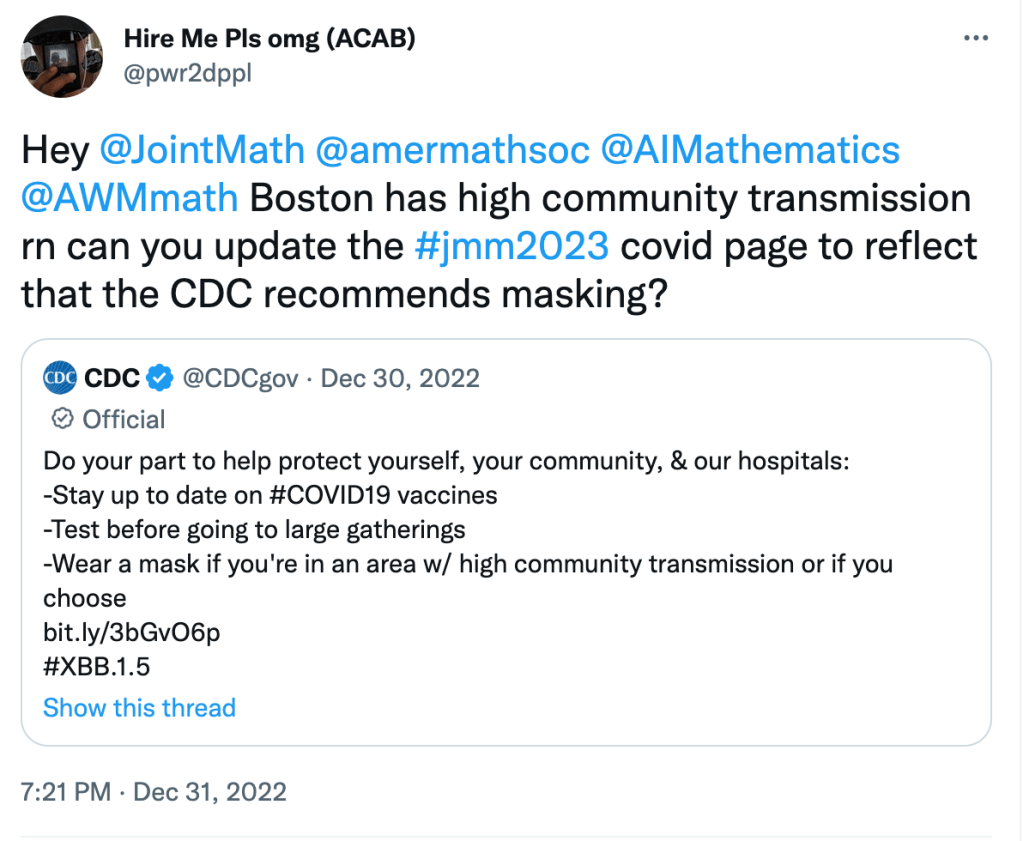
    Quote Tweet from @pwr2dppl Dec 31, 2022

Hey @ Joint Math @ amer math soc @ AI Mathematics @ AWM math Boston has high community transmission rn can you update the hashtag jmm 2023 covid page to reflect that the CDC recommends masking?

Quoted tweet from CDC Dec 30, 2022

Do your part to help protect yourself, your community, & our hospitals:
-Stay up to date on hashtag covid 19 vaccines
-Test before going to large gatherings
-Wear a mask if you're in an area w/ high community transmission or if you choose
hashtag XBB.1.5
    update your guidelines, you cowards

    It’s so funny to me that the New Year is often thought of as a chance for new beginnings, yet we mathematicians open our year with a Business As Usual Conference. A veritable celebration of job insecurity, cop apologetics, and pretense.

    Bernie Sanders fundraising meme: "I am once again asking you to Disrupt JMM"

    In the past, I was energized to bring discussions of equity to those who consistently opt out of such concerns. I still support that! But I’ve had a hard year…s. So I come today with less fire and more desperation.

    I still ask that you #DisruptJMM in a slide if you are a speaker and to encourage others to do so and to use the hashtag like we did before, but I don’t even have the energy (or inner ear stability) to write a full post. Instead I have some questions for you to think about as you plan your disruption.

    1. Why is there an in-person non-hybrid JMM conference? Why are you participating?
      • Did you choose freely? What is the cost?
      • Was your ability to choose effected by (lack of) job security?
      • Do you know the long term consequences of getting COVID?
      • Do you know about the new strain taking over?
      • Who isn’t here that should be?
      • Who benefits?
    2. If you are presenting, is your talk a gift, a burden, or a time for polite disassociation for your audience?
      • Was this choice freely made? If not, what factors went into it?
      • Are the most important messages you would want to share with others contained in your talk?
      • Who benefits from your choice of talk?
    3. Who gets to feel comfortable?
      • How many people were effectively denied access due to disability?
      • How many Black mathematicians, Indigenous mathematicians, and other mathematicians of color will be othered at JMM, fielding the careless questions and comments of white participants?
      • How many trans mathematicians, non-binary mathematicians, and queer mathematicians will be othered at JMM, contending with (perhaps preparing for) the expectations of cis het participants?
      • How many women mathematicians and non-women mathematicians will be harassed at JMM? Or have to share space with their harasser? Or have to hear about abusers being celebrated?
      • How many junior mathematicians will be made to feel like they don’t belong?

    As you prepare to join us in Boston, remember the AMS is not benevolent, academia is not moral, you don’t owe the system anything, but maybe we owe each other safety and a chance at joy.

    A few more links for good measure.

    • COVID-19 Wastewater Report for Boston (image from Massachusetts’ interactive dashboard)
    • The People’s CDC : a coalition of public health practitioners, scientists, healthcare workers, educators, advocates and people from all walks of life working to reduce the harmful impacts of COVID-19.
    • Towards a Mathematics Beyond Police and Prisons statement by The Just Mathematics Collective
    • Old post of mine on (not) belonging in academia

    Piper

    January 2, 2023
    covid, Joint Math Meetings
    #DisruptJMM
  • Testimonios: Dr. Cynthia Oropesa Anhalt
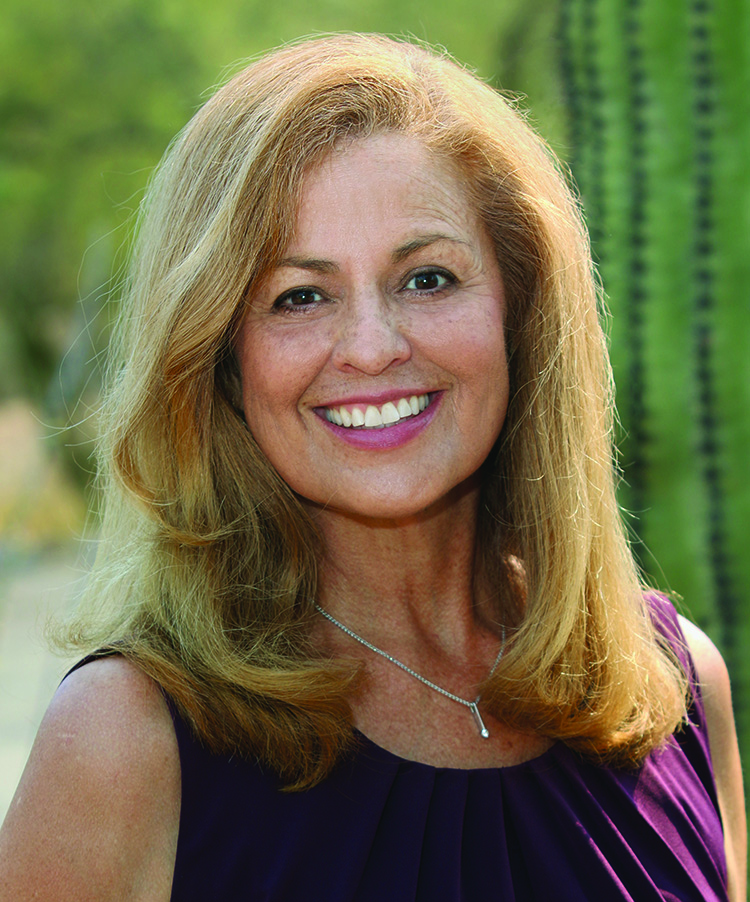
    Testimonios: Dr. Cynthia Oropesa Anhalt
    Dr. Cynthia Oropesa Anhalt; Illustration created by Ana Valle.

    A Story of Latinx

    Something I heard as a child from relatives was the story that God first “baked a batch of people,” and the oven was not hot enough, so the people came out “underbaked” with light skin, so God compensated in the second batch by turning the oven temperature too high and burned the second batch creating the dark skin. For the third batch, God got the temperature exactly right, and created the brown skin Latinx people. This story warms my heart in that my extended family took pride in brown skin, but at the same time, the story is about competition and divisiveness, which has connotations of discrimination inside and outside the Latinx community. This story did not hold meaning for me until I became more aware of our ethnicity when I attended mostly-white public schools.

    Early Life and Immigration

    My father, Sergio Duarte Oropesa, was born in 1935 in Ciudad Juárez, Chihuahua, México to parents who worked in customs for the Mexican government. By his teenage years, his family had lived in Mexico City and various Mexican-U.S. border cities, including Nogales, Sonora, Mexico, where he met my mother, Francisca Orozco. My mother was born on a ranch in Saric, Sonora, Mexico in 1933 and only completed up to third grade in school.

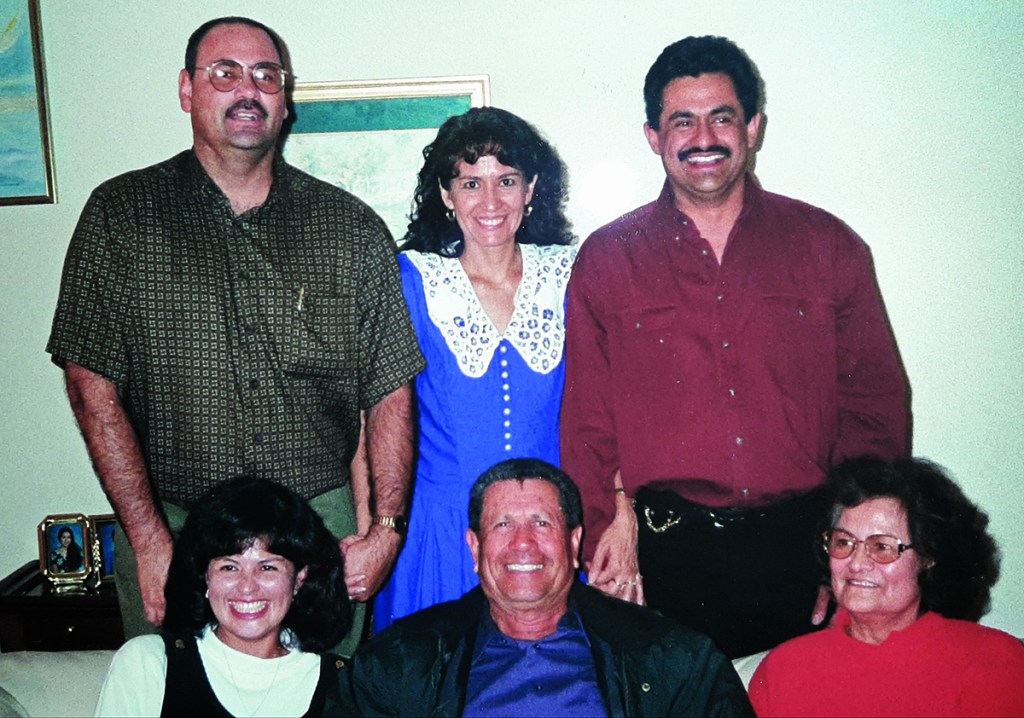
    The family in 1975.

    My parents married in 1956 and had four children while living in Nogales. In 1959, my father gained sponsorship from Selby Motors, a Mercury and Lincoln car dealership, to work as a car technician in the U.S. For nine years, he crossed the U.S.-Mexico border daily in a 1953 Chevy pickup truck, which he fondly remembers as his first vehicle. He remembers the assassination of John F. Kennedy and the national border closed for the day, forcing him to spend the night at a hotel in the U.S. while the family was across the border, which was the first time that my father was apart from the family. It was not until 1968 that my mother, my siblings and I immigrated. My sister, Luz Elena was 11 and has a memory of seeing a large portrait of President Lyndon B. Johnson as we entered the U.S., while my brother, Sergio Agustin was 10 and remembers being in a 1964 Mercury Montclair sedan as we crossed the border. My next older brother, Moses, was six, I was three, and we have little memory of entering the U.S.

    Bilingualism and Biliteracy

    Speaking two languages, Spanish and English, was a natural and organic part of my life. It seems that an unspoken rule was to speak Spanish at home with family and at church, while English was reserved for school and other events outside of the home. This practice became a form of diglossia, which became my parents’ mantra for the two languages we spoke; each language played a role in different social contexts for performing different functions. This ease in separating the two languages was something I never questioned because of my parents’ beliefs that they were responsible for teaching their children the heritage language. My father took English-language classes in the evening twice a week, and remembers proudly that he was the only student who was left at the end of the term. He ended up becoming close friends with his teacher, Señor Garcia, and continued taking private classes with him at no charge. At home in the evenings, my father would begin teaching English grammar to anybody that would sit by him long enough.

    Conducted completely in Spanish, we attended church, and this became the space in which I learned to read academic Spanish language through the King James Bible. Through a game in Sunday School, a Bible verse was announced by its book, chapter, and verse number (eg., “Salmos (Psalms) 27:4”), and the first person to find the verse in the Bible, stand up, and publicly read it was triumphant. This motivated me to read the Bible in Spanish and design a strategy to memorize the sequence of books. I devised a code, such that the book of Genesis was assigned 1G, Exodus was 2E, and so on, in which the number was the order in which the book appeared, while the letter was the first letter in the name. I memorized this sequenced code, and while this was not a perfect system, it allowed me to play with numbers and letters and memorize the books in sequence.

    My father and me.

    This was an early memory of discovering how numbers play a role in developing my own schema with a purpose. While I remember this competition fondly, I never stopped to reflect on how children who did not excel felt during the game. I regret not showing my secret code to my peers, however, I am grateful that these experiences helped me to develop my literacy in the Spanish language.

    Early Education

    My first address in the U.S. was 197 First Street, Nogales, Arizona, 85621, and this is where I observed my siblings do homework in their elementary years, and they tell me that I used to pretend to do homework alongside them by making tiny symbols on paper pretending to write the numbers and letters. I remember clearly looking forward to watching Sesame Street on television daily, and I looked forward to it because I could watch this show while everyone was in school except for my mother and me. I believe that I learned English as I counted numbers with Count von Count and sang with Maria and Big Bird.

    As an adult, I learned that Sesame Street, produced in 1969 by a non-profit organization, specifically aimed to target underprivileged pre-school age children. Sesame Street, coinciding with Head Start, were products funded under the Economic Opportunity Act of 1964 signed by President LBJ, which aspired to provide access to education and economic opportunities long denied to low-income families. When I attended a Head Start Program in our community, I realized how much I had been looking forward to school because I saw my siblings attend school. I felt like I belonged in school.

    The summer after first grade, I asked my teacher, Ms. Laz, for all the discarded mathematics workbooks with unused pages, and she gladly cleaned up and gave me the leftover books. I remember selling the workbooks to the neighborhood kids for 25 cents each, which were required for my tuition-free summer class in the front yard of our house. My parents were supportive, and got me a standing chalkboard that flipped over when I filled one side. I believe this experience convinced me that I wanted to teach mathematics.

    While in second grade, I have memories of sitting in the back seat of our car watching moving numbers on the gas pump as fuel was going into our car at $0.36 and nine-tenths per gallon. It bothered me that I could not understand what the nine-tenths meant after the 0.36 because after all, our money system only had up to the hundredths place value. I remember secretly playing a game of predicting how much the gallons would be after asking my dad how much money he was going to spend. I found the gas pump not easy to understand because the money amount and the gallon amount were changing at different rates.

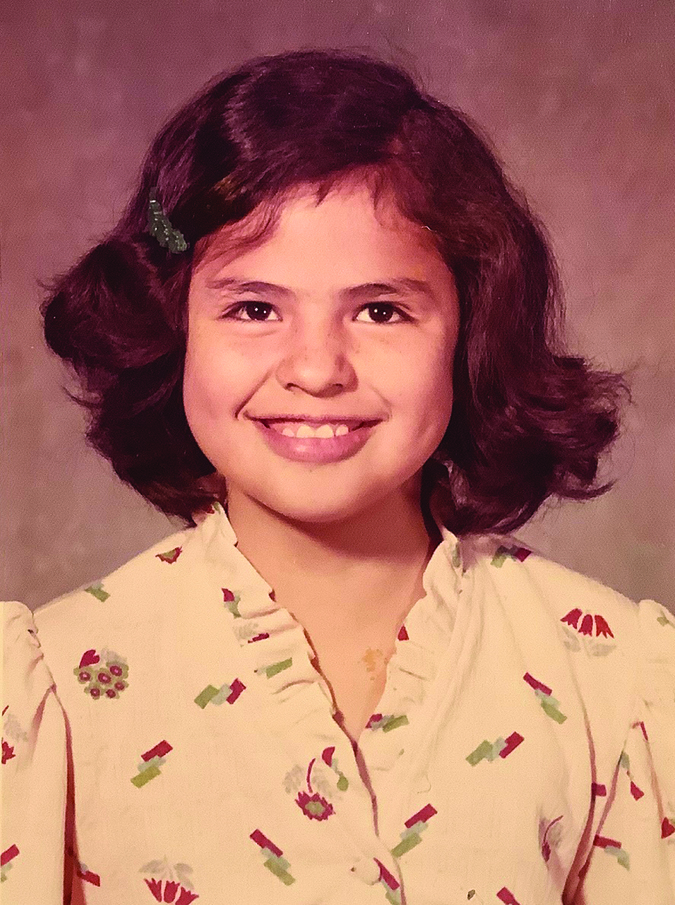
    Third grade.

    While we attended school, my mother worked as a tailor making wedding dresses in Nogales. My father worked for Anamax Mining Company in Sahuarita, Arizona. One evening my father announced we were moving to Tucson, Arizona to the east side by Davis Monthan Air Force Base. This brought a big change to the family from a largely Latinx to mostly a white community.

    At my new school, my third-grade teacher asked the class which fraction was greater, one-third or one-fourth, and I was the only one in the class who knew that one-third was greater. The other students thought that one-fourth was greater because 4 is greater than 3. The teacher asked me to explain to the class how I knew that one-third was greater. This was my opportunity to go to the board, grab a piece of chalk, draw pictures, write fractions, and explain my reasoning to my heart’s content. This experience was exhilarating.

    In sixth grade, my teacher Mr. Garbini, celebrated my learning like no other teacher had ever done, and he made comments to me about how much mathematics I knew, which helped me gain more confidence. By eighth grade, when I was in algebra class, Ms. Stinson was the first teacher who used manipulatives to show concepts, such as two-color coins for positive and negative integers, and arbitrary lengths of small rods for variables. These visual representations of mathematical concepts made sense to me. By the end of junior high, I was the only student with a 4.0 grade point average, and I remember my friends’ parents coming up to congratulate me after the awards ceremony.

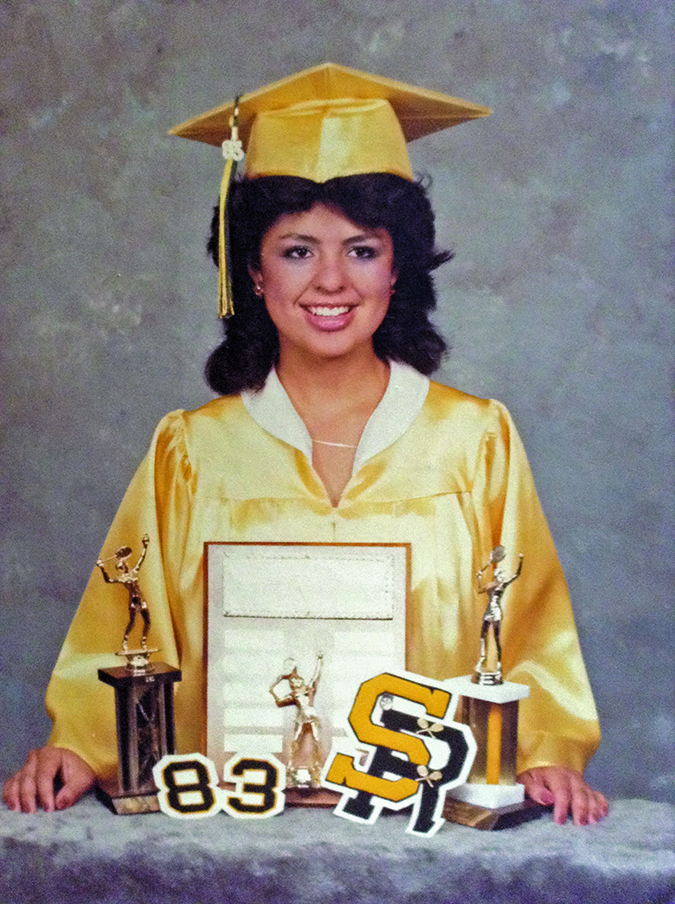
    High school.

    In my senior year, I had an amazing calculus teacher, Mr. Dorsey, and he consistently lifted my spirits by periodically reminding me that I was the only Latina student in calculus in the whole school. This made me feel special somehow to know that he kept an eye on me so that I would succeed. He encouraged our small class of 12 to study together outside of class, so we did. A group of six of us would get large butcher paper from Mr. Dorsey on Fridays so that we could study together on the weekends and use the paper as our “white board.” We were competitive but also collaborative with each other so much that we cared about each other’s grades.

    Outside of academics, I played the clarinet in the school marching band following my sister’s example. I also had the privilege of competing in varsity sports, volleyball and tennis, and I especially excelled in tennis competing in the state championships for three years. My father inspired both my sister and me to play tennis, and each Christmas I got a new tennis racquet to prepare for the spring season. My father took me to a local private club for lessons every so often, and I felt privileged to be doing so with the professional instructor who was a former college and professional player. This must have cost my father a small fortune, but he wanted me to feel like I fit in. I believe that the competitive spirit with which I played tennis influenced my approach to all challenges. To this day, I enjoy playing tennis with friends of more than 20 years.

    During my years in high school, and my siblings’ years in college, my father decided to get his real estate license and became a realtor and a broker. It seems as though my family spent countless hours studying except for my mother, who would take an occasional English class for adults; she was the one who made sure we always had warm meals, clean clothes, supplies for school, and homemade Halloween costumes, always selflessly giving to the family.

    College

    During my college years, I earned extra money by tutoring my friends in mathematics and found that I enjoyed teaching, which reinforced my childhood desire to teach mathematics. I enrolled at the University of Arizona following my siblings’ footsteps as a first-generation college student on an academic scholarship. I do not remember ever meeting with an academic advisor except in my senior year when I decided I wanted to be a teacher. I had taken core mathematics courses (calculus 1 and 2, vector calculus, linear algebra, differential equations). When reviewing my transcripts, an advisor told me that I could combine the mathematics courses and the courses I had taken in chemistry, biology, environmental science, and physics, for an interdisciplinary degree and surpass the requirements in education. Teaching mathematics consumed my thoughts, and a few years into my career, I was invited to do teacher professional development in various school districts. Following these events, I began conducting peer professional development workshops in mathematics education for teachers. After that experience, I knew that I needed to pursue graduate studies.

    Graduate School

    As I entered graduate school at the University of Arizona, I was a non-traditional student. I had taught public school for 10 years, had been married just as long, and had two children. In graduate school I renewed my interest in mathematics and mathematics teaching and learning. My advisor, Maria Fernandez, was my role model in that she was the only Latinx female faculty member in mathematics education, and we developed a life-long friendship beyond my graduate studies. She inspired me to become deeply engaged in the research literature in mathematics education, which consisted of research in teaching and learning of particular content areas in addition to understanding social issues within K–16 mathematics education. It is through experiential project activities, discussions, and analysis of published research that I began to understand academia in the field of mathematics education. Transition to Algebra was my first project in which I co-constructed and co-delivered professional development alongside Maria Fernandez for high school teachers. This project provided me an opportunity to study secondary teachers’ metacognitive mathematical knowledge for teaching particular algebraic topics, and my first article publication resulted from this project.

    My workload during graduate school became overwhelming as I was taking courses, reading research, and conducting research in mathematics education with the College of Medicine and College of Nursing at the University of Arizona. Our research team consisted of a medical doctor, a neuropsychologist, a pediatric nurse research scientist, and me, a doctoral student in mathematics education. Our study analyzed cognitive declines in children who were undergoing treatment for acute lymphoblastic leukemia, a common childhood cancer whose survival rate went from 33% to 80% within 30 years of medical advances, and thus the surviving children were growing up and becoming adults. Autonomously, I developed curriculum for teaching mathematics in a hospital setting for 7–15 year old patients who came for medical treatments for their cancer. They spent one hour per week with me doing mathematics activities prior to their chemotherapy treatments; now I reflect back and think what a torturous research study we conducted! From this project, I co-authored a research article, “Mathematics intervention for prevention of neurocognitive deficits in childhood leukemia,” in the Pediatric Blood and Cancer journal, my first and only article in a medical journal. I was grateful for this opportunity to work in a medical setting, and I elaborate on this experience because I learned of the depth and breadth of mathematics education research, especially in interdisciplinary contexts.

    Although I had unusual research projects during my graduate school, I pursued a dissertation research study focused on the development of mathematical knowledge in mathematical representation that teachers develop that is specific to the work of teaching. I was fortunate to receive support from my advisor, committee members, and my husband, who encouraged me to follow my academic dreams.

    Family Life

    Coming from a small town in Wisconsin, my future husband, Dennis, came to the University of Arizona for graduate school in electrical engineering, and after we met, he decided to stay in Tucson, AZ. We were married in 1988 and have two amazing children. Our oldest, Ashley, was born in 1991 and Brandon in 1992. Through the years, it was interesting to see them develop their identities. When school assignments called for cultural integration, they would ask questions about their Mexican and German backgrounds, trying to make sense of the contrast between the two cultures.

    The family in 1999.

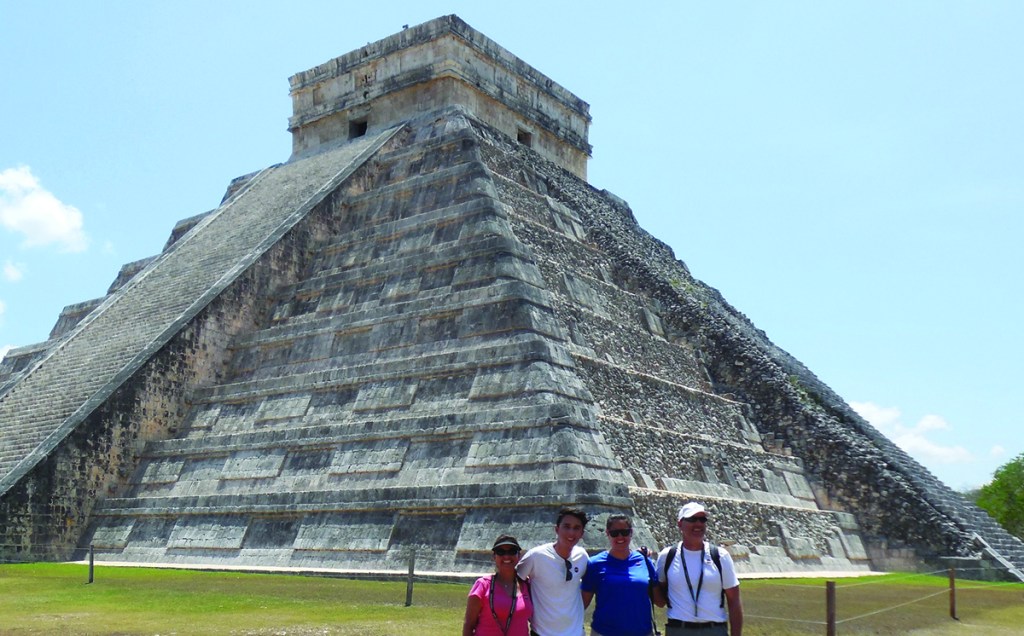
    Between 1998 and 2005, we traveled annually with five families to Punta Chueca and El Desemboque on the mainland coast of the Gulf of California in Sonora, Mexico to camp on the land of the Seri Indigenous people. We developed friendships with the Seri families and traded our essential camping equipment, food, clothing, and bicycles among other things for their hand-woven baskets made of yucca plants. Influenced by these experiences, Ashley and Brandon wrote about them in school assignments. In 2013, we traveled to Yucatan, Mexico, where we immersed ourselves in the Mexican culture and had the privilege of visiting Chichén Itzá, an ancient Mayan ruin. Dennis and I wanted our children to grow up knowing their Mexican heritage and roots.

    My family at Chichén Itzá.

    In our current lives, Dennis works for Texas Instruments as an engineer and manager of several teams of engineers across the world including the U.S., India, Mexico, China, Thailand, Malaysia, Taiwan, and the Philippines, and I am an associate research professor of mathematics education at the University of Arizona in the Department of Mathematics. Our daughter, Ashley, attended the University of Arizona earning dual bachelor’s degrees, in mathematics and in systems engineering, and earned a master’s degree in systems and industrial engineering from the University of Pittsburgh. Our son, Brandon, earned a bachelor’s degree in physiology from the University of Arizona, and earned his medical degree from the Medical College of Wisconsin. I am proud of our accomplishments as a family, and there has been much sacrifice in the time we have spent pursuing our achievements, and in recognizing this, we appreciate the time that we spend together.

    My family at home.

    Final Thoughts

    My path to becoming a faculty member was non-traditional. Upon graduating with my PhD, I became the director of the Center for the Mathematics Education of Latino/as (CEMELA), a National Science Foundation Center for Learning and Teaching in collaboration with three other universities. After one year of administrative service as director, I became a postdoctoral fellow since the project goals were a perfect match for my research interests in the mathematical preparation of teachers of underrepresented Latinx/Hispanic student populations in mathematics. CEMELA, under the direction of Marta Civil, served as a catalyst for my research career. Through this project, I met prominent researchers in mathematics education and mathematicians genuinely interested in mathematics education across the multiple universities.

    I curiously remember discussions with my family around a quote, which to this day influences the lens in which I view the world, “El respeto al derecho ajeno es la paz,” spoken by Benito Juárez, the 26th president of Mexico and the first president of Indigenous origin. My interpretation of the quote, “respect for the rights of others is peace” meant that I should listen to others, appreciate their stories, and understand our differences. I raise this point because for most of my life, I presumed that others would treat me as I treat them, with respect. This presumption was not always the case in my academic experience. In my position as an Assistant Research Professor and director of the Secondary Mathematics Education Program (SMEP), tenured faculty members in my department raised questions about my junior faculty status toward gaining tenure. I suspected that the questions raised were regarding my scholarship mainly due to the decreased workload percentage in research, yet my research publication record proved exceptional, and I became an Associate Research Professor. I continue to serve on department and college-wide committees, for example, I served on the UArizona College of Science dean search committee.

    I continue as the director of SMEP and participating in grant-funded projects. As principal investigator (PI) of the Arizona Noyce project funded by the National Science Foundation (NSF), my focus was on preparing highly qualified mathematics teachers for diverse student populations. I was PI of the Mathematical Modeling in the Middle Grades project funded by the Arizona Board of Regents to deepen and broaden teachers’ knowledge of mathematical modeling for teaching. I led professional development in the Mathematical Modeling in Cultural and Community Contexts project funded by the NSF, and created curriculum materials in mathematical modeling for secondary teacher preparation for the project, Mathematics of Doing, Understanding, Learning and Educating for Secondary Schools, funded by the NSF. My research publications focus on mathematics teacher education with emphases on mathematical modeling and development of teaching practices for inclusion, equity, and social justice. I have been privileged to participate in national and international mathematics education conferences presenting my research.

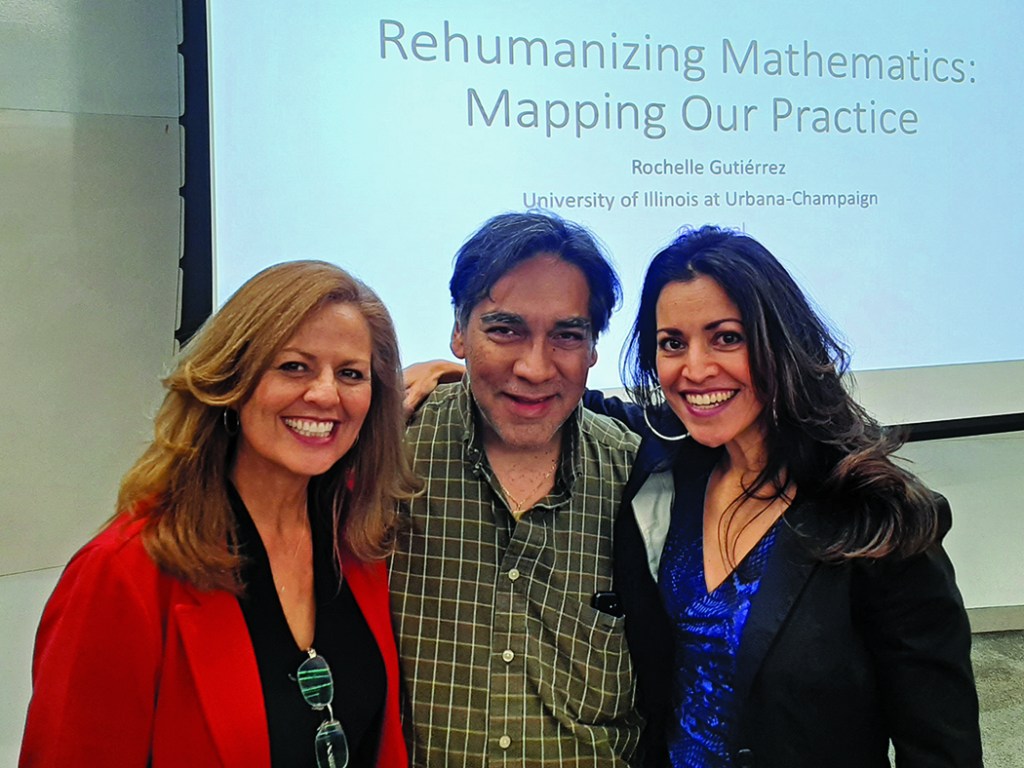
    With Rachel Levy.

    While on sabbatical, I had the privilege of co-leading with Rachel Levy, from the Mathematical Association of America, the 2019 Critical Issues in Mathematics Education Workshop at the Mathematical Sciences Research Institute, which focused on mathematical modeling in K–16 education. This workshop has been a productive setting for developing partnerships among mathematics educators and mathematicians interested in improving K–16 education. One key underpinning of my career has been to build lifelong collaborations that aim to move mathematics education research forward, and I have had the honor to collaborate with colleagues, Ricardo Cortez, Maria Fernandez, Julia Aguirre, Rochelle Gutierrez, Sylvia Celedon-Pattichis, Sandra Crespo, Anthony Fernandes, Marta Civil, and others. I am grateful that I was able to follow my passion and pursue a career in mathematics education.

    With Ricardo Cortez and Rochelle Gutiérrez.

    Advice

    My advice to students is to pursue their dreams and passion, and use their knowledge of mathematics as a foundation for a fulfilling career. The career may be in mathematics, teaching mathematics, actuarial work, data science, and graduate opportunities in mathematics. Sharing your story with a mentor can be powerful. I share my story with students, and I appreciate their reactions and their enthusiasm for sharing their stories with me, as I believe that these interactions help build community and long-term relationships. My hope is to promote access and options, especially for Latinx students when they share their hopes and dreams.

    Dr. Cynthia O. Anhalt.

    Previous Testimonios:

    • Dr. James A. M. Álvarez
    • Dr. Federico Ardila Mantilla
    • Dr. Selenne Bañuelos
    • Dr. Erika Tatiana Camacho
    • Dr. Anastasia Chavez
    • Dr. Minerva Cordero
    • Dr. Ricardo Cortez
    • Dr. Jesús A. De Loera Herrera
    • Dr. Jessica M. Deshler
    • Dr. Carrie Diaz Eaton
    • Dr. Alexander Díaz-López
    • Dr. Stephan Ramon Garcia
    • Dr. Ralph R. Gomez
    • Dr. Victor H. Moll
    • Dr. Ryan R. Mouruzzi, Jr.

    Brian P Katz (BK)

    December 15, 2022
    Uncategorized
  • A conversation with Christopher Havens, Prison Mathematics Project

    A conversation with Christopher Havens, Prison Mathematics Project

    The following is an email conversation with Christopher Havens, an incarcerated individual who discovered his love for mathematics while in prison, and now conducts research in number theory and also directs the Prison Mathematics Project. See here and here for articles about him, and also his paper in the journal Research in Number Theory.

    Hi Christopher, it’s an honor to chat with you for Inclusion/Exclusion. Let’s just start by introducing yourself to our audience — who are you, what do you do, and why?

    Hello An! Truly, the honor is mine, and thanks for having me! An intro … Well, I’m Christopher Havens, a mathematician, a prisoner and the director of the Prison Mathematics Project. My story is a bit unique because my past and my present have such dramatic contrast. Without going too deep into my story, I lived a pretty dark past, landed in prison and I ended up finding mathematics. Through my study and exploration of mathematics I began experiencing profound changes in my heart and mind. Then, for the next 10 years I have been living a life of transformation … of Justice and love. I know I’m skipping over so much, but a nice synopsis of the story can be found here.

    What I do is an especially interesting topic! I research in number theory in my free time, and recently had my second paper accepted for publication at a professional journal. Another was recently submitted and more on the way. However, my contributions to mathematics are nothing special. What I mean is, that my work in Number theory is no different than the work of any other mathematician in their own field. I’ve never made any “ground breaking” discoveries, and I’m not trying to be “the best”. Indeed, I do math because it’s in my heart, and an endeavor of beauty … But my real work lies in a huge effort to understanding the role of mathematics in self identity and desistance from crime.

    My work revolves around the popularization and diversification of mathematics to an incredibly unlikely demographic. In the Prison Mathematics Project Inc, we work with prisoners who are actively involved in the self-studies of mathematics by providing mentorship. The mentorship process helps our participants overcome their conceptual snags, as well as teaching them about the community and culture of mathematics.

    Why? I do this because as I’ve found, mathematics, the community and its culture have an incredible impact on the human heart. Rehabilitation and Justice occur in the most impactful ways … and I suppose that I wanted to share what I experienced with all of the others out there grabbing at straws for a life that might exist, if only they knew where to look! On top of that, I aim to change the culture of prisons.. A tall order, I know. But hell, more and more prisoners are striving to become “anomalous!, which really is quite wonderful!! Imagine what prisons would look like if there were more anomalies doing amazing things than the garden variety “convict”?

    Very cool! And congratulations on your second paper! I have so many follow up questions, but let’s keep going about yourself. I’m curious to learn more about how you understand the role of mathematics in self-identity and desistance from crime. Could you tell us more about your philosophy?

    This is not very easy to describe but I guess I should begin at the point of my life where my own identity was challenged and where my path of desistance began.

    I was in the hole, which is another word for solitary confinement. Picture living in a small concrete room where an incredibly bright fluorescent light stays on the entire time. Time has no meaning with no windows to the outside, and no remarkable features to mark the passage of time. In fact, there were no remarkable features anywhere … even the bed is made from a simple concrete slab. Adding to the atmosphere were the screams of prisoners whose minds were … less than healthy. Some spend hours entertaining themselves by taunting and trying to make others crack under the pressure. No human being is visible from inside the cells in the hole — save for the silhouette of a face on the other side of a narrow window — and so there are men who would kick the walls, sometimes for several hours at a time.

    I like to define hell as being the n’th layer of rock bottom as n increases without bounds … Sometimes it felt like on the other side of that concrete wall, I would reach that infinite limit. My way of passing the days was to play Sudoku and to exercise and when noises outside from my door could be heard, I’d walk over and look at the only external stimulus. Almost always it was a guard or a nurse … but on occasion, there was a gentleman who would walk by, passing a manila envelope under the doors of a couple other prisoners.

    Patterns … I love patterns. Even then, I’d try and track the patters of the external stimulus. The older gentleman was such a pattern, coming approximately twice a week. I don’t want to get too caught up in the minutiae, but my curiosity was piqued and it led me to asking him exactly what was in those envelopes. His answer was to slide one under my door as well! It’s contents?? Mathematics … gobs of it.

    The content he provided was nothing remarkable, but it was all new to me. I studied his material for every hour I was awake. When I slept, I would wake up with the solutions of problems that I could previously solve. I spent weeks in this pattern, and to speak truly, I can’t remember a single voice screaming … no sounds of chaos. Not that it was gone — it wasn’t — but for the first time I had found something that swept me up into a place of beauty and truth …

    Y’know, something should be said about the healing that can happen when we are faced with the exploration of truth in mathematics. I started contemplating truth in mathematics and how something just plain “good” could have such beauty. My thoughts didn’t stop there. I began looking into the truth within myself, and without even realizing it I was confronting all of the lies I had built my life from. I’m leaving out so much, because I’m trying to protect anyone reading this from my long-windedness … but there was a day when I sat in my cell and I heard the voices from some of my associates. They were going on in the same way as they always had, but I was annoyed with their same old talk, with the same old essence of the criminal element I knew so well. In that moment I noticed that my values were changing, and it was like I was standing beside myself, watching this new thing take roots inside of my heart, healing scabs that had developed after years of doing NOTHING good. In that moment I was completely in awe of mathematics because in my entire life NOTHING had ever been able to penetrate the falseness I wore in the effort to maintain my ego and fit in.

    It was funny … I stood there and I looked at that plain concrete wall — meant as the security against me — and I saw it as a blank slate … I decided right there that with 25 years of my life, I could choose to embrace mathematics and completely rebuild myself. I remember thinking, “With 25 years, I could become a mathematician.”

    This is going to sound cheesy, but right then and there, I dedicated the rest of my life to math. I may not be a great mathematician with “huge” discoveries, but I have something truly wonderful, and that is an opportunity to show other people the same meaning and beauty that comes from living a lifestyle that exists around your passions.

    So the role of math in self-identity … it can be a tool of transformation by exposure to beauty and truth. A catalyst for change, especially when focused in the right circumstances. Desistance is simply the byproduct of spending your time doing things that are just. plain. “good”!

    Wow! Thanks for sharing all of that. I’m so struck by your story, how desistance is just the byproduct of the deeper thing, which is discovering your passion for mathematics. Did Mr G., as you referred to your first source of math problems, voluntarily hand out these worksheets and grade your answers to them?

    Yes, I come to find out that they were part of an algebra course. Of course this hadn’t occurred to me the whole time! But Mr G. would send critique and his own passion for math was present. I bombarded that man with requests … asking for double and triple the content. Even after the course was finished, he’d answer my questions until the day where he let me know that I’ve reached the limit of his own math savvy. His words “Mr. Havens, I wish you luck on your journey” was like a spark igniting a fire within me. :] Because it honestly felt like the monumental “goodbye” at the beginning of some grand journey.

    That’s so inspiring. Let’s fast forward a little to your research. What was it like, connecting and working with math professors from Italy? Could you describe how the collaboration went?

    Sure! The collaboration with my Italian colleagues was amazing. I’ve worked with my colleagues in Turin on several projects, and was even a member of their research group for a few years. I now work with a mathematician in Hanover. But to answer your question, working with the team in Italy was one of the greatest experiences of my life … It was surreal for a while and I learned so much about the process of submitting work, and even the referee process. There are things which, because of my researching outside from academia, I would have never learned … For example, for somebody self-taught, I had no idea what LaTeX was, and how to determine which journal to submit to.. how to identify the quality of such journals and even how to navigate the referee process. This was completely foreign to me. But also the dynamic of working with other human beings on the stuff of our imagination in such a way that results in tiny additions to the wealth of human knowledge … that was priceless, and probably the most beautiful thing I had ever experienced up to that point.

    I do research because it’s an endeavor of the heart, and the things I learn about other human beings as a result of collaborative researches has the deepest meaning to me. I think Erdos practiced this same type of “social productivity” where these meaningful endeavors of the heart contribute to the wealth of human knowledge. I don’t think he was after publishing “the next paper” for any paper count … What I think is that he was after the human connection with colorful new people, sampling as much of this beautiful life as he could. I look up to him for that.

    My current research partner is in Hanover, a dear friend, Carsten Elsner. I can’t express how beautiful both of my experiences have been, but man … totally different experiences. Carsten and I are a damned good team. He and I both work a lot in the same area, so when I reached out to him, we had become fast friends … More than that, ideas just started falling from our minds and I began a period of research productivity that I’ve never experienced before. One accepted, one submitted, and two more in the works.

    The difference in researching with Carsten is that I have more of a working presence with him. He’s a damned analytical engine and I’m slower and very creative, but they seem to complement each other. I love experiencing his imagination, and it’s always nice to blend it into my own! In this work, we handle the referee’s together, we decide on where to submit together and I even write all of my own LaTeX — even though I have no computer to compile it!! But I can see it — in my little brain — as I write and so I’ll send him large emails containing source code , which helps us work more efficiently. The biggest challenge, and this drives him crazy, is that since I can’t tell if my work runs off the page, it often does.

    Wow, that’s fantastic! And congratulations on your papers! I’d like to delve into the logistics a little more: How did you learn LaTeX? Do you get to see the output with your own eyes? And what about the correspondence with your co-authors? Could you walk us through the painstaking process of (a) writing and sending physical letters and (b) sending emails?

    From researching with my colleagues in Italy, I learned the importance of LaTeX. In fact, I hired a guy to write my LaTeX for me and as I sent him the material, I would read about LaTeX on the side. I built some basic skills of the syntax, but I couldn’t compile it yet, and I didn’t even know how to set up a document.

    About a year and a half ago I took a web development course and had the use of an offline laptop for several months, and well, three months before returning the computer I sweet talked the teacher into giving me a LaTeX compiler. Here’s where I learned how to really write and visualize it in my mind, but just as I started getting the hang of it, I had to turn the computer in. So now I will spend the remaining time in my sentence with no computer. That was a blow.. I decided right there to do all my math in LaTeX so that I can improve even without a computer. This is a vital tool for mathematicians, so I bought Grätzer’s “More Math Into LaTeX”, and I study it as I work. When all of the math I do gets done this way, I tend to find ways to improve all the time.

    So while I can’t see the PDF version of what I type, I know what it’s supposed to look like, and as I send it to my colleague in Hannover, he sends me critique and a compiled PDF. I’ve gotten to where I can create illustrations with TikZ and still write whole documents virtually error free.
    This also relates to your question of the logistical aspects of my researching. All of my math is sent in LaTeX source code so that all one would have to do is compile it and adjust a few possible errors. Also, I don’t have certain symbols, like ampersand. As we know, this is a delimiter, and so I comment out the message to globally replace the “#” symbol with ampersand. Why don’t I have that symbol? Because I do not have actual email capabilities as you might think.

    Research with me began by handwritten mail, and it was gruesome because I’d write 30+ pages as neat as possible, and also writing extra copies for myself. I have no access to a copier, so with so much writing, sometimes my handwriting became hard to read. Sometimes I’d send out a copy and have somebody scan it and send me copies, then distribute the copies to my Italian friends. Doing mathematics in prison requires much redundancy.

    After a while, I started corresponding using a secure prison version of email called Jpay. I have an offline mp4 player which can send messages similar to text messages. I still use this today … in fact, this is “officially” all I have access to. But it costs both sender and receiver to send messages, and so imagine trying to reach out to another researcher, but first having to ask “Good sir.. I have some questions about your work and would like to know if we can discuss X, Y and Z. But first, can you go to Jpay.com and create an account, which costs you mo ney so that we can continue our talk?”. That’s a huge blockade, but really we have all the technology we need to circumnavigate that obstacle. My solution was to hire an assistant who would manage my outside email accounts. They copy/paste all of my
    messages from Jpay to actual email and thus I have built the illusion that I have the same email capabilities that you do. This is how I communicate with the world. So, I do not send snail mail. I just send source code for my math work and regular emails otherwise. The only snag is that I can’t directly receive attachments, but my assistant sends me these attachments via snail mail or by taking pictures of each page and sending them to me as a Jpay image.

    That’s extremely impressive. I’m sure your LaTeX skills are easily better than most mathematicians! I still to this day can never use TikZ for any small thing without going through a lot of trial and error. And making copies of your handwritten work, what a task! So from what I gather, even though I seem right now to be communicating with you via email, your actual process is: access a JPay kiosk at your correctional facility, send/receive a message to an outside assistant, who then relays your message to the receiver’s email address. Is that right? And when are you allowed to access JPay? I’m also very curious about your offline mp4 player…

    That is almost correct. My outgoing emails are sent to my assistant via Jpay through my tablet. This person manages three email addresses of mine (which I use for various purposes). When they receive a message, they copy it and paste it as a draft in one of my “real” email accounts, and it then has the appearance of being sent out “from me”. When emails come in to my “real” email addresses, my assistant will copy them and paste it into a draft from their Jpay messaging account, and send it to me as a Jpay message. We’ve developed a system for cc’ing, sending subject lines, responding to threads, accepting Zoom invites, … I don’t have Zoom capability either, but I’ve figured that out as well. But to answer the question, I can use a kiosk, but the mp4 tablet I have has an offline Jpay message app, which I can sync every 5 minutes via WiFi. This is what allows me to email with something of a normal frequency.

    This frequency is also what inspired the idea of the PMP Console where I can now also program using JavaScript or Python using a simulated console. This is absolutely not possible without a computer … UNLESS, one were to go through the huge effort of having somebody develop some software that could detect whether a Jpay message contained programming or not, and then copy said programming from a Jpay message, make any global changes as necessary, and then paste the programming into the appropriate compiler. After the program is executed, it’s copied out from the computer’s console and pasted back into a Jpay message headed right back at me. So the whole process is automated. This is, in fact, how I learned Python. In doing this, we’ve essentially made programming available to every prisoner with a secured emailing capability, like a Jpay user or a Corrlinks user, etcetera.

    I have an annoying habit, when I encounter things that aren’t possible, to figure out how, conceivably, it could work? The fact is that I could do pretty much anything from behind these concrete walls provided that I’m willing to expend sufficient amounts of energy to do it. The more “impossible” a thing should be, the more energy it usually takes … kind of like approaching the speed of light.

    Thanks for all the details! So maybe we can transition a little here to your work with PMP. Tell us a little about it, how it got started and how it’s grown. 

    Sure! Well, PMP started as a small inmate run program in a single Washington State prison. It began as a way to hold meetings with other math lovers inside of the prison. Another benefit was that we were able to make a library of math books which any participant could use. What I didn’t expect was that it quickly grew into a community … Prisoners who once would have never spared a single moment for one another would stop and talk about their current studies, and then they’d make plans to meet at a later time! In our meetings, the only rule was that we left “prison” outside from our special time together.

    We became a group of prisoners dedicated to change via our journey into mathematics, and it wasn’t long before we began hosting Pi Day and Tau Day events for the entire prison, where mathematicians from across the globe would visit in person, giving lectures that were accessible. In these events, mathematicians became rock stars in the eyes of the prison population, where after the event, lines of prisoners seeking autographs would form to each of the mathematicians. Sounds far fetched?? Ahh … but it was magical.

    Unfortunately, due to administrative politics, the PMP ended up being disbanded when a correctional officer didn’t want to put in the hours to monitor our program. Then when Covid hit, all programming completely ceased in every prison across the United States. This was around the time when my first research was published and the media grabbed a hold of it something fierce. I had made a comment that one of my goals upon release was to start a nonprofit version of the Prison Mathematics Project, and not long afterwards I was contacted by Walker Blackwell. At the time, Walker was a 15 years old high school student who wanted to be my hands in the community so that we could launch a nonprofit … It was comical, because I thought, “Hell … this kid seems so full of fire, but he’s too young!” And then I realized that he’s experiencing something that I experience all the time, where people don’t take me serious because of my incarceration.

    I ended up contacting Walker’s parents, and they were standing at his side in full support so that he could learn some real life skills in doing something truly meaningful … So there it was! Walker, myself and Jack Smith (our business mind) built a program around the limitations of the pandemic that would recreate the conditions I experienced which led to my own success. My personal transformation was so profound and life-altering that I had to share it with all of the other mathematical prisoners in the United States and Canada. The concept is simple … We are a haven for mathematical prisoners who are active in self-studies, and we provide them with mentorship — like I had — who not only lead them towards their mathematical goals, but they teach their mentee about the community and culture of mathematics. I’ve gotta say, that the community is the biggest contributing factor of cultivating desistance from crime. Show them a lifestyle that exists around the one thing for which they’re most passionate about. That’s it!

    What a journey! And fast forward to today, how has PMP grown? Where does it stand today, and what are you hopes for the future?

    The PMP has grown by leaps and bounds … I mean, just a few months ago the first research supported by PMP was accepted for publication. Now, we are assisting other participants in having their independent researches published in professional journals. We’re also offering guided researches led by … well you, An! This is exciting to see as it begins to unfold.

    Another beautiful recent accomplishment is our PMP Console. Many people do not know that prisoners may never use a computer during their incarceration. Some classes for programming exist, but these are very temporary and the computer does not stay with the prisoner. As well, and often, these classes are only available to prisoners with a short sentence. Consequently, prisoners who are spending lengthy sentences may never have the opportunity to learn programming. We just fixed that.

    Now, any prisoner with a common prison messaging service like Jpay or Corrlinks can learn Python, R and even JavaScript through a type of email. Our software simulates a console so that when a prisoner sends our organization their code, it is then recognized and compiled. The result is sent back and they receive it as a type of email. Clearly this is not as fast as having a computer in your lap, but I learned Python on this system completely, and it’s a game changer. So where we stand today is here … We are an underfunded organization, yet we change lives on a shoestring budget. It’s hard, but it’s what we have to work with, and so we move forward boldly into our future.

    My hopes for this future of PMP is to launch a Juvenile PMP which can help lead our incarcerated youth towards a better life. I remember reflecting on what would it have taken for me not to have made the mistake I’ve made. I never stopped long enough to appreciate the beauty of mathematics. I had the capacity my whole life, but I was always trying to impress whomever was next to me, and so I never found the beauty I see all around me today. These kids … You can almost see it as an opportunity. They’re sitting still inside of a prison. Now it’s our job to show them that a lifestyle can exist around something that they can be passionate about … while they are currently sitting still.

    It’s really exciting to see how far PMP has come under your leadership and vision. To close out our conversation, how can people contribute? Where can people follow PMP’s work and maybe even get involved?

    People can contribute in a number of ways! One of the easiest ways is to donate by visiting our website at www.prisonmathproject.org and clicking on the Donations tab. There is another way to donate to PMP through DonateStock (www.donatestock.com) where you can donate stock and they will match up to 1000 USD in value. Since we’re a registered 501c3 nonprofit, all of your contributions are tax deductible and will go towards helping towards making our world a better place through the spread of the maths!

    Really, there are so many ways to help, especially in running PMP. Currently we are looking for folks with organizational experience for several roles, like in management, fundraising, social media marketing and even mentorship. We are also currently building a large collection of modules for teaching self learners in restrictive environments … We need educators who can contribute to this project. If anyone wants to learn more, please visit our site at www.prisonmathproject.org or email me at christopher@pmathp.org. I’d love get more people involved with something as meaningful as Justice in this pursuit of beauty via the maths!

    Wong Tian An

    November 28, 2022
    Interview
    Christopher Havens, Prison Mathematics Projects
  • Use the mic.

    Use the mic.

    Use the mic at the conference. [1] And if you’re the emcee or organizer, it’s your job to make sure that the mic works and that folks use it.

    I think that’s all you need to know, but here are some details if you’re interested.

    Don’t just assert that everyone can hear. This is false. I say this as a person with a degree in hearing people and making people hear my voice in big rooms, and it barely works in ideal situations. At most conference spaces, there is noise in the hallways and from other rooms, noise from the air conditioning system, and noise from the participants. And the mic generates more even sound across many rooms than a speaker shouting from one corner.

    Don’t just assume that people can hear. It essentially demands that people who need the mic have to make their accessibility needs explicit in front of other participants, and it usually involves them shouting about something barely heard in a situation when folks are expected to be quiet. The speaker and the organizer sitting right near them are specifically the least well positioned folks to notice issues with the audio, so they shouldn’t try to generalize from their experiences. And louder people using mics normalizes it for everyone, keeping mic usage from becoming a big deal, somewhat analogously to cis folks explicitly sharing their pronouns.

    And even when everyone can “hear” the speaker without a mic, this will often involve more cognitive demand put into audio perception to filter out the background noise, which makes it harder to think about the ideas in the session!

    Audio systems are never perfect, but using them appropriately is a bare minimum level of accessibility support that people should be able to trust when they show up to large events. There’s enough emotional labor involved in fighting white supremacist ideas at math conferences; we shouldn’t also have to fight to hear what folks are saying.


    [1] Use the fucking mic.


    Thanks to Grant Lakeland for his feedback and contributions on a draft.

    Brian P Katz (BK)

    November 16, 2022
    Uncategorized
  • Testimonios: Dr. Ryan R. Moruzzi, Jr.

    Testimonios: Dr. Ryan R. Moruzzi, Jr.
    Dr. Ryan R. Moruzzi, Jr.; Illustration created by Ana Valle.

    My Story Begins with my Mother Irene

    My mathematical path was influenced by my parents, especially my mom, Irene. My mom’s dad and my grandpa, Raul Yzaguirre, was in his early twenties when he was diagnosed with myasthenia gravis, a neuromuscular disorder that affected his ability to walk and breathe. Doctors told him he would not live long, and that he would never walk again, forcing him on disability. He used a wheelchair for most of my mom’s early life, so from a young age, she helped care for him.

    Throughout my mom’s childhood, my grandpa frequented various hospitals, and when not in the hospital, my mom would help care for him with his endless daily medication, setting alarms for him at night so he could wake up and take them. The associated financial and emotional struggles of caring for my grandpa impacted my mom in a way that made her conscious of the stress her parents were going through, and therefore, she always pushed herself to do well in school.

    My mom was one of six kids, and throughout high school, she balanced caring for my grandpa, working, and studying. She gave her paychecks to her parents, and overall she helped out in whatever way she could. My grandpa always told my mom, aunts, and uncles to do their best in getting their education, and when my mom heard him say this, she knew she had to do her best.

    After high school, my mom first attended San Bernardino Valley College, a community college in San Bernardino, CA. Part way through, not finishing at Valley College, she switched to a program at Loma Linda University in Loma Linda, CA, to become a licensed vocational nurse. My grandpa told her she would make a great nurse because of how she would always take care of others, especially helping him with his various tasks throughout the day. She had a discouraging experience during an internship where she was told that she would never make it as a nurse, that being a nurse was not for her, because she was not doing some tasks correctly. This was damaging enough to make her drop out of the program. She did not feel the confidence to continue. She did not complete this program, and she did not return to school. It turns out, her academic journey was very similar to and influenced my own.

    Irene standing with her mom, Frances Yzaguirre, when I was first born.

    K–12 Academic Experiences

    My K–12 journey was injected with mathematical confidence early on, brought about by circumstance, and questioned at every step of the way, which was not unlike my mom’s own experience while in school. My schooling was done through the Rialto Unified school district in Rialto, CA. Rialto Unified was and still is, a Title I school district. [1] While I was in elementary school, my mom realized that I enjoyed things that challenged me intellectually; she sought to discuss how the school could push me academically. Because of her persistence, various opportunities arose, including being placed in a program for gifted and talented students, which helped me grow my confidence in school at a young age.

    Figuring a puzzle in elementary school.

    After elementary school , I attended Jehue Middle School. Jehue focused on STEM and college tracks through GEAR-UP. [2] I recall visiting local colleges, such as California State University, San Bernardino, and participating in other programs to broaden college readiness. Though my parents didn’t graduate from college, I was consistently getting the message of attending college from both my school and home. At the time, the conversation was centered on getting a bachelor’s degree, not really graduate school. In fact, throughout my undergraduate career, I was still unaware of the opportunities for graduate education.

    At Jehue, I started to gain more confidence in mathematics. Towards the beginning of my sixth-grade math class, we were covering addition, subtraction, multiplication, and division of fractions. We had already discussed these topics in the previous grade, so I did not understand why we were discussing it again. Maybe my boredom in the class stemmed from the curriculum, or maybe my teacher did not recognize or realize students in that area could/can be challenged and pushed more than how they were. My mom was conscious and worried about keeping me challenged.

    My friends and I (third from the left) posing with creative hats.

    During this time, my grandma was working towards her associate’s degree at San Bernardino Valley College. I note that my grandma did not graduate high school. She stopped going to school while in middle school. She married my grandpa at the age of 14 and spent her life caring for others, including her six kids. In the 1990s, she decided she wanted to get her General Educational Development (GED), [3] and eventually her associate’s degree; she wanted to prove she could complete a college degree. One of the last classes my grandma needed for her associate’s degree was her math class, college algebra. She had felt incapable in math, and struggled. My mom said I could help since I was good at math, and I looked at her workbook. I remember looking at this old workbook that was in typeset font with problems such as:

    Distribute and simplify y2z4(yz+2y2–3z) + 4y2z5.

    Reading through some of the book, I figured the problem was just a matter of following some rules or guidelines.

    After helping my grandma, my mom approached my middle school counselor, Mr. Ed, with the work I was doing. The discussion was centered on how to further challenge me. They decided to pursue moving me up to the next grade in only math. Along with my mom, Mr. Ed became one of my biggest advocates. He wholeheartedly supported the move for me, and with my mom, they further advocated for me in discussions with other teachers and administrators.

    Jehue eighth-grade honor roll.

    To prove I was capable of doing mathematics at the next grade level, I was taken aside into a room by two math teachers: one male and one female. For some reason, I remember the male teacher being more stern and interrogative, while the female teacher, was more inquisitive. I was given a test in a classroom, then asked to explain my reasoning on various questions. After the diagnostic test, they did figure that it was me doing the math, and I had the “correct” thinking with the problems and the only remaining discussion was on the logistics to accommodate me in the next grade level. Luckily, at the middle school, it was easy enough to bump me up to pre-algebra, which was the seventh-grade mathematics class.

    In the pre-algebra class, I was pointed out for being the sixth-grader. The teacher would often call on me as though I should have answers to all of the math questions. The teacher acted like I should be able to do anything thrown at me. I would answer the best I could, and this further helped me develop confidence in my mathematical abilities. Even when I got some part of the answer wrong or if I had to think more about the problem, I still answered. I was viewed by my peers as the one to ask math questions to. This also boosted my confidence since I saw myself as being further along in mathematics than my peers. I now realize that through the move from sixth-grade math to seventh-grade pre-algebra, I gained the confidence that would later propel me to choosing to be a math major.

    In my eighth-grade year, I had my last class of the day, geometry, at the high school that was about half a mile down the street from the middle school. Every day, after my fifth class, I would spend fifteen minutes in Mr. Ed’s office, talking with him. He would check in with me about my classes and how things were going. I would then leave the middle school and make the walk. I was emboldened with the responsibility of making that trip every day, walking onto a high school campus before my peers. In a recent conversation with Mr. Ed, with whom I still keep contact, I found out that he would drive in his car and watch me on that walk every day; he made sure I would make it to the campus. I was shocked to find this out! I always thought I was on my own. When I found this bit of information out, withheld for so long, it made me well up with emotions. I still have trouble putting my feelings into words: thankfulness, pride, endearment, self valuation, belonging, cheerfulness. I found this out at a time when I was pondering what things along my path encouraged me to pursue a PhD math program, and that single circumstance of me walking and feeling empowered aided in that.

    Throughout my early school education, Mr. Ed was an advocate that helped propel me towards becoming a mathematician. Along with my mom, his voicing support for me to move ahead in math, even taking the time to watch me walk to the high school, was work to ensure I was being challenged in mathematics. I don’t know if I would have chosen math without his and my mom’s support. After I left Jehue to attend high school, the middle school created a geometry class for students who were ready for such a challenge. I feel proud that, because of what I was able to do in mathematics, other students were being challenged and encouraged to tackle more advanced mathematics at a younger age.

    Journey towards an Undergraduate Math Major

    My undergraduate experiences parallel my mom’s, with the difference being the choice I made after a discouraging encounter with a professor. Growing up, I saw my parents struggle financially and, like my mom, this struggle made me conscious of the importance of my successes in school. Although my parents were proud of my every step and achievement, they could not give me guidance on navigating college. GEAR-UP and other programs helped in this regard by introducing me to colleges and by keeping the message of attending college visible.

    Leaving high school, I applied to various schools and got accepted to two. I chose to attend Cal Poly Pomona because of my desire to be an architect, which I credit to growing up with imaginative play and building different structures out of Legos. Also, since I was comfortable with mathematics, a math-based career felt natural.

    From the onset of college, I had to adjust and adapt. When I received my acceptance letter to Cal Poly, I learned I was accepted into the program of electrical engineering. This was my second choice since we had to choose more than one potential major in our application. I did not know that architecture at Cal Poly was an impacted major, meaning that I had to not only apply to Cal Poly, but also to their specific program. Therefore, I decided to stick with engineering because it was still math-based, and it gave me an opportunity to make good money, even though I must admit I did not exactly know what electrical engineers did.

    In my first year of undergraduate education, I enjoyed and did well in my classes, riding a natural wave of classes and homework. In the fall semester of my second year, I took a digital logic class with a lab where we built various electrical circuits. In this class is where, similar to my mom, I had a horrible discouraging academic experience that greatly impacted my academic trajectory. A difference here was that I had the confidence to fall back into another subject, and that confidence stemmed from my mom and my K–12 experiences in mathematics. In the engineering lab, we were supposed to collect and put various resistors and capacitors together to successfully build circuits each week. I was left to my own devices to figure things out. I would spend hours and hours before and after class trying to figure out how to build the circuit we were supposed to build. I would ask the professor, but he would scoff at me and tell me I should be able to figure it out on my own. The grade centered on completion of the labs, and going into the fourth week, it was clear that I was not able to do them on my own. With no guidance, I would fail the course.

    When I had that negative experience, I believed I did not have the skills or capability to become an engineer, and I needed to change my major. Not knowing what other major to switch to, coupled with the fact that I wanted to graduate in four years, I switched over to being a math major, which was not viewed as an “easy” major. I had confidence in math, and that confidence came from my mom advocating for me in those early years and other early experiences. This made me think about what would have happened for her if she had confidence in some other area, or had someone to advocate on her behalf. Switching to a math major meant I got some push back from some of my family because I decided I would teach high school math; at the time it was all I knew that one could do with a math degree.

    My grandma and me at Cal Poly graduation.

    As a math major, I went through my classes with a closed mindset. I would push through knowing the end goal was to go off and start teaching high school. My desire to become a teacher was reinforced through my work as a math tutor in GEAR-UP at La Puente high school in Hacienda Heights, CA, and as a math tutor for Sylvan learning center in Rialto, CA working with underserved K–5 students. I enjoyed being able to help students with their perceived struggles and also being a mentor for them, planting the seeds of attending college.

    In my own math education, there were definitely classes in the major that I struggled in, including both real analysis and abstract algebra. Both real analysis I and II were difficult for me. I never really felt as though I understood the concepts, and the professor never seemed concerned. But, in abstract algebra, there was an instance that steered me towards more of a comfort with algebra as a topic of interest. In the fall of my third year at Cal Poly, my first abstract algebra class was poorly run and I did not come out of that class with much knowledge, leaving me unprepared for the next course in the sequence. I also rarely attended professors’ office hours, and I was worried about taking abstract algebra II (rings and fields). I sought out advice from the professor teaching that class, Dr. Robin Wilson. He reassured me that everything would be good, and he said that I did not need a great background of groups to be successful with rings and fields. That little moment of affirmation kept me on track. Throughout his course, he reignited my interest and confidence in algebra, which later led me to studying representation theory in graduate school, though I didn’t know it then.

    Journey towards Graduate Mathematics

    Leaving Cal Poly as a math major, I had one goal in mind—getting my teaching certificate. I moved to Michigan with my wife (then fiancée) and was on track to attend the University of Michigan’s School of Education. I was planning to complete a bachelor’s degree in education along with gaining a certificate, which was naive on my part because I only needed my teaching certificate. I was unaware that the government’s grants, such as the Pell grant, only help you fund one degree. Not having money for out-of-state tuition to become a high school teacher and still not knowing what to do as a math major, I quickly pivoted to pursue a master’s in the mathematics program at Eastern Michigan University. I was still leaning towards teaching, yet the graduate students at Eastern Michigan only graded or worked in the tutoring lab on campus. Through various discussions with the interim chair, Dr. Carla Tayeh, a fellow graduate student and I were able to pilot a program enabling graduate students to teach lower-division math classes. This was the first instance where I advocated for myself, and I got a taste of teaching at the collegiate level.

    I already felt comfortable teaching, and doing so in college was affirming my growing thoughts of staying in the college classroom. This was another moment that could have steered me away from a path towards becoming a professor. If Dr. Tayeh had rejected my opinions of allowing graduate students to teach rather than grade or tutor, then I am not sure I would have been steadfast on teaching at the college level. The openness and willingness of Dr. Tayeh to take a chance on me was another moment of affirmation along my mathematical journey.

    Based on these experiences, I began to research what it would take for me to become a professor at a four-year institution; I did not know much about doctorate degrees. I applied to four schools, three mathematics programs, and one mathematics education program, all in Southern California. I also applied to teach as a part-time instructor at various community colleges. Our plan was to move back to Southern California. Either I would attend graduate school, or teach at a couple schools. I received three rejection notices. With our move back to California and still no word from the fourth school, I did not think too much of it; my mind had already switched to trying to find work. Then, in May of 2013, I got a call from the University of California, Riverside (UCR) asking if I was still interested in their graduate program. That said, I started graduate school fall of 2013, not exactly knowing what I was heading into.

    When I got to graduate school, the struggle got real. I felt woefully underprepared for all of my classes. I remember thinking I was not able to do it because I did not put in the time before as an undergraduate or as a master’s student. I realized I was in classes with people who did much more studying than I did. This realization turned fruitful because I quickly formed study groups with them and became a better student. The more I struggled and thought about the material, the deeper my understanding became; I realized the struggle was good and advantageous. Previously, I rode that wave from the attention I received in sixth grade, believing I was always “good” at math. Failing my first graduate exams in algebra and topology, others in my cohort seemed to be in the same boat as I was, and this was a saving fact. I realized we were all going through this process of learning, and supported each other throughout it; another moment of affirmation. Without this support and friendship, I would not have lasted long in the program. The community that was built early on definitely supported my successes, and still supports my successes today.

    Throughout graduate school, I relied on my cohort for support with classes and began to find my way as an academic. In my third year of graduate school, post-qualifying exams (comprehensives), I distinctly remember a conversation I had with my advisor
    Dr. Vyjayanthi Chari that steered me down the path I am on now. I am not sure if she knows the impact that conversation had on me. It was at a 2016 conference at the University of North Texas. At the conference dinner, she and I began talking about jobs that students want after leaving graduate school. She posed various questions to me, sorting through her own thoughts, and made me think about what job I would want. For example, she asked (paraphrasing) “Why are students getting or not getting certain jobs when they graduate?”. We had a PhD candidate graduating from North Texas that spring sitting with us who had accepted a tenure-track job offer at a four-year institution, and Dr. Chari asked the student what steps they took to get their job. The message from the student was involvement: she was involved in organizing conferences, seminars, attending various conferences, etc. The follow-up question to me from Dr. Chari was “Why or why aren’t our students doing such things?”, with a follow-up comment, “The job market is a difficult thing to navigate.” I thought much about that conversation and about exactly what job I would want leaving graduate school. Specifically, I thought: what was my end goal? I always enjoyed teaching, and working with undergraduates, so I knew I wanted to be at a four-year institution with a focus on teaching. I also wanted to become a professor at a four-year institution to continue to mentor students and hopefully be a source of inspiration for others that may question themselves as they complete their studies. From that conversation with Dr. Chari, I sought out ways to set myself apart from other job applicants, looking for opportunities to develop professionally towards that goal, not just through mathematics. I had always been interested in teaching and outreach, and that conversation with Dr. Chari empowered me to seek out such opportunities, unlocking a door that had been previously invisible.

    The spring of my third year of graduate school was when I first started to get involved, and began to more actively advocate for myself. I got involved in various activities inside and outside the department at UCR, such as joining math club and attending various conferences and workshops that were offered; always intently looking for different opportunities. I never sought out such things as an undergraduate or in my master’s program, but as a PhD candidate, I finally realized I was more capable and turned proactive instead of passive. I passionately pursued things I was interested in. I formed a reading course for undergraduate students in Lie theory, which was not done before in the department. I led work with the math department to organize a math circle type program in the Rialto Unified school district. I also led work with others to organize a seminar on equity and inclusion for math graduate students and faculty. These activities helped me take steps towards my end goal of becoming a professor at a four year institution. They also challenged my thinking about how to unlock students’ potential. How can we empower and support students to pursue things that will help them reach their end goal? How can we, directly or indirectly, positively play a role in a student’s path?

    My Family

    My mom, Irene and grandma, Frances.

    Part of my testimonio and journey through academia is about my family. Having kids in graduate school was a decision that my spouse and I came to and wanted. I was met with resistance from some, receiving questions like, “Why now? Are you going to be able to keep up?” Some thought that if we had children I would not finish my doctoral degree. Those questions and comments fueled me even more to prove to others that it can be done, though there were, and still are, private moments I question myself. Those moments of creeping self-doubt would then be backed by a thought of, “Why should the profession be void of life’s experiences?” Yes, it takes extra work on my part, and it takes support from my spouse, my mom, my grandma, and others in my family. Part of the Hispanic culture, at least for me, has meant receiving unquestioned support from those around me, and that support continued throughout graduate school, still continuing today.

    My dad, Ryan Sr, me, and mom, Irene.

    Being passionate about what I do, teaching and studying mathematics, made it easier to balance life and work. I gained the appreciation for the time I have to work and the time I have for my family. The tug-of-war between work and life is never-ending, always causing moments of stress through many moments of joy. Overall, the experience has been enlightening and rewarding.

    L to R: Ryan III, Ryan, Jr, Bree, Reid.

    Concluding Remarks

    I didn’t take a traditional path to be a professor. In fact, my path towards the professoriate was laced with instances of advocacy and affirmation. My parents did their absolute best in steering my siblings and me with the resources they had. The choices my mom made in her early post-secondary career, leaving college and not finishing, turned into support and motivation for me on my academic journey. My mom’s lived experiences turned into her supporting me by ensuring I had access and confidence in academics, speaking up to teachers to challenge me in school, and advocating for me and instilling a sense of self-belief. I was also motivated by her experiences which gave me a deep desire to make my parents proud, get to the finish line of college, and prove to others that I can do it. That support and motivation eventually pushed me to successfully pursue a doctorate in mathematics. Outside of that, programming in my K–12 schools was also crucial in supporting my thoughts of continuing education beyond high school. That is to say, one way towards supporting more Latinx/Hispanic people in mathematics is to be an advocate and provide support in multiple ways; small things can make a huge impact on a trajectory of a student, for better or for worse. This is what I carry with me throughout all my work. You never know what instance may positively influence someone on their path, and it is my hope that the instances I have shared in my testimonio will positively influence you on your path.


    [1] The U.S. department of education defines Title I as providing financial assistance to local educational agencies (LEAs) and schools with high numbers or high percentages of children from low-income families to help ensure that all children meet challenging state academic standards.
    [2] Gaining Early Awareness and Readiness for Undergraduate Programs was designed to increase the number of low-income students who are prepared to enter and succeed in post-secondary education.
    [3] The General Educational Development tests are a group of subject examinations which when completed are equivalent to the U.S. high school diploma.


    Previous Testimonios:

    • Dr. James A. M. Álvarez
    • Dr. Federico Ardila Mantilla
    • Dr. Selenne Bañuelos
    • Dr. Erika Tatiana Camacho
    • Dr. Anastasia Chavez
    • Dr. Minerva Cordero
    • Dr. Ricardo Cortez
    • Dr. Jesús A. De Loera Herrera
    • Dr. Jessica M. Deshler
    • Dr. Carrie Diaz Eaton
    • Dr. Alexander Díaz-López
    • Dr. Stephan Ramon Garcia
    • Dr. Ralph R. Gomez
    • Dr. Victor H. Moll

    Brian P Katz (BK)

    November 15, 2022
    Uncategorized
←Previous Page
1 … 3 4 5 6 7 8
Next Page→
 

Loading Comments...
 

    • Subscribe Subscribed
      • Inclusion/Exclusion
      • Join 42 other subscribers
      • Already have a WordPress.com account? Log in now.
      • Inclusion/Exclusion
      • Subscribe Subscribed
      • Sign up
      • Log in
      • Report this content
      • View site in Reader
      • Manage subscriptions
      • Collapse this bar