Inclusion/Exclusion

Inclusion/Exclusion

A justice and math weblog

  • Blog
  • About
  • How can we know what we deserve when toxicity is the norm?

    Editorial note from MKL: This article was written for the Early Career Section of the Notices of the American Mathematical Society and it will appear in the February 2024 issue. I am sharing it early as a preprint in the hopes that it will be useful for incoming graduate students, postdocs, and other junior mathematicians who are attempting to navigate the norms of a new department this fall and winter. I initially intended to share this much earlier in the academic year, but delayed due to the ongoing genocide in Gaza which has taken much of my organizing energy and attention. Thank you to Krystal Taylor (an editor of the Early Career Section) for inviting me to write this piece and thank you to my fellow i/e editors for giving me the chance to share it early via this blog. 


    The author (Marissa Loving) would like to thank the organizers of the Hidden NORMS (Navigating Obstructive Rules in the Mathematical Sciences) webinar series for inviting her to lead a discussion on “pseudo norms” in the mathematical community out of which this article sprung. You can find the webinar recording here and an excerpt from the webinar below.

    There’s this feeling that we should just be grateful. We should be grateful that we made it. We don’t deserve to ask for more. What I want us to walk away from this discussion with is the idea that we should always be willing to ask for more for ourselves and for the people around us until we are all being treated with humaneness [sic], with dignity, and with respect. That is what we deserve and anything less than that is toxic. And that is a hard and very difficult standard to hold for yourself in a space which is always degrading our value and the value of those around us. It is hard not to internalize that we deserve less. So if the only thing you take away from this is to say, “Whatever you say I deserve, I deserve more.” That’s good. Because it’s true.


    Setting the scene

    When I was an undergraduate student, I was sexually harassed by one of my computer science (CS) professors for well over a year. It started with small things, like him hanging out in the majors-only upper-division CS lab. Then he asked me to add him on Facebook and started messaging me often. Before I knew it, he was finding excuses to touch me. Eventually he told me he loved me (needless to say, I did not feel the same). I was only 19 at the time (I first met him at 16 and was 17 when I took my first class from him). I felt overwhelmed and out of my depth. Meanwhile, the men in my CS cohort started making snide jabs suggesting I was receiving preferential treatment from faculty (it didn’t help that I consistently outperformed my all male cohort on both homework and exams). I knew something wasn’t right, but I didn’t know what to do about it. I didn’t even know how to name what was happening. It wasn’t until I shared my experiences with several women in my summer REU program that I was given the words to describe my experience: sexual harassment and abuse of power. In retrospect, it all seems so obvious, but abuse thrives in isolation. Without those women in my REU listening to me and affirming my experience I don’t know how long it would have taken me to speak the truth of my situation.

    Fast forward to my first year of graduate school. Once again I was quite isolated as one of the only women of color in my graduate program. I was consistently treated as less than by both my peers and my professors, from being excluded from departmental leadership roles that highlighted mathematical drive (like organizing the graduate student geometry and topology seminar) to never once receiving departmental recognition for any of my accomplishments (grants such as NSF postdocs are usually celebrated with an email to the department, but not mine) to being told to my face time and time again that I didn’t belong. Suffice it to say, my graduate school experience was less than ideal (you can read a little bit more about it here), but the experience nonetheless felt very different than the sexual harassment I had suffered in undergrad. My negative experiences in graduate school weren’t confined to a damaging relationship with one faculty member or consistently obscured by the power that faculty hold over their students; they happened all the time and right out in the open in front of everyone1. At times it felt almost impossible to talk about these negative experiences, not because I felt like I had to keep quiet, but because it felt just too damn normal for anyone to care. 

    It’s been four years since I graduated with my PhD. Three (extremely terrible) years of postdoc and one (pretty good) year of tenure-track later, I’ve realized more and more how pervasive this culture of isolation, discrimination, and exclusion is in mathematical spaces, especially for Black mathematicians like me2. In that time, I’ve also come to believe more strongly than ever in the power of organizing with the people around us to demand what’s ours: respect, dignity, and fair treatment. Unfortunately, what we consider to be fair is so often shaped by how the people around us are treated, and even more unfortunately, academia is a pyramid scheme in which exploitation is normalized especially for people at the base of the pyramid3. So how can we talk about what to expect, what we deserve, and what we can demand when toxicity and exploitation is the norm? 

    I certainly don’t have all the answers, but my hope is that this article can help some up-and-coming mathematicians– especially Black mathematicians, Indigenous mathematicians, disabled mathematicians, trans mathematicians, and those living in the intersections of any of these communities or who belong to other communities that continue to be marginalized within academic mathematics – decide to take up more space for themselves and for those around them. I hope that this article will help you (yes, you, dear reader) develop strategies for creating and maintaining high expectations for how you and those around you deserve to be treated even when you are surrounded by norms that tell you that you are lucky to even be in mathematics in the first place and you should just be happy with whatever you get. I want us all to find the strength to say, “This is how I deserve to be treated and I will not accept anything less.”

    We can keep our expectations high even when toxicity is normalized.

    Building some shared language

    Not only do I not have all the answers, since my professional training is in research mathematics, I don’t even have all the language to describe the problems I want to find answers to (language which I’m sure exists in the wealth of social science literature on workplace culture and harassment). So in order to make this conversation more meaningful, I will do what every mathematician does: I’m going to offer some definitions that will give me enough structure to discuss the problems at hand in a meaningful way. In particular, I want to highlight two types of harmful norms that I have encountered within academic spaces.

    Toxic norm: A negative experience that is widely shared within a community regardless of your individual background or identity.

    Pseudo norm: A negative experience that you are expected to accept as normal but is not typical for other individuals in your community or those with different marginalized identities than your own. 

    Remember, I introduced these terms to help me articulate my experiences and to give us a framework for discussion. These are not distinct categories by any means and how you interpret your experiences as either stemming from toxic norms or pseudo norms will vary significantly especially depending on your own identities and on your local community!

    For me the stories I described in the introduction very broadly illustrate the distinction between these two types of norms: the sexual harassment I experienced in college was a pseudo norm, the horrible experience I had in graduate school (especially during the first couple of years) was much closer to a toxic norm although many of the individual negative incidents of racism or sexism that I experienced were manifestations of pseudo norms. That is, having a bad experience during your first year of graduate school is very common and the community expectation that we should just accept that graduate school will be terrible at times (to the point of destroying our mental health and wellness) lends itself as cover to many specific instances of racism and discrimination. After all, everyone is having a hard time so why should your experience be any different? But having a hard time because of too high teaching loads, uncaring faculty, and a lack of healthcare or a living wage and having a hard time because you are experiencing racist microaggressions from your classmates and professors on top of all of those other problems are just not the same experiences. This brings me to my final observation about toxic norms vs pseudo norms: toxic norms are often specifically weaponized against marginalized students in a way that creates pseudo norms. Let’s consider the following case study to drive this point home.

    Case study: Imposter syndrome

    Wikipedia defines imposter syndrome as “a psychological occurrence in which people doubt their skills, talents, or accomplishments and have a persistent internalized fear of being exposed as frauds”. Academics love throwing around the term imposter syndrome, especially in the face of every marginalized scholar who gives voice to the fear that there isn’t a place for them in the academy. It’s the perfect way to make structural problems into personal failings. Because while imposter syndrome is a real experience for some people, for many marginalized scholars the fear of being an “imposter” isn’t just a “persistent internalized fear”. The reality is that many of us are told day in and day out that we do not belong, our accomplishments are undermined and diminished, and we can find ourselves on the receiving end of months of racist harassment for simply announcing that we accepted a job which other people don’t think we deserve4. So while imposter syndrome is aptly classified as a toxic norm to be expected in any pyramid scheme like academia, it often morphs into a pseudo norm used to silence marginalized people who dare to express their experiences of exclusion.

    Strategies for success

    Now that we have a way to articulate what we’re up against, it’s time to talk about how to challenge these harmful norms as you encounter them. If you find yourself having a negative experience in your department, research group, or any other mathematical space, here is a checklist that I hope you will find useful in deciding what to do next.

    Step 1: Are you experiencing a toxic norm or a pseudo norm? If you’re not sure, think about the experiences of the people around you. Is what’s happening to you a common experience for people with a variety of different identities or does it seem to only be happening to you either because of your identity or because of the power that someone holds over you (like your advisor, department chair, or the chair of your tenure committee)? Remember, these norms aren’t completely distinct, but usually experiences tend to lean one way or the other.

    Step 2: Regardless of your answer in Step 1, the way forward is never alone. Community is the antidote for any kind of harmful norm.

    1. Toxic norms crumble in the face of supportive and care-based communities.
      1. Because toxic norms are often widely experienced regardless of individual identity, they can be effectively tackled through collective action!
      2. Organize with your peers5! Brainstorm solutions! Push for change!
    1. Pseudo norms thrive in silence and isolation.
      1. Find trusted friends and accomplices to share your experiences with. This can be scary and overwhelming. Take things at your own pace. 
      2. Pseudo norms are not as commonly experienced as toxic norms (although they are still pervasive!), which makes collective organizing more difficult. They are often imposed on you by people with direct power over you.
      3. Each situation is different, but shining a light on the problem is crucial. Nevertheless, you don’t owe anyone your story.

    Step 3: Document everything as a defense against gaslighting6.

    1. One of the ways that toxic and pseudo norms persist is by convincing us that our experiences are not as terrible as we’ve experienced them to be or that they are a result of personal failings rather than external environmental causes.
    2. An effective way to combat gaslighting is by documentation! This is especially important when dealing with pseudo norms that may not be widely experienced by your peers.

    Step 4: Don’t become a toxic norm enforcer!

    1. The “if I had to suffer, so should you”-mentality is VERY easy to fall into! And it’s a common way that toxic norms are perpetuated. 
    2. The “we’ve always done it this way”-mentality is probably the PRIMARY way that toxic norms survive because it gives us cover to not do the hard work of figuring out what needs to change and how. An unwillingness to disrupt the status quo keeps us perpetuating the same cycles of harm without even needing to actively recognize the damage we are doing.
    3. Of course, norms can also be good! But they need to be set intentionally and revisited frequently. Good norms also need to be enforced (just like the toxic ones have been for so long)! Accountability is key.

    Know your worth

    At the end of the day, living in a world where people enrich themselves on the backs of our dehumanization is a constant assault on our sense of self. It is a truly revolutionary act to stay grounded in a deep understanding of our innate worth and the innate worth of the people around us. So I want to end with some affirmations. Read them. Say them. Share them. Believe them. And then go out and help build a mathematical community that realizes them.  

    • I deserve to be treated with the utmost dignity and respect.
    • I deserve to have my mathematical talent acknowledged and supported7. 
    • I deserve to be treated as an expert on my own experience.
    • I deserve to be recognized as a complete and complex human being with identities and experiences that materially impact the way I am treated in mathematical spaces.
    • I deserve to voice my experiences and concerns without suffering retaliation or professional harm. 
    • I deserve justice and restorative care.

    Footnotes
    1. For example, before the end of my first semester multiple white men in my cohort told me that I only received the NSF Graduate Research Fellowship because I was a woman of color and they would have been awarded it if they weren’t both white and male. This is only the tip of the iceberg. ↩︎
    2. And, let’s be real, this toxic culture and straight-up racism in mathematics is far harsher for Black mathematicians whose features (skin tone, hair texture, and facial features), unlike mine, read as unambiguously Black and often make them subject to even further discrimination rooted in colorism, texturism, and featurism. ↩︎
    3. The examples of this are too numerous for me to enumerate them, but one very concrete example of this is the poor pay, benefits, and working conditions that so many graduate students, postdocs, and adjuncts experience. Yes, even in mathematics and other STEM fields! ↩︎
    4. Yes, this is a real thing that has happened to me and other marginalized scholars. ↩︎
    5. I’m talking about collective action here, not organizing a research seminar, just so we’re on the same page. This might look like getting involved with your local union, like forming a group to lobby the department chair/college dean to fulfill specific asks, or even forming an affinity group where people can share their experiences and realize they are not alone. ↩︎
    6. Explanatory comma – Gaslighting refers to the act of undermining another person’s sense of knowing their own reality by denying facts, the environment around them, or their feelings. ↩︎
    7. Sometimes this affirmation needs to be directed inward before we can direct it outward. We deserve to recognize our own mathematical talent and potential! Especially when those around us are working overtime to convince us we don’t have any. ↩︎

    Marissa Loving

    December 4, 2023
    Institutions, Racism
  • “X” in the time of Genocide

    Guest post by Tarik Aougab

    Editorial note from MKL: The “X” in the title refers to a variable whose precise value changes as in a mathematical equation. This is made clear in the body of the piece itself. It does not refer to the new name of the website formerly known as Twitter.

    Gathering (some of) the facts

    I wrote this post to document for myself what it’s been like being a mathematician during genocide: how mathematicians are reacting (and how they are justifying those reactions as mathematicians), what they are ignoring, what they are prioritizing, and how they can choose to act in solidarity with Palestinians. But first, given how rapidly the situation in Gaza continues to deteriorate, it feels necessary to record a snapshot of the facts on the ground as they are right now, as I write this sentence:  

    • Over 20,000 Palestinians have officially been murdered by indiscriminate bombing in Gaza. We emphasize that the number of actual casualties may be much higher, but people are still trapped under the rubble and the onslaught has completely destroyed the Gaza Health Ministry’s capacity to keep close tabs on the number of deaths and injuries. 
    • For Y equal to each of 2019, 2020, 2021, and 2022, the number of murdered children in Gaza in the last 6 weeks exceeds the number of child casualties for all global conflicts combined, in year Y (the relevant statistics have not yet been recorded for 2023, but one expects a similarly stark comparison to hold). 
    • Israel has arrested thousands of Palestinians – just in the last 6 weeks– and tried  them in military courts with a 99% conviction rate in preparation for a potential prisoner exchange. 
    • In the West Bank, there have been terrifying pogroms instigated by extremist settlers and spurred on by government and military officials; airstrikes of a refugee camp; and forced evacuations of hospitals. 
    • In Lebanon, there have been attacks on historic churches, Lebanese journalists have been deliberately targeted, and Israeli white phosphorus bombs are causing a devastating environmental impact, destroying over 4.5 million square meters of forest in Southern Lebanon.  
    • Just mere weeks ago, mainstream Western media and political officials took Israel at its word (as it generally does) when it said it would never target a hospital. They now take Israel at its word (as it generally does) when it says that it must target hospitals. There are currently no operating hospitals in Northern Gaza, and medical personnel, ambulances, and other emergency infrastructure have been targeted for destruction.
    • The number of human rights experts, independent NGO’s, and humanitarian organizations that have characterized this as a genocide of the Palestinian people continues to grow. For example Martin Griffiths, the UN under-secretary general for humanitarian affairs and emergency relief coordinator, made clear – live on CNN– that the destruction in Gaza is the “worst ever” that he’s seen after decades in the field. 
    • The IDF continues to put out a stream of remarkably lazy– and quite literally unbelievable– propaganda. Official military spokespeople have now falsely claimed to:
      • Uncover a “terrorist watch schedule” in the basement of Al Rantisi hospital (it was a mere calendar; what the spokesperson said were terrorists’ names in Arabic was actually just the days of the week). 
      • Uncover a secret telephone recording of two Palestinian Islamic Jihad operatives who are admitting on tape that the bomb which destroyed Al-Ahli hospital was one of their own misfires (any Arabic speaker can immediately spot the recording as laughably fake, for example the speakers are not using Gazaoui accents; PIJ operatives do not use telephones to communicate in this way; and an independent analysis confirmed that the two voices were actually recorded independently and then spliced together). 
      • Announce the bombing of densely populated areas – ostensibly to the residents of those areas– but in a language they don’t understand and over a medium that they can’t access (one must therefore ask for whom the announcements are really). 

    While I wish not to spend time on this for reasons this excellent piece makes clear, I can already hear the incessant chorus from colleagues and other readers: “I noticed you didn’t mention the terrorist attacks! Do you not condemn Hamas? WHY DO YOU NOT CONDEMN??” So in the interest of balance, let me also give a summary for the events of October 7, as I so far understand them: 

    • An operation (spearheaded by Hamas but in which several different militant groups participated) was conducted in which armed militants broke through the physical barriers cutting off the 2.3 million inhabitants– most of them refugees– of Gaza from the rest of the world, and both many unarmed Israelis (including, tragically, children) and many armed Israelis were killed. 
    • The ratio of civilian to soldier deaths is estimated by Israel to be about 2 to 1. (Compare this to the over 90% civilian death rate in Gaza since the bombings began on October 8.)
    • Several first hand testimonials– both from Israeli civilians and Israeli soldiers– suggest that Israeli civilians may have been killed by IDF crossfire. 
    • Hundreds of Israeli civilians were taken hostage and brought back to Gaza. And for most of the last 6 weeks, many of their families have been pleading with (and protesting against) their own government to engage in a broad prisoner exchange of the type that was already on the table within the first week of the war. Now that such an exchange has begun, fascist Israeli officials are literally outlawing the public expression of joy for Palestinians who are being reunited with loved ones held without charge or trial in Israeli prisons for years. 
    • Gazan civilians took advantage of the chaos to break through other portions of the border fence. Many of them did not participate in the ensuing violence. 

    This second list is shorter, in part because less details are known for certain. But another reason why this list is shorter is because I am choosing to emphasize the genocidal onslaught enacted by Israel and against Palestinians, and supported by my government and my tax dollars. The rhetorical role of the demand for condemnation is to force us to place Hamas beyond all comprehension and context; it asks us to stop thinking, and then immediately, to step in line and cheer as the bombs fall. I refuse to follow that script. And in any case, I do not claim to be objective, removed, or above the fray, and the reader who is upset with my summary is free to compile their own. 

    Me: Tarik Aougab

    I owe those who make it this far some description of who I am, why this matters to me, and how my position and identity influences my own subjectivities. First and foremost, I am Algerian and Jewish American; one side of my family is Amazigh Indigenous Algerian and Muslim, and the other is Ashkenazi Jewish.

    Algerians and Palestinians have shared a decades-long solidarity, and each of the two peoples see their own anti-colonial struggle in the experiences of the other. My family knows what it means to suffer under brutal colonial rule, and what it means to risk everything for freedom. As an Algerian, I was raised on these lessons, and raised to feel deep love and compassion for Palestine and for Palestinians. When Palestinians are dehumanized, I am also dehumanized, as an Arab. And for the record, almost all Arabs I know who live in the US are reporting levels of racism and discrimination that match or even exceed the days immediately after 9/11. So I am only safe in a world where Palestine is free. 

    As mentioned above, I am also Jewish. My great grandfather emigrated from Russia to escape pogroms and forced conscription and many of my ancestors in (what is now) Hungary were exterminated in the Holocaust. I was raised with both Jewish and Muslim traditions, celebrated both sets of holidays, and was exposed to religious and cultural lessons from both traditions. In particular, I ground my anti-Zionism within– as opposed to in spite of– my Jewish culture. It is for this reason that me and other members of my family and community have chosen to risk arrest, political persecution, and even serious bodily harm at protests lead by anti-Zionist Jewish organizations and activists who refuse to let genocide be carried out in their names. When Palestinians are dehumanized in the name of Judaism, I am also dehumanized, as a Jew. Similarly, when Israelis argue that Jews who do not support their murderous regime should be shunned or culled, what they are doing is erasing a storied tradition of anti-Zionist Jewry. They aim to place constraints on what Judaism is and what it looks like, and in particular, they hope to conflate it with and implicate it in crimes against humanity, in apartheid, and in genocide. I view it as a deep and irreparable corruption of a beautiful tradition that my ancestors have practiced for generations. So once again: I am only safe in a world where Palestine is free. 

    What does this have to do with “X”?

    The title of this post comes from Steven Strogatz’s The Joy of X, referencing (amongst other things…) the joy and pleasure of doing mathematics for its own sake. So one way to interpret the title is that it was chosen for a post that means to explore what being in the mathematics world looks like in the context of everything mentioned above. But before we take a serious step in that direction, I’ll just mention that another reason for choosing this title is to emphasize that we are all–  in one way or another– involved. 

    Medical and healthcare professionals are coming together to protest the intentional destruction of hospitals and emergency infrastructure. Dock workers are refusing to load weapons and other military cargo heading for Israel. Legal scholars are demanding that Israel no longer flagrantly violate international humanitarian law, and Palestinian lawyers are ingeniously crafting frameworks for capturing the unique colonial history of Palestine. Journalists are speaking up for their Palestinian colleagues who are displaying unimaginable courage to document war crimes while Israel intentionally targets them. Poets and other cultural workers are resigning from their positions at publications whose coverage dehumanizes Palestinians. Grassroots student-led movements that aim to push their institutions towards divestment of Israeli holdings are sweeping the U.S. All this to say: there can be no sidelines during genocide, and so one should interpret “X” in the way that we as mathematicians are used to doing: it is a stand-in, a variable. It can be anything, because we all need to be asking what it means to do whatever it is that we do in the context of this crisis. 

    So, what about mathematicians? It bears mention that this violence is being carried out by a state that bills itself as one of the most important technological and scientific hubs in the world. Its crimes are committed only with the technical expertise of scientists and engineers with which mathematicians work and train. Its most prestigious technical universities aid the occupation in a variety of ways– not only through supplying it with brainpower and technology, but also by working directly with the military to facilitate the recruitment of soldiers both in and outside of Israel. Contrary to what many propagandists would have you believe, Israeli academic institutions  (very much like American academic institutions) are not politically neutral bastions of intellectual exploration. They are complicit– in literal, material ways– in the maintenance of apartheid.

    Our Black, Brown, and anti-Zionist students are being targeted

    Now, as students in the US are rising up against genocide, Israeli academic institutions are uniting behind one banner to defame and discredit them. And this should matter to anyone who sets foot in the classroom, because our Arab, Black, Brown, and anti-Zionist Jewish students are being doxxed and harassed. They feel betrayed by their home institutions who choose again and again to criminalize them before empathizing with them, for example: 

    • The president of the University of Pennsylvania attempted to characterize peaceful (and creative!) protest as somehow violent and anti-semitic: protestors projected messaging (eg, “Let Gaza Live”) onto UPenn campus buildings. The university chose to escalate by calling the police and investigating the matter as criminal.  
    • Brandeis University de-chartered their chapter of Students for Justice in Palestine (SJP). When students protested this unjust decision, administration called the cops who violently arrested the demonstrators.  
    • Columbia University suspended both their SJP and Jewish Voice for Peace (JVP) chapters for the duration of the semester. In a truly cynical and undemocratic move, university administrators justified this by unilaterally changing the rules for student assembly days before announcing their decision. 
    • Harvard University evicted a graduate student from campus housing for serving as a marshall during a peaceful protest and getting in between students and an angry Zionist counter-protester. The president also went out of her way to condemn the phrase “From the river to the sea, Palestine will be free” (it deserves mentioning that the fear of this phrase mirrors the fear that colonists have always had of those they displace: if they are truly free, perhaps they’ll choose to do to me what I have done to them.)    
    • The undergraduate student union at McGill University put together- and then passed with a 70% majority vote- a powerful resolution against Palestinian genocide. Before it passed, the president threatened to disband the entire student union if it did; once it passed, a Quebec judge ruled in favor of a student who complained they felt “unsafe” as a result of the resolution and that therefore the union could not adopt the policy. 

    The list goes on. And the theme that binds these examples together is the conflation of genuine danger for Black and Brown students going face to face with cops who look for the smallest excuse to brutalize them; or being shot simply for being Palestinian, wearing kuffiyeh, and speaking Arabic, with the discomfort of Zionist (some Jewish, many others who are Christian, and some of the latter who are truly anti-semitic!) students, faculty, and alumni. Those in the latter category are perhaps understandably triggered by the political moment we are experiencing (and those Zionists who are Jewish may also be experiencing genuine anti-semitism simply because anti-semitism is a scourge that we need to eradicate, and unfortunately it’s common; it just happens to be completely distinct from anti-Zionism) but who do not know how to metabolize or process those feelings and who instead choose to demonize calls for freedom and liberation. 

    On being an angry Arab

    As I’m sure anyone who is plugged into Black and Brown student groups can confirm, the divide on campus is stark. On one side, there are Arab, Black, and Brown students (together with anti-Zionist allies) who justifiably see their own family’s anti-colonial struggles as being intimately connected to what is now happening in Palestine, and who know too well the feeling of being animalized; of being told that they’re too angry, or too loud, or too scary to be taken seriously. On the other side is everyone else, usually including administration. 

    I thought about this as I consumed the media coming out of Palestine in the last several weeks: the murdered children who look like my own little brothers and cousins; the parents screaming the names of their children in hopes that one might respond from under the rubble; the doctor forced to perform an amputation on his own child without anesthesia only for that child to eventually die from the pain; the grandfather who lost both his grandchildren, Reem and Tareq, and who carries Reem’s earring – the only souvenir he has by which to remember his granddaughter– everywhere he goes; and the centuries of beautiful tradition and culture obliterated in an instant. And I could feel myself becoming more and more distraught: how can the world let this happen? Doesn’t anyone care about these people? 

    This is (what I hope is) a deeply relatable emotional spiral, and at least for me, it naturally bottoms out into anger. I am angry at the world; I am angry on behalf of the Palestinian people; I am angry for myself. But of course, we are not all granted the space to be angry in equal measure. This is something that many Black and Brown people understand, because they are forced to: our survival depends on understanding how white people perceive our completely justified and healthy anger to be criminal, savage, or uniquely violent. 

    This couldn’t be more true in the Palestinian context. Palestinian poets are arrested and held for months in prison for expressing their righteous anger, or kidnapped and beaten as they flee a barrage of bombs. Nonviolent Palestinian protest, when it expresses even an ounce of emotion, is met with tyrannical violence. For example, Gaza’s Great March of Return in 2018– in which protestors marched peacefully towards the wall that separates them from their ancestral homeland– saw over 150 demonstrators killed and over 10,000 injured by Israeli soldiers. And in the West, it doesn’t matter how we express solidarity with Palestine; it’s the solidarity itself that is threatening.

    Are mathematicians capable of making space for Palestinian anger?

    In this context of brutal repression, the least I could do for myself– and for the Palestinians who are literally begging us to pay attention – was to elevate the voices of those very Palestinians. And so, on my personal social media account (which has less than 200 followers and on which I don’t use my full name or identify myself as faculty or as a mathematician), that’s what I did. On October 7, I retweeted celebratory images of Palestinian civilians breaking free from their open air prison in creative and imaginative ways (contrary to what Israeli President Isaac Herzog would have you believe, namely that “there are no innocent civilians in Gaza”, “Palestinian civilian” is not an oxy-moron); and then after October 7, I retweeted Palestinians expressing their full range of anger as they endured indiscriminate bombing. And I conveyed the messages that I saw Palestinians shouting as loudly as they possibly could, on all platforms: FUCK Israel, and FUCK the U.S. for aiding and abetting this atrocity!  

    I would not sanitize their anger then, and I will not sanitize my own, now, in this post. And for this, and because I chose to give a talk at the University of Toronto’s wonderfully organized Equity Forum on decolonizing mathematics with a focus on the boycott of Israeli academic institutions, I was doxxed. Someone went through the effort of ferreting out my personal account, connecting it to the talk I was to give, and whipping up an online mob who (1) sent me racist, dehumanizing, and threatening messages, and (2) made contact with the administration at my home institution to try and get me fired.

    Put simply, the crime of which I was guilty– that which made me deserving of harassment– was doing the little I could to ensure Palestinian will was represented in a space that systematically excludes it. In other words, if my sin is located in my retweets and in my talk, and that sin makes me unfit for the classroom, what does that suggest about the very many Palestinians who share the exact same sentiments that I expressed? Are they also unfit? Can they be angry, or do we only let them into our academic spaces if they’re well enough behaved? Note that in this calculus, “good behavior” entails lying down and dying, so even the obedient don’t make it through.

    Unfortunately, I am not the only “misbehaved” one who– I hear through the grapevine– some are telling their students and colleagues to avoid in the aftermath of this controversy. The organizer of that forum– Ila Varma– went through the intensely thoughtful process of cultivating a space in which the talk could take place and not be heckled, interrupted, or shouted down. 

    To understand why such effort is necessary, it’s important to keep in mind the political climate in the vast majority of American and Canadian mathematics departments. Most North American mathematicians have a number of Israeli colleagues, but very few know even a single Palestinian mathematician. Of course this is no accident: the realities of apartheid and occupation make participation in the international academic community very difficult. Those same obstacles do not confront Israeli mathematicians and Zionists, and so the politics on Israel/Palestine in most Western mathematics departments are skewed very heavily towards Israel. This means that if someone wants to organize an event that will attempt to represent Palestinians (and for the reasons just described, this is already a rarity), a tremendous amount of effort must go into figuring out how to moderate that event so that it can proceed successfully. 

    Ila did just that, and they did it for the Palestinian students in their own department who expressed how unwelcome they’ve always felt there, but now especially so. Those students wouldn’t have been able to act, react, and interact fully and freely if the audience was stacked with Zionist detractors. So Ila chose to reply to all who expressed interest in coming to the talk with an open letter against the assault on Gaza (of which I am a coauthor), and encouraged faculty attendees to sign. Signing was not a prerequisite for attendance, and indeed several faculty attended the talk who did not sign. But this helped to set a tone for the event: these are the political commitments of the speaker and they will be treated essentially as axioms in this talk; the presence of someone whose only interest is to question or negate those axioms runs counter to the talk’s objective– to create space for our own Palestinian students to feel that they belong here.

    In any case, in part because of the controversy already swirling on social media, Ila hosted the talk in Q&A mode, with chat and unmuting functions disabled. And the video of the talk is still available to view in full on their website, meaning that anyone who did not attend could simply watch the talk on their own time and miss nothing of the experience. Nevertheless, right wing buffoons picked up the story and portrayed it as a professor forcing their colleagues to sign a political statement “condemning Israel” in order to attend. Ila is still navigating the consequences of all of the negative attention that came from this. But rather than being protected or supported by the chair of the department and the dean of the faculty, they have instead received a “letter of concern” from the Dean citing a perceived incursion of academic freedom of other faculty. And the chair has decided to pause the Equity Forum starting in 2024 until further notice as a part of a review of all “equity”-related activities in math. 

    So, what do we do?

    We do everything we can to center Palestinians: their voices, their feelings, and their full humanity. We engage in solidarity– just like all of the other workers doing it in their own ways, with their own “X”, in their own spheres of influence– by feeding into movements already led and spearheaded by Palestinians. In our case, as mathematicians, we’re lucky in that we don’t have to be clever or creative, because Palestinian scholars have been asking us to do essentially one thing on their behalf, for the last 25 years: academic boycott of Israeli universities complicit in maintaining apartheid and occupation. The Just Mathematics Collective (JMC) has a campaign that you can join– available at the link in the previous sentence. It is open to all STEM practitioners, at any level of the academic hierarchy. Please, please join us. 

    I personally worked on the JMC campaign statement, and I’ve been organizing to bring more people on as signatories for two years. Just in the last 6 weeks, I have emailed hundreds of mathematicians and scientists about this, and had dozens upon dozens of one-on-one conversations. I’ve interacted with many mathematicians on social media; some of those conversations were fruitful, most were not. But I feel the need to engage in those conversations, even though I know I won’t convince anyone of anything, when I see mathematicians parroting Israeli government talking points but also framing them– as mathematicians are wont to do– as if they are the clearly “logical” and obvious positions that any critically thinking person would take. It’s one thing to say what you believe and leave it at that, but another to imply that anyone who disagrees– including the millions in the global South who resonate with the struggle of Palestine – is illogical, irrational, or beyond the pale in some other way. 

    This is why Palestinians– and more broadly, Black and Brown students and scholars with anti-colonial family histories– don’t feel welcome in our mathematics departments. It is not only because they know that faculty by and large don’t recognize their rights to peace and self-determination (although it certainly is partially that!), but also because so many among us equate the willingness to dehumanize them with the capacity to think logically itself, i.e., with the very basis of doing mathematics. How can anyone expect Palestinians to feel welcome in this environment? And how can faculty who have overseen these sorts of climates for years feel as though they’re in any way qualified to pass judgment on events aimed at undoing some of their damage? 

    For concreteness, some examples: 

    • I’ve seen scientists speculate that IQ positively correlates with pro-Israel perspectives, and that therefore STEM faculty are less likely than their counterparts in the humanities to “fall prey” to Palestinian talking points (it would take another 10 pages to unpack everything wrong with this.) 
    • I’ve seen mathematicians argue that to apply the colonial framework to Israel– something done by millions of Palestinian and non-Palestinian thinkers, artists, activists, scientists – is “stupid” and “dumb” (their words). 
    • I’ve seen mathematicians argue– via an appeal to common sense– that giving a talk about boycotting Israeli academic institutions amounts to inciting violence (this included the implication that I somehow represent Hamas). 
    • Finally, and maybe most importantly, I’ve seen many mathematicians who will approach me privately, and let me know that they care about Palestinians and agree with everything we say in our JMC campaign. But when they think rationally, they realize they just can’t jeopardize their working relationships with Israeli colleagues. After all, they’re on the job market, they’re up for tenure, they’re writing a paper, etc. 

    As grotesque as that last form of “rationality” is– a rationality that prioritizes professional opportunity over life itself– I sympathize with those who feel trapped by it, and I know firsthand that many of them are probably enduring deep internal turmoil. It would be easy to dismiss them as insensitive careerists if I hadn’t spent years in graduate school feeling similarly: that if I wanted to make it, I needed to shut up and keep my head down. But at some point this became untenable; I was poisoning myself. To say and do nothing when the asks of Palestinians were so clear – and also so simple! – was very literally sickening to me. As Audre Lorde tells us, our silence will not protect us.  If you feel similarly, you don’t have to email hundreds of people or give controversial talks to mitigate that feeling; you can simply take the small step of adding your signature– and your commitment to peace and justice– to dozens of others. 

    It feels most natural to end a piece about centering Palestinian voices in our spaces, with the voice of a Palestinian. And so to any of you who are still on the fence, or who are worried that speaking up now will cost you an opportunity later, I leave you with Edward Said: 

    Nothing in my view is more reprehensible than those habits of mind in the intellectual that induce avoidance, that characteristic turning away from a difficult and principled position, which you know to be the right one, but which you decide not to take. You do not want to appear too political; you are afraid of seeming controversial; you want to keep a reputation for being balanced, objective, moderate; your hope is to be asked back, to consult, to be on a board or prestigious committee, and so to remain within the responsible mainstream; someday you hope to get an honorary degree, a big prize, perhaps even an ambassadorship. For an intellectual these habits of mind are corrupting par excellence. If anything can denature, neutralize, and finally kill a passionate intellectual life it is the internalization of such habits. Personally I have encountered them in one of the toughest of all contemporary issues, Palestine, where fear of speaking out about one of the greatest injustices in modern history has hobbled, blinkered, muzzled many who know the truth and are in a position to serve it. For despite the abuse and vilification that any outspoken supporter of Palestinian rights and self-determination earns for him or herself, the truth deserves to be spoken, represented by an unafraid and compassionate intellectual.

    Marissa Loving

    November 28, 2023
    Uncategorized
  • Testimonios: Dr. María Cristina Villalobos

    Testimonios: Dr. María Cristina Villalobos
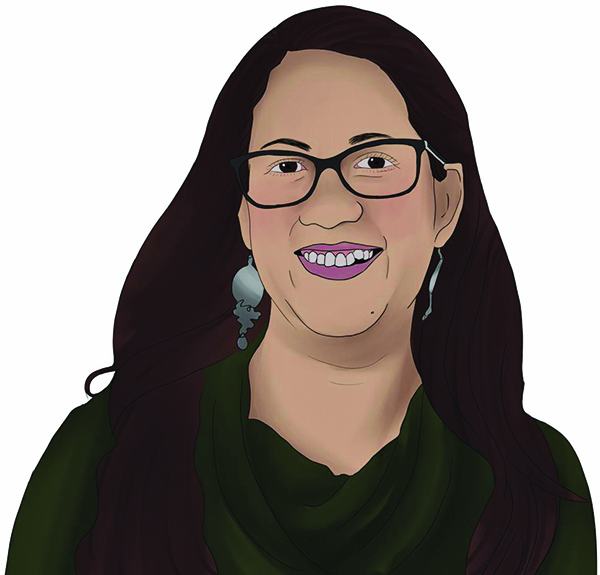
    Dr. María Cristina Villalobos; Illustration created by Ana Valle.

    In this chapter I recount my personal journey from K–12 schooling to my present position as faculty teaching at a university, I detail an important principle instilled in me by my mother—to take the initiative. Growing up, my mother would inform my two siblings and me to speak up and inquire about opportunities. By taking the initiative, we would be carving out a path to do better in our studies, which would lead to our future careers. In this narrative, I provide some of the many instances where I recall “taking the initiative.” Currently, I still “take the initiative” in my own career, as I’ve learned that if I don’t ask or if I don’t try, then I end up doubting what possibilities could have occurred. “Taking the initiative” begins by having confidence in yourself and always inquiring about opportunities. And this is the principle that I now communicate to students and which centers my testimonio.

    My Upbringing

    As is common in Mexican culture, I was named after my mother, while my younger brother was named after my father. My sister, who is the middle sibling, took on the name Gabriela, as it was a favorite name of my mother’s. And thus my story begins. My parents, Jesús Villalobos Cuéllar and María Cristina Sánchez Treviño, were born and raised in Hualahuises, Nuevo León, a small town in northern Mexico, which is close to the larger town, Linares. My parents met at a dance hall in 1969 and married nine months later when my mother was 23 years old and my father was 44 years old.

    My father was born in 1925 while my mother was born in 1946, and as you’ll note they had an age difference of 21 years. Both of my parents came from large families consisting of eight to nine children. Life was difficult in Mexico as my grandfathers worked whatever jobs were available. My grandmothers were homemakers, taking care of the family at home. Hence, my father only completed elementary education through the third grade so that he could work and assist his family financially. He read the newspaper daily and could engage in political conversations and debates with anyone. Now, imagine being nine years old and dropping out of school to take on an important matter that adults are tasked to take. Unfortunately, this still occurs in many parts of Latin America and around the world.

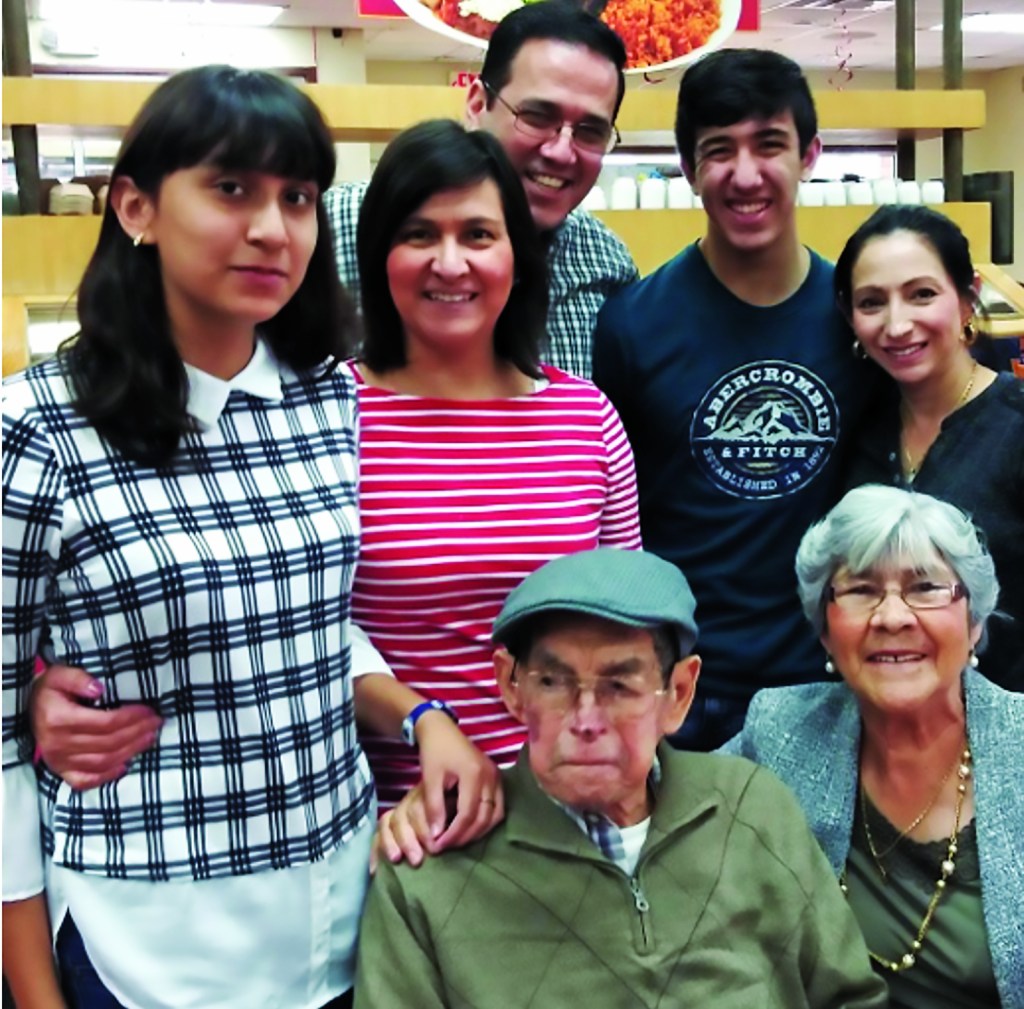
    With my family, sister and parents celebrating my father’s 93rd birthday in November 2018.

    When he grew older, he crossed the Mexican-U.S. border in search of better jobs to support his family. I recall him telling me his adventures and the multiple times he was deported to Mexico. He remembered vividly the discrimination that he encountered in Victoria, Texas, at a barber shop where he could not get a haircut because he was Mexican. So he just walked away. Another incident occurred in McAllen. He was apprehended since he was without papeles. [1] He was put in the back of a police car and took the opportunity to flee when the two policemen decided to have lunch at a restaurant. Perhaps it was a hint for my father to leisurely walk away. Eventually, my father and his younger brother made their way to Chicago to work in a printing company and became U.S. residents. During this time, my parents stayed in contact by writing to each other. My uncle got married, had a family and settled in Chicago where he still lives. His children, my cousins, attended college, some completed graduate degrees, and all are successful in their careers.

    My father returned to Hualahuises and married my mother in 1970. They immigrated to McAllen, Texas, in the Rio Grande Valley, a location close enough to their homes but most importantly a location they thought would provide a “better life.” Soon after, my sister and I were born in McAllen and we all settled in Donna, a smaller town 12 miles from McAllen. It was in Donna where I did all of my K–12 education. At that time there was only one elementary school, one middle school, and one high school; now there are multiples of each. During my school-aged years, my father worked at a local cannery in Donna while my mother worked at a local cannery in San Carlos and then as a custodian at the local Headstart in Donna.

    Early Schooling. I was raised in a Spanish-speaking environment as Spanish was my parents’ native language. My mother has always been a wise woman (as all Latina women are!) and a strong supporter of education. Thus, she took it upon herself to enroll me and my sister in the Donna Headstart preschool program. I spent one year in Headstart while my sister spent two given that she was a year younger than me. I only remember a few things about that year. I remember a field trip where I sprained my ankle, and singing while the teacher played the piano. I also remember watching a world slowly spin on the television screens, which years later I discovered was the intro to the soap opera As the World Turns that our teacher would watch while we were (supposed to be) napping.

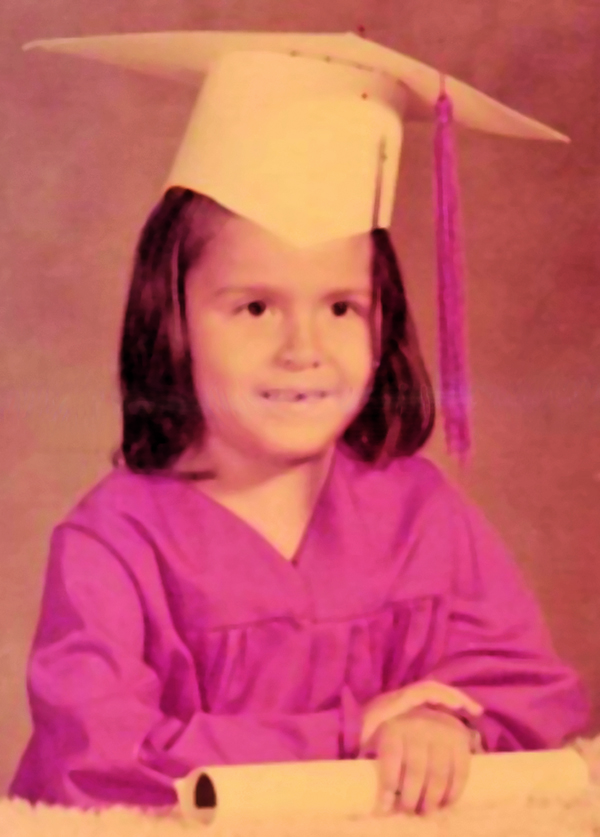
    Kindergarten graduation.

    From kindergarten through second grade, I was in bilingual education with bilingual teachers, perfecting Spanish and learning English. Developing into a dual-language speaker was helped by my immersion in Spanish at home and in English while in school. In third grade, I encountered my first full-blown English-speaking class—I say this since Ms. Turner only spoke English. I remember initially being frightened that Ms. Turner only spoke English, since I had felt comfortable with my bilingual teachers knowing that if needed to I could combine Spanish and English to communicate my thoughts. And thus I would frame English sentences with proper grammar in my mind before I approached Ms. Turner. Eventually this practice went away and the third grade was the best year of all my K–12 years. What made that year great was that we did so much “active learning,” to put it in today’s pedagogical use of words. In Ms. Turner’s class we sang and danced to songs by the Beatles; we built a western town out of construction paper and straws and I was designated “sheriff”; and we built a vegetable garden whose produce we ate at an end-of-school year Hawaiian celebration, which was where I discovered that I didn’t like radishes.

    In terms of mathematics, this was the grade where we learned the multiplication tables. Ms. Turner would provide us with a new set of flashcards each time we mastered learning the multiples of a set of numbers. Most importantly, I learned that I was good at spelling. Ms. Turner would line up the class in the front of the classroom and provide each of us a word to spell orally. If we missed it once, we were out. I kept missing words and wanted to advance and also win first prize. One day I noticed Ms. Turner reading words from the back of our spelling book during our spelling orals. So I went home and studied the words and specifically remember being given the word “different” to spell to which I remembered not to forget the first “e.” After that I won every oral spelling competition and brought home many prizes, one of which was a spider plant!

    I grew up in a low-income family and mom always made it a point to tell us that she could buy us any food (minus candy) we wanted or educational materials, but not toys as they were reserved for birthdays and Christmas. So as a child I would request mathematics workbooks from our local grocery store, which allowed me to practice and learn mathematics.

    Middle school years. Middle School turned out to be a fun time. In eighth grade, I studied algebra for the first time, but I found it to be difficult as the teacher didn’t explain the concepts very well. During one weekend, I remember that my friends and I didn’t understand a concept associated with a word problem. Some of my friends asked their parents for help since they had taken algebra in college; mind you this was a small minority. When my mother saw me struggling she immediately called her friend in Hualahuises who was a mathematics teacher. Guess what? We hopped on a bus that Saturday morning and made the four-hour ride to Hualahuises where Maestra Armandina devoted her afternoon to helping me learn algebra. Wow! Every time that I look back at this instance, I am in awe at my mother’s courage and determination to help me succeed. Although she may not have taken algebra, she showed me that it is not impossible to learn and that there is always a way. The following day I explained the solution to my friends.

    I had taken Spanish classes throughout middle school, learning the pronoun vosotros [2] and the verb tenses associated with it. I couldn’t understand why we needed to learn that pronoun as it was neither used in the Valley nor in Mexico. During this time, I had become more interested in learning about where to place the accent mark in a Spanish word. I had asked my mother about the accent in the words lápiz [3] and árbol [4] to which she replied solamente sabes, that is, “you know.” I didn’t take that at face value as I figured there must be a systematic way, otherwise people would be placing accent marks left and right. When I took (another) Spanish class in eighth grade, my eyes lit up when the topic of accent marks came up. There were rules! I memorized those rules, borrowed my dad’s newspaper El Porvenir and applied the rules. Yes, I had learned where accent marks belonged. In fact, I now knew why my first name “María” had an accent, but not “Cristina” nor “Villalobos,” but “Sánchez” did. Accent marks had now been added to my world, and I was elated!

    High school years. Having thought that I was weak in algebra, I decided to first take Geometry in ninth grade. I enjoyed the class as Mr. Frazier taught us to prove properties about angles, parallel lines, congruency, and other topics by using a two-column table format. Then came tenth grade and I enrolled in Algebra 2, which I feared. However, Mr. Miller taught us very well and I attended morning tutoring sessions to make sure that I understood the material well. Later I took Precalculus in eleventh grade, and in twelfth grade I took Calculus with Ms. Mendiola who turned out to be an exemplary teacher and who prepared me so well that I earned an “A” in first-semester Calculus I at University of Texas at Austin. In fact, my strong high school preparation meant my first year in college was manageable and doable.

    During high school, I learned to “Take the Initiative,” which is what I now tell my students. In order to graduate high school with honors, one needed to take five honors classes, but you needed to pass a standardized test in order to enroll; note that AP courses or dual-enrollment courses were not available then. I was not good at taking standardized tests. I spoke to my mom about this issue, and she advised me to talk with the counselor. So that summer before eleventh grade when registering for classes, I took it upon myself to talk with the counselor. I mentioned that I could do the work of an honors class and I could obtain As in the classes and hence do better than some of the students who had tested in, but had gotten Cs. The counselor looked at my past grades and was surprised as to why I had not been in the honors courses. All said, I had to take five honors classes in two years to graduate with honors. And I did. I enrolled in the honors courses English III, English IV, Spanish 3 (yes there was a lot of Spanish to learn!), Government, Marine Biology, Anatomy and Physiology, and Calculus, and thus I graduated with honors in the top 1% of the class, which had approximately 350 students.

    During high school I decided to participate in the University Interscholastic League (UIL) Spelling competition since I was good at spelling. We were provided with a booklet of over 1000 words to memorize and we competed locally in preparation for the District meet. I did very well. When I had trouble remembering the spelling of words, I would pronounce the word as if it were in Spanish as Spanish has only five vowel sounds, whereas English has five vowels, but with multiple sounds making it tricky to distinguish, for example, between a long “a” and a short “a” and everything else in between. So Spanish was a tool that I used to memorize the spelling of some challenging English words. I did very well placing in the top three in District every year and making it to Regionals to compete in San Antonio, but I never placed in the top three as it was tough.

    Wearing my UIL State medal with my brother, May 1988.

    In tenth grade we travelled with the UIL Typing team to San Antonio and I learned that no one had ever placed in the top three in a UIL State meet and the UIL Typing sponsor was eager for someone to do it; overhearing their conversation, I learned that the students were typing 45–55 words/minute with 0–2 errors. Wow! I had taken a typing course in middle school and I was typing 60 words/minute with errors. That is when I learned that students who competed at the UIL State meet were eligible to apply for a UIL college scholarship. So you can imagine what I did! I enrolled in a typing course in eleventh grade to be eligible to compete in UIL. I was earning first prizes throughout the local competitions until we got to the last practice where I dropped to second place. All of this time I hadn’t quite paid attention to the advice from my UIL Typing sponsor, Ms. Medrano. She had advised me to seek a consistent typing pattern and hence I began to practice quickly. All told, I achieved second place at the UIL State meet at UT-Austin, becoming the first individual to place at the State level from Donna High School. Today these typing skills have certainly helped me greatly in writing grant proposals, research papers, letters of recommendations for students, and answering emails. These UIL trips to San Antonio and Austin were the first I had taken away from my family and away from the Valley. They opened my eyes to the rest of Central Texas.

    Donna High School graduation, May 1989.

    During two high school summers, I enrolled in the Texas PreFreshmen Engineering Program (TexPREP) at our then regional university, Pan American University, which is now part of University of Texas Rio Grande Valley. I met many peers who became good friends and I took classes such as Logic, Computer Science, Engineering, and Physics, which helped me understand a bit more of what an engineering career entailed. In addition, one summer I decided to take on a part-time job where I worked as a shoe department clerk (for one month) and as a cashier in a grocery store. I took these jobs as I didn’t know what awaited me in college especially since I would be a first-generation college student. I didn’t actually know if I wanted to go to college. After these jobs and TexPREP, I figured I’d go to college to become a high school mathematics teacher.

    College Years

    Knowing that I would graduate in the top 10% of my high school class, I knew that I had automatic admission to UT-Austin. I had already visited the campus during the UIL State meet and hence I decided to go there for college. In 1989, my freshmen year I took Calculus 1 and I learned that some peers were part of the Emerging Scholars Program (ESP). I wanted to get the best preparation since I was planning to become a high school math teacher and hence I “took the initiative” and inquired about becoming a part of ESP. The following semester I was part of ESP while taking Calculus 2. And I am glad I was in ESP. I encountered new and challenging material in Calculus 2. ESP met three times a week for two hours each time, providing a total of six hours of weekly meeting time where we collaboratively worked on problems. Outside of class, I met very often with my Graduate Teaching Assistant Ms. Jackie Bacon. The following year ESP offered me the opportunity to be a Student Teaching Assistant and help the current Calculus 2 students with the material. I was assigned to work with Graduate Teaching Assistant James Mendoza Álvarez who became a mentor during college and who is now a friend and colleague teaching at The University of Texas at Arlington in the Department of Mathematics. [5]

    I will change direction here for a moment. UT and the city of Austin opened up my eyes to a different culture. No longer was I, a Latina, in the majority as I was in the Valley. Now I knew what it meant to be in the “minority.” There were few Latinos in Austin, few Latino professors at UT, and few Latino students studying careers in STEM (science, technology, engineering, and mathematics). This was a shock to me. In addition, I met new Latino friends who spoke little Spanish, but it shouldn’t have shocked me as they were multi-generational Latinos while I was first-generation Mexican-American. Moreover, I also learned that I had grown up in a low-income family as I compared myself to others. All of this time growing up in the Valley, I thought I was middle-class. Probably because my parents had bought a 25-year old home when I was in first grade and paid it off within four years (something my mother is extremely proud of!); because we had food on the table although we did ask our neighbor for a loan of $50 every now and then to make do with the week’s expenses; because on a few occasions we purchased new furniture and clothes using the store’s lay-away plan; and because compared with my cousins in Mexico we were doing financially better. There is no shame in being low-income, and I take great pride in the fact that my parents instilled in us the diligence of a strong work ethic and honesty along with “living within your means” to avoid debt, to pay back any loans in the event you needed to ask the same individual for a new loan, and to financially plan ahead. My siblings practice these ideals and are very successful in their own careers.

    Now, in my second year at UT-Austin, I was advised to take a class with Dr. Efraim Armendáriz, who was chair of the mathematics department and a proponent of the ESP program. So I enrolled in his linear algebra class. I was so thrilled to see a Mexican-American mathematician and he was the only one in the department. In addition, he had spent some childhood years in Brownsville, Texas, a city in the Valley. Hence, we were connected! During my undergraduate years at UT-Austin, a school of over 50,000 college students, Dr. Armendáriz and Dr. Uri Treisman became my mentors. On the recommendation of Dr. Armendáriz, a cohort of Mexican-American and African-American students applied to a summer research program at University of California, Berkeley which was led by Dr. Treisman. After that summer, Dr. Treisman joined the faculty at UT-Austin and I took his class on modern algebra, where I learned how to write proofs, and a second course on Galois theory. Both mentors encouraged me to collaborate with two students on a math project and we presented our work at the 1992 Society for the Advancement of Chicanos/Hispanics and Native Americans in Science (SACNAS) national conference held in Chicago. There I met Dr. Bill Velez, [6] a mathematician at the University of Arizona, who has been a mentor, colleague, and friend. He had started a conversation with me where I shared that I was planning to walk to The Art Institute of Chicago as I had taken an art history class in college and I was eager to view paintings and sculptures that I had studied and apply my knowledge of distinguishing Byzantine and Renaissance paintings and everything in between. He joined me and we spent an afternoon together at the museum.

    UT-Austin graduation with my mentor Dr. Efraim Armendáriz, chair of the mathematics department, May 1994.

    While at UT-Austin, a friend had shared a newspaper clipping of another Mexican-American mathematician—Dr. Richard Tapia [7] from Rice University who had just been inducted into the National Academy of Engineering. What an honor! My friend contacted Dr. Tapia who invited us to visit him. And thus another adventure began. We “took the initiative” and drove to Houston one Saturday morning in March/April 1993 to visit him. We had dinner at Picos Restaurant with Dr. Tapia and his family, Dr. Virginia Torczon who is now faculty at William and Mary, and Dr. Michael Trosset, who is now faculty at the Indiana University at Bloomington and with whom I have become good friends. During dinner we discussed mathematics and chatted about life. When I returned to Austin, I called Dr. Tapia and asked if I could apply to his Spend a Summer with a Scientist (SAS) research program although the application deadline had passed. He asked me to contact his assistant, Ms. Theresa Chatman, and submit an application. I was accepted and that summer I worked on a mathematics education project with Dr. Anne Papakonstantinou in the Rice University Summer Mathematics Program (RUSMP) alongside high school teachers. During SAS we had Friday meetings where participants presented their research work. I learned of optimization and differential equation applications through the work of doctoral graduate students, Tony Kearsley now at the National Institute of Science and Technology, Cassandra McZeal now at Exxon-Mobile, and Mónica Martínez now at Intel, and I found it amazing that I was learning of mathematics applications.

    The following academic year, 1993–1994, was my senior year at UT-Austin and there was a lot I had to do. In fall 1993, I applied to applied mathematics graduate programs across the nation and I also applied for fellowships. It was a demanding semester, but I knew I needed to give my all. Since I had only one shot at the applications and fellowships, I did not seek part-time work that semester and instead took out a loan. In addition, I also attended the SACNAS conference where Mónica introduced me to Dr. Juan Meza from Sandia National Laboratory and by the end of the conference I had secured a summer internship at Sandia! My efforts that fall semester paid off, and I got accepted to the Computational and Applied Mathematics (CAAM) department at Rice University and I received a three-year Ford Foundation Predoctoral Fellowship. I was elated! And thus I spent the next five years at Rice University and in 2000 I received my PhD in CAAM.

    To summarize, I had met many Latino mathematicians during my college years who mentored me, who continue to assist me in my career and who have become friends and family. Much of these efforts were attributed to “taking the initiative” and meeting them and learning about opportunities.

    Graduate School Years

    My first year at Rice was smooth and I attribute it to the preparation that UT gave me. I was used to studying late into the night, working on proofs and perfecting them, and just plain working hard. I studied with friends and we quizzed ourselves on the material. I was doing well until I had a moment of truth. I was probably in my second year of graduate studies when I walked into Dr. Tapia’s office telling him that I wasn’t sure how I could be working behind a computer doing applied mathematics while people in other parts of the world were struggling to live day by day. So his advice was to integrate community service into one’s career to start making positive changes. And thus I have done exactly that in broadening STEM participation to women and underrepresented minorities. At Rice, I was a tutor at a local middle school and I served as a mentor to other students. I was nominated by Dr. Tapia for the Rice Volunteer award, which I received.

    If you were a part of Dr. Tapia’s research group, you quickly learned about the “Torture Chamber,” the place where you presented your research work only to be critiqued and questioned by your peers regarding the material. It actually sounds worse than it really was. My peers and I presented our work many times, more than I remember. But think about it like this: questioning is good, as it helps you develop into a researcher and it provides you with opportunities to cement your work, understand it better, and develop new directions of research. In my third year of graduate studies, Dr. Yin Zhang became my PhD advisor (with Dr. Tapia as a coadvisor) for my research work in optimization. Throughout graduate school, Dr. Tapia became my mentor, and throughout my professional career, he has become a colleague, friend, and family.

    Apart from studying, graduate school was a lot of fun. There were Thanksgiving dinners and cookouts at the Tapia’s home. And then there were the times when we made tamales at Dr. Tapia’s home. We purchased masa, corn, chicken and other ingredients. I’ll never forget when we made a phone call to Dr. Tapia’s mother in Los Angeles to find out how we’d know if the masa was ready; she told us to place a piece of it in a glass of water and if it floated it was ready. So we had two winters when we had a tamalada [8] and the entire CAAM department was invited to Dr. Tapia’s home to enjoy our tamales. Now the department had many Latino graduate students from Venezuela and Colombia and so it was critical that we learn how to dance salsa and merengue. Thus one summer about 15 students—all from diverse backgrounds—learned to dance salsa and merengue in Dr. Tapia’s garage from the daughter of one of the graduate students from Colombia. Since then I have applied these dancing skills and they’ve become useful at weddings, social gatherings, and even at conference events!

    There were few Latino graduate students across Rice and as a result we got to know each other and became friends. The CAAM department was very diverse in terms of Latino, Black, and female representation. Friday afternoon meetings with Dr. Tapia’s group meant discussing not only research, but also social/educational justice issues, too. And it also meant having a better understanding of my friends who were Black, Brown, White, and all colors in between. During those meetings we shared our upbringing experiences and respected each others’ opinions. Sure, some discussions were tough and emotional, but we learned from each other.

    My friends and I at Disney World, July 1999. Out of the eight individuals pictured, five defended their doctoral dissertations in CAAM (two), Chemical Engineering, Economics, and Mechanical Engineering.

    In summer 1999, I defended my dissertation successfully. My CAAM peers and friends attended and provided much support. Actually, several of my friends and I defended our doctoral dissertation within days of each other. So what do you do when you accomplish something great? You go to Disney World!

    My then fiancé, now husband Arturo and I at our Rice PhD graduation in May 2000. Arturo also teaches at UTRGV in mechanical engineering.
    Rice PhD graduation with my parents and Dr. Richard Tapia.

    Professional Career

    As a tenured professor at The University of Texas Rio Grande Valley (UTRGV), I teach mathematics classes. I work with colleagues in electrical engineering, computer science, and applied mathematics to model application problems using optimization and optimal control. I also collaborate with colleagues on improving STEM education, and providing service to the department, university, local community, and to the mathematics profession. I am the founding director of the Center of Excellence in STEM Education, which focuses on broadening STEM participation of women and underrepresented minorities, especially that of Latinos, and preparing them for their careers or graduate studies. Our Center was one of three funded nationwide and I am extremely proud of that accomplishment. In addition, I collaborate with colleagues on grant proposals, research publications, teaching initiatives to improve student success, and service activities. I enjoy my job. And I am passionate about preparing the next generation of students to become leaders in academia, government, and industry.

    In 2015, I was appointed Interim Director of the School of Mathematical and Statistical Sciences to transition two mathematics departments into one department consisting of 45 tenure-track/tenured faculty and 25 lecturers to The University of Texas Rio Grande Valley. I was the first Latina and the first woman to serve as department chair in the history of both departments. During my two-year period as chair, I hired a total of nine tenure-track faculty, effectively increasing the number of Latino faculty by 66% and the number of women faculty by 40%. Given these large increases it is important to ask the base value; that is, the original numbers of Latinos and women on the faculty. I can tell you that it was merely a handful or less for each group.

    My first faculty appointment at St. Mary’s University, August 1999.

    Due to my leadership in STEM, I have received many national awards. The one that summarizes my accomplishments in mentoring students and faculty is the Presidential Award for Excellence in Science, Mathematics, and Engineering Mentoring (PAESMEM) which is one of the top honors awarded by the White House. The virtual ceremony took place in August 2020. I shared the excitement and award with my family and mother who were present. Once the pandemic [9] subsides, a formal ceremony will take place at the White House.

    Currently, Full Professor at The University of Texas Rio Grande Valley, 2020, where I hold an endowed position.

    Concluding Advice

    As you’ve noticed I’ve had mentors during my school and college years, however these mentors have also extended to my professional career providing guidance and advise. And so I end by asking you to “Take the Initiative!” and knock on doors. Take things a step at a time, but look five steps ahead. Be proud of your heritage and hold your head high. And finally I couldn’t leave without stating: Do well in Mathematics!


    [1] The word papeles translates to “papers” and is used to refer to documentation establishing legal status in the U.S.
    [2] The pronoun vosotros can be translated to “you all” in English.
    [3] Pencil.
    [4] Tree.
    [5] Dr. James A. Mendoza Álvarez is featured in Chapter 1.
    [6] Dr. William Yslas Velez is featured in Chapter 26.
    [7] Dr. Richard Tapia is featured in Chapter 22.
    [8] A party where the main meal is tamales.
    [9] This was written during the COVID-19 pandemic.


    Previous Testimonios:

    • Dr. James A. M. Álvarez
    • Dr. Federico Ardila Mantilla
    • Dr. Selenne Bañuelos
    • Dr. Erika Tatiana Camacho
    • Dr. Anastasia Chavez
    • Dr. Minerva Cordero
    • Dr. Ricardo Cortez
    • Dr. Jesús A. De Loera Herrera
    • Dr. Jessica M. Deshler
    • Dr. Carrie Diaz Eaton
    • Dr. Alexander Díaz-López
    • Dr. Stephan Ramon Garcia
    • Dr. Ralph R. Gomez
    • Dr. Victor H. Moll
    • Dr. Ryan R. Mouruzzi, Jr.
    • Dr. Cynthia Oropesa Anhalt
    • Dr. Omayra Ortega
    • Dr. José A. Perea
    • Dr. Angel Ramón Pineda Fortín
    • Dr. Hortensia Soto
    • Dr. Roberto Soto
    • Dr. Richard A. Tapia
    • Dr. Tatiana Toro
    • Dr. Anthony Várilly-Alvarado
    • Dr. Mariel Vásquez Melken
    • Dr. William Yslas Vélez

    Brian P Katz (BK)

    November 15, 2023
    Uncategorized
  • Testimonios: Dr. William Yslas Vélez

    Testimonios: Dr. William Yslas Vélez
    Dr. William “Bill” Vélez; Illustration created by Ana Valle.

    Marriage and Partnership

    Bernice and I met when we were 18 years old. We were children, naïve. Our backgrounds were surprisingly similar. We both had families in Magdelena de Kino, Sonora, Mexico, and as children, we both spent part of the summers in that town. On our first date, we went to a wedding shower at El Rio ballroom, where we danced boleros, corridos, and cumbias. [1]

    We married when I came home from my first tour to Vietnam in the U.S. Navy. I was at sea for most of our first married year, and this made for an extended honeymoon. I could not write about my life as a mathematician without also describing the joy and support that I received from Bernice and the family. Entering the mathematical community could have been like entering a not-too-friendly country, whose language I could barely speak. Instead, I walked in with an arsenal of support.

    Every married couple goes through hardships and ours was no different. With large extended families, there are many personalities and viewpoints. The children adopt behaviors of the dominant culture, which have to be begrudgingly accepted. However, we overcame problems and walked through life as lovers and partners. Bernice brought complementary skills to our marriage, which made my life more beautiful, more meaningful, and more delicious. We now spend our time together cooking, still listening to the Mexican music of our youth.

    Bill and Bernice at her Nana’s house.

    Bill’s Early Life

    I was born in 1947 in Tucson, Arizona, and I grew up in the loving embrace of the Mexican-American community. I found out much later that we were poor, just like the rest of the community that surrounded us. I did not internalize this poverty, surrounded as I was by the richness of Mexican culture. I was well cared for and loved. More than anything else, I was well educated. In my home, a song of education played constantly. We were the only family in the neighborhood that valued books. We had a set of encyclopedias and another set of books on nature.

    My mother, who was very proud of the fact that she graduated from Tucson High School despite the then-current attitude that women did not need such an education, would often say to us, “Lo único que les puedo dejar es una buena educación.” [2] My two brothers, Manuel and Gilberto, and I internalized this inheritance and we all graduated from the University of Arizona (UA). Though we led very different lives, we all passed on this song of education to others as teachers of English, music, and mathematics.

    My parents were both born in Sonora, Mexico. My father, Emilio, was born in 1908 in Magdalena de Kino, and my mother, Julia Yslas, was born in 1910 in San Miguel de Horcasitas. At that time, the border between the U.S. and Mexico was fluid and people moved back and forth between Sonora and Arizona. There were families on both sides of the border and children would be sent to live with relatives on the other side of the border for extended periods. As a child, I would spend a good part of the summers living in Magdalena de Kino, and I had the great pleasure of mingling with cousins from both sides of the family. Before my father died, we would travel to Magdalena de Kino about twice per month. The ritual was always the same. We would first arrive at my paternal grandparents’ home where we were received with love and affection, always arriving with gifts of food and other goods. My father would stay with his family and my mother and the children would then drive on about five blocks to stay at my maternal aunt’s home, which was part of their hotel, El Cuervo. As children, we would roam the small town of Magdalena de Kino freely, visiting with many different family members. It was an idyllic life.

    We were wild children. Life was safe and we could roam freely. Living in the Arizona-Sonora desert gave us a world to explore on our bicycles. An empty lot in front of our house was the gathering place for the kids. We would have neighborhood water fights with an arsenal of weapons. We played kick-the-can and hide-and-seek. In the evenings, adults would sit on their porches to try to catch some breeze. Food was enticing. Is there anything better than a fresh homemade tortilla with butter? My mother had a hard time keeping up with us as we passed by the kitchen to pick off a freshly made tortilla.

    On our trips to Magdalena de Kino, we would bring back a variety of firecrackers. A palomita, a triangular-shaped firecracker, four inches on each side, placed inside a mailbox would rip out the rivets and open it up for airmail. We found Josefina’s (my sister) baby buggy in the open lot (or maybe one of us placed it there).This reminded us of covered wagons going across the prairie.We attacked the covered wagon with flaming arrows. Several explosions were heard when the stagecoach caught on fire.This confirmed our suspicions that the wagon train was part of a cavalry resupply unit. No dolls were harmed in this egregious incursion into our sacred empty lot.

    Bill and Bernice at his mother’s house.

    Growing up in Poverty

    Growing up, we lived in a house that my father had built. My father, a mechanic, also had a garage built adjacent to our home. When I was about seven, our family went through financial hardships. My father’s garage was sold to a good friend, Cristóbal Redondo. In order to save our home, most of our home was rented out to a family. We kept two rooms of the house, plus a small trailer that had one bed, where my father had always slept. We had no running water in the two rooms, no heating, and no cooling. We used the bathroom and shower in the garage next door. One room served as a bedroom and the other room as the kitchen and dining room. There were six of us, my parents, my three siblings, and myself. Next to our two rooms was a concrete floor, perhaps 10 feet by 12 feet and over it were grape vines. This concrete floor was separated from the adjacent street by a three-foot-tall wire fence. When the weather permitted, we slept on cots under the grape vines. The sun was our alarm clock. Despite this poverty, my siblings Josefina and Manuel were sent to piano lessons every week. I never learned to play a musical instrument and Gilberto was fortunate that a children’s mariachi group was started in his school and he learned to play the string instruments of a mariachi group.

    When I was in seventh and eighth grades, home dance parties were very popular. For me, at that age, there was nothing more wonderful than holding a girl in my arms and swaying to the music. At home parties, there were no teachers around to monitor the rule of maintaining a distance between dancing partners. Since kindergarten, there was always a girl I was attracted to and these parties gave me an opportunity to dance with that girl.

    I mention these dance parties as an indication of my ignorance about our poverty. How could I have asked my friends to come to our home? I couldn’t invite them in. There was no room. My guests had to sit in this small outdoor floor, which also acted as our bedroom in summer. Worse, what if someone had to go to the bathroom? They would have to go to the garage next door. Apparently, I was blind to the poverty that I lived in. My life was so rich with music, with freedom and wonderful Mexican food.

    Bill in 1968.

    After selling the garage, my father rented a gasoline station from my maternal uncle, Augustín Islas. I started to work there when I was eight, pumping gas and fixing flat tires. My father died when I was nine. My brother Manuel, who was thirteen, took over the management of the gasoline station and was responsible for its day-to-day management. He hired one of our maternal uncles, Francisco Islas, to work at the station during the day, and after school, Manuel would take over and close the station at 9 pm. Manuel would buy old cars, hire a mechanic to fix them and then sell them. He was always looking into how to bring in a bit more money.

    When I was a bit older, I began taking over the late afternoon shift and would work until 9 pm. During the summers, I would walk the half mile to the gasoline station to open it at 7 am and I would work until 9 pm. My pockets served as the cash register, right-hand pocket for coins, left-hand pocket for bills to make change. There were no credit cards then. Gasoline sold for 17 cents per gallon. Teenagers would show up with their 22 cents to buy gas for the evening. The business was slow. Fortunately for me, I was a voracious reader and passed the time reading books. In the seventh or eighth grade, I submitted over 120 book reports.

    My mother was serious about education. I have no idea how she managed it financially. All of my brothers and I attended Catholic schools, first All Saints Catholic School until eighth grade, then Salpointe Catholic High School. She worked three jobs. One of those was selling Stanley Home Products. She would arrange a demonstration party at someone’s home, display goods, and take orders. Stanley Home Products would send my mother large quantities of three-cigarette packages to hand out at these demonstrations. Cavalier cigarettes were the brand. All of the neighborhood kids smoked Cavalier cigarettes.

    On Mexican American Culture

    I grew up in a very diverse environment. We lived at the corner of 34th Street and 7th Avenue. On 34th Street, between 6th Avenue and 8th Avenue, there were at least three Anglo [3] families, one Yaqui family and another Tohono O’Odham, [4] but the majority were Mexican American. At All Saints School, at least a third of the students in my class were Mexican American and there was one African American student. In grade school, all of my teachers, except for one, were nuns. Perhaps it was this Catholic environment that made overt racism a rarity. However, high school was different. There were still many Mexican Americans there, but I felt that the school was trying to make me into a “white boy.” I reacted against this by more fiercely embracing Mexican culture and adding my mother’s maiden name, Yslas, to my name.

    Growing up we understood that we were second-class citizens. The movies portrayed Mexicans as bandits. The movie about the Alamo had a profound impact on me. The white North Americans were the heroes, and the Mexicans were the bad guys. However, all of my family were Mexicans, and I could not internalize that message. I rebelled against this view of ourselves, and I reacted with a racist attitude towards white dominant North American culture and people. They didn’t want me and I didn’t want them. I was an angry young man, and my mother worried about the crowd that I was hanging around with. “Dime con quien andas y te digo quien eres.” [5]

    Not only were Mexican Americans looked down upon, but even within our culture, there was discrimination. We were darker and more Indian-looking than many of our cousins. [6] My paternal grandmother was fair-skinned and had blue eyes as do several of my cousins. Women at that time were told to wear sun hats so that they would not become darker. Added to this, we were poor and had no father. My mother worked three jobs to maintain a home while all of my aunts were stay-at-home moms, as was the norm then. She was often criticized for not being home.

    Many minority youth experience alienation from the dominant culture and, like me, react by not wanting to participate in a culture that demeans them and does not value their background. I never had a Mexican American teacher through high school. In my undergraduate and graduate studies, I remember only one Mexican American teacher, and that in a humanities class. What did that say about the relevance of education for my community? Over the decades, we have lost so many talented minority students because they could not see themselves on a path leading to college. These students saw too many exit signs along that path, and for many, their high school experience simply obliterated the roads that led to further education.

    How did my mother do it? She provided my brothers and me with the best possible education available in Tucson. The financial hardships were significant in sending us to Catholic schools, but what is even more challenging was that somehow she guided us into this educational pathway. We all knew that she worked hard outside the house, but we also knew that she would stay up late into the night washing our clothes and ironing our Levi’s jeans. As I grew up and began to loosen the anger that I felt towards Anglo society, I also gained respect for my mother, my family, and for our culture. This respect began to impact my actions. What would my mother say if she saw me doing this? That thought guided me. I was proud of our family and the respect that they had for education. This pride was an important tool for me that provided the extra impetus to forge ahead in times of difficulties. As I wrote in the dedication to my PhD thesis, “… si me he avanzado, es porque soy Yslas-Vélez. Arriba la familia.” [7]

    Higher Education

    I did not display any particular talents in high school. I was never the best student in a class. I thought I was very well prepared for college though I had not the slightest idea what career to follow. I have written about my four-year career in college and I only want to mention how our wedding occurred.

    Bill and Bernice, July 20, 1968.

    We planned to marry in May 1968, just after graduation. By February 1968 plans were well on the way for this wonderful event, but then the U.S. Navy intervened. I was ordered to report to Long Beach, CA on March 27, 1968 to be processed for sea duty. By April, I was on board the USS Yorktown in the Tonkin Gulf. Fortunately, I had enough units to graduate, but all wedding plans were cancelled, invitations thrown away. In June 1968, President Nixon had a troop withdrawal of 5,000 troops and the Yorktown was ordered back to homeport. I called Bernice by short-wave radio as we sailed back to Long Beach. She had three weeks to plan a wedding. Family and friends jumped in to prepare the traditional wedding food: birria (a prepared beef), beans, rice and tortillas, enough to feed over 400 guests. I arrived in Tucson the night before the wedding, we were married and that night we began our return to Long Beach, but I was soon out to sea again.

    In mentioning the following set of events to a mathematician, he remarked that I should have been the poster child for failure. I started graduate school in 1970, having just returned from Vietnam serving on aircraft carriers. It had been two years since I had completed my undergraduate degree. I earned many Cs in advanced math courses, I was married and our first child, Ana Cristina, was born in the third week of that first semester. I was a teaching assistant, teaching two courses per semester. The salary of $3250 per year was not enough to live on, but I also had the GI bill, which provided educational assistance for veterans and service members. I was fortunate that my brother-in-law, Francisco Redondo, would have side jobs on some weekends, and I would work as a laborer for his masonry crew.

    Not only did I not fail, I thrived. The five years in graduate school were among the happiest in my life. I was learning a great deal of mathematics, I was married, I had two children to come home to, (Andrés Antonio was born on March 25, 1974), and I owned a house. When I returned from Vietnam, I returned with a little bit of money (you don’t spend much out at sea). Bernice, who had taken over our finances, suggested that instead of paying $75 per month in rent, we should look for a house to buy, which we did, and the payments were $135 per month. It was a fix-up special. The week after we bought it, my two brothers and I put up a new roof. I also used my masonry skills and built brick walls to line our flower gardens and I also learned how to do basic carpentry.

    In March 1975, I had completed my thesis and as a gift to myself I bought a skillsaw and a sander. I built a living room set out of pine lumber: sofa, love seat, and end tables. This set was indestructible, and I called it my first approximation to a couch. Later I found springs from an old couch and created the second approximation. After 15 years or so, Bernice got tired of it and I came home one afternoon to find out that she had sold the set for $200.

    Building a playhouse for Ana, 1973.

    Overcoming Naysayers

    I have often heard that being married in graduate school and having children makes graduate school much harder. I found it to be the opposite. On the day that our daughter was born, I did not turn in a good homework set for my algebra class. The next class day the instructor walked into the classroom and handed back the homework. When he came to mine, he wadded it up in a ball, threw it at me across the room and yelled, “You will never be a mathematician.” Such an incident can be devastating to a person, but I went home that night and held a baby in my arms. I felt that my family was a place of refuge. Later, that same professor looked at one of my solutions and asked me to take his course in algebraic number theory the following semester and to think of working with him. He became my thesis advisor.

    I took his course in number theory and I did agree to work with him. I became a number theorist, yet I only took a one-semester course in number theory; I did take supporting courses in group theory and function fields though. Henry Mann, my thesis advisor, took a real interest in me. I would talk to him regularly and in the course of our conversations, I would discuss my family situation. I was born in Tucson, half of Tucson was related to me. Every weekend there was a baptism, birthday party, a quinceañera, [8] or a wedding; and every other Thursday a funeral. I was also the family plumber. Besides my family commitments, I taught two classes per semester for the five years that I was a teaching assistant. I was pressed for time.

    Henry Mann had us over for dinner one evening in my second year. As we drove home that night, Bernice mentioned that Mrs. Mann had taken her aside for a talk. She told Bernice that if she wanted me to be good, she had to learn to leave me alone. Bernice was quiet for a bit and then her quiet, confident voice came out of the darkness, “You will never be good.” Mathematical research is important and it is fun. But so is having a family that loves you. I recall that I read a biography of a mathematician, perhaps it was Hilbert. The biography mentioned that when Hilbert heard that a graduate student had married, he would have nothing more to do with him. I think that was a common attitude back then that mathematics should take over your mind and your body. I bought into it and worked so hard.

    Graduate Research

    Looking back at my research career I made a mistake. I never had a research program. I just loved working on problems. One of my best research tools was the question, “What are you working on?” I wrote several papers based on that question. Of course, I failed more often than I succeeded. I found out that I was not clever enough for this research style. That does not mean I was a failure. I earned a PhD in number theory and in the process participated in the mathematical adventures of a community, sometimes forging a trail myself, but mostly enjoying the scenic views provided by the rest of the community.

    My advisor suggested that I work in the additive theory of groups and number theory. I studied his book on addition theorems and concluded that you had to work a great deal to make little advances. It did not appeal to me. Don Lawver, one of our faculty members, came to Mann and asked him if he knew the answer to a very simple question. Here is the set up. Let F be a field of finite dimension over the field of rationals, f(x) an irreducible polynomial over F, and K = F(θ), where θ is a root of f(x). Let OF and OK be the rings of integers in the two fields and P a prime ideal in OF. A classical result in algebraic number theory shows that the prime ideal factorization P in OK is obtained from factoring f(x) modulo P, except for those P that divide the discriminant of f(x). Lawver’s question was how does P factor when f(x) = xp – a, where p is an odd prime and P is a divisor of p in OF. In this case, P divides the discriminant of f(x) so the classical theorem does not apply. The case for p = 2 was well-known. Mann suggested that I investigate the question of how prime ideals factor in extensions of F when a root of the irreducible polynomial xn – a is adjoined to F. This turned into my thesis problem.

    While working on my thesis, I bumped into the irreducible binomial, x6 + 3. When a root of this binomial is adjoined to Q, the field of rationals, it yields a normal extension with Galois group S3, the symmetric group. I mentioned this to Mann and this gave rise to a joint paper where we characterized all such normal binomials and their Galois groups. It turns out that Olga Taussky-Todd, a classmate of Mann in Vienna, had obtained this result many years before.

    Mann said that I had to learn p-adic methods. Modern mathematics is written in this language. He did not use this language because his thesis advisor, Furtwangler, had a fight with Hensel, who developed p-adic methods. Mann, being Furtwangler’s student, would not use p-adic methods. Later on Mann suggested that I look at his own doctoral thesis. In order to solve my thesis problem, I had to completely understand the results of his thesis. With a German dictionary at my side, I plowed through his thesis. He had left one case unsolved, and this case was critical for my work. Using p-adic completions, I resolved this last case, thus completing his thesis, and was able to move forward with my problem. I still remember the conversation that we had on this. I mentioned how I solved the problem by showing that a particular root of unity existed in the p-adic completion. He completely understood. The year after that, he included p-adic methods in his algebra course.

    Professional Career

    In the summer of 1974, I was offered internships at Jet Propulsion Labs, Sandia Labs and Bell Labs. I selected Bell Labs in Murray Hill, NJ because Bernice and I had never been east of Tucson. Family and friends were concerned about this decision. If the children got sick, “were there doctors in New Jersey?” Others thought that Bernice should stay in Tucson with the children. “Was there food we could eat there?” “Where would we buy tortillas?” The question of our separation was never considered between us. It was an adventure. We bought an old tent-trailer and set off for a 3000-mile camping trip from Tucson to New Jersey with our three-year old, Ana, and six-week-old baby, Andrés. Storms caught us in Kansas. Having to get up in the middle of the night, turn on the camp stove to heat up Andrés’s bottle was a nightly chore. When we returned home, we mentioned these incidents of hardship at a family gathering. One of the nanas of the family recounted her trip from Arizona to Sonora, Mexico when she was a 17-year old, traveling in a horse-drawn wagon with her sick child. That stopped our complaining. We had a wonderful time that summer as a family. Bell Labs was an amazing experience and I wrote a paper on a number-theoretic conjecture of Ron Graham.

    When I completed my PhD, I did not want to be a professor. In fact, I did not apply for any jobs. Sandia Labs in Albuquerque, New Mexico, called me and asked if I would be interested in a position there. I visited and they hired me. I worked on the Command and Control of Atomic Weapons for two years. It was very interesting. In Albuquerque, the Society for the Advancement of Chicanos and Native Americans in Science (SACNAS) was just getting off the ground, and I joined many Chicano and Native American scientists in helping to form this organization. I later served as its president.

    Many of us learn to deal with racism that occurs in our lives. We just push on. Institutionalized racism is much more difficult to deal with and academia is replete with it. It can be difficult to uncover this kind of racism, but it is there. In the late 1980s, I applied to work at the National Security Agency (NSA). In an exit interview, I was told that if I worked at NSA I could not have contact with foreign nationals. I replied that I worked at a university and this was impossible to comply with. The interviewer asked, “besides the university?” I am a Chicano, living 60 miles from the Mexican border, with relatives still living there. How could I avoid such contact? In the end, I said that I could not comply with this rule and I was turned down. I was a Vietnam veteran, had held a security clearance while I worked at Sandia Laboratories, yet this was not enough. It is perfectly fine for Chicanos to give their lives for this country, but it is not fine to devote our lives to work for this country. [9,10]

    Andrés, Ana, Bernice, Bill.

    After two years at Sandia, I found that I missed the teaching. I called Larry Grove, one of my professors at the University of Arizona (UA) to ask if there was a position available there. The department head called and asked me to give a lecture. I was hired and began as an assistant professor there in 1977. For the next ten years, I was lost in thought. There was a strong group in algebra and number theory. Dan Madden, who had been hired the year before me, had common mathematical interests and we investigated number-theoretic questions together. I worked so hard, though work is not a good description. It is not work when you love what you are doing. I didn’t worry about tenure because I knew I would get it. However, like so many minority scientists, I felt out of place in the department, especially in the beginning.

    Mathematically, I could not have asked for a better environment. But I found the social interactions with faculty draining. I have often said that just because we are serious it does not mean we should be somber. Where was the joy that we should feel in having the opportunity of being mathematicians and professors? People were very brusque with each other, and the etiquette of polite Mexican society was totally absent. At the beginning, Bernice and I hosted lots of social gatherings at our home. On one evening we had three mathematicians at dinner. Bernice would ask a question and they would answer me. They couldn’t talk to women. Such socializations were too much for both of us and we withdrew. Having one mathematician in the house was enough for Bernice.

    The lack of socialization skills of mathematicians is legendary. If the mathematician looks at his own shoes when talking, he is in an introvert. When he looks at your shoes he is an extrovert. Is it their vision of how mathematicians should behave? Is this behavior genetic or learned? Do mathematicians feign such behavior to impress upon their students how deep in thought they are and how brilliant they are? I personally think this is a charade for most. Why can’t our model for a brilliant mathematician be someone like Irving Kaplansky? [11] When I spoke with him he would bubble over with enthusiasm.

    On Being the First and Supporting Students

    I was the first Chicano hired in a tenure-track position in the mathematics department at the University of Arizona (UA). Somehow this made me an expert on minority issues. I was trained to be a mathematical researcher yet expected to function as a sociologist. This is the common plight of minorities in our profession. When you are the only minority, the community views you differently. Perhaps you are viewed as being representative of your culture, like a zoo exhibit, or you are viewed as an expert witness for your culture and asked a puzzling number of questions. How do minorities prepare themselves for these encounters? This places an extra burden on us that the majority population does not have. It took me years to find my minority voice, and in this, SACNAS was a tremendous asset. It is a sign of the times that minority scientists have to come together to support each other. That is why organizations like SACNAS, National Association of Mathematicians, Association for Women in Mathematics came into existence. Shouldn’t the mathematical community ask itself why women and minorities have to expend so much energy in creating these organizations to protect themselves from the majority?

    In the 1980s, I became faculty advisor to the student chapter of the Society of Hispanic Professional Engineers. I attended most of their weekly meetings and their annual conferences. I began to learn how to advise students. This was the beginning of the end of my research career. I began more serious efforts at increasing minority participation in mathematics and after a few years it consumed me. I was not happy giving up my research career, but I was not bright enough to carry out this work with students and work on research.

    I was very fortunate to come into contact with Phil Kutzko and the Math Alliance. I served on the board of the Math Alliance for many years. When I was president of SACNAS, I tried to institute a program in SACNAS to help minority students apply to graduate school. We tried it for a few years, but SACNAS was too big. The Math Alliance allowed me to propose this program again and the Facilitated Graduate Application Process program is now an important component of the Math Alliance.

    Passion for life has always been part of my being. I passionately studied mathematics in college and taught with passion when I became a faculty member. When I decided that the mathematics major was the best major for students I passionately promoted the mathematics major, first among minority students. Then when given the opportunity to direct the Math Center in the mathematics department, I directed this energy towards all students.

    I am truly fortunate to have had a career in mathematics. I enjoyed all of it. I loved the research, the joy of teaching, and the challenges to convince students to take more mathematics. I lived an idyllic life, one that I shared with a beautiful person, Bernice.


    [1] Boleros are a genre of slow-tempo Latin music. Corridos are narrative songs and poetry that form ballads. Cumbia is a musical genre that originated among Afro-Colombian populations and later was popularized throughout Latin America and the U.S.
    [2] My inheritance to you will be a good education
    [3] One of the ways Mexican Americans referred to white Americans at the time.
    [4] Both Yaqui and Tohono O’Odham are Native American people of the Sonoran Desert, residing primarily in the U.S. state of Arizona and the Mexican state of Sonora.
    [5] Show me who you are with and I will tell you who you are.
    [6] My recent Ancestry results indicate that I am 25% Native American.
    [7] “If I have succeeded, it is because I am Yslas-Vélez. Long live family.”
    [8] a fifteenth birthday coming-out-into-society party
    [9] NSA Policy on Contact with Foreign Nationals, Letters to the Editor, Notices of the American Math. Soc., Vol. 42 (2), February 1995, pg. 219.
    [10] Names on a Wall—A Perspective on Why Diversity Matters, American Scientist, Vol. 85(2), March-April 1997, p. 200. 13.
    [11] Irving Kaplansky (1917–2006) was a Canadian American mathematician, college professor, author, and musician.


    Previous Testimonios:

    • Dr. James A. M. Álvarez
    • Dr. Federico Ardila Mantilla
    • Dr. Selenne Bañuelos
    • Dr. Erika Tatiana Camacho
    • Dr. Anastasia Chavez
    • Dr. Minerva Cordero
    • Dr. Ricardo Cortez
    • Dr. Jesús A. De Loera Herrera
    • Dr. Jessica M. Deshler
    • Dr. Carrie Diaz Eaton
    • Dr. Alexander Díaz-López
    • Dr. Stephan Ramon Garcia
    • Dr. Ralph R. Gomez
    • Dr. Victor H. Moll
    • Dr. Ryan R. Mouruzzi, Jr.
    • Dr. Cynthia Oropesa Anhalt
    • Dr. Omayra Ortega
    • Dr. José A. Perea
    • Dr. Angel Ramón Pineda Fortín
    • Dr. Hortensia Soto
    • Dr. Roberto Soto
    • Dr. Richard A. Tapia
    • Dr. Tatiana Toro
    • Dr. Anthony Várilly-Alvarado
    • Dr. Mariel Vásquez Melken

    Brian P Katz (BK)

    October 16, 2023
    Uncategorized
  • Testimonios: Dr. Mariel Vázquez Melken

    Dr. Mariel Vázquez; Illustration created by Ana Valle

    Mexico City and the Early Years

    I was born in the great Mexico City. Here the adjective great applies to many different things. First, the Mexico City Metropolitan Area is large and densely populated. People of all colors and creeds coexist within its boundaries. At the time of this writing its population is estimated at 21.7 million, and within the city limits the density is estimated at 15,600 residents per square mile.

    In its second form of greatness the city has a rich history and is deeply cultural. According to a legend, the Mexica tribes traveled thousands of miles looking for the land where they were to settle. As they walked through a valley surrounded by mountains they found an island within the Lake Texcoco. There, perched on a cactus, was an eagle with a snake dangling from its beak. This was the sign. The settlement grew to become the capital of the Aztec empire, the largest city in the American continent. Tenochtitlán was founded in the fourteenth century by the Mexicas. When the Spanish conquistadors arrived it was a prosperous city with a sophisticated socio-economical system and urban architecture.

    In his 1576 book Historia verdadera de la conquista de la Nueva España, [1] Bernal Díaz del Castillo wrote:

    “When we saw so many cities and villages built in the water and other great towns on dry land we were amazed and said that it was like the enchantments […] on account of the great towers […] and buildings rising from the water […]. And some of our soldiers even asked whether the things that we saw were not a dream? […] I do not know how to describe it, seeing things as we did that had never been heard of or seen before, not even dreamed about.”

    The Spanish conquered the city in 1521, and built Mexico City on the ruins of the great Tenochtitlán. Throughout the centuries, the lake was drained and the city expanded over it. Every time an earthquake hits Mexico City its citizens are reminded that they live atop the ancient lake bed. From one of my favorite spots in Mexico City one can witness 500 years of history: the Templo Mayor (built between the fourteenth and the sixteenth centuries), the Metropolitan Cathedral (built between 1573 and 1813), and the Torre Latinoamericana (Latin-American tower, built in 1956). The photos above give a glimpse into the rich culture of Mexico.

    History of Mexico (clockwise from top left): Aztec calendar; Mayan estela (relief) from Yaxchilan, Chiapas; colonial house in the Coyoacán neighborhood in Mexico City; stucco facade of a Mayan temple from Placeres, Campeche. Three of the pieces are on display at the National Museum of Anthropology and History, in Mexico City. Credit: M. Vázquez Melken

    The next measure of greatness is not as captivating. During my childhood the city regularly broke records levels of pollution and crime. Life amidst daily chaos was challenging. Home, family, and school were my protection, and schoolwork was the crutch I leaned on as I navigated the winding path from childhood, through puberty, and into adulthood. Outside the bubble there was turmoil. The 1980s started with one of the worst presidents in Mexican history. The ensuing years of financial instability were felt at all levels of society, with the rich getting richer, the middle class shrinking, and the poor falling in the depths of misery. We dealt with family tragedy, and lived through the earthquake of September 19, 1985. The 8.1 magnitude earthquake started at 7:19am and lasted almost four minutes. We were used to the occasional movement of the earth, but this was different. Thankfully our house was not built on the lake bed, and it was not damaged. When the earth stopped moving we tried to get over the fright and continued with our morning routine; after all it was a school day and we could not be late! It wasn’t until we got in the car that the news of widespread damage reached us through the radio. Ten minutes into our trip, we turned around and returned to our home. Schools were closed for many days. I volunteered at the Red Cross, was given gloves and asked to go through a mountain of debris, in search of lost personal belongings. At least I felt that I was doing something to help, and millions of people came together as the government struggled with their response. This experience taught me early on about the power of grassroots efforts and the need to have empathy, believe in our community and cater to it.

    Family

    In the face of adversity we always turned to family unity and to education. Education is life insurance. Instead of favoring a fancy house, or a move to a neighborhood that would cut down on our daily commute, instead of indulging in expensive vacations, my parents prioritized education. They chose to pay for tuition in a school that was to provide me with the foundation needed to succeed in my later studies. Still, in the social context of our country, we were among the privileged. I understood this and have never taken it for granted.

    In the first half of the 1980s, when the crisis hit the hardest, our vacations consisted of day trips to the many small communities around the city, and bi-yearly trips to see our grandparents in Mérida and Campeche, two beautiful cities in the Yucatán peninsula. The road trip lasted between 16.5 and 22 hours, depending on traffic and on road conditions. My dad did not like to stop and often chose to do the trip in one go. I dreaded the gas station bathrooms, and got nauseous in the car. So I slept, as much as I could. Once we arrived to our destination our wonderful grandparents awaited us along with crates of mangoes and other tropical fruits, coconut water, the smell of the tropics, and the movement of sunlight on the water. It felt like paradise, and we immediately forgot the nuisance of the trip. It was worth it. I learned the value of family, and that personal sacrifice is outweighed by giving joy to others. As tweens and teenagers it would have been easy to whine our way into staying home. That would have been a tremendous loss.

    Discovering Mathematics

    I had a happy childhood, surrounded by a strong and loving family. I remember fondly the frequent weekend outings to the city’s parks or one of the forests in the outskirts of Mexico City. As a little child I loved counting and finding patterns. Every time I had a set of items at hand, I sorted them into similar shapes and colors, and I counted them. I also loved to see geometrical patterns around me. These ranged from daily occurrences on tiled floors and walls, to the painted or embroidered patterns on the artisan work that we saw during our trips. I admired those extraordinary geometrical shapes carved into the stone temples of the Aztec, Mayan, Olmec, Toltec, and Zapotec cultures. I also saw patterns in nature, twisted twigs, entangled seaweed, the intertwining of the waves, and the interplay of light and movement during a sunset on the water. To me, math went beyond numbers. It also consisted of shapes, colors and movement, and it was partly art. As the years passed, my love for mathematics grew. Mathematics was everywhere, but the idea of devoting my life to it, was quite abstract. I did not know that one could do math for a living, and thus I assumed that I would become an engineer, like my father and grandfather.

    At school, I worked extremely hard and started building my vision for the future, however uncertain it felt. In high school, I focused on math and science. The discovery that I could become a mathematician made me very happy. In my senior year I learned about DNA and fell in love with molecular biology. As the time to apply for college approached, I perceived the private universities as too narrow and limiting in their offerings. I had a thirst of knowledge and it soon became clear that my ideal school was the national university. The math curriculum was flexible and enthralling, most courses looked fascinating. Studying math seemed to necessitate giving up biology. I convinced myself that I could become a mathematician and later pursue a master’s degree in molecular biology. Although the plan was unconventional, I persisted. I always followed my dreams.

    My transition from high school to college was smooth. The National Autonomous University of Mexico (UNAM) offered me a first-class education. And it was free of cost. The transition from the tight bubble that enveloped me through high school to a university system that, in 1990, enrolled more than 271,000 students, employed 28,000 academic personnel and 25,600 staff members, may have seemed daunting. I thrived. I flourished in the immensity, the beauty, and the cultural offerings on a campus fittingly called Ciudad Universitaria. [2] Each day, the sensation as I entered the campus was that of coming home.

    La UNAM

    In Mexico, university students live with their parents whenever possible. Those who have to move away from their hometown to attend college live with extended family, primos, tíos, abuelitos. [3] In the absence of extended family, students, especially women, lived in vetted and ‘respectable’ guesthouses. The university had no dorms, and the rental market was intimidating and not affordable. Most also perceived living alone as dangerous, and a sign that you were devoid of your family’s protection.

    I stayed home, with the caveat that my home was far from the university, even by Mexico City standards. I lived in the northwest of the metropolitan area, while the university was located in the southwest. Distance is relative in Mexico. One can measure the absolute distance, which in this case was a mere 25km (approximately 15 miles). The temporal distance was more practically relevant, and it varied from 25 minutes in the wee hours of the night (2 am, for example), to 45 minutes if you were lucky and your commute was light, and up to two hours on the worst of normal days. Abnormal circumstances included road flooding after a storm or road blockage due to a crash, construction or one of the frequent marches for social justice. On those days you had better stay put and wait until late at night to attempt the commute back home. Of course, the temporal measure of distance had to be weighed by the means of transport. I was fortunate enough to own an old car that I could use for my daily trek to University City. Most citizens did not have that luck. Commuting by public transportation meant taking one or two small buses (the infamous peceros) to the nearest subway station, transferring twice, and finally arriving at the University City Station which was a ten-minute walk from the math department. All in all this was an exhausting 2.5-hour one-way commute. When driving I had to leave my home at 7:30 am to make sure that I made it to my 9 am class. As the years went by and traffic worsened, I left earlier and earlier. Leaving at 6:45 am would cut the traffic in half allowing me to cross the city in 45 minutes, arrive early and study on campus, or take the occasional 8 am class. My preferred commute was a hybrid: leave home at 7:15 am, drive for 30–40 minutes to Colonia Roma, exercise, grab a coffee and take the subway into campus.

    Occasionally, I commuted with a friend. It was good to have someone to talk to while braving the road rage and the traffic in Mexico City. He once told me that if I didn’t become a mathematician I would surely find a job as a cab driver. I learned every possible route and shortcut on my way to school. My mission was to not sit in traffic, so I often ventured off the main road, and developed a useful skill. It sounds funny, of course, but underlying it was a sinister cause: pollution and road chaos get on your nerves. They generate mounting anxiety. A few times I felt on the verge of breakdown. Optimizing my trajectories from point A to point B in the city entertained my brain and kept it from going to dark places. Unbeknownst to me, this presaged my future interests in random polygons. After all, each trajectory from home to college and back was a polygon in three dimensional space, whose embedding was affected by the fourth temporal dimension (time of day, day of the week, etc.) and by the randomness conferred to it by the city itself. Observing the world around us, and navigating it, teaches us about shapes and about the dynamics and randomness of different processes. Even adverse situations offer opportunities for reflection and learning.

    Around that time I found a deep love for theoretical mathematics. My favorite classes were those in topology, geometry, set theory, number theory and graph theory. I started attending the national meeting of the Mexican Mathematical Society, and the Graph Theory Colloquium, soon yielding to the prospect of becoming a researcher. I am grateful to so many wonderful teachers, to my classmates, to our philosophical musings and love for math, and to the flexibility of the system.

    At UNAM there were no majors or minors. The college application involved a general and a topics entrance exam. I forget the exact sequence of events, but I do remember having to indicate my chosen subject, as well as second and third choices. The first choice was mathematics. The second, in case you are curious, was architecture. Admittance implied entry into the carrera [4] of mathematics at La Facultad. [5] The Facultad consisted of a cluster of buildings and subjects that included mathematics, physics, computer science, actuarial sciences, statistics, and biology. All courses were chosen from an extensive list of mathematics courses provided by the math department. The first two years were quite rigorous and predetermined, but after that the flexibility was exhilarating.

    The memorable Calculus II classes from the power team, Luis Briceño and Julieta Verdugo, and Calculus IV from Javier Paéz, not only gave me strong foundations, but also taught me how to teach. To this day I find myself shaping my lectures inspired by theirs, with lots of in-class discussion, long homework sets, and by integrating a research project into the student assessment. Briceño and Verdugo demonstrated team science in the classroom, were fantastic lecturers, and gave students a glimpse into the work they did outside the classroom. Several times a year they offered training sessions for K–12 teachers in low-income public schools—an essential service to a population ravaged by poverty, decades of underfunding and poor teacher preparation. I remember my teachers and I am grateful for the education they delivered with passion and dedication. A fantastic teacher can change an undergraduate’s life and start shaping the mold of a future researcher and mathematician. Why then do some of our institutions, and colleagues, look down on those professors who are excellent educators, but do not do much research in mathematics? I personally think that there is room for everyone and that higher-education benefits from a diversity of approaches to teaching. Each instructor meets their students at a different level. Some will capture the student’s imagination in high school or in freshman year. For example, I learned introductory astronomy from Julieta Fierro, who on the first day of the semester, entered the classroom in roller blades, and climbed on the table to illustrate heaven in the Babylonian cosmogony. Dr. Fierro inspired a lifelong fascination for the skies and a deep appreciation for science communication. In mathematics some instructors can inspire the jump into deeper and more abstract mathematics through the calculus or linear algebra series, when a student could as easily switch to a different, not so challenging, discipline or major. Other professors can shape students dreams early on by modeling the path into abstraction and the tenacity needed to go to graduate school in mathematics and to undertake mathematical research.

    Did I mention that UNAM was an oasis amid the surrounding chaos? The comings and goings of mathematicians and other scientists modeled a more civilized society where citizens look out for each other, and work hard for the sake of knowledge, with no financial interest, with the goal of educating the next generation. Our facilities were not fancy, but we had all that we needed. Education was free and all services, including books, photocopies and food were heavily subsidized. I am not familiar with UNAM’s budget model of the 1990s, but from the point of view of the student I can tell you that we had what we needed: good professors, high-quality curriculum, large classrooms (clean and with chalk on the boards), green areas, a small library and a cafeteria. Minutes away was a cluster of world-class science institutes (astronomy, geophysics, materials science, mathematics, applied mathematics) with access to top-notch researchers, and the first and largest super computer in North America. A short drive, or shuttle ride, away was the massive central library, and the school of medicine. Going southwest were the volcanic formations and the university cultural center where I saw more symphony concerts and watched more art movies than I can count; excellent offerings at a very low cost for students. UNAM catapulted me into the possibilities of my future and I am ever so grateful for that.

    Knots and DNA: The Launch of My Career

    After taking the core courses I started leaning towards the theoretical math offerings. I took two number theory classes from the legendary Alberto Barajas, one of the founders of modern mathematics in Mexico. I learned graph theory from Neumann Lara, a wide range of the topology and geometry offerings from Bracho, Clapp, Montejano, Eudave, Gómez Larrañaga, González Acuña, Neumann Coto, four semesters of analysis from Grabinsky and Carrillo, set theory from Amor. Back then I thought of “pure” math in opposition to “applied math” and inferred that I would need to relegate my interest in molecular biology to a mere hobby. I was mistaken. One day, walking through the halls of the department, I found a poster announcing a series of lectures on “knots and DNA” by De Witt Sumners, professor of mathematics at Florida State University. This combined the math that I liked with molecular biology. I have thought about knots and DNA since that day. It has been the leitmotif of my career. This day led me to the path less traveled and shaped my future. Work as hard as you can and follow your dreams as they will take you exactly where you need to go, even when the path may seem unconventional.

    Licenciatura en Matemáticas, bachelor’s degree in mathematics, from the National Autonomous University of Mexico (UNAM). This was a tremendous source of pride for my family, the culmination of many hard years of work and the constant reminder that not everyone is as fortunate and as privileged. The university motto, Por mi raza hablará el espíritu (Roughly translates to: through my people, the spirit will manifest) is a guiding force that maintains that the way forward is through education.

    An undergraduate thesis is a graduation requirement for college students at UNAM (and most other universities in Mexico). I have often claimed that a third of what I learned in college I learned while writing this thesis. In bulk amount of material the thesis can probably not even come close to the hundreds of derivatives, limits, and integrals solved in the calculus series, but if we consider the content weighted by its future impact, the thesis largely overtakes the rest. That being said, doing research would not have been possible without the foundation acquired during the first few semesters of my college years. Beyond enjoying the details of the work itself, writing a thesis moved me into the world of mathematical research. I became an undergraduate scholar in the math institute, attended national and international conferences, listened to famous researchers and witnessed the lifestyle of professional mathematicians.

    It soon became clear that I wanted to go to graduate school and pursue a PhD program. However, I had not asked my parents to pay for a college degree, and was surely not going to ask them to come up with tens of thousands of dollars to pay for graduate school. The idea of applying to a PhD program abroad did not materialize until I understood that I would not only not be expected to pay for the degree and support myself, but that the university that admitted me would pay me a student salary sufficient to support my living expenses, and would cover my tuition. I always wonder how many people don’t even start dreaming because of the fear of the financial cost. Those individuals could have brilliant careers and instead leave the pipeline.

    The community supported me, and encouraged me. I received a scholarship and was admitted into a handful of prestigious universities. The choice was now easy. A few months later I boarded a plane with two suitcases and U.S. $500 in my pocket. My savings vanished in the first week of paying for necessities and various utility and housing deposits. But I was there, I was not afraid and was determined to succeed. I also had a fantastic advisor, De Witt Sumners, whose family helped me tremendously during the first few weeks.

    On Being a Woman in Mathematics

    I am an optimist by nature, and tend to be very positive. I feel compelled, however, to unveil some of my experiences with injustice and misogyny. These are of course not limited to my city, or to the developing world for that matter, but I did not know it when I was young. We always think that the grass is greener on the other side. When I lived in Mexico it was impossible for a woman to walk in the street without being catcalled. For teenagers or young adults, the verbal attacks were vicious and continuous. On occasion they transcended the verbal and the perpetrator followed you for a few blocks on foot or for miles by car, adding to your fear, the constant terror of sexual violence. At secondary school I felt safe. In college I learned to be vigilant as I traversed the city from day to day. While on campus I felt mostly safe. I learned to avoid sensitive areas and to speed up my walking from the subway to the department. Inside the Facultad de Ciencias, [6] life was good. Well, it was good until I started working as an undergraduate research assistant, attracting the attention of one too many middle-aged professors. I was very shy and kept to myself, but I was driven and a very good student. This, compounded by the oddity of a woman in mathematics, appealed to certain types. Of my freshman class of eighty, ten graduated in mathematics, with only two women. I was curious, focused and passionate about learning and breaking barriers. They also found these traits appealing. I was friendly and always carried a gentle smile. This opened the door to abuse of power. The few women doing research, most of them young students, learned to assimilate in the male-dominated world and to live with constant microaggressions in the form of false praise that some took as compliments, some relished, and most others dreaded. And then there was the joking… Many sexual or misogynistic jokes were (and still are) socially accepted. Making fun at the expense of women, minorities, and those with different sexual orientations was normalized. Oh, but do not take me wrong, this was not unique to Mexican society and the Mexican academic environment. I continued my career in the United States and the jokes continue until this day. They are less loud and are concealed under a veil of hypocrisy. There was for example the warning from a fellow graduate student to be aware that professor X just stared at your breasts while he pretended to listen to you. The misogyny in Mexico was overt and accepted, while in the United States it is closeted, but omnipresent.

    It wasn’t until several years into my move to the United States that I learned to recognize discrimination. I have to say that such naïveté and ignorance was helpful. Looking back I now remember those instances and recognize them. For example, a staff member who, throughout the PhD, confused me with the only other Latina in the program. Our names are vastly different and each of us has a distinctive physiognomy, including different skin color. Or that famous mathematician who, after seeing my husband pushing our first child in the stroller, told him that his life as a mathematician was over. We were both postdocs dealing with the uncertainty of the future and navigating our first year as parents while teaching and conducting research.

    These were signs of systemic gender and race discrimination, but I always chose not to linger on them. I thought that the perpetrators were individuals (as opposed to groups) making bad choices, and I tended to give people the benefit of the doubt. I still do, and I am the better for it. My approach has been to distance myself from them. Ever the empath, I rationalize what could have caused the behavior. I do not (or try not to) take it personally, brush it aside and keep moving forward. We make choices in life and the choice to allow the attacks of others to hurt us is one that shapes who we are. There is adversity in life. We cannot know when and where it will strike, but we can choose how much we will allow it to weigh us down. This, I recognize, is easier for those of us who grew up abroad, nevertheless, we have a responsibility to recognize injustices, step up to protect others, and continue moving forward, one step at a time.

    Conclusion

    Today, fast-forward two decades, I am a full professor in the departments of mathematics and of microbiology and molecular genetics at the University of California Davis. I am married to my collaborator, life partner and best friend, Javier Arsuaga, and we have two beautiful children. I devote my research life to studying the molecular intricacies of genomes and the inner working of proteins that interact and change the topology and geometry of DNA. I co-lead a research group with my research and life partner. I find much joy in mentoring students in research and in communicating science at all levels. The other half of my academic life is devoted to combating inequities and providing an equal playing ground for all. I lead the Center for Multicultural Perspectives on Science (CAMPOS) whose mission is to support the discovery of knowledge by promoting women and other groups underrepresented in STEM, through building an inclusive environment. My academic and personal lives intertwine like the DNA double-helix. For now, while still young, our children follow their parents in the uncertain winding path through life. There have been many hurdles, but it is always about looking up and moving forward, with patience and concentration, putting one foot in front of the other. This is a story for another day.


    [1] The True History of the Conquest of New Spain
    [2] University City
    [3] cousins, uncles/aunts, grandparents
    [4] career
    [5] the Faculty of Sciences
    [6] College of Science


    Previous Testimonios:

    • Dr. James A. M. Álvarez
    • Dr. Federico Ardila Mantilla
    • Dr. Selenne Bañuelos
    • Dr. Erika Tatiana Camacho
    • Dr. Anastasia Chavez
    • Dr. Minerva Cordero
    • Dr. Ricardo Cortez
    • Dr. Jesús A. De Loera Herrera
    • Dr. Jessica M. Deshler
    • Dr. Carrie Diaz Eaton
    • Dr. Alexander Díaz-López
    • Dr. Stephan Ramon Garcia
    • Dr. Ralph R. Gomez
    • Dr. Victor H. Moll
    • Dr. Ryan R. Mouruzzi, Jr.
    • Dr. Cynthia Oropesa Anhalt
    • Dr. Omayra Ortega
    • Dr. José A. Perea
    • Dr. Angel Ramón Pineda Fortín
    • Dr. Hortensia Soto
    • Dr. Roberto Soto
    • Dr. Richard A. Tapia
    • Dr. Tatiana Toro
    • Dr. Anthony Várilly-Alvarado

    Brian P Katz (BK)

    September 16, 2023
    Uncategorized
←Previous Page
1 2 3 4 … 8
Next Page→
 

Loading Comments...
 

    • Subscribe Subscribed
      • Inclusion/Exclusion
      • Join 42 other subscribers
      • Already have a WordPress.com account? Log in now.
      • Inclusion/Exclusion
      • Subscribe Subscribed
      • Sign up
      • Log in
      • Report this content
      • View site in Reader
      • Manage subscriptions
      • Collapse this bar