Inclusion/Exclusion

Inclusion/Exclusion

A justice and math weblog

  • Blog
  • About
  • Towards an Insurgent Science for Palestine

    Guest post by Tarik Aougab

    Editorial note from MKL: This article was originally published in the Vol 26, No 3: Palestine issue of Science for the People Magazine. You can view it in its original form here. I am grateful to Alex Adams, the Managing Editor of SftP, for granting us permission to republish this piece on the inclusion/exclusion blog. Given the man-made famine currently ravaging Gaza it felt especially necessary to remind you, the reader, of the urgency of this moment and the concrete steps that we can each take as mathematicians to push for an end to this genocide.

    Image credit: Just Mathematics Collective

    In the wake of one of the most historic student movements in decades, the call for divestment from Israeli institutions complicit in the maintenance of apartheid has never been louder. The Boycott, Divestment, and Sanctions (BDS) movement—inspired by a similar worldwide movement against Apartheid South Africa and spearheaded by Palestinian organizers—has for the last twenty years been at the forefront of the charge to divest from Israeli institutions.1 In 2004, a vast collection of Palestinian unions, professional societies, human rights groups, and community organizers came together to endorse a broad boycott movement, targeting Israeli state institutions and global corporations that profit from settler-colonialism in Palestine.

    In the Global North, most of the news surrounding the BDS movement makes it out to be very radical and fringe.2 Zionist politicians often take pains to mount a “guilty by association” charge by implying connections between BDS and other Palestinian resistance groups that have already been tarred in the Western media as terroristic, militant, or insurgent. This applies equally to the Academic and Cultural Boycott, a component of BDS that asks academics, researchers, artists, and performers not to collaborate with cultural institutions—for example, universities—that sustain the apartheid Zionist regime.3 However, when placed within the scope of Palestinian organizing, BDS is mainstream.4 Amongst the political actors struggling for liberation both within Palestine and in the diaspora, BDS is the bare minimum.

    Insurgent Science

    What would it look like for us, as scientists, to engage in a truly insurgent scientific practice for Palestine? What would this entail? How can we position ourselves such that BDS becomes to us what it is to Palestinians engaged in their own fight for liberation; that is to say, the bare minimum? I will outline several steps that scientists can begin to take now in their own networks. As part of the Just Mathematics Collective, I draw from my experience on a campaign geared towards a mass academic boycott: I encourage every scientist reading to sign on and join us.

    Step 1: Commit Publicly to Scientific BDS and Become an Organizer in Your Own Networks

    I’ve spoken with many scientists about joining our campaign who tell me that they have been quietly adhering to the call for academic boycott for years, for example not attending academic events at Israeli institutions, not submitting research papers to journals published by Israeli universities, and not writing letters of recommendation for employment at such universities. These scientists often ask what is gained by publicly announcing their support for boycott. The answer is simple: vocalizing support for academic boycott plays a normalizing role. Our colleagues need to understand that the tide is turning; we should be aiming for an academic environment in which the politically risky move is to cross the BDS picket line, and we can only arrive there by  publicizing our participation in, and support of, this movement.

    The goal of an organizer in science should be to make our colleagues feel empowered to join us. This is something we think carefully about in the Just Mathematics Collective; for example, our BDS campaign is designed to minimize the barrier of entry for other scientists. We do not publicize the names of our signatories and instead only keep a running tally of the number of participating scientists; after all, the logic of boycott as a political strategy relies on collective strength. We organize in this way in order to protect against a common pitfall: what begins as a handful of enthusiastic people being vocal about their support for a particular cause can sometimes morph into a cult of personality. In an effort to inspire and bring in more people, organizers rely on their own personal charisma and political courage. In the academic context, this might look like intentionally subverting professional norms by mentioning BDS in talks and organizing panels on its merits at conferences which traditionally focus exclusively on basic science. While I encourage scientists to do all of these things, they can backfire if we are not also making clear to would-be supporters that in order to endorse BDS, they don’t have to do everything we do.

    It’s worthwhile mentioning some basic talking points that have worked well in discussing BDS with other scientists. Crucially, we should be able to communicate its basic principles in ways that undercut the most common bad-faith and diversionary critiques of it, namely that it “singles out” the Zionist entity. Consider the common Zionist refrain that BDS must be motivated by antisemitism, because otherwise people would also be calling for a boycott of, for example, Chinese institutions given their government’s role in the Uyghur genocide.5 It can be useful to hone in on several criteria met by the genocide in Palestine and the role Israeli universities play in it—and not met by circumstances in other countries even if those governments are carrying out terrible crimes that justify boycott, both ethically and strategically.

    First, there is the complicity of Israeli universities in the ongoing Nakba and genocide of Palestinians.6 The overlap between Israeli weapons manufacturers and Israeli universities is so pronounced, one does it a disservice by referring to it as merely a revolving door.7 A vast number of employees at Elbit and Rafael—the two largest weapons firms in Israel—are graduates of the Technion, Israel’s leading technical university.8 The Technion granted one of Elbit’s most esteemed presidents, Yossi Ackermann, an honorary doctorate, and it hosts official and lucrative partnerships with Elbit and Rafael.9 Moreover, Israel’s scientific institutions pride themselves on conducting much of the basic research upon which the surveillance and weapons technology (eventually developed and marketed by private Israeli firms) is based.10

    Second, there is the potential for scientists to make a concrete impact. A political movement has the responsibility to demonstrate that its tactics have the capacity to inspire material change. Those who question the efficacy of academic boycott may argue that the academic boycott of South Africa was largely symbolic in nature.11 On the other hand, South Africa was not known the world over for its academic institutions. The South African state did not hedge its international reputation on the prestige of its universities. Its economy was largely agrarian; conversely, Israel’s economy is heavily dependent on the export of high-tech goods.12 Supporters of the Israeli state bill it as a technological hub—the so-called “start-up nation”—fueled by the quality of its academic institutions.13 Its overall economic health is heavily reliant on its capacity to attract scientific talent to study at its universities and to produce new tech in its laboratories. For this reason, a broad and international scientific boycott effort has the capacity to put pressure on the Israeli state in a way that was simply not possible for academic scientists in the case of Apartheid South Africa.

    Third, there is the importance of genuine solidarity with the oppressed. Any movement that claims to exist for the benefit of a certain group of people should be doing its absolute best to take direction from those very people. Of course in practice, this criterion can easily fall prey to the forces of tokenization; just because there are Palestinians who think the international scientific community should be doing one thing or another of course does not preclude the existence of other Palestinians who think the opposite. Having said that, it becomes meaningful when an unprecedentedly large coalition of unions, professional societies, human rights organizations, and resistance groups amongst the oppressed come together to endorse a specific movement, and this is indeed the case for the academic boycott of Israel.

    We can now revisit the example of the Uyghur genocide with our criteria in hand. In that instance, there is no decades-long call for boycott, lead and supported by an overwhelmingly broad cross-section of Uyghur civil society, nor has a scientific boycott in that specific context been argued for (again, for decades and by many political organizers, researchers, and every day people) from a strategic standpoint.

    Step 2: Connect with Community Organizers Fighting for Palestine in Other Spheres

    One of the most heartening aspects of the student intifada is its insistence on a commitment to abolitionist principles; it is not enough to simply divest from companies complicit in the maintenance of apartheid in Palestine—we must divest from weapons manufacturers and policing organizations whether or not their connections to the Palestinian genocide are explicitly spelled out in some institutional investment spreadsheet. The student movement understands the interconnectedness between, for example, the fight for Palestinian liberation, and the fight against Cop City in Atlanta. When we take a page from their book and adopt a wider lens, we will notice many more opportunities for important collaboration.

    For example, the Just Mathematics Collective has a campaign aimed at severing ties between professional mathematics and the National Security Agency (NSA). As part of this campaign, members organized direct actions against NSA recruitment events at large mathematics conferences.14 The first of these actions took place in Boston, in January of 2023. While some of us had experience putting on direct actions, many of us did not. Moreover, most of us were unfamiliar with Boston and had no clue what sort of police response to expect. Luckily, we were put in touch with the Muslim Justice League, a community group in Boston that for years has fought tirelessly for Black and Brown Bostonians (and in the last several months, has been incredibly active in the Boston-area movement against the Palestinian genocide). Organizers with the League were more than happy to collaborate with us, because they understood the importance of fighting against the NSA, given the ways it polices, surveils, and criminalizes Muslim communities.15 They showed us the ropes and helped us organize an action on their turf, and conversely, we facilitated their access to a space in which the NSA was present and totally unprepared to be challenged.

    Insurgent science demands this sort of mutually beneficial collaboration. As established in the previous section, the extent to which big tech has become a target of the movement for a free Palestine, means that scientists have important resources to offer our comrades in organizing spaces. In our case, the Muslim Justice League didn’t need a lecture on how mathematics is put to use by the NSA in cryptographic applications; they just needed our help in gaining access to the conference (and also navigating some of the arcane social norms prevalent at such events). Similarly, we might happen to have connections within our own university settings, or in tech firms complicit in genocide, to which community organizers would love to have access. We can only learn how to contribute to the struggle for Palestinian liberation by participating in it.

    Step 3: Put Your Science to Work for Palestine

    Our next task is to collectively imagine ways in which our scholarly work can facilitate the fight for justice in Palestine. The insurgent scientist should in particular think about how to connect their work to the political tactics that live beyond the modes of engagement that are merely conventional by Palestinian standards, such as BDS.

    For example, the Mapping Project is an interactive web tool designed by an anonymous collective which allows the user to highlight various relationships between organizations in the Boston area that support Zionism, medical apartheid, police brutality, and housing injustice. The purpose of the project is to illustrate how interconnected these forces are, and to perhaps provide organizers with a tool for discerning patterns in the web of Boston-area collaborations between cops, business owners, hedge fund managers, and universities. Predictably, the project was maligned by many in the mainstream media in the ways that Palestine solidarity work often is: by accusing it of dangerous antisemitism, and even collaboration with other governments hostile to US interests.16 In reality, organizations were included in the dataset (or network analysis) if they expressed material support for Zionism, but cheerleaders for Israel have a vested interest in conflating anti-Zionism with antisemitism, and in this instance, they succeeded in passing on that conflation to those who reported on the project.

    The sort of data collected by the Mapping Project is perfect for elementary network analysis. Using mathematical tools that are taught in a standard advanced linear algebra course, a mathematician can study the combinatorics of a network and quantify, using so-called centrality measures, which nodes are most “centrally positioned” within the network. One can for example imagine a community organizing group focused on Palestinian liberation who want to determine a target for a divestment campaign. They could in theory use these sorts of tools to determine which entity in Boston, if removed from the network of Zionist-supporting institutions, would damage the overall health of the network most dramatically.

    This is precisely the sort of application explored in an essay written by two of our members, using the Mapping Project’s interactive tool.17 In it, they determine the relative centrality of Harvard University and they discuss several ways that student divestment organizers might use this information to their advantage, for example by short-circuiting the ways that university administrations try to sap the energy out of divestment campaigns by attempting to minimize the importance of the institution’s investments.18

    It is important to keep in mind the possible consequences of practicing insurgent science. For instance, Israel passed a law in 2017 that gives the state the right to deny entry (both to Palestine and Israel) to anyone known to have publicly supported BDS. This will ostensibly make it harder for the insurgent scientist to participate in collaborative scientific programming taking place in Palestine. There is also the consideration of respectability; as scientists, we have a certain cultural cachet, and we forfeit some of this academic prestige when we choose to engage with more radical tactics. It is not always clear to me how to translate this cache into material impact without immediately losing it, but there are scientists who swear by its importance when it comes to enacting change.

    Navigating the advantages and disadvantages of maintaining respectability is not a challenge faced uniquely by scientists. We can even see this tension playing out after the Boycott National Committee, the organizing team largely responsible for setting the agenda of the BDS movement, put out a statement in which they discouraged international support for Palestinian militant resistance.19 They recently released a second statement in which they walk this back and clarify their support for militant resistance. The Popular Front for the Liberation of Palestine released a statement in response, reiterating its general support for BDS.20 The managing of respectability relates also to the tendency in mainstream organizing for Palestine of relying on the image of Palestinians as perpetual victims: the logic behind this cynical flattening of Palestinian existence is that acknowledging the reality of Palestinians fighting back—as oppressed and colonized peoples have always done throughout history—might dilute international sympathy for the cause.21 Of course the problem with this framing is that those who benefit most from the continual destruction of Palestine are many of the same people with the power to determine what is respectable and what isn’t, and therefore the actions that remain within the bounds of respectability are often toothless or ineffective by design.

    In any case, I am not expecting every scientist will become insurgent for Palestine; indeed, the lion’s share of scientists will not be willing to take on roles that require them to relinquish respectability. Thus, any role in the movement that depends on the maintenance of respectability is far more likely to be reliably filled. It is insurgence that we lack. Let us build a scientific community that collectively honors the many revolutionary Palestinian intellectuals– such as Ghassan Kanafani, Leila Khaled, and Bassel Al Araj—who understood the importance of embracing insurgence in their pursuit of truth and justice. And in the process, let us cultivate a scientific practice that embraces the full spectrum of Palestinian existence.

    1. Adam Shapiro, “Our South Africa Moment”, DAWN, March 24, 2022. ↩︎
    2. Sunlen Serfaty and Ashley Killough, “Bipartisan House Group Introduces anti-BDS Resolution”, CNN, March 21, 2019, https://www.cnn.com/2019/03/21/politics/house-anti-bds-resolution/index.html. ↩︎
    3. Kate Huangpu, “Colleges would face financial punishments for boycotting or divesting from Israel under new Pa. law”, WHYY, June 21, 2024. ↩︎
    4. Mohammed Daraghmeh, “Palestinians Call for Boycott of Israeli Goods”, Associated Press, February 11, 2015, https://apnews.com/general-news-98858aba617a4138bd6a570072f6cd93. ↩︎
    5. Max Boot, “The BDS movement shows its hypocrisy by boycotting Israel and not China”, Washington Post, October 18, 2021. ↩︎
    6. Maya Wind, “Towers of Ivory and Steel: How Israeli Universities Deny Palestinian Freedom”, Verso, 2024. ↩︎
    7. Maya Wind, “Israel’s Universities Are a Key Part of its Apartheid Regime”, Jacobin, February 27, 2024, https://jacobin.com/2024/02/israel-universities-palestine-apartheid-academia. ↩︎
    8. Ahmed Abbes and Ivar Ekeland, “Technion, incubator of the student soldier elite”, Association des Universitaires pour le Respect du Droit Internationale en Palestine (AURDIP), October 6, 2015, https://aurdip.org/en/technion-incubator-of-the-student/. ↩︎
    9. Abbes and Ekeland, “Technion”. ↩︎
    10. From the linked Technion site: key Technion goals include “[bridging] between the needs and gaps of defense authorities, government institutions, defense and security industr[ies]” and “to contribute to the education of high level engineers and scientists who would lead the IDF…”
      ↩︎
    11. F.W. Lancaster and Lorraine Haricombe, “The Academic Boycott of South Africa: Symbolic Gesture of Effective Agent of Change?”, Perspectives on the Professions, Vol. 15, no. 1, Fall 1995, https://web.archive.org/web/20060626004958/http:/ethics.iit.edu/perspective/pers15_1fall95_2.html.
      ↩︎
    12. Israel Innovation Authority, 2023 Annual Report: The State of High Tech, 2023. ↩︎
    13. Start Up Nation book, https://startupnationbook.com/about/, July 31 2024. ↩︎
    14. Umar A Farooq, “’Math Minus Militarism’: US mathematicians disrupt NSA-sponsored maths convention”, Middle East Eye, January 6, 2023, https://www.middleeasteye.net/news/math-minus-militarism-us-mathematicians-disrupt-nsa-sponsored-math-convention. ↩︎
    15. Moustafa Bayoumi, “Decades of spying and repression: the anti-Palestinian origins of American Islamophobia”, The Guardian, May 23, 2024, https://www.theguardian.com/news/article/2024/may/23/islamophobia-us-palestine-history. ↩︎
    16. Jeremy Siegel, “’Simply put, it’s dangerous,’ Jewish nonprofit leader says of The Mapping Project”, GBH News, June 17, 2022, https://www.wgbh.org/news/local/2022-06-17/simply-put-its-dangerous-jewish-nonprofit-leader-says-of-the-mapping-project.; James Jay Carafano, “Massachusett’s Mapping Project’s Unseen Dangers”, The Heritage Foundation, May 17, 2023, https://www.heritage.org/homeland-security/commentary/massachusetts-mapping-projects-unseen-dangers. ↩︎
    17. Rashid Amerzaine and Bernard Flores, “Quantitative power-mapping: a proof of concept in Boston”, Just Mathematics Collective, September 6, 2023. ↩︎
    18. Drew Faust, “Fossil Fuel Divestment Statement”, office of the president, Harvard University, October 3, 2013, https://www.harvard.edu/president/news-faust/2013/fossil-fuel-divestment-statement/.
      ↩︎
    19. Palestinian BDS National Committee, “Supporting the student-led solidarity mobilizations in their demands for boycott and divestment and against repression”, BDS Movement, May 14, 2024, https://archive.ph/w7vfq. ↩︎
    20. Press release from the Popular Front for the Liberation of Palestine, May 20, 2024, https://hadfnews.ps/post/127584/%C2%A0الجبهة–الشعبية–لتحرير–فلسطين–تثني–على–ما–جاء–في–البيان–الصحفي–الصاد ↩︎
    21. Andreas Malm, “Standing with the Palestinian resistance: a response to Matan Kaminer”, Verso Blog, May 28, 2024, https://www.versobooks.com/blogs/news/standing-with-the-palestinian-resistance-a-response-to-matan-kaminer. ↩︎

    Marissa Loving

    July 31, 2025
    Uncategorized
  • A plea

    Dear Readers,

    The old ways are ending; the new ways are here. We are in an awkward phase where various safeguards in the US are being dismantled, but the American public is largely unaware of the scope of the threat.

    I have re-started my personal blog in order to try to address this, but it’s not enough.

    The President of the United States is consolidating power that was purposefully kept unconsolidated. He is hurting his own voters and threatening his own party. He is not living by the law and he is not respecting order. 

    The dangers of having Trump as president, the dangers of having Musk as whatever he is, go well beyond the normal political debates in the US.

    As mathematicians, we are in community with a large number of people who do not concern themselves with politics. We need to tell them to be concerned.

    These are not normal times. American democracy has never fully existed, but what did exist is being dismantled and the only people who can afford to ignore this are the super wealthy. 

    If you are employed in the US, discuss with your colleagues and co-workers the relationship between your employer and the federal government. Can the President of the United States legally require you to change policies? Should the President of the United States be able to get you to change policies? If the people you are talking to do not care about the sort of requests Trump has made so far, don’t argue (today); help them think of a request they would find offensive, or a retaliation they would find unfair. Help them think realistically about what they would do, if it came down to it. Remind them that Trump’s most consistent concern is accumulating and protecting his own power. Whatever Trump can do to punish a person or an institution, he will do if they do not defer to him entirely; no matter how much they have already helped him.

    If you are organizing a big conference in the US, make it hybrid. It is no longer safe to enter the US. It doesn’t matter your legal or professional standing, travelers no longer have rights in the US.

    I have not written this in a way that discloses all of my opinions! Hopefully that can help you reach a wider audience. The main thing is to de-isolate ourselves and to feel a shared responsibility in pushing back on the authoritarianism threatening our finances and our lives.

    If you are outside of the US, please do not come here and please inform any American friends/collaborators that you will be unable to travel to the US. I do not know if there are official campaigns to boycott the US that you could join but if so, please do.

    It is important now to stay in touch with each other. Comment to this post with how you are holding up and if you have discussed current issues with friends or colleagues. What do you need to survive?

    Best,

    Piper

    Piper

    March 20, 2025
    2025, democracy, mathematics community
  • End of Term Post Script

    The following is a guest post written by someone who is not me who has finished their first term teaching at a prestigious boarding school which is not the one I teach at. 

    Open letter to [someone’s] students:

    Congratulations on making it through another term at [school]! I know I was technically your math teacher, but right now I want to talk about all the politics we covered. 

    To begin, let’s define politics (I’m still a mathematician, after all!). Today’s Wikipedia says:

    Politics is the set of activities that are associated with making decisions in groups, or other forms of power relations among individuals, such as the distribution of resources or status.

    As a class, we are a group of people, and it had to be decided how we would spend our time together. As a teacher, I am part of a department and an institution which again has to make many decisions. I have power over my class, but my department and the institution have power over me. Everything is subjective; everything is political.

    My first political act was to allow your lived experience to have more weight than my theories. I was forced to make some decisions before I met you. Once I met you, I asked how you felt about our math curriculum and method of delivery. I asked you what made you feel safe or unsafe in the classroom. I made decisions about the class structure based on what I learned from you. That was political.

    My second political act was to prioritize your learning over anything else (other than your well-being, but anything that jeopardizes your well-being necessarily harms your learning, so I felt prioritizing learning, as your math teacher, was not in conflict with my values or your needs). What are the things that get in the way of learning? Grades!!! Stress! Competition! Lack of safety! Lack of mathematical support!

    Grades!!!! 

    You told me that one of the most stressful things about your high achieving school is that you can’t mess up.  If you mess up on one test it can be impossible to get an A in the course. I responded with “in my class you will always have access to an A on your final grade, you just need to learn and demonstrate learning by the end.” That was political.

    You told me that in addition to how you can’t mess up it was terrible how at your high achieving school, you can’t get sick. There is no time here. There is no time for healing. Students who have serious enough health issues to merit intervention will get institutional support in the form of a dean emailing their teachers saying “please be kind.” Personally, I choose kindness at all times! If you ever emailed me saying you were sick, my reply was: Please rest!!! Please take care of yourself! We will deal with the math when you are ready. That was political. 

    My most questionable political act, which was not exactly on purpose, was that I let us fall behind. Some classes more than others. This was probably a mistake. Or rather, five years from now when I have a better handle of everything, I suspect I will not let us get as far behind as we did. I will be able to adapt more strategically to student needs. But what happened was we were all exhausted. We were all exhausted and you needed a break from the pressure. I listened to what you needed and I knew it would fall to me to deal with it later, and I did. This could have been done better, surely, but I did everything I could to listen and respond to your needs, to assume you were doing your best, and to make sure you were not penalized for my mistakes. I respected that we had a relationship and if I am going to hold you to a standard, I have to do my part to prepare and support you. That is political. 

    I am telling you this because I think it is important, but also because I have a favor to ask of you now. A political favor. It is a favor that I ask only if it feels right and true. You don’t owe me anything, but remember politics is about activities associated with making decisions in groups.

    Some number of you got higher scores with me than you would have received for the same work but with other teachers. Some number of you may attempt to use this as evidence that it’s okay not to grade harshly. Good! Everything is subjective, everything is political, and you earned those high scores by learning new skills. Many teachers, especially in math, have taken the political stance that grades are objective, and worse many view an A as indicative of not needing support. They want to be able to distinguish between “got it right the first time” and “got it right after some help.”

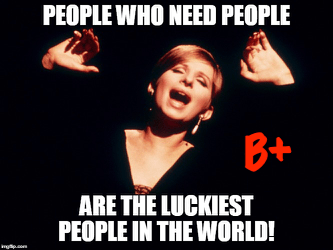
    Image of Barbra Streisand singing with the text "People who need people are the luckiest people in the world!" A red B+ has been added to the imaga.
    Barbra not reaching her potential

    They want to distinguish between “learned on a predetermined schedule” and “learned on an occasionally delayed schedule.” That is hardly objective, and your experience says it’s not necessary.

    There is this fantasy/nightmare harbored by many that a teacher not viewing an A as objective means everyone automatically gets A’s and nobody ever does the work! They believe this even here, as hard as it was to get here, as hard as it is to be here. This is not my experience, and I do not think it is your experience.

    So what I ask of you is this: If you find yourself referencing our class, especially to an adult who is willing to blame high school students for their own stress, be political in your word choice. Again, I value your experience and your truth and I want you to be honest, but if this context fits then I would ask you to include it: whatever skill you didn’t perfect in my class was because I was new and didn’t have the support I needed, and was not because I didn’t properly motivate you with the specter of low grades.

    But more than that, I would ask you, if you can, to make the political choice to feel confident in your grade and your abilities. Everything is subjective and everything is political and you do not need to agree with teachers who think an A means “never made mistakes.” What kind of a world are we creating if we’re trying to pretend that mistakes aren’t essential to being human? You are all extremely capable. You deserve support. You deserve the equity and inclusion you were promised in the brochures. 

    I ask you, if you can, to make the political choice to go into your next class knowing that your voice deserves to be heard, your questions deserve to be asked and addressed, you deserve to feel safe in the classroom, you deserve to feel like you can make mistakes while learning, you deserve to be allowed to learn every day independent of the assessment schedule. You deserve a two-way street of accountability with faculty.

    I learned so much from all of you, and for that I am eternally grateful.

    Your teacher,

    Not Dr H

    Piper

    December 31, 2023
    education
    education, everything is political, grades, high school, learning, teachers, teaching
  • Round-up of JMM 2024 Sessions on Issues of Diversity, Equity, Social Justice, and Affinity

    Round-up of JMM 2024 Sessions on Issues of Diversity, Equity, Social Justice, and Affinity

    The 2024 Joint Meetings of the Mathematical Societies (JMM) will be held in San Fransisco January 3-6. [Editorial note: I continue to have issues with conferences without virtual participation options, I was concerned about some of the fine print at registration, and I struggled to find a space to talk about teaching.]

    Continuing our tradition, this post highlights events at this virtual meeting related to diversity, equity, and justice. In particular, I built the list below be reading the program and noting invited presentations and sessions having either titles indicated that some aspect of diversity/equity/justice would be the focus of the talk or sponsorship by groups including NAM, AWM, Spectra & Math Alliance. In addition, I reached to individuals who have contributed items to similar posts in the past.

    Please note that this list will not be comprehensive. I have not looked within sessions for individual talks, and I certainly hope that we continue to #DisruptJMM by discussing these issues across the whole program. If you catch a session that I missed, you are welcome to message me; please forgive me for what I have missed or typos I have introduced.

    I have recently learned that this kind of list ows has a past debt to Bill Hawkins, who would distribute a similar list in person at conferences.

    Where possible, click on the hyperlinks to be re-directed to an online JMM Scientific Program page containing additional details about the individual talks. I believe that all times are listed in Pacific Time.

    Sections:

    • Invited Addresses
    • Special and Contributed Sessions (not chronological)
    • Other Events
    • Events identified by others

    [Last update based on comments: 12/28/2023 2:45pm Pacific.]


    Invited Addresses

    Wednesday January 3, 2024, 11:00 a.m.-12:05 p.m.
    AMS Erdős Lecture for Students
    From Moments to Matrices
    John Urschel, MIT
    Room 207, The Moscone Center

    Thursday January 4, 2024, 8:30 a.m.-9:35 a.m.
    Spectra Lavender Lecture
    The Role of Spatial Interactions in Managing Ecological Systems: Insights From Mathematical Models
    Julie Blackwood, Williams College
    Room 205, The Moscone Center

    Thursday January 4, 2024, 11:00 a.m.-12:05 p.m.
    MAA Lecture on Teaching and Learning
    (Why) To Build Bridges in Mathematics Education
    Yvonne Lai, University of Nebraska-Lincoln
    Room 205, The Moscone Center

    Thursday January 4, 2024, 2:15 p.m.-3:20 p.m.
    NAM Claytor-Woodard Lecture
    Choosing Hope: Teaching Culturally Relevant Mathematics as a Human Endeavor
    Shelly M Jones, Central Connecticut State University
    Room 205, The Moscone Center

    Friday January 5, 2024, 9:00 a.m.-10:00 a.m.
    MAA-SIAM-AMS Hrabowski-Gates-Tapia-McBay Lecture
    When Mathematicians Don’t Count
    Kamuela E. Yong, University of Hawaii West Oahu
    Room 207, The Moscone Center

    Friday January 5, 2024, 7:45 p.m.-8:45 p.m.
    NAM Cox-Talbot Address
    Quantitative Justice: Intersections of Mathematics and Society
    Ranthony A Clark, The Ohio State University
    Golden Gate A, Marriott Marquis San Francisco

    Saturday January 6, 2024, 9:45 a.m.-10:50 a.m.
    AMS Lecture on Education
    Mathematics in (and for) the Real World
    Suzanne L Weekes, SIAM
    Room 207, The Moscone Center


    Special/Contributed Sessions

    (not chronological)

    AMS Special Session on Epistemologies of the South and the Mathematics of Indigenous Peoples

    • I: Friday January 5, 2024, 2:00 p.m.-5:00 p.m.
      Room 020, The Moscone Center
    • II: Saturday January 6, 2024, 9:00 a.m.-11:00 a.m.
      Room 020, The Moscone Center

    NAM-SIAM-AMS Special Session on Quantitative Justice

    • Wednesday January 3, 2024, 1:00 p.m.-5:00 p.m.
      Room 203, The Moscone Center

    SLMath (MSRI) Special Session on African Diaspora Joint Mathematics Working Groups (ADJOINT)

    • I: Thursday January 4, 2024, 8:00 a.m.-11:30 a.m.
      Room 307, The Moscone Center
    • II: Friday January 5, 2024, 1:00 p.m.-5:00 p.m.
      Room 210, The Moscone Center

    AMS Special Session on Roots of Unity – Mathematics from Graduate Students in the Roots of Unity Program

    • I: Friday January 5, 2024, 9:00 a.m.-12:00 p.m.
      Room 311, The Moscone Center
    • II: Friday January 5, 2024, 2:00 p.m.-4:30 p.m.
      Room 311, The Moscone Center

    NAM Haynes-Granville-Browne Session of Presentations by Recent Doctoral Recipients

    • Thursday January 4, 2024, 8:00 a.m.-12:00 p.m.
      Room 209, The Moscone Center

    AMS Special Session on Research Presentations by Math Alliance Scholar Doctorates

    • I: Wednesday January 3, 2024, 8:00 a.m.-12:00 p.m.
      Room 103, The Moscone Center
    • II: Wednesday January 3, 2024, 1:00 p.m.-3:00 p.m.
      Room 103, The Moscone Center
    • III: Thursday January 4, 2024, 8:00 a.m.-12:00 p.m.
      Room 103, The Moscone Center
    • IV: Thursday January 4, 2024, 1:00 p.m.-3:00 p.m.
      Room 103, The Moscone Center

    AMS Special Session on The EDGE (Enhancing Diversity in Graduate Education) Program: Pure and Applied Talks by Women Math Warriors

    • I: Wednesday January 3, 2024, 1:00 p.m.-5:00 p.m.
      Room 157, The Moscone Center
    • II: Thursday January 4, 2024, 8:00 a.m.-12:00 p.m.
      Room 157, The Moscone Center
    • III: Thursday January 4, 2024, 1:00 p.m.-5:00 p.m.
      Room 157, The Moscone Center

    TPSE Contributed Paper Session on Using Institutional and National Data Sources to Recruit, Retain and

    • Wednesday January 3, 2024, 8:00 a.m.-11:30 a.m.
      Room 211, The Moscone Center

    Spectra Special Session on Research by LGBTQ+ Mathematicians

    • I: Friday January 5, 2024, 9:00 a.m.-12:00 p.m.
      Room 101, The Moscone Center
    • II: Friday January 5, 2024, 1:00 p.m.-4:00 p.m.
      Room 101, The Moscone Center

    Joint Special Session on AMS-AWM Special Session for Women and Gender Minorities in Symplectic and Contact Geometry and Topology

    • I: Wednesday January 3, 2024, 9:00 a.m.-12:00 p.m.
      Room 023, The Moscone Center
    • II: Wednesday January 3, 2024, 2:00 p.m.-5:00 p.m.
      Room 023, The Moscone Center
    • III: Friday January 5, 2024, 9:00 a.m.-12:00 p.m.
      Room 023, The Moscone Center
    • IV: Friday January 5, 2024, 2:00 p.m.-5:00 p.m.
      Room 023, The Moscone Center

    AWM Special Session on Women in Mathematical Biology

    • I: Wednesday January 3, 2024, 8:00 a.m.-12:00 p.m.
      Room 301, The Moscone Center
    • II: Wednesday January 3, 2024, 1:00 p.m.-5:00 p.m.
      Room 301, The Moscone Center
    • III: Friday January 5, 2024, 8:00 a.m.-12:00 p.m.
      Room 301, The Moscone Center

    AMS Special Session on Ethics in the Mathematics Classroom

    • I: Wednesday January 3, 2024, 9:00 a.m.-12:00 p.m.
      Room 009, The Moscone Center
    • II: Wednesday January 3, 2024, 1:00 p.m.-3:00 p.m.
      Room 009, The Moscone Center

    Other Events

    Wednesday January 3, 2024, 8:00 a.m.-1:00 p.m.
    Black Mathematicians Edit-A-Thon
    Pacific E, Marriott Marquis San Francisco

    Wednesday January 3, 2024, 3:00 p.m.-4:30 p.m.
    JMM Panel: Decolonizing Mathematics
    Room 304, The Moscone Center

    Wednesday January 3, 2024, 3:00 p.m.-4:30 p.m.
    AMS Committee on Equity, Diversity and Inclusion Panel Discussion: Successful Programs that Support Equity, Diversity and Inclusion
    Room 102, The Moscone Center

    Thursday January 4, 2024, 1:00 p.m.-5:00 p.m.
    Spectra Workshop: Creating an Inclusive Undergraduate Mathematics Curriculum
    Room 202, The Moscone Center
    [I believe this requires pre-registration.]

    Thursday January 4, 2024, 3:00 p.m.-4:30 p.m.
    Joint Committee on Women Panel: Financial Empowerment for Mathematicians
    Room 102, The Moscone Center

    Friday January 5, 2024, 10:30 a.m.-12:00 p.m.
    AWM Workshop: Mathematicians + Wikipedia — A Training Edit-a-thon
    Room 202, The Moscone Center
    [Does NOT require pre-registration.]

    Friday January 5, 2024, 1:00 p.m.-2:15 p.m.
    MAA Project NExT Panel on MAA Project NExT Panel Discussion on Diversity, Equity, and Inclusion Practices in an Undergraduate Math Class
    Room 303, The Moscone Center

    Friday January 5, 2024, 1:00 p.m.-2:30 p.m.
    AWM Panel: Celebrating Academic Pivots in Mathematics
    Room 304, The Moscone Center

    Saturday January 6, 2024, 11:30 a.m.-1:00 p.m.
    SLMath Special Session on SLMath (MSRI) – NAM Film Presentation: World Premiere of George Csicsery’s film “Journeys of Black Mathematicians: Part 1” and Panel Discussion
    Room 304, The Moscone Center

    Saturday January 6, 2024, 2:00 p.m.-3:30 p.m.
    JMM Panel: Cal-Bridge: Building Bridges and Diversifying Mathematics
    Room 304, The Moscone Center


    Identified by others

    NSF Special Session on Outcomes and Innovations from NSF Undergraduate Education Programs in the Mathematical Sciences I

    • I: Friday January 5, 2024, 8:00 a.m.-12:00 p.m.
      Room 212, The Moscone Center
    • II: Friday January 5, 2024, 1:00 p.m.-5:00 p.m.
      Room 212, The Moscone Center
    • III: Saturday January 6, 2024, 8:00 a.m.-12:00 p.m.
      Room 212, The Moscone Center
    • IV: Saturday January 6, 2024, 1:00 p.m.-4:30 p.m.
      Room 212, The Moscone Center

    AWM Special Session on EvenQuads Live and in person: The honorees and the games

    • I: Thursday January 4, 2024, 1:00 p.m.-4:30 p.m.
      Room 158, The Moscone Center
    • II: Friday January 5, 2024, 8:00 a.m.-12:00 p.m.
      Room 158, The Moscone Center

    AMS Committee on the Profession Panel Discussion: Building a Successful Research Career in Mathematics

    • Wednesday January 3, 20024, 1:00 p.m.-2:30 p.m.
      Room 102, The Moscone Center

    A partial list of individual talks, contributed by Dr Edray Goins.

    Wednesday January 3, 2024

    Mathematical assessment of the role of pre-exposure prophylaxis on HIV dynamics in an MSM population
    AMS Special Session on Recent Advances in Mathematical Models of Diseases: Analysis and Computation, I
    Abba Gumel*, University of Maryland
    8:00 a.m., Room 152, The Moscone Center

    (1192-92-28808)

    Gromov-Wasserstein distance between spheres
    AMS Special Session on Applied Topology: Theory, Algorithms, and Applications, I 

    Ranthony A C Edmonds*, The Ohio State University 

    10:00 a.m., Room 012, The Moscone Center
    (1192-54-33020)

    Scarce congruences for r-colored partitions
    AMS Special Session on Number Theory in Memory of Kevin James, I
    Robert Dicks*, University of Illinois at Urbana-Champaign
    9:30 a.m., Room 310, The Moscone Center

    (1192-11-31302)


    The Clebsch-Gordan Problem for Truncated Polynomial Rings in One Variable
    AMS Special Session on Research Presentations by Math Alliance Scholar Doctorates, I
    10:00 a.m., Room 103, The Moscone Center

    Kevin Steine Harris*, Tacoma Community College 

    (1192-13-28249)

    Inner-faithful actions of the Drinfeld double of a finite group
    AMS Special Session on Homological Techniques in Noncommutative Algebra, I
    Tolulope Oke*, Wake Forest University
    10:30 a.m., Room 072, The Moscone Center

    (1192-16-28304)

    Can insecticide resistance increase malaria transmission? A genetics-epidemiology mathematical modeling approach
    AMS Special Session on Recent Advances in Mathematical Models of Diseases: Analysis and Computation, I
    10:30 a.m., Room 152, The Moscone Center

    Jemal S Mohammed-Awel*, Department of Mathematics, Morgan State University
    (1192-92-31573)

    Hybrid discrete-time-continuous-time models and a SARS CoV-2 mystery: Sub-Saharan Africa’s low SARS CoV-2 disease burden
    AMS Special Session on Recent Advances in Mathematical Models of Diseases: Analysis and Computation, I
    11:00 a.m., Room 152, The Moscone Center

    Nourridine Of Siewe*, Rochester Institute of Technology
    (1192-34-29725)


    Arithmeticity of modular forms on G_{2}
    AMS Special Session on Theta Correspondence, I
    Aaron J Pollack*, University of California, San Diego
    11:00 a.m., Room 311, The Moscone Center

    (1192-11-30482)

    Cellular resolutions of the diagonal and exceptional collections for toric Deligne-Mumford stacks
    AMS Special Session on Combinatorial Insights into Algebraic Geometry, I
    Reginald Cyril Wallis Anderson*, Claremont McKenna College 

    11:30 a.m., Room 309, The Moscone Center
    (1192-14-32897)

    Can malaria eradication be achieved despite widespread Anopheles resistance to available insecticides?
    AMS Special Session on Dynamical Systems Modeling for Biological and Social Systems, I
    Abba Gumel*, University of Maryland 

    11:30 a.m., Room 156, The Moscone Center
    (1192-92-28805)


    Local and global sensitivity analysis in a mathematical model of human papillomavirus (HPV) and cervical cancer
    AMS Special Session on Recent Advances in Mathematical Models of Diseases: Analysis and Computation, I
    Najat Ziyadi*, Morgan State University
    11:30 a.m., Room 152, The Moscone Center

    (1192-92-31912)


    Estimation problems for some perturbations of the independence copula.
    AMS Special Session on Modelling with Copulas: Discrete vs Continuous Dependent Data, II
    Mous-Abou Hamadou*, University of Mississippi
    1:00 p.m., Room 154, The Moscone Center

    (1192-60-25444)


    The Function Number Method : Basis and Applications
    AMS Contributed Paper Session on Harmonic Analysis, Probability Theory, and Related Topics, II
    Marcel Julmard Ongoumakaa Yanzda*, Marien Ngouabi University
    1:15 p.m., Room 114, The Moscone Center

    (1192-34-25455)


    Gaming Districting Metrics
    NAM-SIAM-AMS Special Session on Quantitative Justice, I
    Stephanie Somersille*, Somersille Math Consulting Services
    1:30 p.m., Room 203, The Moscone Center

    (1192-60-32720)

    Estimation under parametric assumptions on copula-based Markov chains
    AMS Special Session on Modelling with Copulas: Discrete vs Continuous Dependent Data, II
    Fidel Djongreba Ndikwa*, University of Maroua
    2:00 p.m., Room 154, The Moscone Center

    (1192-60-26335)


    Neural Networks Applied to ODE’s
    AMS Special Session on Research Presentations by Math Alliance Scholar Doctorates, II
    Ty Frazier*, University of Minnesota
    2:00 p.m., Room 103, The Moscone Center

    (1192-37-28209)


    Fundamental Checkmates on an Extended Chess Board
    AMS Special Session on Serious Recreational Mathematics, II
    John Urschel*, MIT
    2:30 p.m., Room 024, The Moscone Center

    (1192-10-28247)

    Model order reduction techniques for parameter-dependent partial differential equations with constraints
    AMS Special Session on Research Presentations by Math Alliance Scholar Doctorates, II
    Kayla D Davie*, University of Maryland College Park
    2:30 p.m., Room 103, The Moscone Center

    (1192-35-28071)

    Framing Ethics through General Public Education
    AMS Special Session on Ethics in the Mathematics Classroom, II
    Lawrence C Udeigwe*, Manhattan College & MIT
    2:30 p.m., Room 009, The Moscone Center

    (1192-10-33169)

    Modelling COVID-19 Dynamics Incorporating Vaccine Hesitancy
    AMS Special Session on Recent Advances in Mathematical Models of Diseases: Analysis and Computation, II
    Maruf A Lawal*, University of Tennessee
    2:30 p.m., Room 152, The Moscone Center

    (1192-92-31469)

    On continuous exchangeable Markov chains
    AMS Special Session on Modelling with Copulas: Discrete vs Continuous Dependent Data, II
    Martial Longla*, University of Mississippi 

    3:00 p.m., Room 154, The Moscone Center

    (1192-62-25981)

    Anti-van der Waerden Numbers of Graph Products with Trees
    AMS Special Session on The EDGE (Enhancing Diversity in Graduate Education) Program: Pure and Applied Talks by Women Math Warriors, I
    Shanise Walker*, Clark Atlanta University
    3:30 p.m., Room 157, The Moscone Center

    (1192-05-31433)

    ==============================================================

    Thursday January 4, 2024

    Topological Comparison of Some Dimension Reduction Methods Using Persistent Homology on EEG Data
    SLMath (MSRI) Special Session on African Diaspora Joint Mathematics Working Groups (ADJOINT)
    E. Kwessi*, Trinity University
    8:00 a.m., Room 307, The Moscone Center
    (1192-58-32379)

    Hyperplane Arrangement and Flop Transitions of E6-models
    SLMath (MSRI) Special Session on African Diaspora Joint Mathematics Working Groups (ADJOINT)
    Saber Ahmed*, Hamilton College
    8:30 a.m., Room 307, The Moscone Center
    (1192-14-31529)

    A graph-theoretic approach to analyzing decoding failures of BIKE
    AMS Special Session on Advances in Coding Theory, III
    Angela Robinson*, NIST
    9:00 a.m., Room 011, The Moscone Center

    (1192-94-32455)

    Asymmetric Spectrum and Solvability of Nonlinear Elliptic Equations
    SLMath (MSRI) Special Session on African Diaspora Joint Mathematics Working Groups (ADJOINT)
    Nsoki Mavinga*, Swarthmore College
    9:30 a.m., Room 307, The Moscone Center
    (1192-35-31843)

    Optimal Transport in the Design of Refractors in Anisotropic Media
    SLMath (MSRI) Special Session on African Diaspora Joint Mathematics Working Groups (ADJOINT)
    Henok Mawi*, Howard University (Washington, DC, US)
    10:30 a.m., Room 307, The Moscone Center
    (1192-78-33018)


    Isotopes in Physics and in Mathematics
    AMS Special Session on Mathematical Physics and Future Directions, I
    Tepper L. Gill*, Howard University
    11:00 a.m., Room 009, The Moscone Center

    (1192-81-31967)


    MODELLING THE TRANSMISSION DYNAMICS OF CHOLERA WITH OPTIMAL CONTROL AND COST-EFFECTIVENESS ANALYSIS
    AIM Special Session on Little School Dynamics: Cool Research by Researchers at PUIs, I
    Oguntolu Abiodun Festus*, Federal University Technology, Minna
    11:30 a.m., Room 201, The Moscone Center

    (1192-92-25636)

    Brian P Katz (BK)

    December 27, 2023
    Joint Math Meetings
  • Testimonios! Lathisms: Latinx and Hispanics in the Mathematical Sciences

    Testimonios! Lathisms: Latinx and Hispanics in the Mathematical Sciences

    [Editorial note: This final monthly Testimonios post is the Preface of Testimonios as well as the short biographies of the book editors.]


    It is often the case that mathematical proofs and theorems seem to magically appear out of thin air—as if in that magical moment of epiphany, the proof wrote itself in its beautiful form. Of course, for most of us, this is only an illusion—theorems occur after mental marathons, struggles, and refinement. Books also appear to us as if they fall from the heavens, often lacking a story of how the book came to fruition. We decided that it would be a disservice to not tell the story of how this book came to fruition, for every mathematical story has people behind it. Thus, we decided to begin this book of Testimonios with the story of Lathisms: Latinxs and Hispanics in the Mathematical Sciences. It is the editors’ personal testimonios of a mathematical family brought together by a deep need to be seen and accepted as our authentic selves within mathematical spaces. We consider this book to be a tangible source of inspiration, not only for those who lack a mathematical family and those rising through the ranks, but for ourselves.

    A Chance Meeting — Pamela and Alicia

    Pamela Harris. I completed my PhD studies in 2012 at the University of Wisconsin Milwaukee, and I later learned that Alicia completed her PhD studies the same year at University of Texas at Arlington. I worked on problems in combinatorial representation theory and Alicia on problems in mathematical biology. It is truly an example of mathematical and personal fate that we would meet each other, as we couldn’t be further apart in our mathematical interests. Yet, this is the beauty of being MAA Project NExT (New Experiences in Teaching) fellows. I was a Silver ’12 and Alicia a Brown ’13 and we both attended MathFest 2013 in Hartford, Connecticut. Although the story of our meeting is something I prefer to tell over mezcal and tacos, I am happy to share it here because of the deep impact it had on us and in the many friendships we have cultivated since our meeting.

    During MathFest 2013, I co-organized a panel on how to write letters of recommendations; something that no one ever taught me to do as a graduate student, but that I needed to learn as I was now a professor. Setting-up for the panel, I realized that none of us as organizers had remembered to bring a clicker to advance the panelists’ slides. I left the room in a hurry looking for Dr. Aparna Higgins, who at the time was the Director of Project NExT. I was sure that Aparna would be able to lend me a clicker. When I found Aparna by the registration table, she thankfully had a clicker. I fondly remember that as we fidgeted with the batteries ensuring they were placed in the correct orientation, Aparna took advantage of the opportunity to teach me that one should keep the batteries out of the clicker when not in use so that the batteries are not dead on arrival. With the working clicker ready, I quickly walked away to return to my panel, without a clue that the next few minutes of my life would lead to finding my mathematical soulmate.

    Alicia Prieto. As a recent immigrant from Mexico, I had always had a hard time getting used to being “the only one” at every math conference or meeting. After a while, I made it a point to find any person of color that I could bond with. After realizing that among the 80+ Brown ’13 fellows there were exactly eight nonwhite participants, only four Latinxs of which only one was U.S. born, I decided to confront Aparna about this lack of representation within the Project NExT Fellows. This was the question I posed Aparna, who just minutes prior had handed Harris [1] a clicker, and she replied: “No, there are more! There is a Pamela Harris!” pointing to Harris who was about 30 feet away. With that last name, I was skeptical that Harris could be Latina. So when Aparna pointed her out in the crowd, as she was walking back toward her panel, and after I realized that Harris did “look” Mexican, I softly called out (in Mexican full-on volume) toward Harris’s direction: “Brown people!! Brown peopleeeeeeeeeeeee!” As Harris turned to look toward me to see who was screaming “Brown people,” and realizing that in fact I was shouting at her, she turned and saw me sprinting toward her. Harris stopped and waited for me to get closer and that’s when I began my inquisition:

    Alicia: Where are you from?
    Pamela: México
    Alicia: ¿Hablas Español?
    Pamela: Si.
    Alicia: Y ¿de donde en Mexico?
    Pamela: Guadalajara.
    Alicia: Yo también!
    Pamela: Ok. Sorry, but I have to go because my panel is about to start. Maybe we can go to lunch afterwards?

    I quickly scribbled my phone number on a scrap of paper to share with Harris; she still has that scrap paper and it is pictured on the next page. As Harris went off to her panel, I reflected on how happy I was to find someone who not only looked like me, but who was born in the same Mexican city of Guadalajara, Jalisco. By the end of our lunch that day we discovered that we were born just three days apart in the same city, we are the oldest of three siblings (one sister and one brother), and both of our mothers have the same name: Rosa. We also quickly discovered that we had another very important thing in common: a terrible thirst for a family within the mathematical community|a family of people who shared our culture, values, and beliefs. A family we believed existed, but which often felt so invisible. That chance encounter was the beginning of the Lathisms family.

    Scrap of paper where Alicia gave Pamela her phone number along with a copy of the program for MAA MathFest 2013.

    The Founding of Lathisms

    Pamela Harris. Many good ideas have begun from conversations and discussions via social media. Lathisms is one such idea which began in the spring of 2016 when on social media someone asked if there was a repository or a list of minority mathematicians. Someone pointed to the SACNAS biography project, yet this only had a few mathematicians. Motivated by this, in private conversations with Alicia, Alexander Díaz-López, and Gabriel Sosa, we decided that if no such website existed, we would create it. We were especially excited for the timing since it would allow us to unveil this website during Hispanic Heritage Month that upcoming fall.

    This was the birth of Lathisms: Latinxs and Hispanics in the Mathematical Sciences in 2016. We began Lathisms with the idea of bringing visibility to the vibrant and active Latinx and Hispanic community within the mathematical sciences by creating a Hispanic Heritage Month calendar (running yearly during National Hispanic Heritage month, from September 15–October 15) in which a featured mathematician was uncovered daily. Our primary goal was to provide an accessible platform that featured the multifaceted and diverse nature of the Latinx and Hispanic mathematical community and which would inspire younger generations of mathematicians. This work expanded to collaborations with the American Mathematical Society for a poster, and with the financial support of the Mathematical Association of America we were able to expand our efforts to include podcast interviews hosted by Evelyn Lamb.

    Alicia Prieto. The work of Lathisms in those initial years came with a lot of feedback from the community at large. Most of this feedback was quite positive, but some came with a warning to us about the time commitment it takes to make such initiatives last. This was well-intended seeing how we were all early-career mathematicians, and those sharing their concern were right to think that we might fall behind on our research and possibly live through some negative repercussions later on in our careers.

    Harris and I are the first to admit that the workload in running Lathisms was intense, especially as there were only four of us involved during those initial years. The support from the MAA in the form of a Tensor SUMMA grant alleviated some of the workload as we were able to hire a web developer, Richard Diaz, but as Alexander stepped down to move onto other projects and later Gabriel; Harris and I needed to reassess the workload and bring in additional people with a passion for advancing the Lathisms mission and vision and who would help us lead the organization. Hence, in 2018 we created a Lathisms Leadership Team and a Lathisms Junior Associate Team.

    Pamela Harris. With the need for additional help to run Lathisms, Alicia and I discussed who to include in the Lathisms Leadership Team. We both agreed that we needed someone who was dependable and passionate about addressing issues of underrepresentation of Latinxs and Hispanics in the mathematical sciences. Naturally, Luis Sordo Vieira came to mind given his move to research in medicine following his completion of a PhD in number theory. After working together for a few months, we realized we needed more help. This sparked the idea of putting together a Junior Associates Team, made up of rising stars who shared our values and who could help shape the future of Lathisms. Our first goal was filling a need for someone who had a background in scientific writing and a network within applied mathematics, and luckily we knew Vanessa Rivera Quiñones who came highly recommended by Alexander Diaz-Lopez and had established a track record in her work.

    Alicia Prieto. New to the team was another rising star within our community; Andrés Vindas Meléndez, whose trajectory Pamela knew of from years prior, brought energy and renewed passion for highlighting the broad diversity within the Lathisms community. Finally, we knew we needed an expert in mathematics education, especially as the 2019 Lathisms calendar would focus on math educators. Fortunately, I knew one of the BEST mathematics education researchers, who happened to be another amazing Latina, and who happened to be one of my best friends: Rosaura Uscanga Lomelí. The addition of Vanessa, Andrés and Rosaura to the Lathisms Team has made the team awesome.

    The Lathisms Team

    Luis Sordo Vieira. I graduated from the University of Kentucky in 2017, completing my undergraduate studies at Wayne State University. As a Venezuelan-American mathematician, I, like Alicia, also experienced being “the only one” in several spaces, as this has often felt like the rule rather than the exception. Although I had met Pamela at the Latinos in the Mathematical Sciences Conference at the Institute for Pure and Applied Mathematics in 2015, Lathisms was where our friendship really started. I found a mathematical older sister, not in the sense of an academic co-descendant, but rather in the sense of an additional familial older sister, a person I could trust who would tell me when I messed up, cherish my successes, and give me a hand when I struggled. When I decided to change focus from my PhD work in number theory to applying mathematics to medicine in my late years of graduate school, I remember my doubts and fears of failing fading away as I told Pamela about my plans. Pamela displayed an honest joy—a joy that many reserve for their own success.

    A year after graduation, Alicia (who by then I had already met and admired her quick wits and fearless will to speak out) and Pamela invited me to join the Lathisms family as part of the Leadership Team. I accepted without hesitation, as it is a rare opportunity to work side-to-side with your family on something that you believe to have a deep impact on your community. And the Lathisms family kept expanding. I find a great sense of joy in contacting the Lathisms calendar nominees, reading why they were nominated, and in reading and editing their stories. Reading their stories and working with the rest of the Lathisms team to highlight all of these outstanding accomplishments on either the website, articles, or this book, served not only as a source of inspiration for the pursing of new mathematics—but also as a source of motivation to keep striving for a more equitable society.

    Vanessa Rivera Quiñones. Born and raised in Puerto Rico, I was always excited to meet other Latinx/Hispanic mathematicians. As an undergraduate, I studied at the University of Puerto Rico at Río Piedras and met Alexander Díaz-Lopez during a Calculus competition. I saw in Alexander a contemporary role model and was very excited about his work with Lathisms. However, joining Lathisms came a while later, when Pamela invited me to join the team. At the time, I was a graduate student at the University of Illinois at Urbana-Champaign. I had met Luis and Andrés at the Latinxs in the Mathematical Conference in 2018, and seen the powerful work done by the co-founders. So, I jumped at the opportunity to collaborate with the team.

    It has been all I ever hoped for and more. I am inspired by each of the members, and how they bring their full selves to this life-transforming work. I’ve learned so much from Pamela, Alicia, Luis, Rosaura, and Andrés. It’s through their passion, dedication, and hard-work that Lathisms has been able to grow and become a family. By featuring and sharing the personal and professional stories of Latinx/Hispanic mathematicians through so many avenues (i.e., our website, posters, podcasts, and articles), we’ve painted a rich picture of our honorees and our community. For me, working with the Lathisms team has been a way to honor those that are paving the way to make mathematics a home for us.

    Andrés Vindas Meléndez. I first met Pamela during the 2012 SACNAS National Conference, where Pamela was a poster judge and I was presenting my undergraduate research. We corresponded by email after the conference with intentions to work on mathematics together, but life happened and mathematical collaborations did not come until years later. After completing my undergraduate studies at UC Berkeley, I pursued a master’s degree at San Francisco State University, where I found a community that shared my passions for both mathematics and social justice. At San Francisco State, I co-founded and co-organized the Distinguished Women in Mathematics Lecture Series in the Fall of 2016. Fortunately, Pamela was attending an American Institute of Mathematics workshop in nearby San José and accepted our invitation to be our first distinguished speaker. Since then we have attended and bonded at several national and international conferences, collaborated on research and organizing conference sessions. I met Luis at the 2015 Latinos in Math conference. It was encouraging to meet other Latinx graduate students at the conference and this is where Luis shared with me his experiences as a graduate student at the University of Kentucky; I would go on to attend the University of Kentucky for my PhD, exemplifying the power of connections. I had the pleasure of meeting Alicia (after having heard amazing things about her) at the 2018 Critical Issues in Mathematics Education Conference hosted by the Mathematical Sciences Research Institute at Berkeley. It felt as if I had known Alicia forever. As mentioned by Vanessa above, we met in person at the second iteration of the Latinos in Math conference in 2018. As a fun fact, I had actually emailed Vanessa for help on a graduate fellowship a few years before after noticing her name on the roster of award recipients. While I have not had the pleasure of meeting Rosaura in person, I value her presence on the team and admire her contributions and knowledge of mathematics education.

    When I was asked to join the Lathisms team, as a Junior Associate, I accepted immediately since I knew the team is amazing. In a short time we have connected and have created very close bonds. Our different personalities, qualities, and abilities, makes the team work so well! Since joining the Lathisms team, I have helped expand the work and network of Latinx mathematicians. My goals within Lathisms is to facilitate the professional development of Latinx mathematicians and their supporters to create a space where everyone feels comfortable and supported so that they can thrive in whatever mathematical pursuits and directions they take.

    Rosaura Uscanga Lomelí. Alicia and I met in 2008 back when I was in my first year of my undergraduate studies and she was working on her PhD at the University of Texas at Arlington. There were not many Hispanics in the mathematics department so I noticed Alicia right away, but as a first year student in college, I was scared to approach her. If you know Alicia, you know that she makes a significant effort to build a network with fellow Black and Brown mathematicians, so she noticed me one day at math club and made sure to come introduce herself (she asked me who I was, where I was from, and more importantly for her, if I spoke Spanish). We found out we were both from México which gave us a shared perspective on life in the U.S., and being around her made me feel close to home. Right away I felt a connection with her! She has been a constant source of inspiration and support in my life. For the rest of my undergraduate education, we met weekly for lunch and for walks around campus. She quickly became an important part of my life and I was excited for her to get to know my family and for them to get to know her. So I invited her over to my house (I lived with my parents at the time) to meet my whole family and they loved her as much as I do. From then on, she knew she was always welcome at my house and at any family gatherings; she was part of the family. She became like my older sister (although she says younger, because she claims I am more mature but I disagree).

    In light of our deep connection, I happily accepted the invitation to join Lathisms in 2019! I was honored that they thought of me to help out with their mission. At the time, I only knew of Pamela because I had heard a lot about her from Alicia and her story had inspired me—the stories I had heard about her life resonated with me. So I thought there was nothing better than getting the opportunity to work with two amazing Latina mathematicians. Once I became part of the team, I “met’’ (online) Vanessa, Andrés, and Luis. While I have not yet had the pleasure of meeting them in person, these amazing individuals have made a huge impact in my life and inspire me each and every day. They are passionate about everything they do and are dedicated to making Lathisms better each year and to make the road easier for Latinx and Hispanic students who aspire to become mathematicians. I had never before been surrounded by so many Hispanics in mathematics and I’ve got to admit that it is pretty awesome. Working at Lathisms does not feel like work, our weekly meetings feel just like spending time with family.

    Testimonios: Stories of Latinx and Hispanic Mathematicians

    Mathematics is not created nor discovered in a vacuum. Inherent to mathematical progress is the stories of the people behind it. So as we reached the fifth anniversary of Lathisms, we wanted to highlight the power of stories about our community and family. We compiled this book because we thought that seeing the testimonios of inspiring mathematicians could help further the growth and the brilliance of the community of Latinx and Hispanic mathematicians. Our goal has always been to inspire younger generations of Latinx and Hispanic mathematicians, so that they may see themselves reflected in these stories, and so they may learn that we stand on the shoulders of giants; inspiring the next Tapias and Toros of mathematics. This book also highlights rising-stars in our community. Their lives and journeys will inspire current undergraduate and graduate students who often seek a role model who shares their language, culture, and heritage, and who are clearing the path in front of them so they can reach further than ever before. Moreover, these stories talk about the American experience at large. We seek to inspire anyone who has or wants to have a career in mathematics or any other STEM field—particularly those from underrepresented groups. In general, we want to reach a wide variety of individuals at all different stages in their careers. We hope this book helps people outside of our community, specially those who want to be allies or mentors, realize the particular challenges faced by minoritized populations and we offer, in the many examples, a window to potential barriers and to ways in which everyone can help overcome them.

    In addition, this book was also for ourselves. As we read every testimonio, we relived those stories and imagined the impact these narratives would have had on our younger selves and on our trajectories in the mathematical community. How less isolated, lonely, and lost would we have felt as some of us immigrated to a new country, learned a new language, or failed graduate school examinations. Knowing we are not the only ones to have struggled and who have overcome would have helped us tremendously in those times of need. It is because of this that we consider this book a true success, for the impact it has had on us is immeasurable. These stories have truly inspired us. The great efforts to overcome challenges, both personal and systemic, and the resilience and devotion of outstanding researchers and educators showcased through these stories have energized us in an extremely difficult year. [2]

    We end by extending our thanks to Ana Valle for the beautiful illustrations accompanying each chapter, and by expressing our deep gratitude to all of those who contributed to this book. We thank you for sharing your stories, your lives, your beings, fully and authentically. We want to acknowledge that, for many, this was a cathartic, and sometimes, emotionally painful and time consuming process. We are confident your testimonios will inspire all within the mathematical community to pay attention to the struggles, inequalities, and problems that we, as a community and as individuals, should strive to resolve in order to improve the experience of those marginalized in mathematics, including Latinxs and Hispanics. Our future is brighter because of your words and your work.

    Con mucho amor y respeto,
    Pamela E. Harris
    Alicia Prieto Langarica
    Vanessa Rivera Quiñones
    Luis Sordo Vieira
    Rosaura Uscanga Lomelí
    Andrés R. Vindas Meléndez

    The Lathisms Team.

    Agradecimientos y Dedicatorias / Acknowledgements and Appreciation

    Pamela. Toda historia tiene un comienzo, y para mi esta empieza con mis gracias a mis padres, Rosa y Jorge, por todos los sacrificios que han hecho para que yo tuviera la oportunidad de poder realizar mis sueños. Toda mi vida seguiré tratando de hacerlos orgullosos por que quiero que sepan que sus sacrificios no fueron en vano. Para mi hermana y mi hermano, Ana y Jorge, les agradesco toda una viva de inspiración. Para mi hija Akira, mi sueño para ti es que encuentres tu pasión y que continues trabajando para crear un mundo mas justo. Para mi pareja, Jamual, mi amor desde los quince años. No tengo palabras para agradecerte todo lo que siempre has hecho por mi y por nuestra familia. Lo bueno que he podido contribuir a este mundo es por que siempre me as apoyado y querido. Te amo!

    Every story has a beginning, and for me it begins with my thanks to my parents, Rosa and Jorge, for all of the sacrifices they have made so that I had the opportunity to make my dreams come true. Throughout my life I will continue trying to make you proud because I want you to know that your sacrifices were not in vain. For my sister and my brother, Ana and Jorge, I thank you for a lifetime of inspiration. For my daughter Akira, my dream for you is that you find your passion and that you continue to work to create a more just world. For my partner, Jamual, my love since I was fifteen, I have no words to thank you for everything you have always done for me and our family. The good things that I have been able to contribute to this world are because you have always supported and loved me. I love you!

    Alicia. First and foremost, I want to thank the authors for writing these amazing testimonios. We are all incredibly grateful for trusting us with your stories and for taking the time to relive the many times traumatic episodes you all share with us and allowing us to witness and celebrate your many successes. I also want to thank Mr. for his love and unconditional support. A mis padres. A mi abuelo Max, (fintas), quien siempre fue partidario de mi educación y maestro, en ejemplo, de disciplina y trabajo duro. A mi abuela Lupe, (Buki), que paso horas ayudandome a aprender las tablas de multiplicar. A mi abuela Hildelisa (Licho), que me amo tal como siempre he sido (su morisqueta la extraña todos los dias) Y finalmente a mis abuelos Agustín y Alicia, que nunca conocí mas cuya sangre corre en mis venas y alimenta mi trabajo y misión.

    Luis. Para mi gente, que demuestran los valores del empeño, trabajo duro, y sacrificio. Para mi gente del pasado, que han sacrificado tanto para que yo pueda llegar a donde estoy hoy. Para mi primo Alejandro Sordo Vieira, el niño que me enseñó que uno puede sonreir puramente al frente de una tragedia. Para mi mamá y papá, las personas que siempre estarán a mi lado. Para Sarah y Joaquin—los amo con todo mi corazón. Con cariño para toda mi gente.

    Vanessa. This book would not be possible without the authors who shared their powerful stories of success, hardship, and perseverance. I am grateful for your trust and confidence in us as safe-keepers of your stories. Thank you for paving the way for many of us. To my fellow editors, thank you for your dedication and work to make these stories shine and reflect the authors’ authentic voices. Para mis padres, Gloria y Rafael, y mis hermanos, Glorimar y Rafael José, gracias por siempre apoyarme, ser mis fans número uno y una parte vital de mi historia. Para mis abuelos, que aunque su vida no fue fácil, se empeñaron en crear un mejor futuro para nosotros. Su legado vive a través de nosotros—los amo. To my partner Gert, for your love and support, and for always empowering me to use my voice to make a difference. To Elke, for being my friend, cheerleader, and walking by my side in my journey. Para mi gente, que estas historias sean una celebración de nuestro recorrido y el camino que queda por recorrer. To my friends that have become like family, you inspire me to fight the good fight. Finally, to the reader, thank you for honoring these stories with us.

    Rosaura. Para mis padres, Rosa y Victor, que han sacrificado tanto por mi y siempre me han brindado amor y apoyo incondicional. Me han enseñado lo importante que es luchar por lo que quieres y nunca darte por vencido. Mi padre siempre dice “No me digas que no puedes, dime que no sabes.’’ Toda mi vida he llevado esta frase en mente que me recuerda que yo puedo, aunque a veces las cosas sean difíciles. Los amo con todo mi ser. For my little sister Fernanda, who is my partner in crime and has always been unafraid to stand up for what she believes is right and just. She inspires me to do better and be better every day. I love you sis. Para mi tío Rafa, que ya no está con nosotros, pero con su ejemplo me enseñó a nunca dejar de aprender. Te extraño. Para toda mi maravillosa familia, son mi fuente de inspiración. Los quiero. Y finalmente, para mi esposo Alek, who is my biggest supporter y una de las personas con el corazón mas grande y lindo que conozco. Siempre ha estado a mi lado ayudandome y apoyandome en todo momento. Te amo hoy y siempre, my love.

    Andrés. Para mis creadores, Mami (Sara) y Papi (Rodolfo). Para mis hermanas, Alejandra y Sarah. Para mis padrinos, Ana y Julio. Para mi familia con la que el universo me bendició (mis tíos, tías, primos, y sobrinos) y para mis amigos que se han convertido en familia. Gracias por su amor y por apoyar mis metas. Para mis maestros que me enseñaron a apreciar la belleza de la matemática. Gracias a todos que han cruzado mi camino y me han ayudado a redefinir lo que significa ser matemático. Gracias a la vida que me ha dado tanto. ¡Pura vida!

    For my creators, Mami (Sara) and Papi (Rodolfo). For my sisters, Alejandra and Sarah. For my godparents, Ana and Julio. For my family with whom the universe blessed me with (my uncles, aunts, cousins, and nephews) and for my friends who have become family.Thank you for your love and for supporting my goals. For my teachers who taught me to appreciate the beauty of math. Thank you to everyone who has crossed paths with me and has helped me redefine what it means to be a mathematician. Thank you to this life, which has given me so much. ¡Pura vida!


    About the Editors

    Dr. Pamela E. Harris

    Dr. Pamela E. Harris is a Mexican-American mathematician and Associate Professor in the Department of Mathematics and Statistics at Williams College. She received her AA and AS from Milwaukee Area Technical College, BS from Marquette University, and MS and PhD in mathematics from the University of Wisconsin-Milwaukee. Dr. Pamela E. Harris’s research is in algebraic combinatorics and she is the author of over 50 peer-reviewed research articles in internationally recognized journals. An award-winning mathematical educator, Dr. Harris received the 2020 MAA Northeast Section Award for Distinguished College or University Teaching, the 2019 MAA Henry L. Alder Award for Distinguished Teaching by a Beginning College or University Mathematics Faculty Member, the 2019 Council on Undergraduate Research Mathematics and Computer Sciences Division Early Career Faculty Mentor Award, was named a 2020 Inaugural Class of Karen EDGE Fellow, and was one of 50 women featured in the book Power in Numbers: The Rebel Women of Mathematics. Her professional mission is to develop learning communities that reinforce students’ self-identity as scientists, in particular for women and underrepresented minorities. In support of this mission, Dr. Harris co-organizes research symposia and professional development sessions for the national conference of the Society for the Advancement of Chicanos/Hispanics and Native Americans in Science (SACNAS), and is an editor of the e-Mentoring Network blog of the American Mathematical Society. Moreover, in order to provide visibility to and increase the positive impact of the role models within our community, Dr. Harris co-founded Lathisms.org, a platform that features the contributions of Latinx and Hispanic scholars in the mathematical sciences. She cohosts the podcast “Mathematically Uncensored,” sponsored by The Center for Minorities in the Mathematical Sciences, and has recently coauthored the book Asked And Answered: Dialogues On Advocating For Students of Color in Mathematics.

    Dr. Alicia Prieto Langarica

    Dr. Alicia Prieto-Langarica is a Distinguished Professor in the Department of Mathematics and Statistics at Youngstown State University. She obtained the Distinguished Professor designation in May 2020, after being awarded the distinguished professor award in Research, Teaching and Service. She received her Undergraduate degree in applied mathematics from the University of Texas at Dallas in 2008 and her PhD from the University of Texas at Arlington in 2012. Prieto-Langarica’s research is in the intersection of mathematics and biology, specifically problems related to the medical field. Recently she started conducting research in data science, public policy and mathematics education. Some of her awards include the MAA Henry L. Alder Award for Distinguished Teaching by a Beginning College or University Mathematics Faculty Member, the 2020 SmithMurphy Award by the Student Government Association at YSU, the Athena Award Finalist by the Mahoning Valley Regional Chamber of Commerce, and The 25 Under 35 Mahonning Valley Young Professionals MVP award.

    Dr. Vanessa Rivera Quiñones

    Dr. Vanessa Rivera Quiñones is a mathematical biologist with a passion for telling stories through numbers using mathematical models, data science, and education. Born in Puerto Rico, her love for mathematics began at an early age and continued to grow thanks to the encouragement of her family, teachers, and the support of many mentors. She received her bachelor’s (BS) degree from the University of Puerto Rico at Río Piedras (2013) and her doctoral degree (2019) from the University of Illinois at Urbana-Champaign in mathematics. She has been involved in several organizations and initiatives that focus on broadening the participation and mentoring of underrepresented students in mathematics. In 2015, she was awarded the Ford Foundation Predoctoral Fellowship, which seeks to diversify colleges and universities. She is a proud member of multiple national organizations such as the Association for Women in Mathematics (AWM), SACNAS, American Mathematical Society (AMS), Mathematical Association of America (MAA), and the National Alliance for Doctoral Studies in the Mathematical Sciences. She believes mathematics is a human endeavor and that by creating inclusive and equitable environments that embrace the identities of who does mathematics, our community will flourish. Currently, she is a data science consultant and instructor. At the next step of her career, she is interested in working on the ever-growing challenges of sustainability, healthcare, and education through a social justice lens.

    Dr. Luis Sordo Vieira

    Dr. Luis Sordo Vieira is a Research Assistant Professor in the Department of Medicine at The University of Florida. He is a Venezuelan-American Applied Mathematician with scientific experience broadly described as being in the area of systems medicine. He completed his Bachelor of Science from Wayne State University in mathematics, minoring in physics, and his PhD in number theory from the University of Kentucky as a National Science Foundation Graduate Student Fellow. He has served in the Lathisms leadership team since 2019. Dr. Sordo Vieira has served in the organizing committee for The Mathematics Summer Workshop for Achieving Greater Graduate Educational Readiness, a program to prepare students from underrepresented minorities in mathematics for graduate studies. He is a Society for Industrial and Applied Mathematics Science Policy Fellow and received the American Mathematical Society Simons Foundation Travel Grant.

    Dr. Rosaura Uscanga Lomelí

    Dr. Rosaura Uscanga Lomelí was born in Mexico and came to the U.S. at the age of 11, so she considers herself a Mexican-American. She is an Assistant Professor in the Department of Mathematics and Computer Sciences at Mercy College (as of Fall 2021). Her research area lies in mathematics education, specifically in the teaching and learning of abstract algebra. She completed her PhD at Oklahoma State University in 2021. Her dissertation explored students’ thinking regarding the concept of “function” in the context of abstract algebra. She received her BS in mathematics from The University of Texas at Arlington in 2012 and her MS in mathematics from Oklahoma State University in 2015. Dr. Uscanga is passionate about teaching and enjoys working with students—one of the reasons she decided to study mathematics education. She strives to make sure students in her classroom feel a sense of belonging and view themselves positively in relation to mathematics. She is extremely interested in issues of equity, diversity, and inclusion in mathematics.

    Dr. Andrés R. Vindas Meléndez

    Dr. Andrés R. Vindas Meléndez is a Costa Rican-American mathematician, raised in Lynwood, South East Los Angeles, California. He is a first-generation college graduate and is currently a National Science Foundation Postdoctoral Fellow at the University of California, Berkeley and Mathematical Sciences Research Institute Postdoctoral Fellow. He completed his PhD at the University of Kentucky where he was supported by a National Science Foundation Graduate Research Fellowship and by a National Science Foundation Louis Stokes Alliance for Minority Participation Bridge to Doctorate Fellowship. At the University of Kentucky he was also an affiliated graduate student in the Latin American Studies program and earned a graduate certificate in Latin American, Caribbean, and Latino/a Studies. He earned a master’s degree in mathematics at San Francisco State University and completed his undergraduate degree in mathematics at the University of California, Berkeley where he also minored in Philosophy and Chicana/o & Latina/o Studies. His research interests are in algebraic, enumerative, and geometric combinatorics. In particular, he is interested in lattice-point enumeration for polyhedra. Dr. Vindas Meléndez’s teaching, service, and outreach is student-centered. He has the opportunity to help guide students to learn abstract mathematics and find their voice while also developing a sense of ownership of their knowledge and mathematical abilities. Dr. Vindas Meléndez strives to create community in order to build students’ confidence in spite of society’s negative messages and stigma about mathematics. He also aims to build meaningful and empowering experiences with mathematics, while also challenging others to think about the power structures that are present in and outside mathematical spaces.


    [1] This is the official nickname for Pamela.
    [2] This book was written and edited during the global COVID-19 pandemic.


    Previous Testimonios:

    • Dr. James A. M. Álvarez
    • Dr. Federico Ardila Mantilla
    • Dr. Selenne Bañuelos
    • Dr. Erika Tatiana Camacho
    • Dr. Anastasia Chavez
    • Dr. Minerva Cordero
    • Dr. Ricardo Cortez
    • Dr. Jesús A. De Loera Herrera
    • Dr. Jessica M. Deshler
    • Dr. Carrie Diaz Eaton
    • Dr. Alexander Díaz-López
    • Dr. Stephan Ramon Garcia
    • Dr. Ralph R. Gomez
    • Dr. Victor H. Moll
    • Dr. Ryan R. Mouruzzi, Jr.
    • Dr. Cynthia Oropesa Anhalt
    • Dr. Omayra Ortega
    • Dr. José A. Perea
    • Dr. Angel Ramón Pineda Fortín
    • Dr. Hortensia Soto
    • Dr. Roberto Soto
    • Dr. Richard A. Tapia
    • Dr. Tatiana Toro
    • Dr. Anthony Várilly-Alvarado
    • Dr. Mariel Vásquez Melken
    • Dr. William Yslas Vélez
    • Dr. María Cristina Villalobos

    Brian P Katz (BK)

    December 15, 2023
    Uncategorized
1 2 3 … 8
Next Page→
 

Loading Comments...
 

    • Subscribe Subscribed
      • Inclusion/Exclusion
      • Join 42 other subscribers
      • Already have a WordPress.com account? Log in now.
      • Inclusion/Exclusion
      • Subscribe Subscribed
      • Sign up
      • Log in
      • Report this content
      • View site in Reader
      • Manage subscriptions
      • Collapse this bar